



Why „accessible“ Doesn’t Always Mean Accessible
The term „accessible“ often promises more than reality delivers. Many travelers with limited mobility are familiar with this: The accommodation advertises itself using this term, but once there, they find steps at the entrance or doors that are too narrow for a wheelchair. A Accessible Vacation Rental in the Waldviertel Region Finding reliable sources therefore requires more than just a search query with the right filter.
Accessibility is a personalized commitment. What works easily for someone with a walking disability may be insurmountable for a wheelchair user. Your personal needs are what matter most: your height, the width of your wheelchair, the strength you need for transfers, or whether you rely on a shower chair. The details make all the difference.
That’s why the most important rule before making any reservation is: Ask for specific measurements and recent photos. Don’t rely on general descriptions. A helpful guide is the Accessibility Plan of the State of Lower Austria, which defines the criteria for accessible construction and housing. Below, we’ll show you exactly what to look for when choosing wheelchair-accessible accommodations.
It's the journey that counts: A seamless path from the parking lot to the door
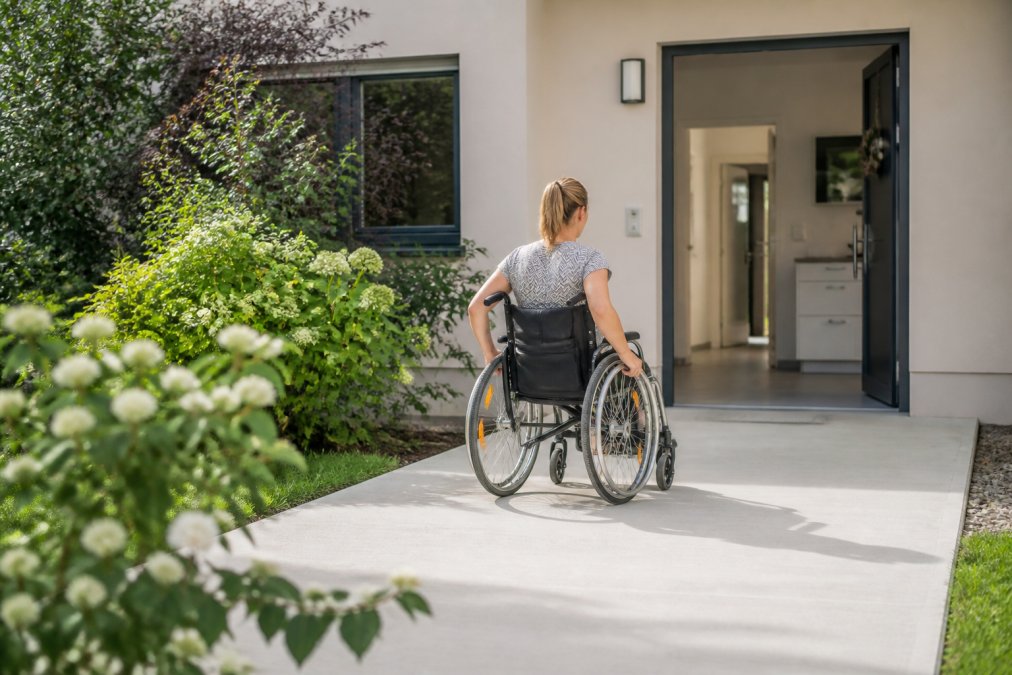
The first hurdle is often right on your doorstep. A Wheelchair-accessible vacations It doesn't start at the front door, but in the parking lot. Check to see if the parking lot is paved, is as close as possible to the entrance, and if there is a step-free path leading to it.
Unpaved gravel paths or grassy areas that become muddy when it rains are a common obstacle. A wheelchair can quickly sink into them. Look for paths made of asphalt, concrete, or firmly laid slabs that are at least 120 centimeters wide. The slope also matters: Ramps that are too steep can be nearly impossible to navigate without assistance.
The ramp itself should have a maximum slope of six percent and be equipped with handrails on both sides. Ask about the length of the ramp and whether there is a landing in front of the door where you can turn around safely.
Accessibility of Vacation Rental: Dimensions—Doors, Hallways, and Turning Radius
General descriptions such as „wide doors“ or „plenty of space“ are useless when planning a vacation. What matters are precise measurements in centimeters that you can compare with the dimensions of your own wheelchair or power wheelchair. The Austrian standard ÖNORM B 1600 defines minimum dimensions, but experience shows that these are often the absolute minimum and not comfortable for every user.
Door Widths: More Than Just Passing Through
The clear door width—that is, the distance between the door frame and the open door leaf—should be at least 90 centimeters in an accessible vacation rental. For electric wheelchairs or larger models, 100 centimeters or more is recommended. Make sure that not only the room doors but also the door handles are installed at a height that is within your reach (approximately 85 centimeters). Also ask about the type of door opening: Sliding doors require less effort than conventional hinged doors and are often the more practical solution.
Maneuvering Areas and Turning Circles: The Difference Between Comfort and Effort
A turning circle with a diameter of 150 centimeters is considered the standard for manual wheelchairs. For electric wheelchairs, which often have a larger turning radius, 180 centimeters or more are required. Plan not only for turning, but also for transfers:
- Next to the bed: Do you need a lateral transfer area measuring at least 120 x 150 centimeters to get from your wheelchair to the bed? Or do you use a ceiling lift that requires a corresponding ceiling mount?
- In front of the toilet: A lateral clearance of at least 90 centimeters next to the toilet is necessary to position the wheelchair and facilitate the transfer.
- In the kitchen: A wheelchair-accessible countertop should be approximately 80 centimeters high and provide at least 70 centimeters of legroom.
Measure your wheelchair before booking: width across the wheels, length, and turning radius. Then compare these measurements with the rental company’s specifications. A reputable provider can give you these figures or measure the space for you on site.
One detail that’s often overlooked is the flooring. Carpeted floors can be a real challenge for wheelchair users. Look for smooth but non-slip surfaces such as hardwood, laminate, or tile. Also ask about the transitions between rooms—even a small unevenness can make navigating much more difficult.
The exact measurements are the basis for a realistic assessment. Request these figures in writing and ask for photos with a folding rule as a reference. This is the only way to be sure that the apartment isn’t just labeled „accessible,“ but is actually accessible for your specific situation.
The Bathroom as a Litmus Test: Shower, Toilet, and Sink
No room reveals as clearly as this whether a place to stay is truly barrier-free is the bathroom. A walk-in shower with no threshold is the most important feature. The shower area should be large enough to accommodate a wheelchair or to safely place a shower chair.
Grab bars in the shower and next to the toilet are essential. They must be securely anchored to the wall and able to safely support a person’s body weight. The toilet itself should have a seat height of about 46 to 48 centimeters to make transferring from a wheelchair easier. In addition, there needs to be enough space on the side to position the wheelchair.
The sink should be wheelchair-accessible—that is, without a vanity cabinet—so you can roll your wheelchair right up to it. The mirror should also be hung at a height you can reach while seated. A movable or angled mirror is a good sign that the landlord has put some thought into this.
Thresholds and Balconies: The Details That Make a Vacation Special
After the bathroom, it’s often the small details that make the difference between a successful vacation and a stressful one. Door thresholds are the most common hidden obstacle. Even a threshold that’s just two centimeters high can be insurmountable for a wheelchair user if it isn’t beveled.
Check all doorways: from the hallway to the bedroom, from the living area to the balcony or patio. Balcony and patio doors should also be wide enough and open easily. A threshold that is flush with the floor or a gentle slope is crucial here.
The balcony itself must also be spacious enough for you to fit and turn around in your wheelchair. Ask about the exact dimensions and whether the flooring is level and non-slip. A balcony where you can’t move around is useless for a vacation.
Your Checklist for Accessible Vacation Rentals: How to Check Before Booking
A structured approach helps prevent disappointment. Go through the following points systematically and ask the landlord for specific answers:
- Is the path from the parking lot to the apartment step-free, and is it at least 120 cm wide?
- Are all the doorways in the apartment at least 90 cm wide (preferably 100 cm)?
- Is there a turning circle of at least 150 cm in the hallways and rooms?
- Is the shower walk-in with enough space for a shower chair?
- Are the grab bars on the shower and toilet permanently installed?
- Is there enough space to maneuver a wheelchair under the sink?
- Are all thresholds (including those leading to the balcony and patio) no more than 2 cm high or beveled?
- Is the area around the lodging suitable for wheelchair-accessible excursions?
You should go through this checklist for accessible vacation rentals before making any reservation. A host who answers such questions in detail and in a friendly manner and sends up-to-date photos is a good sign. Anyone who gives evasive answers often has something to hide.
Be wary of general claims such as „everything is at ground level“ or „completely accessible“ without specific figures. Always ask for the exact dimensions to be confirmed in writing—this will protect you from unpleasant surprises. at the Getting There.
Wheelchair-accessible accommodations in Lower Austria: Consider the location and surrounding area
The apartment is the foundation, but the vacation also takes place outside of it. Its location in the Waldviertel region offers nature, tranquility, and open spaces—but these very factors can pose challenges for travelers with limited mobility. Careful planning of the trip and the surrounding area is therefore just as important as the apartment’s dimensions.
Accessible Travel by Public Transportation: A Realistic Assessment
Traveling by car is the most common—and often the easiest—way to get to the rural Waldviertel region. However, not everyone is able or willing to drive themselves. Traveling by train is possible, but it requires a careful review of the individual route segments. The ÖBB Passenger Information on Accessibility provide an overview of accessible train stations. One important point: Vienna’s main station is fully accessible, but the regional trains in the Waldviertel are often older models. There may be a step at the entrance, and wheelchair-accessible ramps are not always available.
Be sure to find out in advance not only about your destination station, but also about the specific train model on your route. Call the ÖBB hotline to ask whether the train you’ve selected has wheelchair-accessible boarding. Advance registration with the station’s mobility service is often required. The final leg of the journey from the station to your accommodations is the biggest challenge in the Waldviertel region: there is no extensive bus network with low-floor buses in the area. Therefore, plan to arrange for a pickup service from your rental provider or an accessible taxi.
The Surroundings: More Than Just the Nearest Attraction
The immediate surroundings of the lodging are crucial. You can often take a walk on paved paths right outside the front door. Ask the landlord about the condition of the nearby paths: Are the sidewalks in town continuous and at ground level? Is there a supermarket or restaurant that’s accessible without steps?
Be skeptical of tourist attractions that advertise „pure nature“ or „untouched trails.“ These are often unpaved and impassable for wheelchair users. Rely on official information regarding the accessibility of tourist destinations, and if in doubt, check directly with the operator.
A practical tip: Use the database for accessible travel in Austria or similar platforms to find specific first-hand accounts of tourist destinations. These accounts are often more honest than official descriptions. However, a good host who lives in the region can give you the most valuable tips: Where can you visit a coffeehouse without having to climb steps? Which hiking trail is actually paved? These insider tips aren’t a substitute for doing your own research, but they complement it perfectly.
Planning your trip and exploring the surrounding area are essential parts of a successful, accessible vacation. By considering these aspects from the very beginning, you’ll not only avoid unpleasant surprises but also save valuable vacation time.
Asking the Landlord the Right Questions
A good landlord knows their property inside and out and will answer your questions honestly. Formulate your inquiries precisely and ask for specific measurements rather than general assurances. The following questions have proven useful in practice:
- „Exactly how wide is the door to the bathroom and the patio?“
- „Is the shower really flush with the floor, or is there a slight step?“
- „Are the grab bars in the bathroom securely screwed in place, or are they just glued on?“
- „How high is the toilet, and is there room next to it for my wheelchair?“
- „Can you send me recent photos of all the thresholds and doors?“
Don't hesitate to ask about personalized support. Who can help if something doesn't work? Is there a local contact person? For vacation rentals Gutenbrunn Anna and Herbert are available in person and understand their guests' needs.
The more detailed your questions are, the more informative the answers will be. A landlord who can provide precise measurements and recent photos demonstrates that accessibility isn't just a marketing buzzword for them, but a genuine expression of hospitality.
Conclusion: With the right preparation, you can enjoy a barrier-free vacation
A truly Accessible Vacation Rental in the Waldviertel Region Finding one is possible—if you know what to look for. The term „accessible“ alone isn’t enough. What matters most are specific measurements, step-free access, and a landlord who takes your questions seriously and answers them honestly.
Take your time planning and work through the checklist systematically. Ask for recent photos and written confirmation of the most important measurements. This way, you’ll avoid disappointments and can truly enjoy your vacation in the Waldviertel’s natural surroundings—without any hitches and with the confidence that everything will be just right.
Gutenbrunn Vacation Rentals offers four lovingly furnished, wheelchair-accessible apartments in a quiet location. Anna & Herbert will welcome you personally, answer your questions in detail before you book, and provide you with tips for wheelchair-accessible excursions in the region.
Preparation is the key to a successful, accessible vacation in the Waldviertel. If you ask the right questions and pay attention to technical details, you’ll find accommodations that truly meet your needs. The personalized service provided by experienced hosts like Anna & Herbert from Ferienwohnungen Gutenbrunn makes all the difference—from your first contact through to your departure. Contact us directly for advice tailored to your individual situation.
Frequently Asked Questions
What exactly does “accessible” mean when it comes to vacation rentals?
"Accessible" means that the apartment and its entrances can be accessed and used by people with disabilities without assistance. This includes step-free entrances, doors and circulation areas that are wide enough, and a wheelchair-accessible bathroom. Please note: This term is not uniformly defined. Always ask for specific measurements and recent photos, because what works for one guest may not be suitable for another. Your individual accessibility requirements for the vacation rental in the Waldviertel are what matter most.
What dimensions are important for wheelchair users in a vacation rental?
The most important measurements are the clear door width (at least 80 cm, preferably 90 cm), the clear space in the hallway and in front of furniture, and a turning radius of at least 150 cm in diameter to allow for maneuvering in a wheelchair. The height of the bed, the sink (wheelchair-accessible starting at 67 cm), and the toilet seat (approx. 46–48 cm) also play a role. Check the shower area: It should be at floor level and at least 120 x 120 cm in size. You should have these accessibility measurements confirmed in writing before booking.
How can I tell if a place to stay is truly fully accessible?
Don’t rely on the self-description „barrier-free.“ Ask specific questions about the path from the parking lot to the apartment door: Is it completely step-free, and does it have a maximum slope of 6 percent? Ask about thresholds at the entrance door, as well as those leading to the balcony and terrace. Ask to be sent recent photos of these paths and transitions. Level access without a ramp is the safest option. Don’t hesitate to request specific measurements—this is completely standard when searching for a wheelchair-accessible vacation rental.
What questions should I ask the landlord before booking a vacation rental in the Waldviertel?
Don’t just ask, „Is the apartment accessible?“ Ask specific questions: How wide are the doors? Is the shower floor-level, and is there a shower chair or grab bars? Is the sink wheelchair-accessible? Are there steps leading to the balcony? How far away is the nearest accessible parking spot? Also ask about the surrounding area: Are the paths suitable for outings? Insist on seeing recent photos or scheduling a video call so you can get a first-hand look. On-site assistance is a major advantage when planning your trip.

Comments are closed, but trackbacks and pingbacks are open.