


Table of Contents
- Why the Waldviertel Is Ideal for Beginners
- Which non-predatory fish are biting in the Waldviertel region
- Lower Austria Fishing License: What Beginners Need to Know
- Suitable fishing waters and an interactive map of water bodies
- Equipment Checklist for Beginners
- Fishing Rigs for Beginners
- Baits for Non-Predatory Fish: Dough, Polenta, and More
- Seasonal Considerations and Closed Seasons
- Hunting Ethics and Conduct at the Water's Edge
- Frequently Asked Questions
Last updated: September 29, 2026
Why the Waldviertel Is Ideal for Beginners
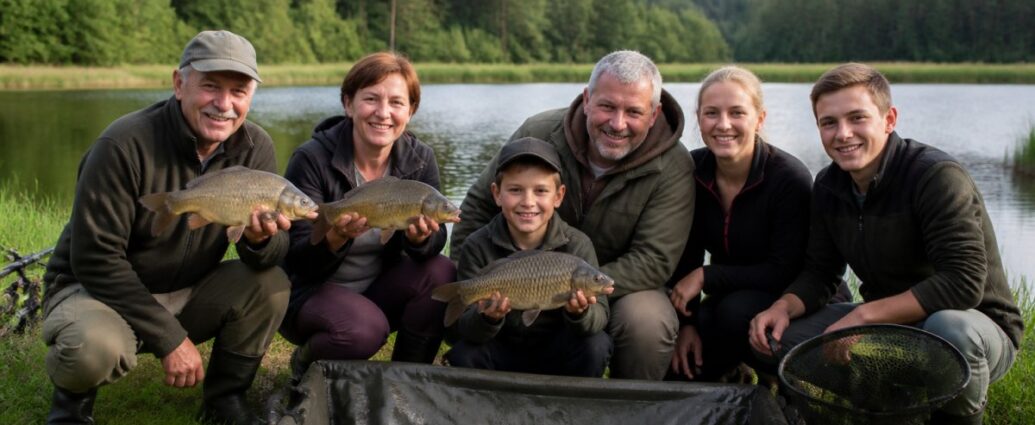
Non-predatory Fishing in the Waldviertel Region It’s so accessible to beginners because the region offers hundreds of quiet ponds and slow-moving waters where carp, tench, and whitefish bite without any pressure to perform. If you’re just starting out with fishing, you don’t need expensive gear or years of experience—what you need most is patience, the right spot, and a basic understanding of the rules. That’s exactly where this guide from Ferienwohnungen Gutenbrunn comes in.
The Waldviertel pond landscape has developed over centuries through pond farming. Many of the bodies of water are small, manageable, and shallow, which is ideal for beginners: The fish are often found near the shore, the rig doesn’t need to be cast far, and a bite indicator is clearly visible. Another advantage is the tranquility. Unlike heavily fished waters in the south or west, here only a few anglers often share a single pond.
What most beginner’s guides fail to mention: The real hurdle isn’t casting or tying on bait, but the paperwork. Without a valid fishing license and the appropriate fishing rights for a body of water, any attempt to fish is illegal—no matter how good your technique is. That’s why we’ll start by explaining the legal basics, then move on to equipment, and finally cover the practical aspects. The Lower Austria State Fishing Association, which provides information on bodies of water and management, is the central point of contact for everything related to management and permits.
If you're new to fishing in the Waldviertel, you should start with a small, shallow pond where carp and tench are the main target fish. This makes it much easier to get started.
Which non-predatory fish are biting in the Waldviertel region
Non-predatory fish are species that feed primarily on plant matter, small animals, and food found on the bottom, and are therefore specifically targeted with dough, polenta, or corn. In the Waldviertel region, carp, tench, and various whitefish are the most common, with trout also found in some ponds.
Carp and tench as the main target fish
Carp is the classic target fish for beginners. It grows large, puts up a strong fight, and is relatively forgiving of baiting mistakes. Tench are more skittish, but they’re abundant in many Waldviertel ponds and bite particularly well in the early morning hours. Both species tend to stay close to the bottom, which is why a bottom rig with a bottom weight is the obvious choice here.
Whitefish and Trout in the Pond
Whitefish such as roach, bream, and rudd are small but ideal for practicing. They bite quickly, so beginners can experience success right away. Trout are found in cooler, oxygen-rich ponds and tend to respond to moving lures, which already points toward using a spinning rod. Those who focus on non-predatory fish at first learn the most important things first: patience, recognizing a bite, and unhooking the fish properly.
Lower Austria Fishing License: What Beginners Need to Know
The Lower Austria fishing license is the primary requirement for being allowed to fish in any body of water at all. If you don’t have an annual license, you can fish as a guest with a day or weekly permit, provided the body of water in question allows it. This is exactly where most beginners run into trouble—not with the technique, but with figuring out which permit they actually need.
Basically, there are three ways to get to a body of water:
- Annual license with exam: If you want to fish regularly and in many different areas, you’ll need to pass the fishing exam. In Lower Austria, the exam is administered by the relevant authority; fishing associations and clubs offer preparatory courses. The exam covers ichthyology, hydrology, fishing equipment, fishing laws, and nature conservation.
- Guest card without verification: The most convenient option for vacationers and casual anglers. It is issued on a daily or weekly basis, is tied to a specific body of water or group of bodies of water, and generally does not require a fishing exam.
- Daily Permit for Club Waters: Some clubs issue day passes to guests, often only on certain weekdays or in limited quantities. It’s worth checking directly with the club manager.
The specific requirements, deadlines, and forms are determined by the respective state. Binding information regarding eligibility requirements, courses, and examination procedures is provided by the competent authority, whose current regulations can be found at the Official Access to Fisheries Matters in Lower Austria are available for review. If you're unsure whether a check is required or what forms of proof are accepted, you should clarify this before arriving, not once you're at the shore.
Guest Pass for Tourists Without an Annual License
For vacationers, the visitor's permit is the most convenient option. It is usually issued on a daily or weekly basis and is tied to a specific body of water or a group of bodies of water. Typical steps:
- Select a body of water where guest passes are issued
- Check with the manager or the distribution center regarding availability
- Submit the required documentation and purchase the card
- Read the fishing regulations and closed seasons for that specific pond
- Carry a map with you while fishing
A common misconception: The guest permit does not exempt you from any required certification if the fishing area in question mandates it. Some fishing area operators also require proof of basic knowledge or a brief on-site orientation. Visitors from abroad should therefore check in advance whether a recognized certificate from their home country is valid or whether an on-site briefing at the body of water is sufficient.
A guest permit is valid only for the specified body of water. Anyone who continues fishing in a neighboring pond is committing poaching, even if both ponds appear identical. Equally important: You must carry the permit with you while fishing; a copy at home is not sufficient.
What's on the map and in the water regulations
When you buy a permit, you usually get more than just a piece of paper. The permit comes with the fishing regulations, which are the most important reading material of the day for beginners. They cover:
- Closed Seasons and Minimum Sizes by fish species
- Permitted Methods (Pose, Bottom, Feeding, Artificial Lures)
- Withdrawal Rules, which fish may be kept and which must be released
- Shore Boundaries and Restricted Areas
- Number of rods, which may be laid out at the same time
If you read these points before your first cast, you’ll avoid the most common violation of all: intentionally fishing for a fish during its closed season. A quick glance at the regulations takes five minutes and saves you a lot of trouble. with the Supervision.
Suitable fishing waters and an interactive map of water bodies
Suitable fishing spots for beginners are small, shallow ponds with easily accessible shores, clear fishing regulations, and a nearby location where guest permits are issued. The Waldviertel meets these conditions in many places, but not every pond is open to the public for fishing. The key question isn’t „Where is it nice?“ but rather „Where am I actually allowed to fish as a guest without club membership?“
An interactive map of the waterways is the most useful tool for planning. Such maps—like those provided by fishing associations—show fishing area boundaries, access points along the shore, and, in some cases, the managing authority. Before your first trip, it’s worth checking three things: Is the body of water open to visiting anglers? Where exactly does the fishing area begin and end? And are there any restrictions on certain sections of the shore?
How Beginners Can Identify a Suitable Body of Water
Not every pond in the Waldviertel is equally suitable for beginners. Five characteristics can help you choose:
- Shallow shoreline zone: Where the water remains knee-deep for the first few meters, carp and tench are within casting range. Steep bank edges are more difficult for beginners to fish.
- Accessible fishing spot: A solid—or at least dry—strip of shore where you can stand and launch a boat safely is more important than a picturesque view.
- Nearby distribution center: If you have to pick up your guest permit the day before, you'll lose half a day of fishing. Waterways with on-site permit offices are more convenient.
- Clear Water Regulations: A written policy outlining closed seasons and methods is a sign of quality. If such a policy is missing, caution is advised.
- Not very busy: Ponds where swimmers, boaters, and anglers share the same stretch of shore can be chaotic and frustrating for beginners.
Pond-based fishing areas as a starting point
Many of the Waldviertel’s bodies of water have their origins in centuries-old pond farming. This offers a concrete advantage for beginners: These ponds are often small, manageable, and shallow; the fish stay close to the shore; and you don’t have to cast your rig very far. A bite indicator is clearly visible, and the fight remains under control.
Another advantage is the peace and quiet. Unlike heavily fished waters in the south or west, here there are often only a few anglers sharing a pond. However, if you’re a guest angler at such a body of water, you should still check with the manager beforehand—not every pond is open to guest anglers, and some are strictly for breeding and not open to the public.
Once you’re there, the fishing spot is what matters. Good spots are located in quiet coves with reeds or water lilies, because that’s where food gathers and fish find cover. You should avoid spots right next to swimmers or boat docks, because those areas are too busy. Anyone who with the family Those on the go will find the area around Gutenbrunn to be a great starting point for combining fishing trips with hikes.
| Water Body Type | Target Fish | Appropriate Method | For Beginners |
|---|---|---|---|
| Shallow pond with reeds | Carp, Tench | Base Mounting with Base Plate | Very well suited |
| Small pond, cool | Trout | Spinning rod, moving lure | Medium |
| A slowly flowing stream | Whitefish | Pose rod, light rig | Well-suited |
| Large lake, windy | Carp, Bream | Feeder, long casts | Less suitable |
Plan your first outing to a small, shallow body of water with a ticket booth in town. A pond where you can buy a permit that same morning is a better place to start than a larger fishing area that requires a long drive.
Equipment Checklist for Beginners
The basic gear for non-predatory fishing is fairly straightforward. If you don’t want to spend a lot of money right away, a single versatile rod and a few accessories will take you a long way. The following checklist covers everything you need for your first day of fishing:
- Medium-length float rod, with a matching reel
- Line of the appropriate thickness, freshly spooled
- Leader material and hooks in various sizes
- Bottom weights and floats in various weights
- Bite indicator or float with a clearly visible tip
- Landing net with a rubberized mesh
- Unhooking mat for handling fish gently
- Bait box with dough, polenta, and corn
- A bucket, a towel, and a small pair of scissors
- Seating and Weather Protection
A feeder rod is a useful addition if you plan to fish at longer distances later on, but it’s not essential for beginners. A spinning rod is only worth it if you’re targeting trout or predatory fish.
When buying your first rod, don't choose it based on maximum length, but rather on the body of water where you'll actually be fishing. In small ponds, a shorter float rod is easier to handle and casts more accurately than a long rod that gets caught on the vegetation along the shore.
Fishing Rigs for Beginners
Fishing rigs for beginners should be simple, sturdy, and quick to tie. Two basic setups are enough to get started: the float rig for calm, shallow areas and the bottom rig with a sinker for deeper water.
A float rig consists of a main line, a float, a leader, and a hook. The float holds the bait at a set depth and clearly indicates a bite. It is particularly suitable when you suspect the fish are in midwater or just above the bottom.
The bottom rig uses a sinker to keep the line on the bottom and a leader with a hook. The bite indicator is either a delicate float tip or an electronic indicator. This rig is ideal for carp and tench that feed on the bottom.
A common beginner’s mistake is using a leader that’s too thick. Non-predatory fish are cautious; a thinner leader results in more bites, even if it requires a more delicate touch when playing the fish. Equally important: The hook must match the size of the bait. A hook that’s too large with a small piece of dough looks unnatural and is often ignored.
Baits for Non-Predatory Fish: Dough, Polenta, and More
Baits for non-predatory fish can be grouped into a few categories, and most of them are inexpensive and easy to make. Dough, polenta, and corn are the classics, along with bread crumbs, potatoes, and various types of commercial fish food.
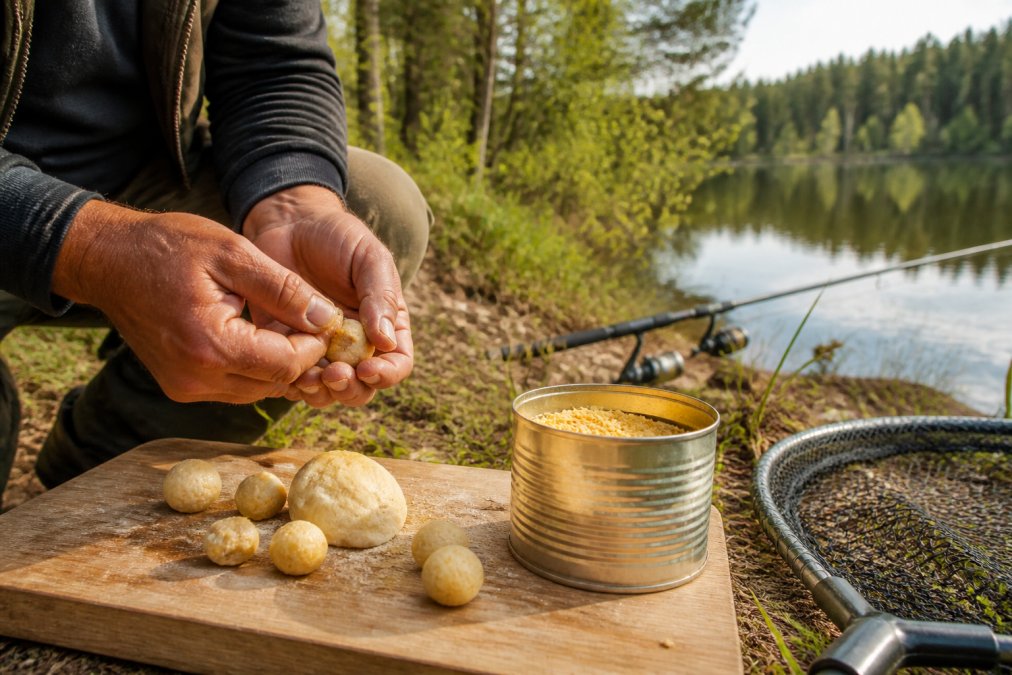
Dough is the most versatile starter bait. You can make it yourself using flour, water, and a little flavoring, and it stays on the hook as long as the consistency is right. Polenta is cooked, cooled, and shaped into small balls; it’s especially popular for carp and tench. Canned corn is convenient, has a long shelf life, and works almost anywhere.
Baiting is the second key step. If you regularly cast small amounts of bait into the same spot, you’ll get the fish used to that location. Moderation is key: Too much bait will fill the fish up before they even take an interest in the hook bait. A few handfuls per day of fishing are usually more than enough in small ponds.
Seasonal Considerations and Closed Seasons
Closed seasons and minimum sizes vary depending on the fish species and body of water and are determined by the fisheries management authority. Anyone who is unaware of these regulations risks fines and harms the fish population. The specific dates and size limits for each fishing area are listed in the water regulations, which should be read before fishing.
Seasonally speaking: In the spring, as the water warms up, carp and tench become active again. Summer offers the best conditions in the early morning and late evening hours, because the fish avoid the midday heat. In the fall, many species stock up on food and bite reliably. In the winter, fishing is restricted or prohibited at many ponds.
If you don't know the closed season for a target fish, you shouldn't even try to catch it. A quick glance at the fishing regulations before your first cast will prevent the most common violation of all.
Hunting Ethics and Conduct at the Water's Edge
Ethical fishing means treating the fish as a living creature and not merely as a trophy. In practice, this means: using gentle gear, a quick fight, wet hands, a landing mat, proper release, or ethical euthanasia when the fish is removed from the water.
There are unwritten rules at the water’s edge that visitors should take particularly seriously. These include leaving your fishing spot clean, not crowding other anglers, and casting from a sufficient distance. Noise and sudden movements scare fish away from shallow areas near the shore.
If you keep a fish out of the water for an unnecessarily long time just to take a photo, you’re causing it significant harm. Unhook it quickly, take a quick photo, and put it back in the water: That’s how we keep the fish population healthy and ensure that fishing remains permitted.
Sustainability isn’t just a buzzword—it’s essential for ensuring that the Waldviertel pond landscape remains what it is. Those who catch only as many fish as they can use and respect closed seasons ensure that fishing will be available for the next generation. For families vacationing in the region, this fits well with the nature experience: Here, fishing isn’t a competition, but a peaceful pastime by the water.
Fishing for non-predatory fish in the Waldviertel doesn’t require a masterful performance, but rather preparation: the right fishing license, a simple rig, suitable bait, and respect for the water. It is precisely this tranquility and manageability that make the region attractive to beginners. If you’d like to combine your fishing vacation with nearby accommodations, Ferienwohnungen Gutenbrunn offers the perfect base: four vacation apartments in a quiet location, personalized service from Anna and Herbert, and a central location that puts you just a short distance from the area’s fishing waters. Whether you’re traveling with your family, your dog, or have limited mobility, the apartments are designed to be accessible and can be booked directly with the hosts. Start your inquiry with Ferienwohnungen Gutenbrunn and plan your first day of fishing at your leisure.
Frequently Asked Questions
What types of non-predatory fish can you catch in the Waldviertel?
In the Waldviertel region, carp, tench, bream, rudd, and roach are the main species you’ll catch. In cooler ponds, trout and other salmonids are also found. The target fish determines the bait and rig: Carp and tench prefer sweet dough baits and polenta, while whitefish take fine hook baits. For beginners, a pond with a mixed stock of fish is ideal because almost every cast results in a bite, and you quickly learn to correctly interpret bite indicators and leaders.
Do I need a fishing license to fish in the Waldviertel?
Yes, you are not allowed to fish without a valid Lower Austria fishing license. If you do not have an annual or daily permit, many water management authorities will issue you a guest permit, often after a brief on-site orientation. This guest permit is valid only for the specific body of water and the specified time period. Always carry the permit with you and follow the fishing regulations, as inspections by enforcement authorities are common.
What is the ideal gear for beginners in non-predatory fishing?
To get started, all you need is a float rod with a matching reel, plus a leader, hooks in sizes 10 through 14, a landing net, an unhooking mat, and a bite indicator. You won’t need a feeder or spinning rod until later. Make sure your gear complies with local fishing regulations, and bring spare hooks as well as a small bucket for groundbait. This basic setup covers most non-predatory fish rigs for beginners and can be expanded as needed over time.
What are the best baits for carp and tench?
There are many different baits for non-predatory fish: dough, polenta, corn, bread flakes, and potatoes work in most ponds. Carp respond well to sweet dough and corn, while tench prefer worms or small dough balls on the bottom. It’s important to pre-feed the spot with the right bait so the fish can find your fishing spot. Try two or three different baits until you figure out what works best in that particular body of water.

Comments are closed, but trackbacks and pingbacks are open.