



Table of Contents
- Vacations for People Who Need Care: Why Choosing the Right Accommodation Is Crucial
- Clarify care needs and personal requirements before planning
- Accessible Vacation Rental Checklist: These Criteria Matter
- Vacationing in a Wheelchair: Choosing the Right Accommodations and Surroundings
- Organizing Care at Your Vacation Destination: How to Ensure You Receive the Care You Need
- Short-Term Care and Substitute Care During Vacations: What Family Caregivers Should Know
- Planning Your Travel, Assistive Devices, and Medications Properly
- Safety and Emergency Planning at the Lodging Facility
- Booking and Cancellation in the Event of a Sudden Deterioration
- Conclusion: With good preparation, you can enjoy a relaxing vacation even if you require care
- Frequently Asked Questions
Last updated: October 5, 2026
Vacations for People Who Need Care: Why Choosing the Right Accommodation Is Crucial
A vacation for someone who needs care stands or falls on the choice of accommodations. Anyone planning a trip for a family member who needs care quickly realizes that pretty photos don’t tell you much about whether daily life at the destination will actually work out. That’s exactly where this guide from Ferienwohnungen Gutenbrunn comes in. We’ll walk you through, step by step, what to look for when choosing accommodations.
The key question is: Does the apartment meet your actual care needs? Not based on a general promise, but on your specific daily routine. If you clarify this before booking, you’ll save yourself disappointment and stress.
Vacations for People Who Need Care In other words: relaxation for everyone involved. To make that happen, preparation is key. The following eight areas cover everything you should take care of before your trip.
Clarify care needs and personal requirements before planning
The first step is to take an honest look at the situation. Make a list of the tasks your family member can do on their own and where they need help. Only then should you start looking for housing.
Many families start by looking for a place to live and then realize that something is missing. Reverse the order. Your needs should determine your choice.
Match care needs with care levels and specific tasks
The care level alone says little about vacation time. What matters are the specific activities:
- Mobility: Walking, climbing stairs, transferring from bed to wheelchair
- Personal Care: Showering, washing up at the sink, brushing your teeth
- How to put it on: Independent, with assistance, or fully supported
- Food and Drink: Preparation, Enrichment, Special Dietary Forms
- Trips to the bathroom: Independently, with assistance, or using assistive devices
- Night: Sleeping Through the Night, Changing Positions, Nighttime Bathroom Trips
Go over the list together with the caregiver. This will give you a clear picture.
Instead of asking the accommodation, „Is it accessible?“, ask, „How many steps lead to the entrance, how wide is the bathroom door, and is there a shower stool?“ Specific questions yield specific answers.
Accessible Vacation Rental Checklist: These Criteria Matter
One Barrier-free vacation apartment A checklist is no substitute for a face-to-face conversation, but it helps make the inspection structured and comparable. Go through the items before each booking—preferably with a folding rule or measuring tape, because while many details can be obtained over the phone, not all of them can.
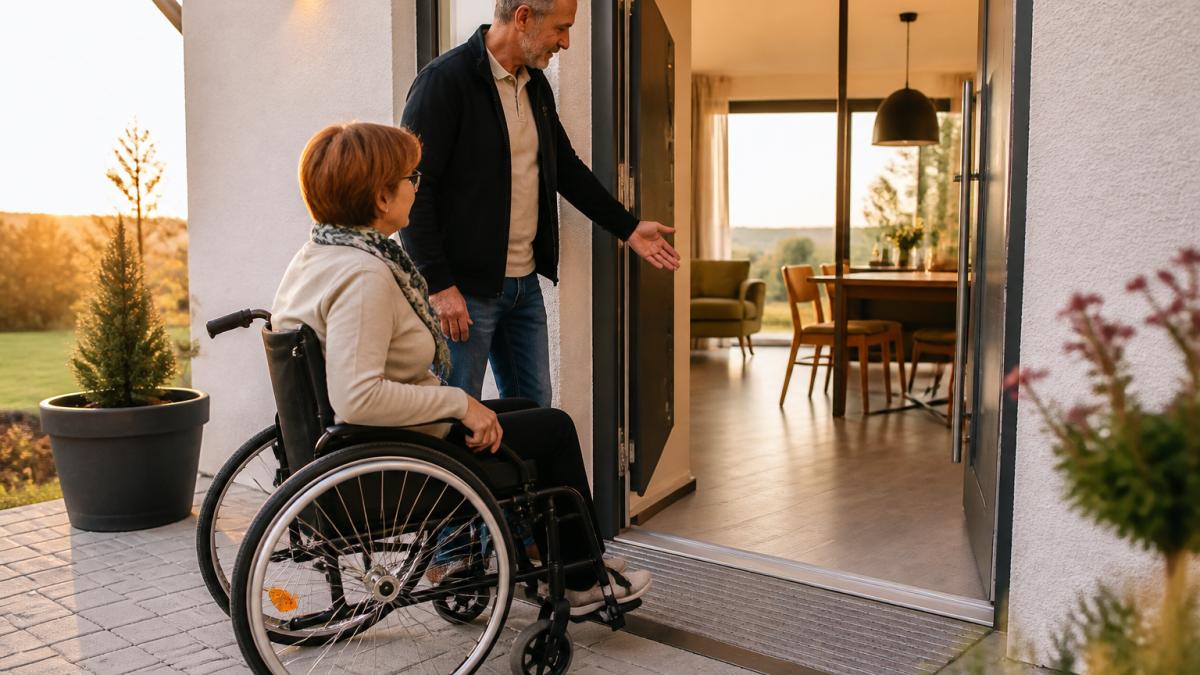
Access and Entrance
- Step-free access from the parking lot to the apartment door—no steps at all, not even ones that are 2–3 cm high
- If a ramp is present: The slope should ideally not be steeper than 6 %; for short ramps, up to 8 %
- Entrance door with a clear width of at least 90 cm, so that a wheelchair can pass through without bumping into anything
- Threshold at the entrance no more than 2 cm high, ideally beveled
- Doorbell and mailbox at a height between 85 and 105 cm
- Paved, non-slip path to the entrance—no gravel, no crushed stone, no loose slabs
Living Area and Bedroom
- Interior door widths should be at least 80 cm, preferably 90 cm
- A turning area of at least 150 cm × 150 cm in the living area so that a wheelchair can turn around
- A clear space of at least 150 cm in front of the bed, on at least one of the long sides
- A bed that is about 45 to 50 cm high, to facilitate the transfer from a wheelchair
- Nightstand and light switch within reach from the bed
- Outlets within reach, between 40 and 120 cm
- No loose rugs or cables on the main walkways
The Bathroom—The Most Critical Room
- Bathroom door: at least 80 cm, preferably 90 cm clear width
- Walk-in shower with no threshold, or alternatively, a step-up of no more than 2 cm
- The shower area must be at least 120 cm × 120 cm to accommodate a shower stool or shower chair
- Grab bars next to the toilet and in the shower, mounted—not suction-cup style
- Restroom with a side approach of at least 70 cm for wheelchairs
- Washbasin with space underneath to allow for personal hygiene while seated
- Non-slip floor tiles or mats in the shower and in front of the sink
- Access to an emergency line, or at least a waterproof phone within reach
Common Areas and Outdoor Facilities
- Hallways must be at least 120 cm wide so that two people can pass each other
- Elevator, if there are multiple floors—cabin at least 110 cm × 140 cm, door at least 90 cm
- A patio or balcony with step-free access and at least 150 cm of clear space
- Seating with armrests and a seat height of about 45 cm
- Lighting along all paths, even at night
Check accessibility in detail instead of relying on promises
„Accessible“ is not a protected term. Any lodging facility may use it without undergoing an inspection. Therefore, don’t rely on the label—instead, ask for measurements and have them send you photos.
Ask for measurements, not descriptions. „The door is wide enough“ isn’t helpful. „The bathroom door has a clear width of 90 cm“ does. Ask for photos of the entrance, bathroom, sleeping area, and the path from the parking lot to the door. A reputable accommodation provider will be happy to send them—and if not, that’s already telling.
A tried-and-true trick: Ask someone to place an everyday object next to the spot in question—such as a sheet of A4 paper next to the door threshold or a chair next to the toilet. This makes it easy to roughly estimate dimensions in photos when you don’t have a measuring tape on hand.
Never assume that a place is „wheelchair-accessible“ without asking. If there’s no ramp, the shower is too high, or the toilet isn’t accessible from the side, a vacation for wheelchair users can quickly become a major challenge. Check the dimensions before booking, not when you arrive—once you’re there, structural changes can’t be made.
Vacationing in a Wheelchair: Choosing the Right Accommodations and Surroundings
When vacationing in a wheelchair, it's not just the apartment that matters. The surrounding area has to be suitable, too. A step-free entrance isn't much use if the nearest path is covered in gravel.
Check three levels:
- The apartment: Doors, Bathroom, Floors, Clearance Areas
- The property: Paths, patio, parking lot, entrance area
- The Surroundings: Walkways, tourist attractions, shops, restaurants
Ask about the condition of the paths. Paved paths with a solid surface are suitable for wheelchairs and walkers. Gravel and crushed stone make it significantly more difficult to get around.
Your trip there also needs to be planned. An accessible train station, a suitable parking spot, and enough time for breaks will make the start of your trip more relaxing.
Organizing Care at Your Vacation Destination: How to Ensure You Receive the Care You Need
Organizing care at your vacation destination means figuring out in advance who will help in an emergency and how the daily routine works there. If you’re the one providing care, you need a reliable point of contact while on vacation—not just a phone number, but a person who is actually available.
Ensuring a Three-Tiered Supply System
Think of the care process as consisting of three stages that build on one another:
- Basic Care Provided by the Caregiver – everything you do on a daily basis anyway: personal hygiene, getting dressed, eating, and assisting with bathroom visits.
- Support from a local home care service – for specific services such as basic morning care, administering medication, or wound care, when you need a break yourself.
- Emergency Care – medical care, hospital, emergency medical services. This level is only used in exceptional cases, but must be clarified in advance.
For Level 2, it’s a good idea to check with a local home care agency before booking to see if they have availability for the travel period. Many agencies plan several weeks in advance and cannot always accommodate last-minute requests. Also clarify whether billing through your own long-term care insurance is possible, or whether you’ll need to pay out of pocket first and apply for reimbursement later.
Match Care Needs by Activity with Available Services
The care level alone says little about the vacation. What matters is which specific tasks are covered on-site. Go through the following points and note down for each line who will take care of it:
| Occupation | Who will take over? | Has this been clarified in advance? |
|---|---|---|
| Transfer from Bed ↔ Wheelchair | ||
| Morning Personal Care | ||
| Evening Personal Care Routine | ||
| Clothing and Shoes | ||
| Preparing and Serving Food | ||
| Trips to the bathroom during the day | ||
| Nighttime trips to the bathroom | ||
| Administration of Medication | ||
| Wound Care | ||
| Accompaniment on Field Trips |
This table is the most important part of the planning process. It immediately shows where gaps exist—and whether the residential facility or a home care service can fill those gaps.
Clarify Nighttime Care and Dementia Care
Two areas are particularly often overlooked:
Nighttime care. Anyone who gets up at night needs someone to accompany them, lighting, and a safe path to the bathroom. Find out whether the facility has staff available at night or if you are responsible for this on your own. A nightlight along the path to the bathroom and a non-slip floor are minimum requirements.
Dementia Care. For guests with cognitive impairments, accessibility alone is not enough. Make sure the facility has a clear, low-stimulus layout, a familiar environment, and places where guests can retreat. Ask if the facility has experience with guests who have dementia—for example, whether it has an enclosed garden area or a quiet location away from through traffic.
Store Medications Safely
Medications should be stored in a cool, dry place in your accommodations that is inaccessible to unauthorized persons. A lockable container or a lockable compartment in the bedroom is a good idea if children or pets are traveling with you. Special care must also be taken with medical devices that require careful preparation and safe transport, such as Dialysis While Traveling that is the case.
Check in advance to see if the accommodation has a refrigerator with a lockable compartment—some medications must be stored in the refrigerator. A medication schedule listing the dosage, time, and emergency contact information should be posted in a visible place on the wall or in the kitchen.
Emergency Plan for the Shelter
Before you arrive, create an emergency plan that includes the following information:
- Emergency numbers: Emergency Medical Services, On-Call Medical Service, Poison Control
- Local family doctor including address and phone number
- Nearest hospital with address and directions
- Nearest Pharmacy with hours of operation
- Accommodation Contact Person with your name and phone number, even at night
- On-site Nursing Care including your name and phone number
- Important Diagnoses and Allergies The well-groomed person, in brief
- List of Medications with dosage
Print out the plan and display it where it can be easily seen—in the kitchen, by the bed, or on the front door. In an emergency, every minute counts, and no one has time to search for it in an app.
The most important question to ask before booking isn’t „How much does the apartment cost?“ but „Who do I contact if something happens at night?“ Make sure to clarify this before you book—and have the person’s name and contact information confirmed in writing.
Short-Term Care and Substitute Care During Vacations: What Family Caregivers Should Know
Short-term care and substitute care during vacations provide relief for family caregivers. Both services are covered by long-term care insurance. The exact eligibility requirements and benefit amounts vary by state and region.
As a general rule, family caregivers are entitled to respite care if they need a break themselves. Those who spend their vacation together may also receive support, depending on the situation.
Important to know:
- To receive a refund, you generally need the Notice of Care Allowance and matching Documents.
- The accommodation of your choice may be recognized under certain conditions.
- You can find out the exact rules and amounts from your long-term care insurance provider and in the Official Information on Long-Term Care Insurance.
Check with your point-of-sale system before making the reservation. That way, you'll know which documents you need to gather.
Planning Your Travel, Assistive Devices, and Medications Properly
Travel time is an underestimated factor. Allow more time than necessary. This includes breaks, bathroom stops, and opportunities to stretch your legs.
A packing list for medical supplies and medications is helpful:
- All medications in sufficient quantities, plus a supply
- Medication Schedule with Dosage and Time
- Prescriptions and medical certificates
- Wheelchair or walker, if necessary
- Shower stools and grab bars designed to be suction-mounted
- Toilet Seat Riser
- A sufficient supply of incontinence supplies
- Wound Care and Dressings
- Personal Care Products
Check in advance to see if the lodging already provides certain assistive devices. This will save space in your car.
Safety and Emergency Planning at the Lodging Facility
Safety in your living space starts with a walk-through on the first day. Walk through the apartment together and make a note of any tripping hazards.
Please note:
- Loose rugs and cables
- Poorly lit hallways and stairways
- Lack of grab bars in the bathroom
- Slippery Floors
- Sharp edges at grip height
- Emergency Exit and Escape Route
Write down important phone numbers: your local family doctor, home care service, emergency hotline, and the contact person at your place of residence. Keep the list in a visible place.
A quick tour on the day you arrive will prevent most problems. Take the time to do it.
Booking and Cancellation in the Event of a Sudden Deterioration
A sudden deterioration in your health can ruin any plans. Therefore, be sure to check the cancellation policy before booking.
Be sure to ask specifically about:
- How flexible are the cancellation policies in case of illness?
- Is there a policy regarding last-minute cancellations?
- What documentation is required?
- How does the reversal process work?
Booking directly with the hosts makes things much easier. You're talking directly to the people who are actually there. If there's a last-minute change, you can usually find solutions faster this way than through an anonymous platform.
| Situation | What to Clarify in Advance | Why It's Important |
|---|---|---|
| Barrier-free access | Request Dimensions and Photos | Avoid surprises when you arrive |
| Nighttime Care Needs | Contact Person and Availability | Security Around the Clock |
| Last-minute cancellation | Cancellation Policy in Writing | Coverage in Case of Illness |
| On-site resources | Check Availability | Saves space and effort |
| Medications | Refrigeration and Storage | Ensure Proper Storage |
Conclusion: With good preparation, you can enjoy a relaxing vacation even if you require care
A vacation that requires special care needs more preparation than a typical trip. But that’s no reason to skip it. If you clarify your needs, carefully review your accommodations, and arrange for care in advance, you’ll be able to travel with peace of mind.
That’s exactly what we’re here for. At Ferienwohnungen Gutenbrunn, you’ll find barrier-free and wheelchair-accessible vacation rentals with personalized service from Anna and Herbert. Our peaceful setting surrounded by nature offers relaxation without the pressure of a tight schedule. Upon request, you’re welcome to bring your dog, and our central location is ideal for exploring the region.
Would you like to plan a vacation that accommodates your care needs? Please contact us directly. We’ll provide personalized advice and help answer any questions you may have about accommodations. Look forward to a getaway that works for everyone involved.
Frequently Asked Questions
What should you look for when choosing accommodations for a vacation with special care needs?
Before booking, check for step-free access, door widths of at least 80 cm, a walk-in shower, and sufficient space to move around in the bedroom and bathroom areas. Ask specifically about grab bars, the height of the bed, and wheelchair accessibility. Have the accessibility confirmed in writing and find out what care services are available nearby. A detailed checklist will help ensure that the vacation accommodation is truly suitable for those with care needs.
Can care be arranged at the vacation destination?
Yes, care at your vacation destination can be arranged in advance. Contact mobile care services in the region, check their availability for your travel dates, and discuss your specific care needs, such as personal hygiene, mobility assistance, or medication administration. Also ask about billing through care allowances or substitute care. Contacting them early—ideally several weeks before your vacation begins—gives you peace of mind and ensures you’ll receive the care you need while you’re there.
What information about my care needs should I provide to the facility in advance?
Let the accommodation know in advance if a wheelchair or walking aid will be used, what assistive devices are needed, and whether assistance is required for transfers to bed or into the shower. Indicate whether a home care provider will be visiting and whether a service dog will be traveling with you. Information about a night light, emergency call system, or special dietary needs is also helpful. This allows the accommodation to prepare for your stay and make appropriate arrangements for your care needs during your vacation.
What should be included on a checklist for a vacation with family members who need care?
A good checklist should include: accessibility of the lodging, availability of care at the vacation destination, bringing assistive devices and a sufficient supply of medication, emergency contacts and proof of insurance, as well as arrangements for short-term care and substitute care. Add details about travel time, breaks, and transportation. Also check whether the accommodation requires a care allowance notification or documentation for substitute care. This will help you stay organized when planning a vacation with care needs.


Comments are closed, but trackbacks and pingbacks are open.