


Table of Contents
- What makes a vacation rental accessible?
- Wheelchair-Accessible Vacation Rental: Criteria and Standards
- Requirements for the Entrance Area
- Doors and Hallways: Width and Clearance Over Thresholds
- Bathrooms and Plumbing Areas
- Kitchen and Living Area for Wheelchair Users
- Finding Accessible Accommodations: What Guests Should Keep in Mind
- Accessibility for People with Visual and Hearing Impairments
- Accessible Tourist Attractions in the Waldviertel Region
- Certifications and Seals of Approval
- Frequently Asked Questions
Last updated: September 27, 2026
What makes a vacation rental accessible?
One Barrier-free vacation apartment is a lodging option that enables people with mobility, visual, or hearing impairments, as well as seniors, to enjoy their vacations independently and without assistance. At Ferienwohnungen Gutenbrunn, we don’t view accessibility as a compromise on comfort, but rather as a well-thought-out design that benefits all guests. Specifically, this means: threshold-free entrances, sufficiently wide doors and hallways, floor-level showers, non-slip flooring, and thoughtfully placed light switches and outlets. A truly accessible vacation rental caters not only to wheelchair users but also to people with visual or hearing impairments, as well as older guests who need to avoid stairs.
The requirements for accessible housing go beyond individual measures. It involves a holistic approach in which every detail—from the parking space to the bedroom—is carefully considered. Many landlords think that accessibility simply means installing a wide door. That is a common mistake. True accessibility requires planning, an understanding of different types of disabilities, and a willingness to take standards such as DIN 18040 seriously.
The main difference between „accessible“ and „wheelchair-accessible“ lies in the scope of the focus: “Wheelchair-accessible” refers specifically to facilities optimized for wheelchair users, while “accessible” takes into account all types of mobility impairments and sensory disabilities.
Wheelchair-Accessible Vacation Rental: Criteria and Standards
DIN 18040 and applicable standards
DIN 18040-1 is the Austrian standard for accessible construction. It defines specific dimensions and requirements that a wheelchair-accessible vacation rental must meet. This standard forms the basis for true accessibility. DIN 18040 stipulates that maneuvering areas must be at least 150 × 150 centimeters so that a wheelchair can turn around. Doors must have a clear width of at least 90 centimeters; 100 centimeters is preferable.
Many landlords are unaware of this standard or consider it too strict. This results in accommodations that are advertised as „accessible“ but don’t actually meet those standards in practice. A door that is 85 centimeters wide may seem narrow, but it is not accessible according to DIN 18040. At Ferienwohnungen Gutenbrunn, we adhere to these standards—not just ignore them.
Maneuvering Areas and Turning Circle
The turning radius determines whether a wheelchair user can move around in a room. A wheelchair needs a diameter of about 150 centimeters to turn around. That sounds simple, but in practice it means that in a bathroom 160 centimeters wide, a turning circle is virtually impossible. It doesn’t work in a kitchen with narrow spaces between the stove and the sink.
Mobility spaces are the clear areas in front of doors, furniture, and appliances. At least 70 centimeters of space is needed in front of a toilet to transfer from a wheelchair. In front of the shower, the space should be 150 × 150 centimeters. These dimensions are not generous—they are the minimum required for people who use wheelchairs to function independently.
An accessible vacation rental isn't just a regular apartment with a wide doorway. It requires thoughtful space planning that makes the most of every centimeter to allow for mobility and independence.
Requirements for the Entrance Area
The entryway often determines whether a guest can even use the apartment. An accessible vacation rental must offer level or ramp-accessible entrances—no steps. Specifically, this means: The path from the parking lot to the front door should be flat, the front door should have no threshold, and the ramp (if necessary) should have a maximum slope of 6 percent.
Many homes in rural areas have steps leading up to the entrance. A ramp is necessary in such cases, but a poorly constructed ramp is worse than no ramp at all—it is too steep, too narrow, or has sharp edges. A good ramp is at least 120 centimeters wide, has handrails on both sides, and has a slope that a wheelchair user can navigate independently.
The area in front of the door needs to be a level surface measuring at least 150 × 150 centimeters so that a person in a wheelchair can open the door. The doorknob should be installed at a height of 85 to 105 centimeters—not too high, not too low. An accessible vacation rental shows right from the entrance that the landlord knows what they’re doing.
Doors and Hallways: Width and Clearance Over Thresholds
Door width is non-negotiable. A clear door opening of at least 90 centimeters is standard; 100 centimeters is better. This refers not to the width of the door frame, but to the actual space through which a wheelchair can pass. Many older homes have doors that are 75 or 80 centimeters wide—that won’t work.
Door thresholds are often underestimated. A threshold as low as 2 centimeters can be a major obstacle for a wheelchair. A truly accessible vacation rental has threshold-free transitions between all rooms. Where thresholds are unavoidable (such as between different floor coverings), they should be no more than 5 millimeters high and beveled.
Hallways must be at least 150 centimeters wide to allow a wheelchair to pass through. In older homes, hallways are often only 100 to 120 centimeters wide. That’s too narrow. A wheelchair user cannot move if someone else is standing in the hallway. Wide hallways are a sign that the apartment has been well thought out.
| Requirement | Measure | Reason |
|---|---|---|
| Door width (clear opening) | 90–100 cm | Wheelchair fits through |
| Hallway width | at least 150 cm | Turning circle possible |
| Door threshold | max. 5 mm | No tripping hazards |
| Activity Area | 150 × 150 cm | The wheelchair can turn |
| Ramp Slope | max. 6 % | Automatic Startup |
Bathrooms and Plumbing Areas
The bathroom is often the most critical room in an accessible vacation rental. Here, a wheelchair user must be able to shower, use the toilet, and wash independently. This requires careful planning.
Walk-in shower and grab bars
A floor-level shower isn't optional—it's the foundation of an accessible bathroom. That means: no shower pan, no step, just a level surface with a slight slope toward the drain. A wheelchair user can then roll directly into the shower without having to transfer.
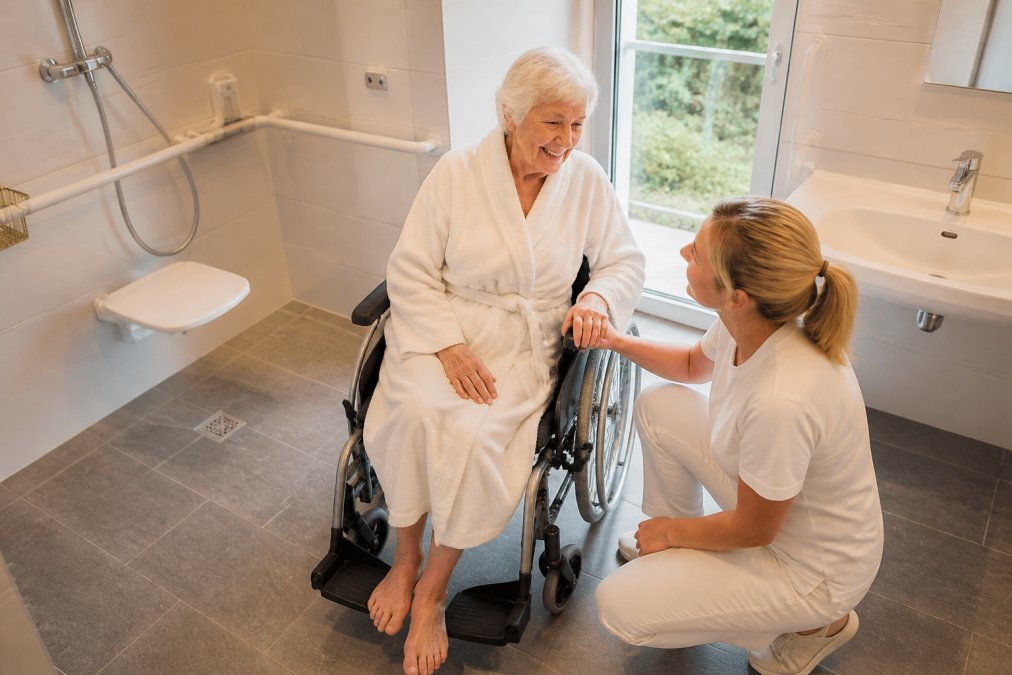
Grab bars aren’t just for decoration—they’re for safety. They should be installed at a height of 75 to 85 centimeters and have a diameter of 32 to 35 millimeters. A wheelchair user needs handrails to transfer from the wheelchair to the shower seat. A shower seat is also important—not every guest can stand.
The shower needs non-slip flooring. This is important not only for wheelchair users, but also for older adults and families with children. Non-slip flooring helps prevent falls, which can become a real problem while on vacation.
Kitchen and Living Area for Wheelchair Users
An accessible kitchen is one in which a person in a wheelchair can cook. This means that the stove and sink must be wheelchair-accessible—that is, there should be no cabinets underneath them. The countertop should be 80 to 85 centimeters high—not 90 centimeters like in a standard kitchen. Handles and controls must be mounted at a height of 80 to 120 centimeters.
Many landlords think that a small kitchen is sufficient. That’s not true. A person in a wheelchair needs space to move around. A kitchen with narrow aisles doesn’t work. The clearance area in front of the stove, sink, and refrigerator should be at least 150 centimeters in each case.
The living area should also be well-designed. Furniture should not be in the way, light switches should be installed at a height of 85 to 105 centimeters, and there should be enough space for a wheelchair. An accessible vacation rental doesn’t feel cramped or impractical—it feels spacious and well-designed.
Finding Accessible Accommodations: What Guests Should Keep in Mind
The search for a truly accessible vacation rental is often frustrating. Many accommodations advertise themselves as accessible, but aren't. A guest with limited mobility needs to know before booking whether the rental is truly suitable.
The first question should be: Are there stairs? Not „Is there an elevator?“ but „Are there stairs?“ If so, the apartment isn’t accessible. The second question: How wide are the doors, really? Many landlords give optimistic measurements. It’s important to measure them accurately.
The third question: What amenities does the bathroom have? Is there a walk-in shower, grab bars, and a shower seat? Can the toilet be accessed from both the left and right sides? These details determine whether a guest can be independent.
Direct contact is important. A phone call with the landlord is better than a website. The landlord should know the exact dimensions and answer honestly. At Ferienwohnungen Gutenbrunn, this personal contact is standard—Anna & Herbert know every apartment inside and out and can answer any question.
Accessibility for People with Visual and Hearing Impairments
Accessible Vacation Rentals are often thought of as being intended only for wheelchair users. That is a big mistake. People with visual impairments and the deaf have very different needs.
Good lighting is crucial for people with visual impairments. The home should have natural light and additional lighting in the right places. Contrast is important—dark door frames against dark walls can be problematic. Stairs should be marked so they are visible. Obstacles should not be placed in the middle of rooms.
Visual information is important for deaf guests. A doorbell system with a light signal is helpful. Information should be available in writing, not just verbally. An accessible vacation rental for deaf guests is one where the host communicates in writing and understands that some information must be conveyed visually.
Many landlords think that accessibility only applies to wheelchair users. That’s not true. People with visual or hearing impairments have completely different needs and are often overlooked. A truly inclusive vacation rental caters to everyone.
Accessible Tourist Attractions in the Waldviertel Region
An accessible vacation rental is only half the battle. A vacation should also offer opportunities for activities. The Waldviertel region has many beautiful places that are accessible to people with disabilities.
Lake Edlesberg is a popular destination for day trips. The path to the lake is partially accessible, but not everywhere. There is an accessible parking lot and access to the lakeshore, but not all areas are at ground level. Wheelchair users should check in advance to see which paths are accessible.
Hikes in the Waldviertel can often be done on regular trails. There are many flat trails that are also suitable for people with limited mobility. An accessible vacation rental should serve as a starting point for such activities.
Museums and cultural sites should be accessible. Many museums in the Waldviertel have stairs and are not wheelchair-accessible. It’s a good idea to call ahead and ask. A good landlord knows the accessible attractions in the region and can offer tips.
Certifications and Seals of Approval
An official accessibility certification is a powerful sign of trust for property owners. Guests with mobility challenges prefer to book with certified providers because they know that independent auditors have verified compliance with the requirements. There are several ways to have a vacation rental certified.
Austrian Standards and Test Procedures
Recognition pursuant to DIN 18040-1 Certification by independent inspection agencies is an important requirement. In Austria, specialized inspectors (often architects or engineers specializing in accessibility) work according to this standard. The inspection process works as follows: The landlord registers the apartment; an inspector visits the property, measures all relevant dimensions (door widths, clearances, heights of switches and handles), photographs critical areas, and prepares a detailed report. This report indicates which requirements have been met and which have not.
If the apartment meets all the criteria, the landlord receives a certificate that he may use in his listings and on his website. This certificate is valid for a limited time—usually 3 to 5 years—and must then be renewed.
Well-Known Quality Seals and Their Meanings
There are several recognized seals of approval that guests are familiar with and trust:
Austrian Ecolabel for Lodging Facilities – This certification takes sustainability and accessibility into account. To earn it, a lodging facility must demonstrate that it operates in accordance with environmental and social standards.
Certification by Organizations for People with Disabilities – Organizations such as the Austrian Disabled Sports Association or local disability councils offer certifications. A seal of approval from a disability organization is particularly valuable to guests because it comes from experts with personal experience.
Industry-Specific Certificates – Some vacation rental booking platforms have developed their own accessibility standards. If a rental meets these standards, it is marked with a special badge.
Why Certification Is Worth It for Landlords
A certification seal offers several concrete benefits:
-
Higher booking rates – Guests with limited mobility prefer to book through certified providers. This saves them time spent searching and avoids uncertainty.
-
Better Reviews – When guests know that the apartment is truly accessible, they are more satisfied and leave more positive reviews.
-
Legal Certainty – A certificate confirms that the landlord meets the standards. This protects against complaints and liability issues should a guest encounter any problems.
-
Marketing Advantage – Certified apartments can be listed in specialized directories and on platforms for accessible accommodations. This effectively reaches the target audience.
How to Apply for Certification
The first step is to find an inspector. You can do this through the Chamber of Trades, local chambers of architects, or specialized advisory services. The inspector will advise you on what steps still need to be taken before the official inspection takes place. This saves money by avoiding costly renovations that aren’t necessary.
Next comes the official inspection. The inspector prepares a report, and if everything is in order, the certificate is issued. The property owner can then use this certificate on their website, in advertisements, and on booking platforms.
Important: Certification is not a marketing gimmick. It is a genuine evaluation by independent experts. Guests know this and trust certified accommodations significantly more than self-rated options.
Frequently Asked Questions
What does accessibility entail for a vacation rental?
Accessibility in a vacation rental encompasses several aspects: threshold-free entrances, doors and hallways wide enough for wheelchair users, walk-in showers, grab bars in the bathroom, kitchen cabinets with space underneath for wheelchairs, non-slip flooring, and easily accessible light switches and electrical outlets. Information in large print and visual wayfinding systems are also part of this. A truly accessible vacation rental takes into account the needs of people with various mobility impairments.
What structural requirements make a vacation rental wheelchair-accessible?
According to DIN 18040, a wheelchair-accessible vacation rental must have a ground-level or ramp-free entrance, door widths of at least 90 centimeters, sufficient maneuvering space (at least 150 x 150 centimeters for a turning circle), floor-level showers instead of bathtubs, wheelchair-accessible sinks and stovetops, and grab bars in strategic locations. Parking spaces should be located in the immediate vicinity and clearly marked.
How can I find truly accessible accommodations that meet my needs?
When booking, look for detailed descriptions of the amenities—not just the word ‚accessible.‘ Ask for specific measurements (door widths, hallway widths), the type of shower, and any grab bars available. Direct contact with the hosts is valuable: you can ask specific questions and get honest answers. Certifications such as the Austrian Seal of Quality for Accessibility provide additional assurance. Be sure to read reviews from guests with similar needs.
Are there any accessible attractions near the accessible accommodations?
Yes, many regions offer accessible hiking trails, lakes with accessible swimming areas, and museums with elevators. In the Waldviertel, for example, there are flat loop trails and lakes with paved access to the shore. Check with your lodging provider or regional tourism offices in advance to find specific destinations that meet your needs. A good lodging provider is familiar with the options in the area and can offer specific recommendations.


Comments are closed, but trackbacks and pingbacks are open.