


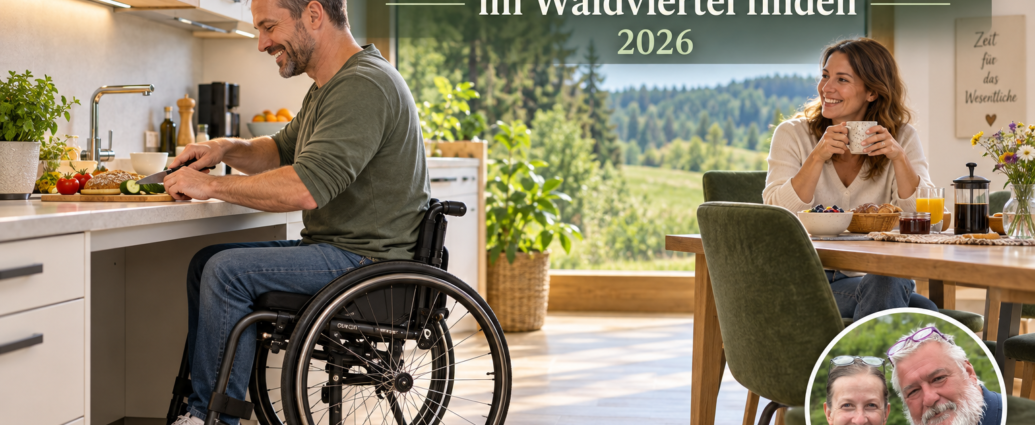
What Makes a Vacation Rental Truly Accessible
One Barrier-free vacation apartment is a lodging facility that people with limited mobility can use without assistance, from the parking lot to their bed. That sounds obvious, but it isn't. Many lodging facilities call themselves wheelchair accessible and then get tripped up by a single step at the entrance.
That’s exactly where this guide comes in. Accessibility comes down to centimeters, not advertising brochures. The following chapters will show you what to look for when planning your vacation, what questions to ask before booking, and how to find a vacation rental in the Waldviertel that lives up to its promises.
Door width, clearance, and ground-level access
Three factors determine usability: door width, clearance, and level access. If any one of these is missing, even the most beautiful furnishings are of no use.
- Door width: Wheelchairs require clear passage widths that allow for comfortable passage. Ask for the actual measurement, not just „wide doors.“.
- Activity Area: In addition to a bed, toilet, and shower, there must be enough space to move around. A bathroom with grab bars but no room to turn around is unusable.
- Ground-level access: The path from the entrance to the apartment should be free of steps. An elevator is only helpful if it goes all the way to the apartment door.
Also, make sure there are low-threshold transitions between rooms. A two-centimeter-high step at the bathroom entrance can quickly become an obstacle in everyday life.
Wheelchair-Accessible Vacation Rental: Amenities That Make All the Difference
Making a vacation rental wheelchair-accessible involves more than just a wide hallway. The details that are used every day are what really matter: the bathroom, bedroom, kitchen, and whether you can move around independently.
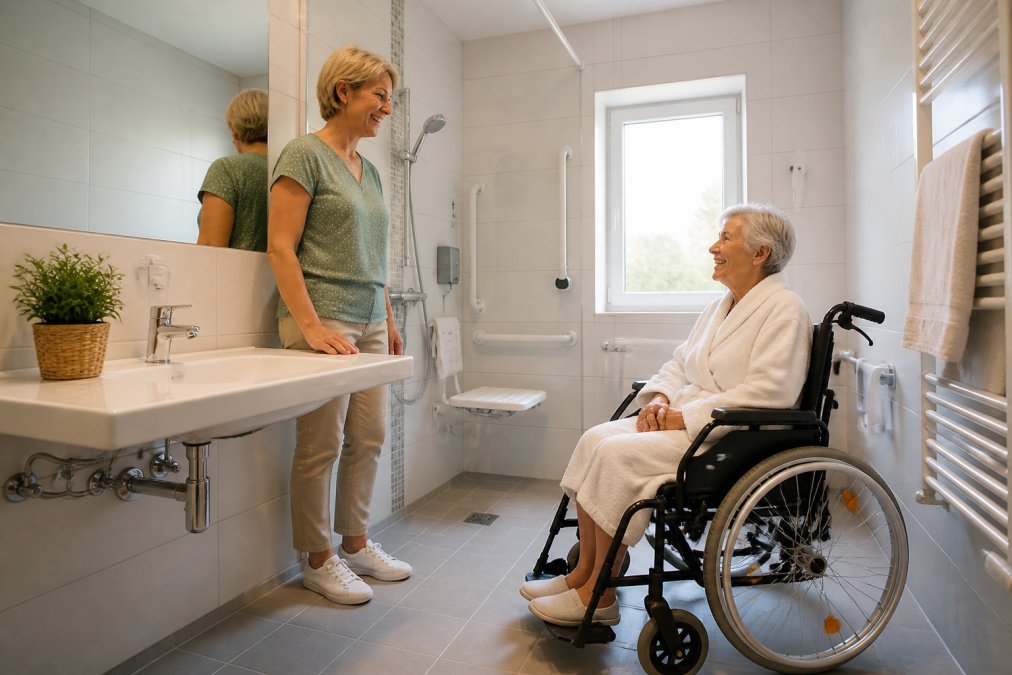
Bathroom: Grab bars, shower seat, and wheelchair-accessible sink
The bathroom is the most critical room. It's where you can really tell if a place has been well thought out.
- Handrails: They should be installed next to the toilet and in the shower, securely mounted and at the appropriate height.
- Shower seat: A folding seat in the floor-level shower makes it possible to bathe without assistance.
- Wheelchair-accessible sink: Without a siphon in the way, a wheelchair can be wheeled right up to the sink.
- Floor-level shower area: A threshold of just a few centimeters is enough to make it impossible to use.
Also check to make sure light switches and faucets are within easy reach. What may seem obvious in the catalog is often too high or too far away in real life.
Ask for photos, not just promises. A picture of the shower threshold and the toilet area says more than any description. If someone doesn't send photos, there's usually a reason.
Accessible Accommodations Checklist: Questions to Ask Before Booking
A checklist for accessible accommodations helps prevent the most common disappointment: arriving to find a step that nobody mentioned. Go through the items on the checklist before every booking.
- Is the entrance to the apartment completely at ground level?
- How wide are the doors at their clear opening?
- Are there grab bars in the restroom and shower area?
- Is the shower floor-level and equipped with a shower seat?
- Is there room to get under the sink?
- How much space is left next to the bed for moving around?
- Are the kitchen and living area accessible by wheelchair?
- Is there parking available right next to the building?
| Area | What to Look For | Why It Matters |
|---|---|---|
| Access | At ground level, no steps | Independent Arrival |
| Doors | Clear width | Getting by without help |
| Bathroom | Grab bars, shower seat | Safety in Personal Hygiene |
| Sink | Wheelchair-accessible | Reachability While Seated |
| Bedroom | Activity Area | Maneuvering Around the Bed |
| Kitchen | Accessible work surfaces | Self-sufficiency |
This overview isn't a substitute for a conversation, but it helps structure it. Check off each item before you agree.
Identifying and Correctly Classifying Certified Accommodations
Being certified does not automatically mean it is suitable. A certificate confirms that an accommodation meets defined quality criteria, but not that it is suitable for your specific mobility limitations. The difference lies in which criteria were assessed, who conducted the assessment, and when.
What a certificate typically covers—and what it doesn't
Most accessibility certifications in the tourism industry are based on a fixed list of criteria. Common criteria include:
- Step-free access to the building and the residential unit
- clear door widths, usually in specified minimum dimensions
- Clear spaces in the bathroom and next to the bed
- Grab bars, walk-in shower, wheelchair-accessible sink
- Accessible switches, faucets, and kitchen countertops
What is often missing from such inspections, however, is whether the space is actually usable given your specific disability. A certificate says nothing about whether the maneuvering space is sufficient for your type of wheelchair, whether the handrails are at a height you can reach, or whether the path from the parking lot to your apartment door is truly paved all the way through.
Three Questions That Make a Certificate Meaningful
- What criteria were evaluated? Ask to see the list of features, not just the logo. If it simply says ‚accessible‘ without any details, that proof isn’t worth much.
- Who did the review? An independent agency with a published list of criteria is more reliable than a self-assessment by the landlord.
- When was the last inspection? Specifications change. A certificate without a date says nothing about the current condition.
The List of Criteria for Accessible Construction Austrian building codes provide a good guide to the general requirements for accessible buildings. Compare these standards with the information provided by the accommodation—and with the specific dimensions you need.
A certificate without a date is worthless. Equipment changes, handrails are removed, and modifications are taken down. Always ask when the last inspection took place.
Certificate plus interview: the winning combination
It makes sense to combine both: proof of verified criteria and a personal discussion about your specific needs. Don’t rely solely on a logo. A certificate answers the question, ‚Does the accommodation meet defined standards?‘ It does not answer the question, ‚Can I use this apartment independently?‘ You can only clarify this second question through direct contact—preferably in writing, requesting confirmation of the dimensions that are crucial for you.
Accessible Attractions in the Waldviertel for Your Vacation
There are more accessible tourist destinations in the Waldviertel than many people expect. The region is gentle, green, and surprisingly accessible—if you know the right places.
The Lake Edlesberg is located near Gutenbrunn and features flat paths along the riverbanks that are accessible by wheelchair. Many hiking and biking trails in the Waldviertel also follow former railroad right-of-ways and are therefore almost entirely flat. This makes them attractive to visitors with limited mobility.
Ask your lodging provider for specific routes. Anyone familiar with the region knows which paths are actually passable and which ones only appear flat on paper.
Accessible Travel and Mobility on Site
The trip itself is the most commonly underestimated part of vacation planning. If you don’t realize until you arrive that the train platform isn’t accessible without steps, you’re in for a problem. Almost all guidebooks list accommodations but leave this point out—yet it can make or break your entire vacation.
Traveling by Train: Register for Assistance Early
The Passenger Information on Accessible Travel Austrian Federal Railways provides information about assistance services and accessible train stations. Two points are crucial here:
- Advance registration: Assistance with boarding, alighting, and transferring must generally be requested in advance—not once you're on the platform. Plan for this when you make your reservation, not afterward.
- Check the station, not just the route: A train with no stops does not indicate the destination station. For each transfer, check separately whether the platform is accessible by elevator or ramp.
From the train station to your lodging
The final leg of the journey is often the most difficult. Three realistic options:
- Pickup by the accommodation: When making your reservation, ask if a shuttle or pickup service is available. This is the most reliable option because the hosts know the route.
- Accessible Taxi: Not every taxi company has a wheelchair-accessible vehicle. Be sure to ask specifically for vehicles with a ramp or lift, and make a reservation in advance.
- Personal car: It offers the greatest independence and is often the most practical choice in rural areas. Make sure to check whether the parking space is right next to the house and whether the path from there to the front door is paved throughout and has no steps.
Local Mobility: Realistically Assessing Distances
In the Waldviertel region, the most beautiful spots are often off the main roads. This means that without a car, the distances to tourist destinations can quickly become long, and public transportation is limited. If you’re traveling without a car, you should check the following in advance:
- How far is the nearest town with shopping?
- Is there an accessible route to the nearest destination?
- Does the lodging provide assistance with organizing transportation?
Ask your lodging provider for specific routes and distances. Anyone familiar with the region knows which paths are actually passable and which ones only appear flat on paper.
How you get there sets the tone for your entire vacation. If you plan your trip to be accessible—by arranging train assistance, figuring out the last leg of your journey, and realistically assessing distances—you’ll enjoy freedom once you arrive. If you ignore these details, you’ll lose that freedom on the very first day.
The Booking Request: How to Ask the Right Questions
A good booking request is specific, in writing, and includes a request for confirmation. That way, you'll have something to refer to later if the information is incorrect.
Phrase your questions so that they cannot be answered with a simple „yes“ or „no.“ Instead of asking, „Is the apartment accessible?“ ask: „How wide is the clear opening of the bathroom door, and are there any steps between the apartment entrance and the bedroom?“
Template for your booking request:
Hello,
We are planning a stay from [date] to [date] and will be traveling with a wheelchair. Please confirm the following in writing:
- Access to the apartment is step-free and at ground level.
- The clear door width is at least [your measurement] centimeters.
- The bathroom is equipped with grab bars, a shower seat, and an accessible sink.
- There is a clear space of [your measurement] centimeters next to the bed.
- There is a parking space right next to the house.
Thank you very much for your feedback.
If you ask specific questions, you'll get honest answers. If you ask general questions, you'll get general assurances that are worthless in practice.
Use reviews to find a vacation rental in the Waldviertel
Reviews from other guests are the best way to supplement your own research. They show how a place to stay actually works in practice, not just in the description.
Look specifically for reviews from guests with similar needs. Pay attention to specific details: Was the door width mentioned? What was the interaction with the hosts like? Were there any problems, and how were they resolved?
Personal attention from the hosts and a quiet location near the Lake Edlesberg are important factors. Booking directly with the hosts means you’re talking to the people who are actually there, not a call center.
The guide to accessible tourism published by the relevant ministry outlines the standards that apply to accessible services. Use such resources as a framework and personal feedback as a concrete basis.
Finding a vacation rental in the Waldviertel ultimately comes down to balancing different factors: checking certifications, requesting photos, asking specific questions, and listening to others’ experiences.
Finding the right accommodations takes time, and that’s exactly where most people fall short. If you rely on vague promises, you’ll end up at a dead end. Contact us directly, tell us what you’re looking for, and we’ll confirm in writing exactly what you’ll find.
Frequently Asked Questions
What criteria make a vacation rental truly accessible?
A vacation rental is considered accessible if it can be entered without steps, the doors are at least 80 centimeters wide, and there is sufficient space to move around in the bathroom and kitchen. This includes grab bars, a shower seat, and a wheelchair-accessible sink. Before booking, ask for these specific measurements instead of relying on general descriptions such as ‚wheelchair-accessible.‘.
How can I check the accessibility of a place to stay before booking?
Use an accessible housing checklist and ask specific questions about door widths, clearances, and bathroom amenities. Ask for recent photos of the entrance, bathroom, and bedroom. A personal conversation with the hosts is often more helpful than a standardized platform description, as it allows you to address your individual needs.
Are there any specific certifications for accessible accommodations in the Waldviertel region?
In Austria, there are various quality criteria and certifications for accessible accommodations, which are awarded by tourism associations and advocacy groups. Look for official labels and ask the accommodation provider which criteria are met. A certification is a good starting point, but it does not replace asking specific questions about door widths and amenities.
What should couples look for when choosing an accessible vacation rental?
In addition to accessibility, couples should look for a quiet location, a well-equipped kitchen, and a comfortable bedroom. If one person has limited mobility, make sure that both can comfortably use the living area and the bathroom. The surrounding area also plays a role: accessible attractions in the Waldviertel region and short distances to the nearest town make for a more enjoyable stay.
Comments are closed, but trackbacks and pingbacks are open.