


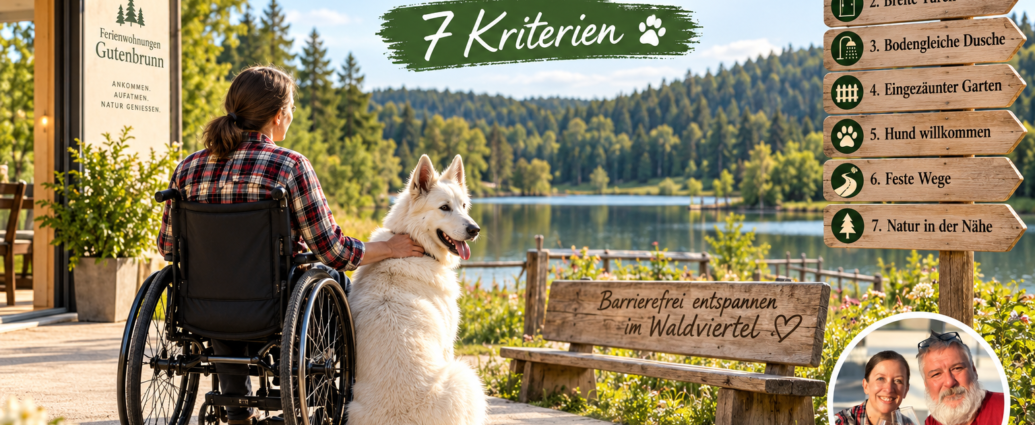
Finding accommodations that are suitable for both wheelchair users and their four-legged companions is often like looking for the proverbial needle in a haystack. Many providers advertise their facilities as „accessible,“ but by that they simply mean one fewer step at the entrance. A truly Barrier-free vacation apartment in the Waldviertel Finding a place to stay with a dog requires specific questions and clear criteria. In this guide from Vacation Rentals Gutenbrunn We'll show you what's important when planning so that the vacation is a relaxing experience for everyone involved.
An accessible vacation rental is a place to stay that is designed so that people with limited mobility can use it without assistance. This includes step-free access, doors that are wide enough, and a bathroom that can be used without restriction. In our experience, the actual quality varies greatly. The following sections highlight the details that make a difference and explain how you can avoid unpleasant surprises once you arrive.
What Really Makes a Vacation Rental Accessible
The term „accessible“ is not a protected term in Austria and is often used quite broadly (oesterreich.gv.at). To make a reliable assessment, you should not rely on marketing claims but instead look for specific features. What matters most is the accessibility of the entire apartment—not just individual rooms—and the ability to use all facilities without assistance. A residence that is only on the ground floor wheelchair accessible ...but since the bedroom is upstairs, it does not meet the criteria.
Plan your trip with a clear list of priorities. Compare your own needs with the host’s descriptions. Ask specific questions about the clear width of the doorways, the height of the beds, and the exact layout of the shower area. An open conversation with the host before booking prevents most disappointments. Many hosts who take this matter seriously will answer such questions in detail and honestly.
A Detailed Look at the Features of Accessible Vacation Rentals
The features of accessible vacation rentals determine the level of comfort and independence during a stay. In the bathroom, a walk-in shower with level access is the most important feature. A shower stool or folding seat, as well as a grab bar within easy reach, significantly increase safety. The height of the sink and the toilet seat also plays a major role in daily use.
In the living and sleeping areas, sufficient space for wheelchair maneuvering is crucial. A turning circle with a diameter of at least 150 centimeters allows for independent maneuvering. Beds should have an appropriate entry height, and access to the balcony or patio must be possible without steps. A wheelchair-accessible outdoor area is especially valuable if you with a dog travel, since it offers safe and easy access to nature.
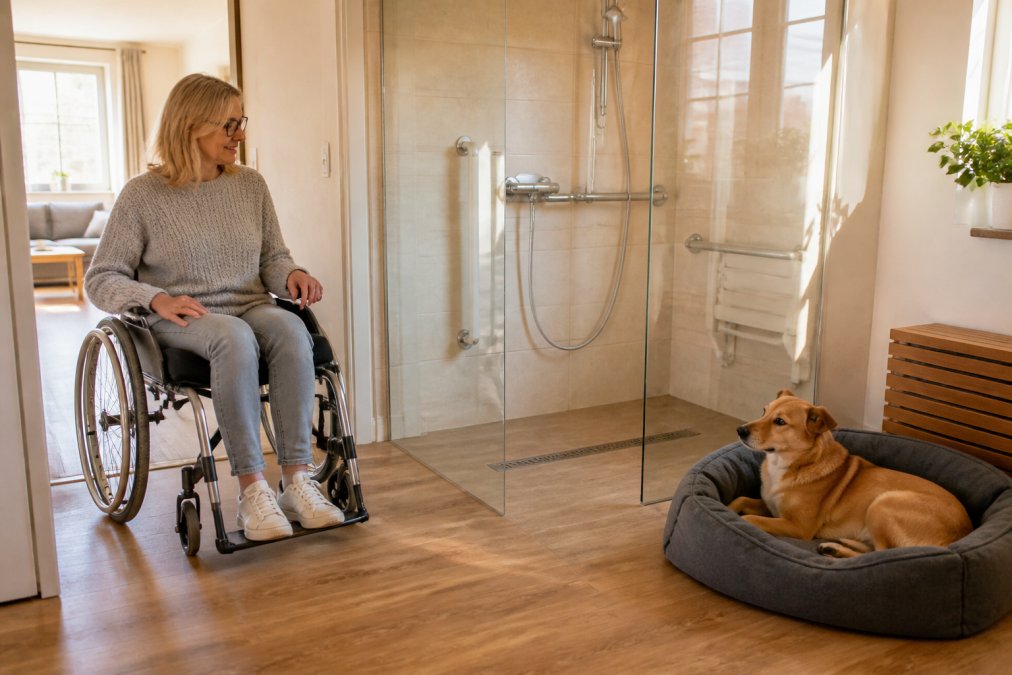
Checklist for Vacationing with Your Dog: Questions to Ask the Host
Most checklists online ask about a „fenced-in yard“ and a „dog bed.“ But if you use a wheelchair, there are entirely different considerations to take into account. A fenced-in yard is of little use to you if it’s only accessible via stairs or if the ground is covered in loose gravel. This checklist combines your dog’s needs with your mobility requirements—a combination you won’t find on any booking portal.
Questions about the accessibility of the outdoor area:
- Is the garden accessible from the living area without any steps? A patio door with a threshold higher than 2 centimeters can already be an obstacle for a wheelchair. Ask about the exact threshold height.
- What kind of flooring is in the fenced-in area? Paved surfaces or grass are ideal. Plain gravel or bark mulch is unsuitable for wheelchair tires—they’ll get stuck or won’t be able to move forward.
- How tall is the fence? For a large, jumpy dog, 120 centimeters isn't enough. Ask about the exact height and whether the fence reaches all the way to the ground so the dog can't slip underneath it.
- Is there a sheltered area in the garden? A covered area or a sheltered spot is important so that your dog can be outside when it rains without you having to push the wheelchair through the mud.
Questions about keeping dogs in an apartment:
- Are dog beds or blankets provided, or do you need to bring your own? If you bring your own, make sure they aren't in the way—a small basket in the hallway can be an obstacle for a wheelchair.
- Is there a non-slip mat for food and water bowls? Bowls can easily slide on smooth floors. Ask if the host can provide a non-slip mat.
- Where is the dog allowed to go? Is the bedroom off-limits? If you need to get up at night and the dog is sleeping in the living room, you need to be able to leave the door open—which can sometimes be difficult with a wheelchair. Ask if there’s a doorstop solution available.
The crucial question that no one asks:
„Is there an emergency plan for the dog in case I need help myself?“ If you’re traveling alone with your dog and have health issues while on vacation, who will take care of the dog? Ask your host if they can contact a veterinarian or look after the dog in an emergency. A good host will be receptive to this—and asking this question shows that you’re planning responsibly.
Additional questions about nearby walking trails:
- Is there a paved path leading from the front door? A paved dirt road or an asphalt bike path nearby is worth its weight in gold for the daily dog walk.
- Where is the nearest dog park or off-leash area? In the Waldviertel There are few official dog-friendly areas, but plenty of quiet country roads. Ask your host for a personal recommendation for a route you can manage in a wheelchair.
- Is there a veterinarian nearby with ground-level access? Not every doctor's office is accessible. Be sure to ask specifically whether the office can be reached without steps—this is crucial in an emergency.
Ask for written answers to the most important questions—via email or in the booking confirmation. Verbal promises made over the phone are difficult to prove if problems arise on site.
A hands-on test before booking:
Ask the host for a short video of the entrance area, the garden, and the path to the nearest street. A 30-second video tells you more than ten photos ever could. Many hosts are willing to do this if you explain that you use a wheelchair. This way, you can see right away whether the path to the garden is truly step-free and whether the fence looks sturdy enough.
Accessible Hiking Trails in the Waldviertel for People and Dogs
The Waldviertel is one of Austria’s most unspoiled regions, but not every hiking trail is wheelchair-accessible. Here, we’ll show you how to plan a trip with both a wheelchair and a dog. It’s not just the surface that matters—the width of the trail is also crucial to give your dog enough room to maneuver and to safely pass oncoming hikers.
The most important criteria for a wheelchair-accessible path:
- Surface: Asphalt or a water-bound surface (fine, compacted gravel) are ideal. Coarse gravel, tree roots, or soft forest floors are unsuitable, as the wheelchair may sink into them or get stuck.
- Longitudinal slope: A maximum gradient of 6 percent over short distances. Check with the local municipality or tourism office for exact gradient information.
- Cross-slope: Often overlooked, but critical: A path with a steep cross-slope pulls the wheelchair to one side. Paths with a cross-slope of less than 2 percent are ideal.
- Path width: At least 120 centimeters, so that a wheelchair and a dog (on a leash) can easily fit side by side. Narrow paths with dense vegetation are stressful for both people and animals.
- Places to take a break: Benches with armrests and enough space next to them so that a wheelchair can be parked there without blocking the path.
Specific routes that have proven to be suitable for wheelchairs and dogs:
- Around the Lake Edlesberg: The trails are mostly flat and have a water-bound surface. The loop is about 3.5 kilometers long and winds through peaceful surroundings. There are several shallow spots where dogs can enter the water. Please note: It can get busier on weekends during peak season—be sure to bring a muzzle for your dog if he doesn’t get along well with other Dogs responds.
- The Buchenweg trail near Bad Großpertholz: A loop trail about 2 kilometers long with a slight elevation gain and a solid surface. The trail is wide enough to allow people to pass each other and winds through an old beech forest that provides shade even on hot days.
- The Nature Trail in Heidenreichstein: This path is partially paved and leads past some ponds. The loop is short (about 1.5 km), but ideal for a first walk after arriving. Dog owners should note that there are many waterfowl near the ponds—your dog should be able to come when called.
- The Thaya Loop near Hardegg: In the Thayatal National Park, there is a wheelchair-accessible section along the Thaya River. The surface is firm, and the route is relatively flat. The national park requires that dogs be kept on a leash—this is especially important here because wild animals live in the area.
A unique tip for wheelchair users with dogs:
A dog walking on a leash alongside a wheelchair needs training. Many dogs instinctively run ahead or cut across the wheelchair’s path. Before your trip, practice walking on a leash right next to the wheelchair without pulling. A harness with a handle (such as a „dog-leading harness“) gives you more control in case the dog spots something. Also, plan to take a break every 20 to 30 minutes—not just for the dog, but also for your arms, which are put under greater strain when traveling over uneven terrain.
Use the free „Waldviertel mobil“ app or the tourism association’s website to check for current trail closures and construction zones. Especially after heavy rain, dirt trails can become temporarily impassable.
Another aspect that many people forget: getting to the trail itself. Not every parking spot is wheelchair-accessible. Check with the local municipality or a nearby inn to see if there’s a wheelchair-accessible parking spot available. Often, there’s a separate disabled parking spot right along the trail that isn’t marked on standard maps. maintain high hygiene standards.
Technical Specifications: What Wheelchair Users Should Look For
For wheelchair users, technical specifications often determine whether an apartment is actually usable. The clear door width should be at least 80 centimeters to allow a standard wheelchair to pass through without difficulty (ada.gov). If in doubt, measure the width of your own wheelchair and compare it to the host's specifications. The width of the hallways and the space between pieces of furniture are also critical factors that are rarely apparent in photos.
The threshold to the balcony or patio is a common tripping hazard. An absolutely level surface without a step is ideal. If there is a ramp, ask about its slope and length. A ramp with a gradient of more than six percent is often too steep for independent use in a wheelchair. Also ask about the height of the light switches, electrical outlets, and the kitchen countertop. A lodging provider that is aware of these details and communicates them openly is generally the more reliable choice.
When making a reservation, pay close attention to the exact description of the accessibility features. A „wheelchair-accessible“ apartment has stricter requirements than one described as „barrier-free“ or „senior-friendly.“ You should not make a reservation without specific measurements for doors, showers, and ramps.
Emergency Services: Doctors, Pharmacies, and Veterinarians Nearby
Proper preparation also includes finding out about the local emergency services. Before you arrive, find out which nearby doctors’ offices are wheelchair-accessible and check the opening hours of pharmacies. In the rural Waldviertel region, distances are often greater than in the city, and not every doctor’s office is accessible. A phone call in advance will clarify whether a house call is possible or if the office offers step-free access.
For your dog, having access to a veterinarian is just as important. Keep the phone number of a nearby veterinary clinic handy and find out if they offer emergency services. Many veterinarians in the area offer house calls, which makes the situation much less stressful. Keep the most important numbers handy and let your host know if you have any special medical needs. A well-informed host can help more quickly in an emergency and put you in touch with the right people.
Reviews: Here's How Other Guests' Vacations Went
Reviews from guests with similar needs are a valuable source of information. Look specifically for reviews that mention both accessibility and dog-friendliness. Pay attention to specific details: Was the walk-in shower praised? Was the fenced-in yard truly safe? Such specific details are more meaningful than general praise.
Don’t hesitate to ask the host directly for contact information for previous guests who used a wheelchair or brought a dog. Many hosts who prioritize accessibility themselves are happy to provide such contacts. A personal conversation with someone who has already stayed there will give you a realistic picture. Ask about the actual conditions that aren’t visible in photos, such as the condition of the driveway or how noisy the surroundings are.
Finding the Right Accommodation: Here's How to Go About It
The search for the right place to live should be approached in a structured way to save time and avoid disappointment. Start by making a list of your non-negotiable criteria. These include barrier-free access to the apartment, a walk-in shower, and a fenced-in outdoor area for your dog. Distinguish between “must-have” and “nice-to-have” criteria to narrow down your options. Then contact the hosts directly by phone or email and present your checklist with specific questions.
A face-to-face conversation is often more informative than email correspondence. Listen carefully to how confidently and thoroughly the host answers your questions. At Ferienwohnungen Gutenbrunn, we value the personal attention provided by our hosts, Anna & Herbert, who know the region and its surroundings inside and out. Booking directly with the hosts allows you to discuss your individual requests right away. The quiet location near Lake Edlesberg offers the ideal starting point for a relaxing vacation.
Book directly with the host rather than through a booking site. You’ll often get valuable, local tips that aren’t in any travel guide. A personal phone call before booking clears up any questions about accessibility faster than any email exchange.
Conclusion: Find an accessible vacation rental in the Waldviertel region that allows dogs
Finding an accessible vacation rental in the Waldviertel where dogs are welcome is a challenge that can be overcome with the right preparation. The key is to ask specific questions about technical details, honestly assess your own needs, and be willing to communicate directly with the host. The combination of architectural accessibility and genuine dog-friendliness is rare, but it does exist. If you work through the seven criteria presented here, you’ll significantly increase your chances of having a truly relaxing vacation.
The Waldviertel region rewards well-prepared guests with peace and quiet, nature, and a level of hospitality that’s often missing in tourist hubs. The personalized attention you receive when booking directly with the hosts at Ferienwohnungen Gutenbrunn makes all the difference. Our four accessible apartments, each with a kitchen-living room and bedrooms, offer families, wheelchair users, and dog owners a place to settle in and relax. Start planning early, ask the right questions, and look forward to a break free from time pressures in one of Austria’s most beautiful natural landscapes.
Planning an accessible vacation with your dog requires careful planning, but it’s well worth the effort. Ferienwohnungen Gutenbrunn combines wheelchair-accessible amenities with warm hospitality and a location that allows both people and pets to enjoy nature. Enjoy the personalized service provided by Anna & Herbert and the central location, perfect for exploring the region. Book directly with Ferienwohnungen Gutenbrunn and experience a vacation that meets everyone’s needs.
Frequently Asked Questions
What makes a vacation rental truly accessible?
A vacation rental is truly accessible if it can be reached without steps and all rooms are accessible without thresholds. Key features include a door width of at least 80 centimeters, a floor-level shower with a shower stool or seating, a wheelchair-accessible sink, and a toilet accessible from the side. Always ask for the specific dimensions—don’t just rely on the ‚accessible‘ label. An elevator on the ground floor isn’t necessary, but the apartment should be accessible directly from the parking lot.
How do I prepare my dog for a vacation in a vacation rental?
Get your dog used to the carrier or the car in advance if the trip will take a while. Pack familiar items such as a blanket, food and water bowls, and a favorite toy. Before booking, check whether the outdoor area is securely fenced and where you can take your dog for walks nearby. On the day of arrival, allow for a gradual adjustment period and let your dog explore the new home at its own pace before you go out to explore the area.
Which attractions in the Waldviertel are suitable for wheelchair users and dogs?
Many attractions in the Waldviertel are accessible to wheelchair users and dogs. Lake Edlesberg features a well-maintained loop trail that is also wheelchair-accessible. Numerous restaurants with outdoor seating welcome guests with dogs. When looking for accommodations, be sure to ask specifically about accessible hiking trails in the area, as not all nature trails are wheelchair-accessible. Your host knows the region well and can provide you with up-to-date recommendations.
Are there any legal standards for accessibility in vacation rentals?
In Austria, the Federal Act on Equal Treatment of Persons with Disabilities applies; however, it does not specify any concrete structural standards for vacation rentals. The Austrian Ecolabel and the ‚Travel for All‘ certification define clear criteria for accessibility. Many establishments describe themselves as ‚accessible‘ without meeting these standards. Therefore, always ask about specific features such as door width, showers, and access, rather than relying on the label.
Comments are closed, but trackbacks and pingbacks are open.