


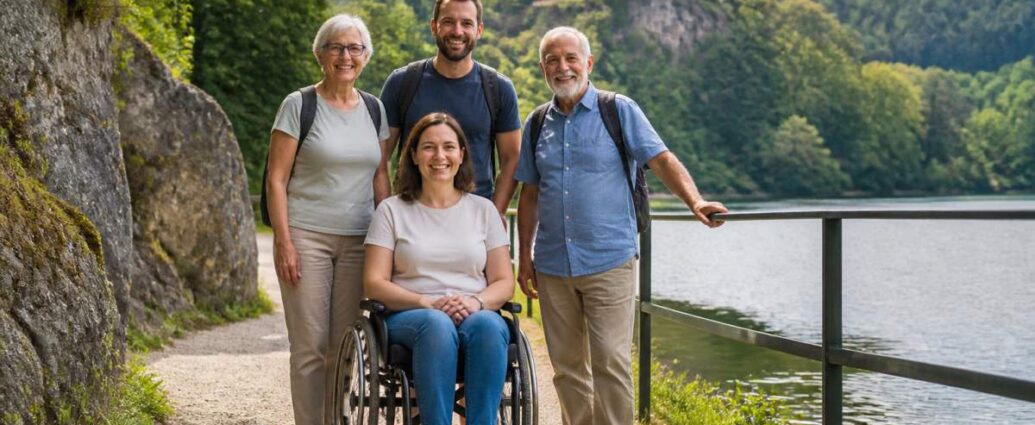
Table of Contents
- Accessible Nearby Attractions: What Really Matters
- Accessible Hiking Trails in Lower Austria: Wheelchair-Accessible Nature Trails
- Museums and cultural institutions with accessible entry
- Accessible Mountain Railways and Lifts: Up the Mountain in a Wheelchair
- Dining and Lodging for People with Mobility Impairments
- Directions and Parking: Public Transportation and Accessibility
- Certified Accessible Services: How to Identify Reliable Infrastructure
- Checklist for an Accessible Outing: Step-by-Step Preparation
- Conclusion: Plan accessible day trips nearby with ease
- Frequently Asked Questions
Last updated: October 2, 2026
Accessible Nearby Attractions: What Really Matters
An accessible destination is a place that a person in a wheelchair can reach, use, and leave without assistance. It sounds obvious. But it isn't.
Many businesses list „accessible“ on their websites simply because the entrance has a ramp. Nowhere does it mention that the door is 70 cm wide or that the restrooms are three steps down. That’s exactly why day trips fall through.
This Planning Guide for Vacation Rentals Gutenbrunn shows what really matters when it comes to accessible nearby destinations for wheelchair users. We’ve compiled the criteria that make a difference in practice: slope gradients, door widths, floor surfaces, and how to get reliable information before you arrive.
The good news: There are many wheelchair-accessible nature trails, museums, and mountain railways in Lower Austria and the Waldviertel. You just need to know how to check them out.
The Most Important Criteria for True Accessibility
If you're looking for a place to stay or a destination, don't just trust the word „accessible“—look for measurable information instead. These five points determine whether a trip will be relaxing or end in frustration:
- Door width: At least 80 cm, preferably 90 cm for an electric wheelchair
- Gradient: A gradient of less than 6 percent is considered flat and is suitable for year-round use
- Soil conditions: Paved, level, with no large gravel or roots
- Restroom facilities: Accessible at ground level, with handrails and a clear path
- Elevator or ramp: As an alternative to each individual step
A common misconception is the assumption that a „wheelchair-accessible“ hiking trail is automatically stroller-friendly. That’s usually true. But the reverse isn’t necessarily the case: a stroller-friendly trail may be too steep for a walker or wheelchair.
Before you arrive, ask for specific measurements, not general descriptions. „How wide is the door to the restroom?“ will get you a useful answer. „Is your facility accessible?“ will get you a „Yes, of course.“
Accessible Hiking Trails in Lower Austria: Wheelchair-Accessible Nature Trails
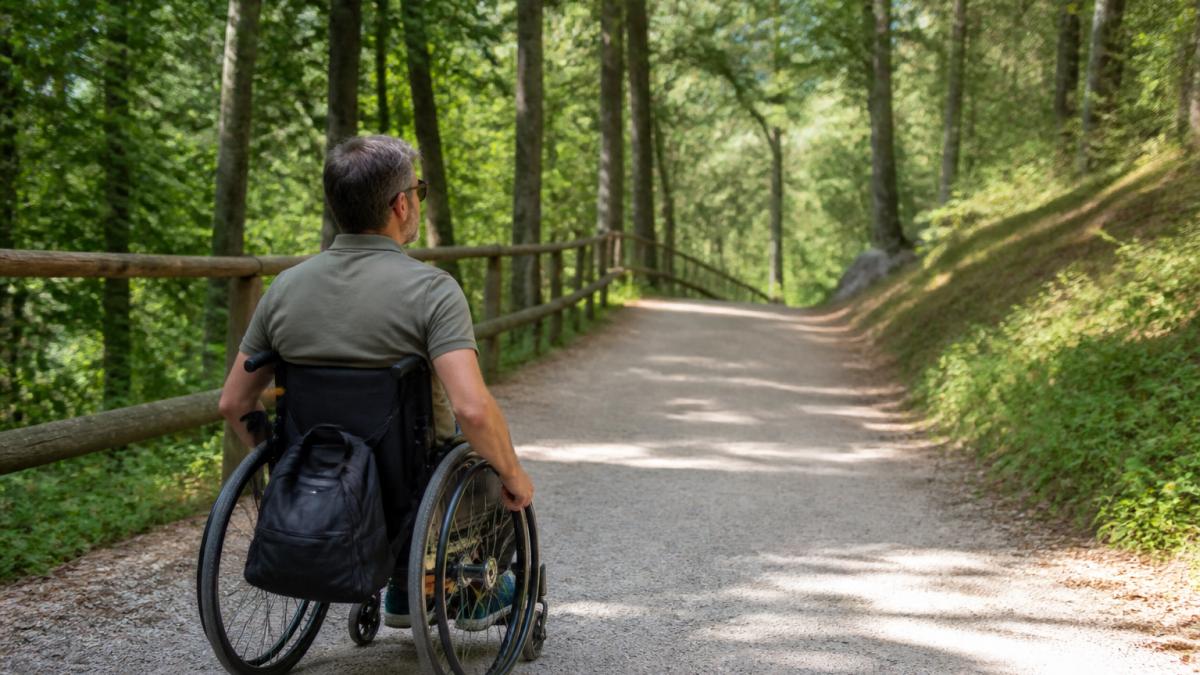
Lower Austria’s most beautiful accessible hiking trails are found where the ground is firm and the incline is gentle. The Waldviertel is well-suited for this because the landscape here is gently rolling rather than alpine. The key difference between a trail described as „wheelchair-accessible“ and one that actually is lies in measurable values. It is precisely these values that are missing from most official trail descriptions.
The Three Types of Roads Based on Grade
Classification by gradient is the most practical because it directly indicates whether a path is accessible without assistance:
- No incline (less than 6 percent): Can be driven on independently at all times, even over longer distances. This is roughly equivalent to the slope of a standard building access ramp.
- Moderately steep (6 to 10 percent): Feasible with assistance and breaks; usually no problem for electric wheelchairs, but strenuous for manual wheelchairs.
- Steep (over 10 percent): Not suitable for wheelchair users without assistance. Additionally, there is a risk of tipping downhill at slopes steeper than 12 percent.
A common mistake is to check only the outbound leg. A path that’s easy going downhill can become a challenge going uphill. Therefore, always check the gradient in both directions and expect the return trip to be the more strenuous part.
Flooring: The Underestimated Factor
It's not just the incline that matters, but also the surface you're riding on. The following surfaces are listed in order of suitability:
- Asphalt and Concrete: Best suited for the job, low rolling resistance, stable even in wet conditions
- Solid, compacted gravel (grain size up to about 8 mm): well suited when the top layer is compacted
- Wooden Slats and Crossbars: Well-suited, but be mindful of the gap width (narrow rolls can get caught)
- Loose pebbles and coarse gravel: Unsuitable; the wheelchair sinks and becomes difficult to steer
- Meadow, sand, and forest floor with roots: unsuitable, especially after rain
Root protrusions are the most common reason why a forest trail that is otherwise flat becomes impassable for wheelchairs. They are rarely marked on maps and can only be reliably assessed on-site or through firsthand accounts.
Width, turning areas, and rest areas
In addition to the surface material, the following dimensions are important for actual usability:
- Path width: At least 120 cm for two-way traffic; 150 cm is better so that two wheelchairs can pass each other
- Turning areas: at scenic overlooks and at the end of the trail, at least 150 × 150 cm
- Rest areas: Benches with armrests and a flat surface next to them where a wheelchair can be placed
- Passages and Gates: often the narrowest part of the path, frequently less than 90 cm wide
How to Check a Route Before You Travel
The tourist infrastructure in the Waldviertel is well-signposted, and visitor information centers usually provide details about ground conditions. However, don’t rely on just one source. The following sequence has proven effective:
- Check the official directions: Is there any information about the slope (in percent) and the flooring? If not, the description is incomplete.
- Call to inquire: Ask about the steepest section (in percent) and the surface of the last 500 meters before the finish line.
- Search for reviews: Reports from other wheelchair users reveal exposed tree roots and narrow passages that are not mentioned in official descriptions.
- Quick test: Plan a shorter route and check the most challenging section first.
Don't ask, „Is the path wheelchair-accessible?“ but rather, „What is the percentage grade of the steepest section, and what is the ground like there?“ Only the second question will yield a useful answer.
If you follow these four steps, you'll avoid the most common pitfalls. The journey is often the harder part of the trip, not the destination.
Museums and cultural institutions with accessible entry
Cultural institutions are often better equipped than their reputation suggests. Many museums in the region offer ground-level entrances, elevators, and wheelchair-accessible restrooms. The challenge lies not in the building itself, but in the information provided.
Call ahead of your visit and ask about three things: the width of the door at the main entrance, accessibility to the exhibition halls, and the location of the accessible restroom. These three pieces of information cover most issues.
A quick check at the visitor information desk has proven to be very helpful. Many venues provide a map showing the accessible routes through the building upon request. This saves a lot of time searching once you’re there.
Don't just rely on the statement „Elevator available.“ Ask whether the elevator goes to all exhibition levels. In older buildings, the elevator sometimes only goes as far as the first floor, while the special exhibition is located in the basement.
Accessible Mountain Railways and Lifts: Up the Mountain in a Wheelchair
Mountain railways and lifts are accessible to wheelchair users if they have low-floor entry or a ramp. Many railways in Lower Austria have adapted their cabins and entrances accordingly.
The crucial moment is the transfer. Ask in advance whether the staff will help you get on and off and whether the cabin can be stopped during the ride. With gondola lifts, getting on at ground level is usually no problem. With chairlifts, it’s more difficult because you have to transfer.
Here are the guidelines for a trip up the mountain:
- Introduction: Low-floor or with a ramp, no steps
- Cabin: Space for a wheelchair and one accompanying person
- Upper Station: Ground-level exit and paved path to the lookout point
- Staff: Keeping you informed in advance and helping you make the switch
Those who use the mountain railway can often reach scenic overlooks with little effort—viewpoints that would otherwise be accessible only via steep hiking trails. This makes it one of the best recreational options for guests with limited mobility.
Dining and Lodging for People with Mobility Impairments
When it comes to restaurants and lodging, it's not the amenities that matter, but accessibility. A restaurant with excellent cuisine is of no use if the entrance has three steps and the restroom is on the first floor.
When making a reservation, ask about the entire route: from the parking lot, through the entrance, to the table, and to the restrooms. Establishments that answer this question confidently are usually well-prepared.
For a stay lasting several days, there’s more to consider than just the entrance. A vacation rental should be accessible at ground level, have a walk-in shower, and offer enough space to move around in the kitchen and bedroom. That’s exactly what the four apartments at Ferienwohnungen Gutenbrunn are designed for: barrier-free and wheelchair accessible, with personalized assistance from Anna and Herbert, who know the region well and can offer specific tips on wheelchair-accessible routes.
Accessible Restrooms: The Underestimated Planning Tool
Accessible restrooms are the point where most outings fall apart. That's why the restroom issue should be addressed right at the beginning of the planning process, not at the end.
Look for these characteristics:
- Ground-level access without steps or thresholds
- Door width at least 80 cm wide, opening outward
- Handrails to the left and right of the restroom
- Activity Area at least 150 cm in front of the toilet
- Emergency Call System or available assistance
A practical planning tip is to look up accessible restrooms along your planned route. Knowing where the nearest suitable restroom is makes planning much less stressful. Many tourist regions provide lists of such facilities.
Directions and Parking: Public Transportation and Accessibility
The journey often determines whether a trip is even feasible. No matter how well-equipped a destination may be, it remains inaccessible if the path to it involves stairs.
If you're coming by car, you'll need a parking space that's wide enough and has a ramp leading directly to the entrance. A standard parking space isn't sufficient if there's a curb between your car and your destination.
When using public transportation, low-floor access is key. More and more train stations in the region are being made accessible, with elevators to the platforms and ramps to the trains. Check in advance to see if the station you’ve chosen is accessible without steps.
Low-floor vehicles and accessible train stations in the region
Low-floor vehicles allow passengers to board without having to step up. Many buses and trains in the region are already equipped with them. However, the train station itself must be compatible.
When you arrive, ask about three things:
- Platform height: Does it fit the vehicle, or is a ramp needed?
- Elevator: Does it serve every platform you use?
- Connection: Is the transfer at the destination station seamless?
Information about public transportation connections is one of the things often missing from many travel guides. If you check this information in advance, you’ll save yourself a lot of hassle on the day of your trip.
Certified Accessible Services: How to Identify Reliable Infrastructure
Certifications are useful when they reflect verifiable criteria. A general statement such as „accessible“ doesn’t say much. A certificate with clearly defined characteristics helps in making a selection.
Pay attention to the criteria behind a certification. Good certifications specify concrete details: door widths, slope gradients, floor conditions, and restroom facilities. If this information is missing, the certification is of little value.
| Criterion | What to Check | Why It Matters |
|---|---|---|
| Door width | At least 80 cm | Otherwise, the wheelchair won't fit through |
| Slope | Less than 6 percent | Permanently accessible by vehicle |
| Floor | Secured, level | No gravel, no roots |
| Plumbing | At ground level, with handles | Most Common Reason for Canceled Trips |
| Elevator | Complete all levels | Not just „available,“ but usable |
This table itself serves as a planning guide. If you review it before booking, you’ll quickly be able to tell whether an offer is truly accessible.
Checklist for an Accessible Outing: Step-by-Step Preparation
Good preparation takes the uncertainty out of a trip. This checklist will guide you from the planning stage right through to the day of the trip.
Before booking:
- Ask for the width of the entrance door
- Check the slope of the path or access route
- Determine the soil conditions
- Ask about the location and amenities of the restrooms
- Confirm parking lot with a ramp
- Check public transportation access
Before your arrival:
- Check the route for steps and curbs
- Confirm by phone that the destination is reachable
- Ask for assistance getting on the mountain railway or lift
- Write down the emergency number and contact person
On the day itself:
- Allow for some extra time; don't rush
- Use rest stops along the route
- If you have any problems, please report them directly to the staff
If you work through this checklist, you'll cover the most common pitfalls. A common mistake is to focus only on the goal and forget about the path to getting there. The path is often the harder part.
If you're looking for a place to stay that serves as a base for several excursions, Ferienwohnungen Gutenbrunn offers a quiet location in the Waldviertel region, just a short distance from natural highlights such as the Lake Edlesberg. The personal assistance provided by the hosts makes planning easier, because Anna and Herbert know the region and its trails.
Conclusion: Plan accessible day trips nearby with ease
Finding accessible destinations for wheelchair users nearby is less a matter of availability than of information. There are plenty of wheelchair-accessible trails, museums, mountain railways, and accommodations. The difference lies in whether you ask the right questions in advance.
Ask for numbers instead of features. Examine the process, not just the end result. And plan for plumbing from the very beginning. These three habits will make planning much easier.
If you're looking for an accessible vacation rental as a base for your excursions in the Waldviertel region, Ferienwohnungen Gutenbrunn is the right choice for you. The four wheelchair-accessible apartments feature a walk-in shower, a fully equipped kitchen-living room, and a quiet location close to nature. Vacation with Your Dog is also an option. Book directly with Anna and Herbert and start your getaway without the pressure of a schedule.
Frequently Asked Questions
How can I find accessible places to visit near me?
Use regional tourism portals that allow you to filter for accessible destinations, and check the information on door widths, ramps, and restroom facilities. Look for certifications such as the Austrian Seal of Quality for Accessibility. If in doubt, contact the visitor information center directly to ask for specific details—such as slope gradients or surface conditions—before you set out.
Are there wheelchair-accessible hiking trails in the Waldviertel?
Yes, there are several wheelchair-accessible hiking trails in the Waldviertel with paved, level, or gently sloping sections. Many nature trails are stroller-friendly and therefore also suitable for wheelchair users. Be sure to check in advance about the ground conditions and any potential obstacles, as not every trail is fully accessible throughout its entire length.
What should you keep in mind when planning an accessible outing?
Plan your trip using public transportation or by car, including accessible parking spaces. Check in advance the door widths, elevators, ramps, and accessible restrooms at your destination. A checklist will help ensure you don’t forget anything. Also consider opportunities for breaks and whether on-site dining options are accessible.
Are the vacation rentals in Gutenbrunn accessible to wheelchair users?
The Gutenbrunn vacation rentals are specifically designed to meet the needs of wheelchair users and people with limited mobility. They offer barrier-free and wheelchair-accessible amenities. For specific details on door widths, ramps, and restroom facilities, we recommend contacting the hosts, Anna and Herbert, directly to ensure that the accommodations meet your individual needs.


Comments are closed, but trackbacks and pingbacks are open.