


Table of Contents
- Why an accessible vacation rental is ideal for families with strollers
- Features of an Accessible Vacation Rental: What Really Matters
- Tips for Traveling with a Stroller: Arrive Relaxed and Enjoy Yourself
- Accessible Vacations with Toddlers: What Families Really Need
- Legal Standards vs. Convenience: What Accessibility Means in Austria
- A Comparison of Accommodation Types: Vacation Rental, Hotel, or Apartment
- Checklist for Booking an Accessible Vacation Rental
- Costs and Benefits: Why Accessibility Pays Off for Families
- Conclusion: Accessibility Benefits the Whole Family
- Frequently Asked Questions
Last updated: September 29, 2026
Why an accessible vacation rental is ideal for families with strollers
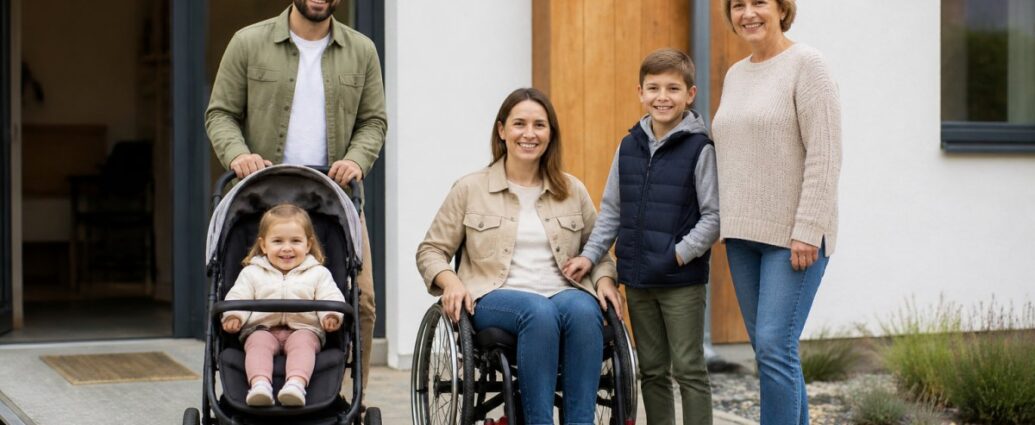
Anyone who travels with a stroller knows the problem: The apartment looks spacious in the photos, but when you get there, there’s a step at the entrance, and the door to the room is too narrow for the stroller. This is exactly where the true value of a accessible vacation rental: It's not only suitable for wheelchair users and people with limited mobility, but it also makes everyday life on vacation much easier for families with strollers. At Apartments Gutenbrunn In Gutenbrunn in the Waldviertel region, ground-level access and wide doors are therefore standard features, not the exception.
The difference lies in the details. An accessible vacation rental is a place to stay that can be reached without steps, has doors and clear spaces that are wide enough, and is designed so that it can be used independently even with a stroller, wheelchair, or walker. That may sound technical, but in practice it means one thing above all else: less lugging around, less maneuvering, and more travel comfort.
Accessibility isn't just a niche feature for a handful of guests. For families with strollers, it's the difference between a place to stay that works and one that requires a minor feat of strength every day.
Features of an Accessible Vacation Rental: What Really Matters
When furnishing an accessible vacation rental, three factors determine its actual comfort: door widths, thresholds, and level-entry access, as well as sufficient storage space for a stroller. If you check these points when booking, you’ll avoid the most common disappointment: an accommodation that promises accessibility only on paper.
Door widths, thresholds, and ground-level access
Door width is the first factor that matters in practice. A standard stroller is often 55 to 60 cm wide when folded, and when unfolded—with the side wheels and handle extended—it can easily reach 60 to 70 cm. A clear passage width of at least 80 cm—preferably 90 cm—is therefore the rule of thumb that parents should follow. However, many older apartments have a clear width of only 60 to 70 cm in the bathroom or bedroom—making it a real challenge to maneuver the stroller through those spaces.
In addition to sheer width, thresholds and ground-level access are key considerations. Even a threshold of just two to three centimeters at the entrance or between the living and sleeping areas makes pushing a stroller difficult, especially with a sleeping child in it. Accessible apartments that comply with the relevant ÖNORM guidelines are generally threshold-free or have a maximum height of two centimeters, so that wheelchairs and walkers can pass through without difficulty. For strollers, this very absence of thresholds is the key factor, as it eliminates the need to constantly lift and lower the stroller.
Another often-overlooked factor is the flooring. Smooth tiles or hardwood floors make it easy to push a stroller, whereas shag carpets or loose rugs slow down every movement. Asking about the flooring in advance helps you avoid an often-overlooked everyday pitfall.
Storage space for strollers and freedom of movement
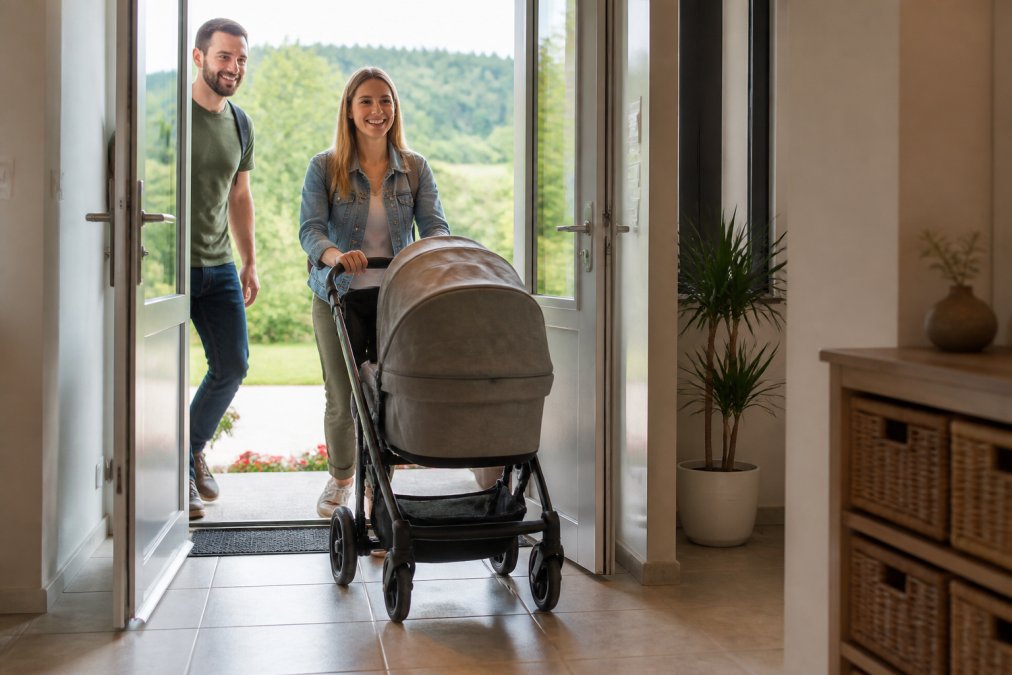
Storage space is the most underrated consideration. A stroller needs a designated spot where it won’t be in the way and won’t have to be folded up every time. The ideal solution is a covered, ground-level storage area right by the entrance or a spacious entryway with at least 1.5 square meters of floor space where the stroller can be left unfolded.
Combined with ample space to move around in the hallway, kitchen-diner, and bedroom, this results in a truly obstacle-free environment. As a general guideline, there should be at least 90 cm of clear space in front of cabinets, beds, and bathroom fixtures so that the wheelchair can also be turned sideways. In the kitchen-dining area, a clear space of about 120 x 120 cm in front of the stove and refrigerator is practical, since the wheelchair is often maneuvered there.
When making a reservation, be sure to ask not only about the door width, but also about the flooring and the size of the storage area. These three details combined tell you more about whether a place is actually stroller-friendly than the „accessible“ label does.
Why the standard alone is not enough
The legal and regulatory requirements for accessible construction are designed with wheelchair use and mobility impairments in mind. They guarantee the absence of thresholds and minimum widths, but say nothing about the things that matter to families with strollers: whether the stroller can be parked in its unfolded state, whether the flooring is easy to navigate with a stroller, or whether there is enough space in the bathroom to park the stroller next to the changing area. This is precisely where the difference lies between formal accessibility and true family comfort.
Tips for Traveling with a Stroller: Arrive Relaxed and Enjoy Yourself
The best tips for traveling with a stroller start with your travel preparations, not just upon arrival. If you figure out in advance how to get to your accommodations and where you can park the stroller, you’ll save yourself the stress that would otherwise arise right after a long trip.
- Before booking, ask about door widths, thresholds, and level access—don’t just rely on the term „accessible.“
- Find out where the stroller can be parked without blocking the hallway
- Plan for plenty of opportunities to take a break so that both the child and the parents can relax
- Hiking Trails and Attractions Check their accessibility in advance
- Check directly with the hosts instead of relying solely on the description
That last point, in particular, pays off. A quick, specific inquiry before your arrival clarifies more than even the most detailed list of amenities.
Accessible Vacations with Toddlers: What Families Really Need
An accessible vacation with a toddler works best when the accommodations offer both safety and freedom of movement. Families don’t need a particularly large apartment, but rather one where a crawling or walking child can move around safely and parents still have room to breathe.
In practice, this means: open-concept spaces without tripping hazards, a kitchen-dining area where the child can join in, and separate bedrooms for true privacy. Safety here means, above all, that there are no unnecessary obstacles in the way and that doors and entrances can be opened effortlessly. These practical considerations determine whether the vacation will be relaxing or turn into a constant vigil.
Legal Standards vs. Convenience: What Accessibility Means in Austria
Accessibility in Austria is more than just a matter of compliance with standards. Legal requirements define minimum standards for accessible construction, but there is often a significant difference between merely meeting these standards and providing genuine convenience for families with strollers. An entrance may be technically accessible yet still prove impractical for everyday use with a stroller.
That’s why it’s worth looking at the actual features rather than just the label. In Austria, the official guidelines for accessible construction are set forth, among other places, in the ÖNORM Guidelines for Accessible Construction as well as in the building codes issued by the Federal Ministry for Climate Protection, Environment, Energy, Mobility, Innovation, and Technology. Anyone looking for an overview can find comprehensive information on accessible travel and construction at barrierefrei.gv.at.
Don’t rely solely on the term „accessible.“ Ask specific questions about door widths, thresholds, and space to park a stroller. Otherwise, you’ll end up with a place that technically meets the standard but doesn’t offer real convenience when you’re out and about with a stroller.
A Comparison of Accommodation Types: Vacation Rental, Hotel, or Apartment
The type of lodging that best suits families with strollers depends on space requirements, opportunities for privacy, and independence. The following overview categorizes the three most common options based on the criteria that really matter in everyday life with a stroller.
| Type of Accommodation | Accessibility | Space for strollers | Withdrawal | Suitable for |
|---|---|---|---|---|
| Vacation Rental | Level-access design is easy to plan | Private parking space available | Separate bedrooms | Families with strollers, longer stays |
| Hotel | Often by elevator, sometimes by stairs | Mostly limited parking space | A room as the only place of refuge | Short stays, service requested |
| Apartment | Varies greatly depending on the provider | Often smaller areas | Partially available | Couples, short stays |
Vacation rentals usually offer families with strollers the greatest freedom of movement, because the kitchen-dining area, bedroom, and storage space can be used separately. Hotels excel in service, but often have limited space for strollers. Apartments fall somewhere in between and vary greatly depending on the provider.
Checklist for Booking an Accessible Vacation Rental
The most reliable way to make a reservation is to clarify the key points in writing beforehand. You can use this checklist directly when making your inquiry:
- Is the entrance to the apartment completely barrier-free and at ground level?
- How wide are the doors, especially the ones to the bedroom and bathroom?
- Is there a designated spot to park the stroller?
- Are the kitchen-dining area and the bedroom separate, providing a true place to retreat?
- Is the apartment safe for a toddler, with no tripping hazards or narrow passageways?
- How many people can fit in the apartment, and is there enough room to move around?
- Are there any accessible hiking trails and places to visit nearby?
- Is the booking made directly with the host, with a clear confirmation?
When booking, don't just ask if the apartment is accessible; also ask for specific details about the door width and where to park the stroller. Providers who can answer these questions immediately and precisely really know their apartment.
Costs and Benefits: Why Accessibility Pays Off for Families
Accessibility pays off for families in ways that can’t be expressed by a single number. The benefit lies in what is eliminated: no daily struggle with narrow doors, no detours around steps, no constantly folding up the stroller. These small conveniences add up over the course of an entire trip to significantly greater travel comfort and quality of life.
What Accessibility Actually Costs
A common misconception is that accessible accommodations are generally more expensive. In practice, the price of a vacation rental depends on its location, the season, its amenities, and the length of stay—not on its accessibility. Threshold-free entrances, wider doors, and walk-in showers are now standard in new construction and renovations and do not result in any additional cost passed on to guests. If you compare an accessible apartment with a non-accessible one of comparable location and size, you’ll often find no consistent price difference.
It tends to get more expensive because of the consequences of a lack of accessibility: If you have to improvise once you’re there, you might end up buying a second, lighter stroller, paying for luggage storage, or putting up with longer walks. These hidden costs don’t show up on any booking form, but they add up over the course of a stay.
The real benefit: stress factor instead of price
The biggest benefit isn't the money you save, but the stress you avoid. An apartment that's accessible without stairs and where the stroller has a designated spot noticeably changes your daily routine:
- Napping in the stroller works because you don't have to fold it up every time.
- The walk from the car to the apartment takes minutes instead of a quarter of an hour.
- It's possible to have dinner with a sleeping child in the stroller because there's enough room to move around in the kitchen-dining area.
- Trips can start without having to repack first, because the car is right there and ready to go.
These factors can’t be expressed in euros, but they determine whether a vacation is relaxing or turns into a never-ending logistical challenge. If you have a choice between two accommodations of similar cost, you shouldn’t base your decision solely on price, but rather on the specific amenities offered.
Accessibility is rarely a factor driving up prices, but it often helps reduce stress. The real cost-benefit analysis isn't based on the rental price, but on how much time for relaxation is actually left over each day of the vacation.
Planning certainty as a soft factor
Added to this is the peace of mind that comes with planning. If you know in advance that the accommodations are truly accessible, you won’t have to improvise once you’re there and can realistically plan outings, hikes, and rest periods. This peace of mind is especially valuable when traveling with a toddler, as it helps maintain a stable daily routine. You can get specific prices for the apartments at Ferienwohnungen Gutenbrunn directly from the hosts, Anna and Herbert, who are also happy to answer any questions you may have about accessibility in person.
Conclusion: Accessibility Benefits the Whole Family
An accessible vacation rental isn’t a luxury for families with strollers—it’s a practical choice that makes the entire vacation more relaxing. If you check door widths, thresholds, storage space, and places to relax in advance, you’ll arrive without any surprises and can truly enjoy your time there.
The challenge remains finding accommodations that don’t just claim to be accessible but actually are in everyday life with a stroller. That’s exactly what Ferienwohnungen Gutenbrunn stands for: four lovingly furnished, barrier-free, and wheelchair-accessible apartments with personalized service from Anna and Herbert, a quiet location in the Waldviertel region, and the option to book directly with the hosts. If you’re looking for a vacation without steps, without time pressure, and with true freedom of movement, you’ve come to the right place. Book directly with Gutenbrunn Vacation Rentals and look forward to a getaway that works for the whole family.
Frequently Asked Questions
Why is accessible lodging ideal for families with strollers?
An accessible vacation rental features wide doors, ground-level entry, and ample space to move around, so that strollers can be easily maneuvered through all rooms. There are no thresholds or steps, which makes everyday life with a baby or toddler much easier. In addition, there are often storage areas for strollers and accessible bathrooms with walk-in showers. This ensures a comfortable travel experience for the whole family and allows for greater independence while on vacation.
How can I tell if a vacation rental is truly stroller-friendly?
Look for specific details about the door width (at least 80 cm), level access, and the absence of thresholds. Ask about an elevator or a step-free entrance, storage space for a stroller, and the floor plan. Good amenities also include a walk-in shower and enough space between pieces of furniture. Ask to see photos and ask specific questions before you book.
Is accessibility relevant only to people with disabilities?
No, accessibility benefits many groups. Families with strollers benefit just as much as older adults, people with temporary mobility challenges, or travelers with a lot of luggage. Threshold-free entrances, wide doors, and walk-in showers increase comfort for everyone. Inclusion means that as many people as possible can use the accommodations without barriers. That’s why accessible travel is no longer a niche topic.
What does accessibility specifically mean in the context of a vacation rental?
Specifically, this means: step-free or ground-level access, doors that are wide enough, threshold-free floors, an accessible bathroom with a walk-in shower and grab bars, as well as sufficient space to move around in all rooms. The kitchen should also be wheelchair-accessible or at least easily accessible. This also includes storage space for strollers or wheelchairs. These features are what distinguish a mere claim from actual usability.


Comments are closed, but trackbacks and pingbacks are open.