


Table of Contents
- What makes a vacation rental accessible?
- Accessible Vacation Rental Amenities: Here Are the Key Features
- Why Accessibility Is Valuable Even for Couples Without Mobility Limitations
- The Difference Between Accessible and Wheelchair-Accessible
- Accessible Vacations in the Waldviertel: Location and Accessibility
- Accessible Accommodations Checklist: What to Look for Before Booking
- Legal Requirements and DIN Standards in Austria
- Common Misconceptions About Accessible Accommodations
- Conclusion: Is an accessible vacation rental worth it for couples?
- Frequently Asked Questions
Last updated: September 23, 2026
What makes a vacation rental accessible?
An accessible vacation rental is a place to stay that is designed so that people with various mobility limitations or physical disabilities can use it without assistance. Specifically, this means: no stairs in the entryway, wide doorways, wheelchair-accessible bathrooms, and easily reachable switches and handles. But accessibility isn’t just valuable for people with disabilities. An accessible vacation rental for couples offers more space, greater freedom of movement, and well-thought-out Ergonomics.
Gutenbrunn Vacation Rentals specializes precisely in meeting these needs. The accommodations in the Waldviertel are fully accessible, offering guests of all mobility levels a relaxing vacation without compromise.
The basic principles of an accessible vacation rental are simple:
- Rooms with no thresholds
- Wide doors (at least 80 cm clear width)
- Flat Floors Without Tripping Hazards
- Non-slip flooring in wet areas
- Handrails at strategic locations
- Ample space to move around in all rooms
These standards did not come about by chance. They are based on guidelines that define requirements for accessible design.
Accessible Vacation Rental Amenities: Here Are the Key Features
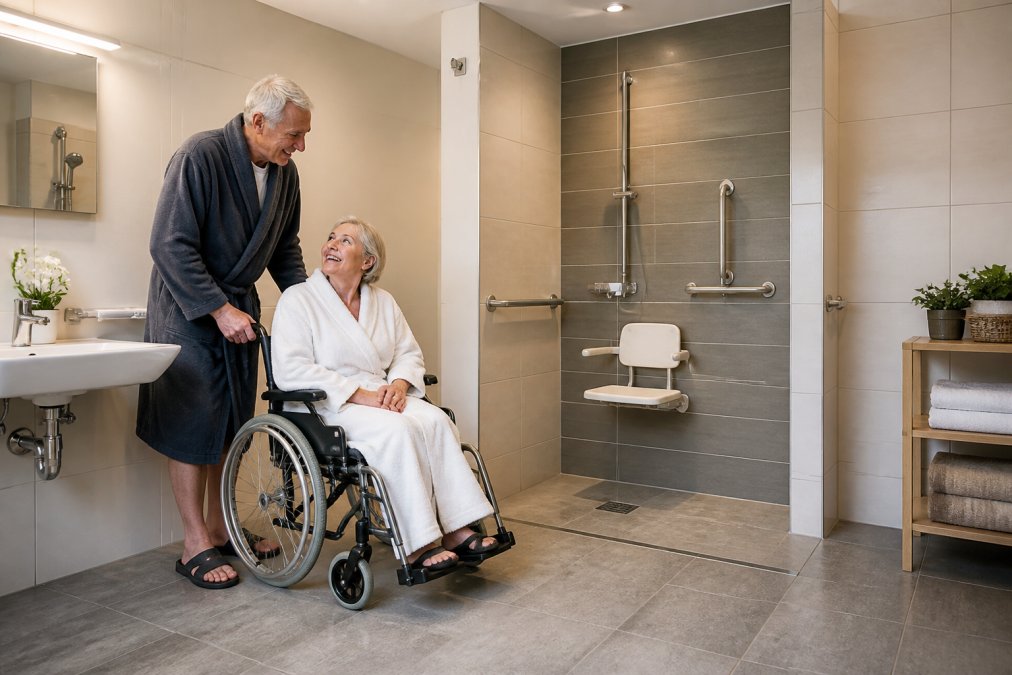
The right amenities in an accessible vacation rental are the foundation for a pleasant stay. It’s not about luxury, but about well-thought-out details that make everyday life easier.
The bathroom is the most critical area. It should have a walk-in or low-threshold shower with a shower seat. Grab bars must be installed in the right places— not only not only for safety, but also to provide support when standing up. The flooring must be slip-resistant, especially in damp areas. A wheelchair-accessible sink also allows wheelchair users to use it comfortably.
Bedrooms should provide enough space to move around. At least 150 cm of clear space next to the bed is recommended. A sturdy bed at an appropriate height makes it easier to get in and out. Some guests may also need a nursing bed—this should be an option.
Other important features:
- Emergency call or call system in all rooms
- Height-Adjustable Kitchen Cabinets
- Light switches and outlets that are easy to reach
- Doors with enough space to maneuver
- Elevator or level access to the entrance
At Ferienwohnungen Gutenbrunn, all of this comes standard. The four lovingly furnished apartments were designed specifically to meet these requirements.
Why Accessibility Is Valuable Even for Couples Without Mobility Limitations
Here's where the truly interesting insight begins: Accessibility isn't just for people with disabilities. It's a mark of quality for any vacation.
Imagine you’re traveling with an elderly parent or a partner who has temporary mobility issues. Or maybe you’re pregnant and don’t want to be constantly navigating stairs. Or perhaps you simply have a demanding daily routine and want a vacation free of physical obstacles. An accessible vacation rental for couples is ideal for all of these situations.
The psychological aspect is often underestimated. A hassle-free vacation means less stress, less planning, and fewer worries. You can focus on what really matters: relaxation, spending time with your partner, and enjoying nature.
Specifically, accessible design offers the following benefits for all guests:
- More space and freedom of movement
- Improved Ergonomics in the Bathroom
- Fewer tripping hazards and safety risks
- Greater overall living comfort
- Improved accessibility to all areas
A couple without physical limitations can an accessible vacation rental You can relax just as well as anywhere else—only with significantly more comfort.
The Difference Between Accessible and Wheelchair-Accessible
These two terms are often confused, but they do not mean the same thing.
Barrier-free is the more general term. An accessible The accommodations are designed so that people with various types of disabilities can use them—not just wheelchair users. This includes people with visual impairments, hearing impairments, mobility impairments, older adults, and many others.
Wheelchair accessible is more specific. It means that the accommodation is specially equipped for wheelchair users. This includes sufficient space to maneuver, low-mounted switches and handles, level entrances, and other wheelchair-accessible features.
Every wheelchair-accessible accommodation is automatically barrier-free. But not every barrier-free accommodation is wheelchair-accessible.
The practical differences:
- Accessible accommodations may have smaller rooms, as long as they are safely accessible
- Wheelchair-accessible accommodations require larger clear spaces
- Accessibility also addresses other needs (visual impairments, mobility impairments)
- "Wheelchair-accessible" is a subset of "barrier-free"
Gutenbrunn Vacation Rentals offers both options. The apartments are fully accessible AND wheelchair-accessible—providing maximum flexibility for a variety of guests.
Accessible Vacations in the Waldviertel: Location and Accessibility
Even the best amenities are of little use if the accommodation is difficult to reach or located in an isolated area. For couples with different levels of mobility, location is crucial: one partner may be mobile, while the other requires accessible pathways. The surroundings must meet both of their needs.
The Waldviertel is one of the most beautiful natural landscapes Austria. Gentle hills, forests, lakes, and small villages define the landscape. It’s the perfect destination for an accessible vacation—the natural surroundings are relaxing, and you won’t have to travel long distances or venture into densely populated tourist areas.
Practical accessibility:
The commute is a factor that is often underestimated. Long car rides can be exhausting for people with limited mobility. The Waldviertel region is located about 100 km north of Vienna and can be reached by car in just over two hours—a moderate distance that isn’t too taxing. The roads are well-maintained, and there are rest stops with accessible restrooms.
The local infrastructure is modest but functional. Small villages mean short distances to stores and restaurants. There are no large shopping malls, but there are local stores, which are often located in flat town centers. This is convenient for couples: the partner who can get around can go shopping while the other rests—or they can go together without having to navigate crowds.
Accessible Activities in the Region:
The region offers a variety of activities that are accessible even for people with limited mobility:
- Lake Edlesberger: About 15 km away. The lake has wheelchair-accessible entry and parking nearby. A couple can walk along the shore together or sit there—depending on how they feel that day.
- Hiking Trails: Not all hiking trails are wheelchair-accessible, but there are flat paths along streams and through forests. The more mobile partner can take longer hikes, while the other can take shorter walks.
- Village centers: Small towns like Gutenbrunn itself have flat paths and are easy to explore.
- Local Restaurants: Many traditional inns have level entrances and plenty of space between tables.
Personalized support makes all the difference:
The hosts know the region firsthand and can offer specific, honest advice—not from a travel guide, but from their everyday lives. They know which paths are actually wheelchair-accessible, which restaurants have good access, and which day trips are worth taking and which aren’t. This saves couples the frustration of arriving at a place only to discover that the advertised attraction isn’t accessible after all.
For couples with different levels of mobility, this local expertise is invaluable. They can plan their activities flexibly without having to spend hours beforehand scouring websites or making phone calls.
Accessible Accommodations Checklist: What to Look for Before Booking
Before you book an accessible vacation rental, you should carefully check to make sure it truly meets your needs. Many accommodations promise accessibility, but may still hold some surprises.
This checklist will help you ask the right questions:
Entrance and Access:
- Is the entrance accessible without steps?
- Is there a ramp or level access?
- Are the doors wide enough (at least 80 cm)?
- Is the front door easy to open?
Bathroom:
- Is the shower walk-in or low-threshold?
- Are there handrails in convenient locations?
- Is the flooring slip-resistant?
- Is there enough space to maneuver a wheelchair under the sink?
Sleeping area:
- Is there enough room to maneuver?
- Is the bed height appropriate?
- Can you get in and out of bed easily?
General:
- Are the light switches and outlets at an appropriate height?
- Is there an emergency call system?
- Are the rooms well-lit?
- Can you get to all areas on your own?
Ask the landlord directly for details. Good landlords, like Anna and Herbert at Ferienwohnungen Gutenbrunn, are happy to answer such questions in detail. They know exactly what their apartments offer and can give specific examples.
Legal Requirements and DIN Standards in Austria
Accessibility is not just a recommendation—it is also enshrined in Austrian law.
Accessibility is not just a recommendation—it is also required by law. There are standards that define requirements for accessible design, including minimum widths for doors and passageways, the height of switches and handles, the surface texture of floors, and the design of restroom facilities.
In addition, there are laws that prohibit discrimination based on disability, which also apply to lodging and vacation facilities.
Many federal states have their own building codes that require accessibility in new construction or renovations. Transition periods often apply to existing accommodations, but the trend is clear: accessibility is becoming the standard.
For landlords, this means that those who invest in accessible accommodations today will be prepared for the future. Demand is rising, and legal requirements are becoming stricter.
For guests, this means they can count on certain standards. An accommodation that advertises itself as accessible should meet these standards.
Common Misconceptions About Accessible Accommodations
There are several misconceptions about accessible vacation rentals that deter potential guests—especially couples in which only one partner has limited mobility.
Myth 1: Accessible accommodations are clinical and uncomfortable.
That's not true. Accessibility and coziness aren't mutually exclusive. Good design means that you hardly notice the accessible features—they're simply there when you need them. A lovingly furnished apartment with wide doors and good handles doesn't feel clinical; it feels well thought out.
Misconception 2: Accessible accommodations only make sense if both partners have mobility limitations.
That’s one of the biggest misconceptions—and this is precisely where the added value lies for many couples. Often, only one partner has limited mobility—due to an injury, a chronic illness, osteoarthritis, or simply old age. The other partner is mobile and active.
In an accessible lodging, both can relax:
- The mobile partner doesn't have to constantly worry about the other person or improvise.
- The partner with disabilities can move around on their own and does not need constant assistance.
- It's possible to do things together without anyone feeling overwhelmed or left out.
- There is no psychological pressure to „keep up.“.
It's not just practical—it's emotionally relieving. A vacation without these stresses is a real vacation.
Myth 3: Accessible accommodations are more expensive.
It doesn't have to be that way. Yes, the amenities cost money. But that doesn't automatically mean you'll pay more. Many landlords offer accessible apartments at fair prices—because they recognize the importance of this and know that demand is rising.
Myth 4: Direct booking is unsafe.
Some guests hesitate to book directly with hosts instead of through major platforms. That’s understandable, but unnecessary. Reputable hosts are reliable and transparent. They answer questions in detail, confirm reservations in writing, and are available if something goes wrong. For accessible accommodations, direct contact is actually an advantage: You can ask specific questions and get honest answers instead of standardized checklists.
Myth 5: Accessibility means that everything looks the same.
Wrong. Accessible design is a framework, not a one-size-fits-all solution. Within these standards, accommodations can look and feel completely different. An accessible vacation rental can be rustic, modern, cozy, or minimalist—depending on the owner’s taste and the guests’ needs.
Conclusion: Is an accessible vacation rental worth it for couples?
The answer is clear: Yes. But not just for couples with limited mobility.
An accessible vacation rental offers every couple more comfort, more safety, and less stress. The well-thought-out design, the spacious rooms, and the sturdy handrails—all of these make a difference. You can focus on what matters most on vacation: spending time together, relaxing, and enjoying nature.
Gutenbrunn Vacation Rentals proves that accessibility doesn't mean compromising. The four lovingly furnished apartments in the Waldviertel region offer:
- Complete accessibility without compromise
- Personal attention from the hosts
- A quiet location in a beautiful natural setting
- Direct booking, no strings attached
- A temporary home, not just a place to stay
If you're planning a vacation where you can truly relax—without obstacles or worries—then an accessible vacation rental is the right choice.
Frequently Asked Questions
What is the difference between "accessible" and "wheelchair-accessible"?
“Barrier-free” means that a residence is accessible to people with various mobility impairments—not just wheelchair users. This includes threshold-free entrances, wide doors, and easily accessible counters. “Wheelchair-accessible” is a more specific term and refers to requirements such as maneuvering space, clearance under furniture, and the layout of bathroom fixtures. A wheelchair-accessible apartment is always barrier-free, but not every barrier-free apartment meets all wheelchair standards.
Why is accessibility also a benefit for couples without disabilities?
Accessibility creates comfort for everyone: threshold-free transitions reduce the risk of tripping, spacious areas feel less cramped, and better lighting along with easily accessible switches save time and effort. Relaxation is especially important on vacation—when you don’t have to constantly watch out for narrow doors or high steps, you’ll enjoy your stay much more. Many couples also appreciate the spaciousness of barrier-free design, which offers room for relaxing together.
What should couples look for when booking accessible accommodations?
Check the specific features: Are the entrances and doors truly threshold-free? How wide are the passageways (at least 80 cm for wheelchairs)? Are there grab bars in the bathroom and enough space to move around? Ask about the location—is the accommodation on the ground floor, or is there an elevator? Find out how easily you can reach the hosts in person if you have any questions or encounter any problems. Read reviews from other guests with similar needs to ensure that the promises are kept.
Does an accessible vacation rental make sense for couples overall?
Yes, especially if at least one partner has limited mobility or if you value comfort and safety. Accessible accommodations offer more space, better accessibility, and thoughtful details that make for a relaxing vacation. Even without any mobility limitations, couples benefit from the spaciousness and safety. The key is to choose the right accommodation and clarify exactly what amenities you need in advance.
An accessible vacation rental for couples isn’t just practical—it’s an investment in your vacation. Gutenbrunn Vacation Rentals offers exactly that: wheelchair-accessible and barrier-free apartments with personalized service, an ideal location for hikes and excursions, and a focus on true relaxation without the pressure of a tight schedule. Book directly with Anna & Herbert and experience a vacation that’s truly relaxing.


Comments are closed, but trackbacks and pingbacks are open.