


Table of Contents
- Why the Waldviertel Is the Ideal Place to Learn Fly Fishing
- Fly Fishing Gear for Beginners: What You Really Need
- Fly Fishing Course in Lower Austria: What You'll Learn in a Beginner's Course
- Lower Austria Fishing Law: Licenses and Legal Provisions
- Closed Seasons, Minimum Size Limits, and Environmental Responsibility on the Water
- A Comparison of the Different Kamp Sections
- Checklist for Your First Day of Fishing: Behavior at the Water's Edge and Equipment
- Travel and Logistics: How to Plan Your Fly-Fishing Trip to the Waldviertel
- Conclusion: Learn to Fly Fish Successfully with the Right Preparation
- Frequently Asked Questions
Last updated: October 4, 2026
Why the Waldviertel Is the Ideal Place to Learn Fly Fishing
Who Learn Fly Fishing Anyone who wants to fish is usually looking for two things: calm waters and patient instructors. You’ll find both in the Waldviertel. The region is considered one of Austria’s best spots for beginners because the streams here are clear, cool, and have a steady flow year-round. These are exactly the conditions that brook trout and grayling need.
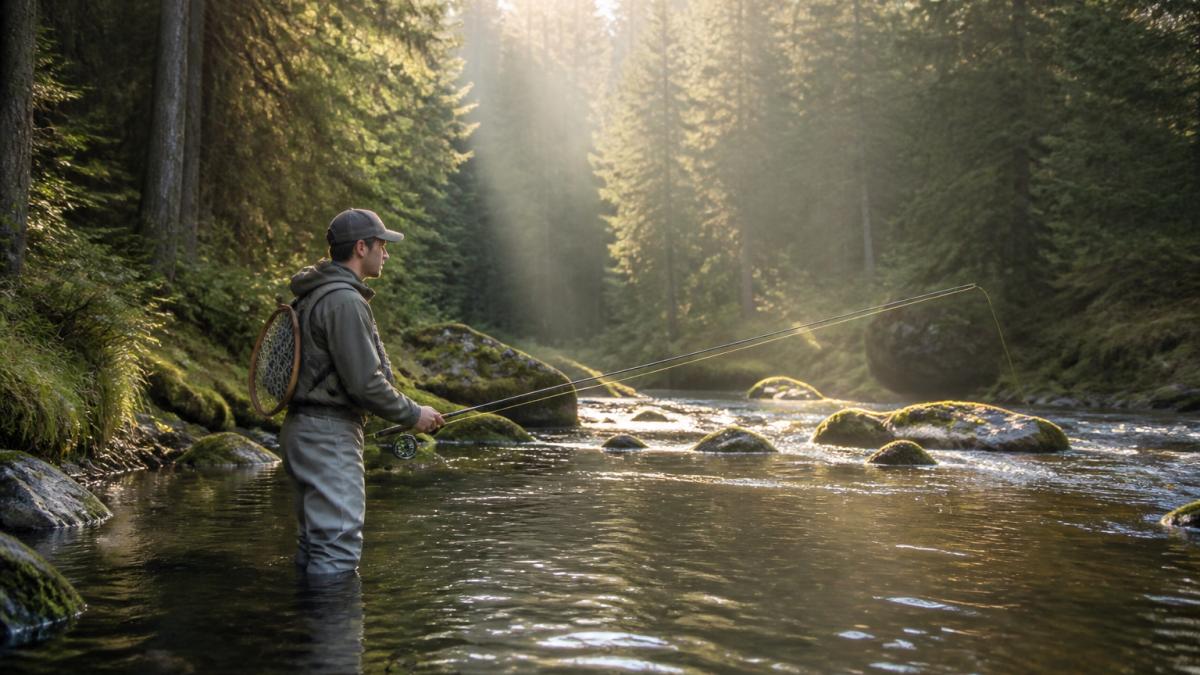
Why is this region so well-suited for beginners?
- The rivers are small and easy to follow, so they're easy to read
- Not much activity by the water, which means more peace and quiet for practicing
- Short distances between accommodations and the river
- A clear view of the fish, which speeds up learning
Water Quality in the Waldviertel: Brook Trout and Grayling
The Waldviertel region lies on a granite and gneiss plateau. As a result, the water here is soft, oxygen-rich, and cool. Such fly-fishing waters usually support a healthy fish population.
Brook Trout and Ash are the main species. Both need clean, fast-flowing water with a gravel bottom. Where the river meanders naturally, the fish find spawning grounds and hiding places. This is an advantage for beginners: where there are fish, you learn faster.
A common mistake is to wade right into the current. It’s better to watch from the bank. That way, you don’t disturb that section of the water and can see where it’s worth casting.
Fly Fishing Gear for Beginners: What You Really Need
The right Fly Fishing Gear for Beginners It's manageable. You don't need a professional set. Four pieces are enough to get started.
| Equipment Part | Recommendation for Beginners | Why It's Important |
|---|---|---|
| Fly Rod | Class 5, length 2.40 to 2.70 m | Please forgive any typos |
| Fly Reel | Simple Pulley with Brake | Balances out deviations |
| Fly line | Floating WF Line | Easy to throw |
| Waders | Breathable, ankle-high is sufficient | Dry and flexible |
In addition, Leader, Fishing net and a small selection of flies. That's all you need.
A common beginner's mistake is using a rod that's too heavy. A stiff Class 7 or 8 rod is too much to handle when casting and leads to frustration. Start with a Class 5 rod.
How to Choose the Right Fly Rod, Fly Reel, and Fly Line
The Fly Rod is the heart of your gear. For small streams in the Waldviertel, a Class 5 rod with a medium action is ideal. It loads easily and casts cleanly even in windy conditions.
The Fly Reel It is primarily used to store line. A simple reel with a working drag is sufficient. Make sure it is compatible with your rod's line class.
In the Fly line The following applies: A floating WF (weight-forward) line is ideal for beginners. It can be cast far enough and does not sink. For Nymph and Dry Fly Is that the right choice?.
Fly Fishing Course in Lower Austria: What You'll Learn in a Beginner's Course
A Fly Fishing Course in Lower Austria It significantly shortens the learning curve. In a good beginner's course, you'll learn more in two days than you would in months of trying on your own.
Typical course content includes:
- Equipment Overview and Rod Construction
- Basic Throw and Throwing Technique
- Presentation the fly on the water
- Right away, Drill and landing with the Fishing net
- Behavior Near Water and Fisheries Enforcement
A Instructor It corrects your movement immediately. That's the biggest advantage. Without feedback, mistakes become ingrained and are difficult to correct later on.
Before booking, ask how large the class is. Small groups with a maximum of four people allow for significantly more personalized feedback than classes with twelve participants.
Casting Techniques for Beginners: From the First Cast to the Bite
The Throwing Technique determines success. The basic throw consists of four steps:
- Move the rod backward until the line is taut
- Wait a moment until the line unwinds
- Accelerate the rod forward
- Gently lower the line into the water
The most common mistake is using too much force. If you whip the rod around, you'll lose the line in the bushes. A calm, steady Throwing Style takes the fly to where the fish is.
Practice in a field first. Only once you’ve got the throw down should you head to the water. That way, you’ll avoid frustration and go easy on the Fishing Area.
Lower Austria Fishing Law: Licenses and Legal Provisions
Anyone who wants to fish in the Waldviertel needs a valid Fishing License. In Lower Austria, this is governed by the Fisheries Act the requirements (RIS – Lower Austria Fisheries Act of 2001). Fishing is not permitted without a valid license—this also applies to brief test casts.
What Types of Licenses Are Available?
In Lower Austria, a basic distinction is made between:
- Annual License: applies to an entire fishing year and a specific fishing area
- Daily or Weekly Pass: is provided by many fishing area owners as an extra, often for visiting anglers
- Guest Card: Some hunting grounds issue their own guest passes, which are valid only when accompanied by the owner or leaseholder of the hunting ground
You can find the exact terms and current fees at Office of the Lower Austrian State Government, Department of Fisheries. Be sure to check with the property owner before you head out—the rules vary from property to property.
What the Fisheries Inspection Agency Monitors
The Fisheries Enforcement conducts on-site inspections. It checks:
- the valid Fishing License and the area map
- compliance with Actual measurement and Closed Season
- Permitted fishing methods and bait
- the number of fish caught
Anyone caught without a valid license can expect to be charged. This is not a minor offense—the protection of the Fish stocks is enshrined in law.
Rules for Water Activities
In addition to the license, there are certain requirements that apply to all anglers:
- Catch Report: Some fishing areas require that caught fish be documented
- Withdrawal Rules: only fish within the Actual dimensions may be taken along
- Equipment Regulations: In some fishing areas, only fly rods are allowed; in others, spinning rods are also permitted
- Beach Access: You are not allowed to walk on every part of the shore; some sections are private
Before your first cast, check whether your fishing area requires you to report your catch. Anyone who forgets to report their catch risks a fine—even if their license is valid.
Seasonal Highlights
The fishing season in the Waldviertel usually begins in the spring. Depending on the fishing area and the species of fish, different rules apply Closed Seasons. The Brook Trout has a closed season during the fall spawning period in many fishing districts, which Ash often in the spring. Anyone who fishes out of season is committing a crime.
Each hunting district sets its own exact dates. Check with the district owner before you pack your gear.
Closed Seasons, Minimum Size Limits, and Environmental Responsibility on the Water
Closed Seasons and Actual measurement protect the Fish stock. During the spawning season, certain species may not be fished. This ensures the Reproduction and thus the future of the mining district.
Catch and Release is common in fly fishing. The fish is gently released. To do this, you'll need a wet landing net and damp hands.
Important for the Aquatic Ecology:
- barbs Press down or use hooks without barbs
- Do not place fish on dry land
- Do not trample the vegetation along the shore
- Pick up trash—even if it's not yours
Waterway Maintenance It's not an obligation, but a mindset. If you fish responsibly, you'll still find fish there on your next visit.
A Comparison of the Different Kamp Sections
The Kamp offers a variety of Sections of Waterways. Each section presents different challenges for beginners.
| Section | Character | Suitable for |
|---|---|---|
| Upper Course | Fast, rocky, narrow | Experienced Throwers |
| Middle Run | Balanced, gravelly | Beginners |
| Dust Collection Area | Calm, deep | Dry Fly, Sight Fishing |
For beginners, the middle section is the best choice. The water flows steadily, there's plenty of room to cast, and the Fish stock is stable.
The upper reaches are scenic but technically challenging. Narrow sections and fast currents require precise casting. Anyone still working on their basic cast should not start here.
The middle section of the Kamp River is the best choice for beginners. Calm waters, good visibility, and a stable fish population make learning easier.
Checklist for Your First Day of Fishing: Behavior at the Water's Edge and Equipment
A good first day of fishing starts with planning. This checklist will help you make sure you don't forget anything.
- Valid Fishing License in the process
- Day Pass for the Hunting Ground
- Rod, reel, and line checked
- Leader, Nymph, Dry Fly and Streamer sorted
- Waders and waders
- Fishing net with a wet net
- Water and a Snack
- Rain jacket
To the Behavior Near Water It takes more than just gear. Walk slowly toward the shore. Don't cast right away; watch first. Don't step into the River Course, when fish are right in front of you.
If you wade straight into the water and make waves, you'll scare away every fish within a radius of several meters. Watch from the shore first, then sneak up on them.
Travel and Logistics: How to Plan Your Fly-Fishing Trip to the Waldviertel
Getting to the Waldviertel is easy. From Vienna, you can reach the region via the B37 or the B38. Depending on your destination, the drive takes about two hours.
For a successful outing, here's the best way to plan:
- District and Fishing License clarify in advance
- Choose accommodations near the water
- Start of the Season check, usually in the spring
- Course or Coaching for Beginners book in advance
- Pack your gear and a change of clothes
Staying nearby saves travel time and lets you get to the water early. The morning hours are often the best.
This is exactly where vacation rentals come in Gutenbrunn into play. Our four apartments are located in a quiet area of the Waldviertel and serve as an ideal base for fishing trips. Families, We welcome wheelchair users and dog owners. After a long day by the water, a cozy kitchen-dining area awaits you. If you want to get an early start, you can be at the river in just a few minutes.
Lower Austria Tourism: Information on the Waldviertel Region
Conclusion: Learn to Fly Fish Successfully with the Right Preparation
Learn Fly Fishing It doesn't require expensive equipment or years of training. All it takes is calm water, a good instructor, and a little patience. The Waldviertel offers exactly that combination.
Start with a beginner's course, practice the basic throw on the grass, and plan your first day at the Mittellauf. Then you'll be ready for your first Bite Nothing in the way.
Frequently Asked Questions
What equipment do you need as a beginner in fly fishing?
To get started, all you need is a combination of a size 5 or 6 fly rod, a matching fly reel, and a floating fly line. You’ll also need a leader, a few dry flies, nymphs, and streamers, as well as waders for wading. A landing net and fishing sunglasses are also important. Many courses provide the equipment you need to get started, so you don’t have to buy everything right away.
Do you need a special fishing license for fly fishing?
Yes, you need a valid fishing license to fly fish in Lower Austria. You can obtain one by passing the fishing exam or by purchasing a day pass, which is often tied to a specific fly-fishing body of water. The exact regulations are governed by the Lower Austrian Fisheries Act. Check in advance with the relevant district administrative authority or the course provider to find out which documents are required for your chosen fishing waters.
When is the best time to take a fly-fishing course in the Waldviertel?
The season usually begins in the spring, following the start of the season and the closed seasons. The months of May through June and September through October often offer the best conditions, as brown trout and grayling are active during this time and water temperatures remain pleasant. Courses are often held on weekends. Before booking, check the current closed seasons for your chosen body of water to ensure that your course falls within a permitted fishing period.
How does fly fishing differ from conventional fishing?
In fly fishing, the weight of the fly line is used to cast the artificial fly, rather than a lead weight as in spin fishing. This requires a specific casting technique in which the rod is moved back and forth. The presentation of the fly is much more natural, which is particularly crucial when targeting shy brook trout and grayling in clear fly-fishing waters. Coaching for beginners helps them learn the casting technique correctly from the ground up.
A day of fishing in the Waldviertel starts early and often ends with tired arms and a smile. To help you focus fully on the water, you’ll need the right accommodations. At Ferienwohnungen Gutenbrunn, you’ll find accessible apartments, personalized service from Anna and Herbert, and a peaceful setting close to nature. Vacation with Your Dog is welcome here. Book directly with us and start your first day of fly fishing feeling relaxed.


Comments are closed, but trackbacks and pingbacks are open.