


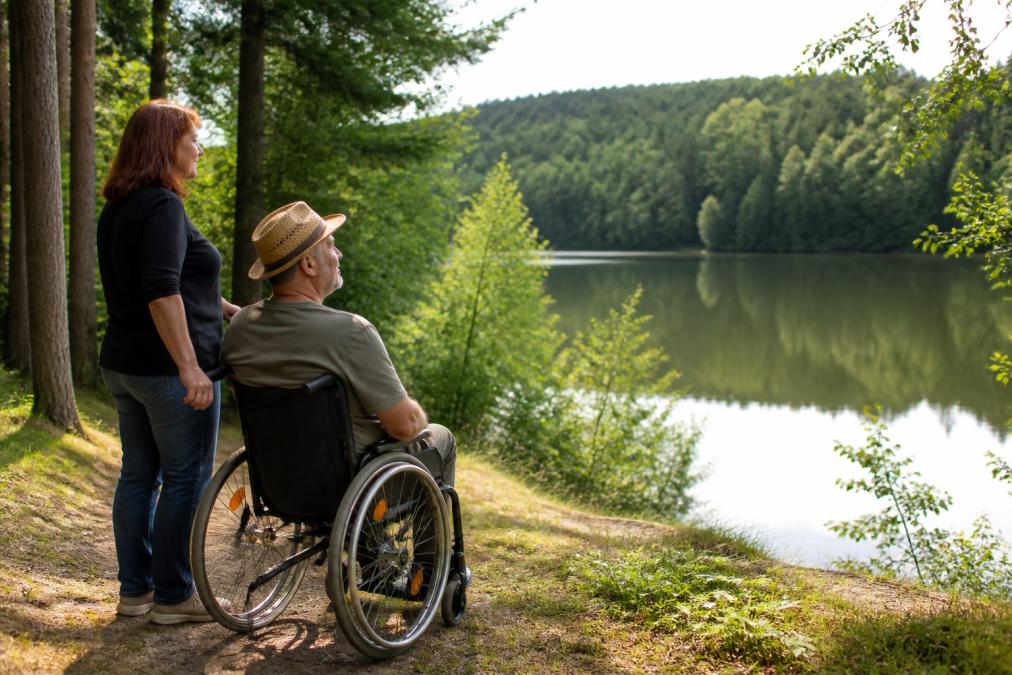
![”Couple by the lake: A woman in a wheelchair is being pushed by her husband in front of a forest and the water; an advertisement for accessible vacations by the lake."], ,](https://www.ferienwohnungen-gutenbrunn.at/wp-content/uploads/2026/09/Barrierefreie-Wohnungen-see-anna-und-herbert-2-1035x425.png "Accessible Apartments \"See Anna and Herbert\" - Vacation Rentals in Gutenbrunn")
Accessible Vacations by the Lake: What Really Matters
An accessible vacation by the lake is more than just a ramp at the entrance. It comes down to door widths, walkway surfaces, restrooms, and whether someone is available if something goes wrong while you’re there. That’s exactly why many bookings fall through not because of a lack of options, but because of unclear information provided before arrival.
For vacation rentals Gutenbrunn Here in Gutenbrunn in the Waldviertel, we know both sides of the story: the hosts, who have to describe exactly what their accommodations offer, and the guests, who have all too often found that „accessible“ actually meant three steps right at the door. This guide explains what really matters when it comes to accommodations, getting there, places to visit, and travel planning.
First, the most important point: Accessibility is not a simple yes-or-no characteristic, but a chain. If one link is missing, even the best individual component is useless.
Never check just the accommodations; always check the entire chain: the trip there, the check-in, the apartment, the bathrooms, the destination, and the trip back. A single missing link can make or break the entire vacation.
Accessible Accommodations: What Matters Most
When choosing an accessible accommodation, the actual measurements matter most—not the photos. Asking the right questions beforehand will help you avoid surprises when you arrive.
Many hosts mean well and write „wheelchair accessible“ without knowing the key specifications. Pay attention to these points:
- Step-free access from the parking lot to the apartment door
- Space next to the bed to allow for a transfer
- Bathroom with grab bars and a wheelchair-accessible sink
- Kitchen with a countertop that is wheelchair-accessible
A common mistake is to ask only about the inlet. The actual bottleneck is usually in the bathroom.
Technical Details: Door Widths, Ramps, and Plumbing
Door widths, ramps, and restroom facilities are the three factors that practically determine accessibility. Ask specifically about clear passage widths, not just „wide doors.“.
In practice, a clear passage width of at least 80 centimeters is considered the minimum requirement for a wheelchair. Ramps should be gentle enough to be navigable without assistance and should have an edge strip to prevent the wheelchair from sliding off the side. In the bathroom, key features include walk-in showers, non-slip floors, and grab bars at the appropriate height. In Austria, many businesses follow the guidelines set by the ÖNORM B 1600 on Accessible Design.
Never just ask, „Is it accessible?“ but rather, „How wide is the narrowest door, and how high is the highest step?“ The first question gets you a “yes,” while the second gives you a number that’s actually helpful.
Accessible Vacation Rental for Couples: More Than Just Accessibility
One Barrier-free vacation apartment For couples, it meets the same technical standards as any other, but it must also do one additional thing: allow for a break. If one partner needs support, the other shouldn't have to become a caregiver while on vacation.
This works if the apartment offers enough space for two separate quiet areas, the kitchen functions well even on bad days, and the surroundings are quiet enough that no one feels pressured to „get things done.“ Personal support is also crucial: Someone who knows the apartment and is available helps relieve the tension for both of them.
At Ferienwohnungen Gutenbrunn, this is evident in the layout—featuring a kitchen-dining area and bedrooms that offer both privacy and a sense of togetherness. The peaceful location in the Waldviertel adds to the experience: no time pressure, no rush.
Accessible Destinations in Lower Austria: Nature Without Barriers
Accessible tourist destinations in Lower Austria are more common than many people expect, but they are rarely fully accessible. The difference almost always lies in the surface of the path and the final stretch leading to the viewpoint, as well as in whether the key dimensions are available in advance.
Many nature destinations advertise themselves as „accessible,“ but by that they mean only a paved main path. People who rely on a wheelchair need more: a solid surface throughout, no exposed tree roots, paths wide enough for two people to pass each other, and seating areas at short intervals. It is precisely these details that are missing from almost all guides, which is why it’s worth checking directly with the destination by phone or email before you go.
Technical Specifications: Grade, Trail Width, and Rest Areas
The following guidelines have proven effective in practice for wheelchair-accessible nature trails. They are based on the principles of ÖNORM B 1600 on Accessible Design and on the experiences of users who regularly travel along these routes:
| Characteristic | Recommended guideline | Why is it crucial? |
|---|---|---|
| Longitudinal Slope | Max. 6 % over the long term; short stretches up to 8 % | Higher elevations are hardly passable on a long-term basis without outside assistance |
| Lateral tilt | max. 2 % | Prevents side-to-side slippage, especially in wet conditions |
| Path width | at least 150 cm, ideally 180 cm | Allows for encounters with oncoming traffic and an accompanying person |
| Distance Between Rest Areas | every 200–300 m | Allows for breaks without overexertion |
| Rest Area Amenities | Seat height approx. 45–50 cm, with backrest and armrests | Makes it easier to get up and move around |
| Road surface | Asphalt, fine gravel, or water-bound pavement | Wheelchair- and stroller-accessible, even after rain |
| Edge Boundary | Curbstone or flat curb | Prevents sideways slipping on downhill slopes |
These values are not a rigid standard, but rather a matter for negotiation with the respective operator. If you know what they are, you can ask specific questions and get useful answers instead of a blanket „Yes, it’s accessible.“.
Accessible Hiking Trails and Nature Experiences
Accessible hiking trails and nature experiences work best when the trail is paved throughout and the inclines remain moderate. Be sure to ask about the surface in advance—not just the length.
Wide gravel or asphalt paths with a gentle slope and rest areas with benches have proven particularly effective. Nature parks and cultural landmarks in the region are increasingly offering such routes, some of which feature tactile guidance systems for people with visual impairments. For families with children, this is an advantage in any case: a stroller can roll along the same path.
An often-overlooked point: Access to the trailhead is also part of accessibility. No matter how good a trail is, it’s of little use if the parking lot is only accessible via a steep access road or if the nearest accessible restroom is several kilometers away. Therefore, always ask about the entire route: parking lot, trailhead, trail route, rest areas, and return route.
Before you set out, call your destination directly and ask about the condition of the last section of the trail. Right there, between the parking lot and the lookout point, is the barrier that isn't mentioned in any brochure.
Accessible Restrooms and Sanitary Facilities on the Go
One factor that is often overlooked when planning outings in nature is the availability of accessible restrooms along the route. Unlike in cities, they are often scarce in rural areas and are not always clearly marked.
When making an inquiry in advance, look for the following characteristics:
- Door width: at least 80 cm clear passage width
- Space in front of and next to the toilet for transferring
- Handrails on the left and right, foldable or fixed
- Wheelchair-accessible sink
- Emergency contact or someone who can be reached
Ask the tourism office or the attraction directly about the nearest accessible restroom and make sure to include it as a key part of your itinerary. Sorting out restroom arrangements in advance makes for a more relaxed trip—and that goes for everyone involved.
Planning Accessible Travel and Local Transportation
Getting there and getting around once you’re there often have a bigger impact on your vacation than the accommodations themselves. If you know the routes in advance, you’ll arrive feeling relaxed; if you wing it, you might end up at the train station without a suitable connection. The key difference from most travel guides: This guide isn’t just about getting to your lodging, but about seamlessly connecting public transportation with accessible destinations.
Public Transportation and Low-Floor Buses
Public transportation with low-floor buses isn't always available everywhere in rural areas. Therefore, be sure to check the specific route for your travel date, not just the route in general.
Low-floor buses make it easier to board, but not every route uses them on every trip. Contact the transit authority to inquire about accessible transfers and whether the bus has a ramp. If you’re traveling by car, keep in mind that having a parking space that’s wide enough and a step-free path from the parking lot to the apartment are more important than the distance itself.
A practical approach is the „accessibility chain,“ which also applies to public transportation: the platform, boarding, transfers, exiting, and the route from the exit to the destination must all function properly. Even a single missing elevator at a transfer station renders the entire connection unusable.
Accessible Connections to Tourist Attractions
Most travel guides stop at how to get to your accommodations. But the question of how to get from there to accessible tourist destinations is just as important. This is precisely where the biggest gap in the available information lies.
When planning, follow these steps:
- Select a destination, Are you looking for a destination with confirmed accessibility (surface of the path, slope, restroom)?.
- Check the next stop, Ask the public transit authority whether the stop itself is accessible (platform height, ramp, elevator).
- Clarify transfers, Every transfer is a potential obstacle. Ask about accessible transfer options and the availability of low-floor vehicles on that specific route.
- Plan the Last Mile, The route from the stop to your destination is often the most challenging part. Ask about the width of the sidewalk, curb cuts, and whether there is accessible entry.
- Have an alternative ready, Not every connection goes as planned. Having a taxi company with a wheelchair-accessible vehicle as a backup is a sensible precaution.
If you're traveling by train, it's a good idea to check with the provider in advance: Many train stations offer portable ramps or lift platforms, which must be reserved ahead of time. If you wait until you're on the platform to ask for one, you may have to wait for the next train.
| Stage | What to Look For | Common Pitfalls |
|---|---|---|
| Travel by Train and Bus | Low-floor bus, accessible transfer, pre-register for ramp | Transferring without a ramp or elevator |
| Traveling by Car | Ample parking, a path with no steps | Gravel path to the door |
| On site | Ramp, elevator, short distances | No elevator |
| Field Trip | Paved paths, rest areas, accessible restroom | Exposed tree roots, no restroom |
| Return Trip | Check the last connection of the day | Last bus leaves too early |
In rural areas, the last bus or train of the day often leaves early. Always check your return trip before you set out; otherwise, your relaxing outing could turn into an unexpected overnight stay.
Accessible Parking and the Last Mile
For anyone traveling by car, the last mile from the parking lot to their lodging or destination is crucial. A spacious parking lot is of little use if the path to the door leads over gravel, steps, or a steep ramp.
Be sure to ask specifically about:
- Number and width of accessible parking spaces
- Distance from the parking lot to the entrance
- Surface of the path (asphalt, crushed stone, gravel)
- Uphill section of the trail
- Lighting Upon Arrival at Dusk
These details may seem obvious, but they’re rarely communicated in advance. If you ask about them, you’ll avoid any unpleasant surprises upon arrival and can enjoy your vacation from the very first minute.
Accessible Spas and Wellness Services
Accessible thermal baths and wellness facilities are common in Lower Austria, but the specifics vary widely. The main challenge is almost always the path from the changing room to the water.
Lift chairs, level-entry showers, and grab bars are standard features of well-designed facilities. Ask in advance whether a lift is available, whether it needs to be reserved, and whether trained staff are on hand to assist with transfers. The restrooms and the path leading to them should also be step-free and wide enough.
For many guests, the real reward isn't the pool itself, but the tranquility that follows: a peaceful retreat where the day comes to a close without any time pressure. That's exactly what fits the relaxed getaway for which the region is known.
Accessible Dining and Culinary Experiences
Accessible dining and cuisine rarely fail because of the food—it’s almost always a matter of accessibility. A restaurant with excellent cuisine is of no use if the entrance has three steps and the restroom is upstairs.
When making a reservation, ask about the step-free entrance, the space between tables, and an accessible restroom. Good restaurants will answer these questions without hesitation. Tables with a fixed height and a wheelchair-accessible tabletop make all the difference, as does a seat that isn’t located right in the middle of an aisle.
A practical tip based on experience: Make your reservation early and specify your needs right away. If you wait until you arrive to ask, you're less likely to get the table you want.
Seasonal Accessibility: What Changes Throughout the Year
Seasonal accessibility is a point that hardly any travel guide mentions. The same trail can be easily navigable in the summer but impassable in the winter.
Leaves, moisture, ice, and snow significantly affect the passability of paved paths. In the spring, paths may be soft, while in midsummer the ground becomes hard and cracked. Therefore, don’t just ask, „Is the path accessible?“ but also, „Is it accessible at the time of my trip?“ In winter, it’s worth asking whether the path is cleared and whether ramps are kept free of ice.
Accessibility is not a fixed characteristic, but rather a snapshot in time. Always check it for your specific travel dates and confirm it again shortly before your arrival.
Tips for Planning Your Trip: Checklist and Common Mistakes
When planning a trip, a written checklist is more helpful than any mental reminder. It forces you to go through the entire sequence—from the parking lot to your destination—one by one.
- Clear door widths for the apartment, confirmed in writing
- Access from the parking lot to the apartment without steps has been resolved
- Plumbing with grab bars and an accessible sink, as certified
- Travel directions, including transfers and low-floor buses, have been researched
- Destinations Selected Based on Road Surface and Grade
- Local contact person with direct phone number noted
- Travel time and weather conditions factored into the planning
The most common mistake is to check only the accommodations and leave the rest unchecked. The second most common: relying on the claim that a place is „accessible“ without asking for specific figures. If you avoid both of these, you’ll have a more relaxing trip.
A barrier-free vacation by the lake stands or falls on the preparation, and this is exactly where it gets tricky: finding the right accommodations that deliver on their promises. Gutenbrunn Vacation Rentals were built to meet precisely these needs, offering accessible and wheelchair-friendly vacation rentals, personalized service from Anna and Herbert, the option to bring your dog, and a peaceful location in the Waldviertel region near natural highlights such as the Lake Edlesberg. Instead of calling a hotline, you'll be put in touch with hosts who know their apartments well and are easy to reach. Book directly with Ferienwohnungen Gutenbrunn and start your getaway without any time pressure.
Frequently Asked Questions
What criteria make a vacation rental truly accessible?
You can tell if a vacation rental is truly accessible by looking at specific measurements: Doors should be at least 80 cm wide, and the clear spaces in the bathroom and bedroom should measure at least 120 x 120 cm. Other important features include threshold-free access, a floor-level shower, grab bars, and sufficient space next to the toilet. When booking, always ask for these technical details—don’t just rely on the term ‚accessible.‘ Reputable hosts will be happy to provide you with these specific measurements.
Is an accessible vacation rental a good choice for couples?
Yes, an accessible vacation rental is often the more relaxing choice, especially for couples. If one partner has limited mobility, the threshold-free access and spacious bathroom allow both to enjoy a stress-free stay. But even without any immediate limitations, couples benefit from the added comfort—for example, when one partner is tired after a hike or is temporarily injured. The open floor plan also feels more spacious and serene, which is important to many couples looking for a break.
What accessible tourist destinations are there in Lower Austria?
There are several accessible tourist attractions in Lower Austria. These include nature parks with paved, wheelchair-accessible trails, accessible museums and exhibitions, as well as several thermal spas with ramps, elevators, and accessible restrooms. Many hiking trails in the Waldviertel are flat and well-paved. Before your visit, check the current opening hours and whether a wayfinding system for visually impaired guests is available. It’s best to ask your lodging directly for specific recommendations in the area.
What should you look for when booking accessible accommodations?
When making a reservation, look for more than just the ‚accessible‘ label. Ask for specific measurements of doors, ramps, and restrooms, as well as the type of access and parking options right at the property. Find out if there’s an elevator and how wide the hallways are. Having someone on-site to assist you is a major advantage, because you’ll have a direct point of contact if you have any questions. Have the most important details confirmed in writing before making your reservation so you can plan with confidence.

Comments are closed, but trackbacks and pingbacks are open.