


The History of a Special Place
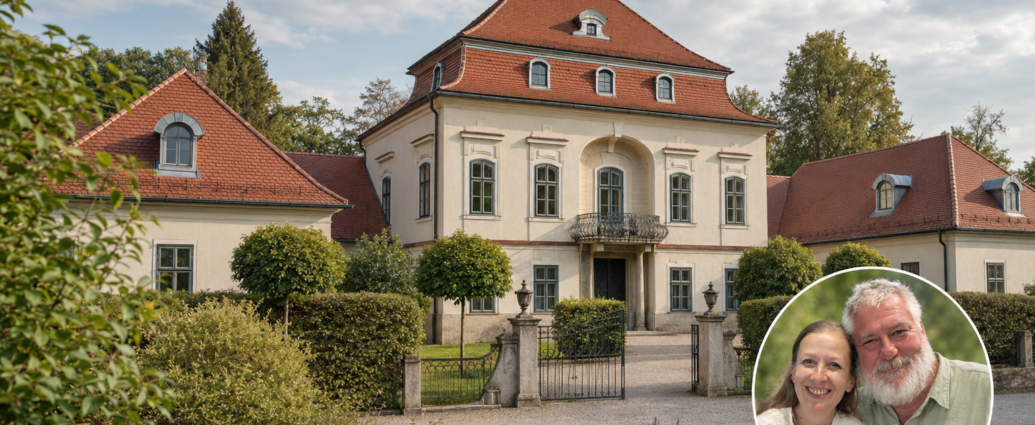
The Castle Gutenbrunn It is one of the most historically significant buildings in this small Waldviertel community. Its elegant façade is a reminder of a time when Gutenbrunn was the economic center of a vast estate. To this day, the castle, together with the parish church, shapes the historic character of the town.
Joseph von Fürnberg and the Construction of the Castle
Gutenbrunn Castle was built between 1771 and 1785 by Joseph von Fürnberg. The entrepreneur and landowner played an important role in the economic development of the southern Waldviertel region.
Fürnberg did not limit himself to establishing commercial enterprises in Gutenbrunn. With the new castle, he also created a stately administrative center for his estates. The building was intended to convey prosperity without taking on the scale of a grand residence.
Early Classical Architecture
Gutenbrunn Castle is designed as a three-sided courtyard complex. The two-story main wing is flanked by lower side wings. This creates a sheltered courtyard that opens toward the front.
The following are particularly noteworthy:
- the tall mansard hipped roof,
- the central wing, which is five window bays wide,
- the large basket-arch-shaped niche above the entrance,
- the curved balcony with its Baroque railing,
- the understated, light-colored facade,
- as well as the historic lanterns in front of the main entrance.
This combination of a clean, early-Classical design and individual Baroque decorative elements gives the palace its distinctive character.
From Fürnberg to Emperor Franz I.
In 1795, the castle was acquired by Emperor Franz II. The same ruler later assumed the title of Emperor of Austria as Franz I.
Around 1800, the estates of Gutenbrunn and Persenbeug became part of the emperor’s private holdings. This marked the beginning of the castle’s long association with the House of Habsburg-Lorraine. Through several generations of inheritance, the estates eventually passed to Emperor Franz Joseph I, who bequeathed them to his daughter Marie Valerie in 1916.
Until 2012, Gutenbrunn Castle was part of the Habsburg-Lorraine estate of Persenbeug. After that, the historic building, which is a designated historic landmark, passed into private ownership.
The Castle Today
In recent years, the castle has been restored in accordance with historic preservation guidelines. The historic proportions and distinctive architectural features have been preserved in the process.
The building is privately owned and is not a museum that is regularly open to the public. However, while taking a walk through Gutenbrunn, you can view the complex from the areas open to the public.
The market town has also announced plans for future public use of the castle gardens. Since such plans and access regulations are subject to change, it is advisable to check with the town hall or visit the Website of the Market Town of Gutenbrunn.
Please be mindful of private property lines, barriers, and current signs.
A Walk Through Gutenbrunn's History
The castle is a wonderful addition to a leisurely stroll through town. Just a few minutes’ walk away are other points of interest worth seeing:
- the pilgrimage and parish church in Gutenbrunn,
- the historical Gutenbrunner Spring,
- the museum and the stage at the Trucker House,
- that Inhalation Room with a Kneipp facility,
- as well as walking and hiking trails around the town.
The castle rooms and the private castle grounds cannot be used as barrier-free It is assumed that the publicly accessible paths within the town are partially paved but may have inclines or uneven surfaces.
You can find more ideas in our overview Places to Visit in Gutenbrunn – Vacation Right on Your Doorstep.
Vacation with Anna and Herbert
If you’d like to explore the history and nature of the Waldviertel at your own pace, you’ll find a cozy base here with Anna and Herbert. Our three vacation apartments cater to a variety of vacation needs:

Comments are closed, but trackbacks and pingbacks are open.