



Table of Contents
- Fishing Vacations with Your Dog in the Waldviertel: The Most Important Steps for Planning
- Lower Austria Fishing License: What Anglers with Dogs Need to Know
- Best Fishing Spots in the Waldviertel for Vacationers with Dogs
- Dog-Friendly Accommodations in the Waldviertel: What to Look for When Booking
- Fishing Vacation with Your Dog: Packing List—What to Pack in Your Suitcase and First-Aid Kit
- Rules of Conduct at the Water: Respect Leash Requirements and Quiet Zones
- Hiking with Your Dog: Dog-Walking Routes and Adventure Hikes Around the Fishing Spot
- Emergency Veterinarians and Practical Tips for a Fishing Vacation with Your Dog
- Conclusion: This is how travel planning becomes a relaxing experience in nature
- Frequently Asked Questions
Last updated: October 1, 2026
Fishing Vacations with Your Dog in the Waldviertel: The Most Important Steps for Planning
A Fishing Vacation with Your Dog in the Waldviertel requires more preparation than a typical short vacation. If you sort out fishing spots, lodging, and day passes in advance, you’ll save a lot of time and hassle once you’re there. This guide from Ferienwohnungen Gutenbrunn outlines the steps that really matter.
The region is perfect for this. The area around Gutenbrunn is dotted with tranquil lakes, small reservoirs, and hiking trails that are easy to combine with dog walks. If you're visiting for the first time, a Fishing Vacation with Your Dog Anyone planning a fishing trip usually underestimates two things: the fishing regulations and whether dogs are even allowed on the shore.
Both of these can be clarified in advance. Here is the schedule.
- Select a beach that allows dogs on the shore
- Obtain a fishing license for Lower Austria
- Book Accommodations That Allow Dogs
- Write a packing list for your dog and equipment
- Check leash requirements and quiet zones in advance
- Make a note of an emergency veterinarian nearby
Lower Austria Fishing License: What Anglers with Dogs Need to Know
In Lower Austria, you need a valid fishing license. Without it, fishing is not permitted in most bodies of water, not even with a dog in addition. You can find the exact terms and current rates at the Lower Austrian Provincial Government Office, Fisheries.
Fishing licenses aren't the same everywhere. Some fishing areas are owned by municipalities, while others are owned by private leaseholders or fishing clubs. Before booking, check directly with the fishing area to find out which license is required.
Day Pass or Annual Pass: Which Is Best for Which Type of Vacation?
- Day Pass: Ideal for one to three days of fishing or for trying out new fishing spots
- Weekly Menu: Perfect for a week-long vacation with several stops
- Annual Pass: It's only worth it if you visit frequently or live in the region
For a short fishing trip with your dog, a day pass is usually the most flexible option. It gives you the freedom to move between lakes.
Many fishing areas require a license plus a separate permit from the leaseholder. Confirm both by email before you arrive, and bring a printed copy of the confirmation with you.
Best Fishing Spots in the Waldviertel for Vacationers with Dogs
The best spots for anglers with dogs are quiet bodies of water with shallow, easily accessible shores and few people around. The Waldviertel Lake District and smaller reservoirs are ideal because they offer plenty of space for launching boats and walking your dog.
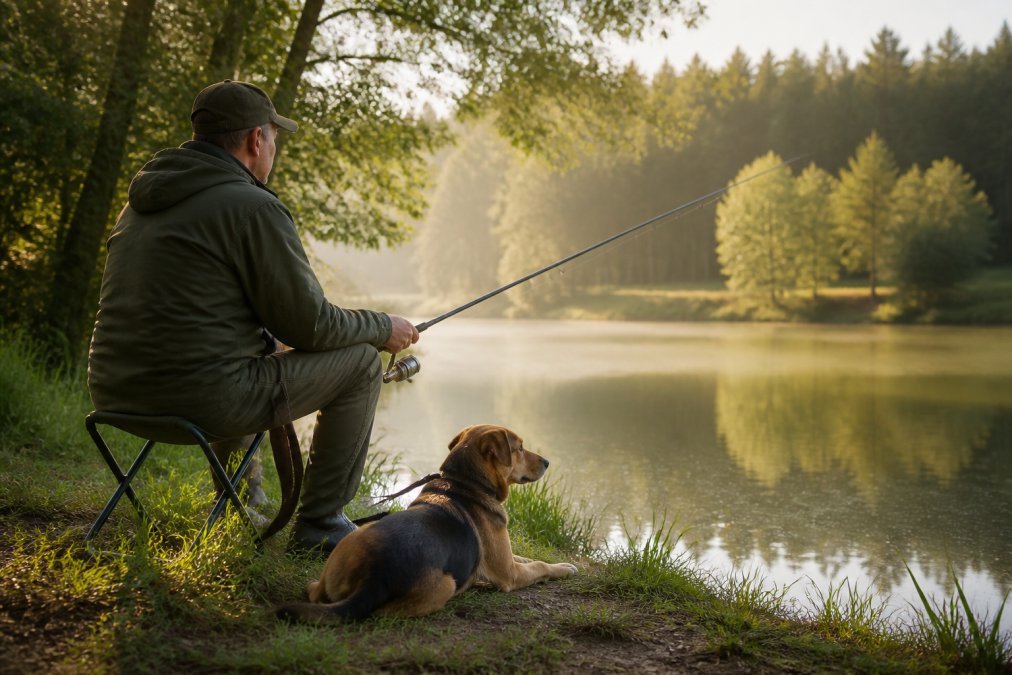
A fishing spot with a good fish population and fair rules is worth more than a well-known name. Keep these points in mind:
- A flat stretch of shore so the dog can stand safely
- Shaded spots for hot days
- Short distances to accommodations
- Clear Rules Regarding Leashes and Quiet Zones
How Dog-Friendly Are Different Types of Water Bodies?
Most guidebooks treat „fishing“ and „dogs“ as separate topics. This is precisely where the most important difference lies: It’s not the type of fish that determines whether a fishing spot is suitable for you and your dog, but rather the type of shoreline and the local fishing regulations. A rough classification by body of water type can help with the initial selection:
| Water Body Type | Beach Access | Suitability for Dog Owners | What to Look For |
|---|---|---|---|
| Small Forest Pond | flat, often marshy | very good | Soft ground, ticks, leash requirement in the woods |
| Reservoir | steeply sloping | conditional | Risk of Falling, Edge, No Swimming |
| Section of a river | varying, gravel banks | Good in low water | Water Flow, Weirs, Right of Public Access to the Riverbank |
| A club's pond facility | secured, narrow | conditional | Tight spaces; leashes are usually required |
Smaller ponds with shallow edges are better suited for beginners and families than deep reservoirs. Reservoirs often drop off steeply just a few meters from the shore, so it’s important to be careful with your dog there, especially if he likes to go into the water.
Which Fish Species Bite and When
When planning your day with your dog, the key factor is determining when you actually need to be by the water. In the Waldviertel region, classic pond and river fish are the most common:
- Carp, peak season from May through September; active in the early morning hours and at dusk
- Pike, spring and fall, preferably at dawn
- Zander, mostly at dusk and at night
- Trout, cool, oxygen-rich streams and ponds, spring and fall
- Tench and Whitefish, summer bottom fishing from the shore
If you're out with your dog, it's best to plan your hunting sessions for the cooler times of day. This works well both in terms of the dog's behavior and for the dog itself: the midday heat on the riverbank is stressful for both of you.
Check the park rules before booking
Whether your dog is allowed right at the fishing spot isn't specified in the fishing law, but rather in the rules for the respective fishing area. Some leaseholders explicitly allow dogs on the shore, while others exclude them on the map or require that they be kept on a leash and at a minimum distance from the water. Therefore, be sure to ask specifically before making any reservation:
- Are dogs allowed at the fishing spot, or only in the parking lot?
- Is a leash requirement in effect along the entire shoreline?
- Is the dog allowed in the water, and if so, in which areas?
- Are there any protected areas or breeding grounds that are off-limits?
Ask for the answer in writing—either by email or as a screenshot of the fishing regulations. On the shore, it’s the written confirmation that counts, not verbal information given over the phone.
The Waldviertel Lake District and Reservoirs: Where Dogs and Fishing Go Hand in Hand
Reservoirs are often deep and drop off steeply. It’s important to be careful with your dog there. Smaller lakes with shallow shores are better suited for beginners and families. As a rule of thumb: The smaller and shallower the body of water, the more relaxed your day with your dog will be, and the easier it will be to choose a fishing spot where your dog can lie in the shade while you keep an eye on your rod.
Dog-Friendly Accommodations in the Waldviertel: What to Look for When Booking
When it comes to dog-friendly accommodations in the Waldviertel, there’s more to consider than just whether dogs are allowed. The location, opportunities for exercise, and whether there’s a clean place for the dog to stay after fishing are all crucial factors.
Apartments Gutenbrunn This is a great place to stay. Anna and Herbert’s four apartments are located in a quiet area of Gutenbrunn; you can bring your dog on vacation, and the location near Lake Edlesberg makes it easy to get to the water. The layout, featuring a kitchen-dining area and bedrooms, is practical for families and active travelers.
Ask about the following with every booking:
- Does the lodging allow large, active dogs?
- Is there a meadow or a path right next to the house?
- Where can the dog dry off after fishing?
- Is the apartment accessible if someone in the group has limited mobility?
If you don't specify your dog's size in advance, you may often be turned away upon arrival. Always include the breed and weight in your booking request.
Fishing Vacation with Your Dog: Packing List—What to Pack in Your Suitcase and First-Aid Kit
A good packing list for a fishing vacation with your dog breaks things down into three categories: fishing gear, dog supplies, and a first-aid kit. Once you’ve made it, you’ll save time on every future trip.
Fishing Supplies
- Rod, reel, line, hook
- Fish net, pliers, measuring tape
- Fishing License and Fishing Area Permit
- Bucket, towel, disinfectant
Dog Supplies
- Leash and harness, even for use on shore
- Water Bowl and Food
- Blanket or mat to lie on
- Poop bags, towel, brush
Travel First Aid Kit
- Tick remover and wound ointment
- Bandages
- Poop Bags and Disinfection
- Copy of the vaccination record
The first-aid kit is the one thing almost everyone forgets. Tick removers and bandages don't cost much and can save your day if an emergency arises.
Rules of Conduct at the Water: Respect Leash Requirements and Quiet Zones
There are clear rules along the water. The leash requirement and quiet zones protect wildlife, other anglers, and your own dog. Anyone who ignores them risks administrative fines and the loss of their fishing license. Functional clothing also provides additional safety in the underbrush during changeable weather. Dog Clothing for Outdoor Activities, which protects your four-legged friend from getting wet and getting cold during long waits on the shore.
Unlike the Fisheries Act, there is no uniform regulation governing the requirement to use a line. Three levels are interrelated:
- Fishing Regulations for the Area, the leaseholder specifies in the fishing area regulations whether and how dogs are permitted at the fishing spot.
- Municipal Law, Many municipalities regulate leash requirements and access restrictions through their own ordinances, some of which are temporary.
- Environmental Protection Law, In protected areas, breeding zones, and conservation zones, additional rules regarding access and leash requirements apply, which take precedence over fishing regulations.
The most important rules:
- Tie up where required
- Keep a safe distance from other fishing spots
- Do not go into the water if it is prohibited
- Take your trash and any leftover string with you
- Stay calm; don't rush around on the shore
Why the rules are stricter for anglers than for walkers
A fishing spot is not a walking trail. Someone who stands in the same spot for hours has a different effect on wildlife than a passerby who moves on. That is why many fishing regulations require anglers with dogs to do more than just follow the general leash requirement:
- Leashing at the launch site, even in places where walkers are allowed to let their dogs run free
- Minimum Distance from the Water, usually a few meters, so the dog doesn't wade into restricted areas
- No free-range access during the breeding season, especially severe in the spring
- Do not bathe the dog, prohibited in many fishing areas because it scares away fish and destroys shoreline areas
Identifying Quiet Zones
Quiet zones are not always marked with signs. Typical characteristics:
- Reed beds and siltation zones along the shoreline
- Shallow-water areas with pondweed
- Islands and peninsulas with waterbird colonies
- Cordoned-off or marked sections on the hunting grounds map
Anyone who enters such an area with a dog risks not only a fine, but also trouble with other anglers, and in the worst case, having their day pass revoked by the leaseholder.
A dog running loose near the water is the most common reason why leaseholders refuse to issue fishing permits to anglers. Make sure you understand the leash policy before you buy your day pass—don’t wait until you’re at the water’s edge.
Practical Application at the Fishing Spot
- Keep the leash short, when other anglers are in sight
- Tie up the dog at a fixed point, not on the rod or the landing net
- After the drill Keep the dog on a leash for a moment before you tend to the fish
- Whiskers and Hooks Pick it up immediately—risk of injury to paws and mouth
- When approaching Ask another angler to take the dog and keep it calm
Many municipalities regulate leash requirements through their own ordinances. Check the rules for the fishing area in advance—not once you’re at the shore—and, if in doubt, ask the leaseholder what rules apply to dogs at the fishing spot.
Hiking with Your Dog: Dog-Walking Routes and Adventure Hikes Around the Fishing Spot
Hiking with your dog goes well with fishing. Around Gutenbrunn, there are hiking trails and quiet walking routes that are perfect even on rainy days.
Plan your day into two blocks: fishing in the morning, hiking in the afternoon. That way, your dog gets plenty of exercise and you get some exercise too. For families with children, short adventure hikes are better than long hikes.
- A quick walk before fishing to stretch my legs
- Lunch break with water and shade
- Afternoon Walk with Strict Leash Rules
- Evening walk right by the lodging
Emergency Veterinarians and Practical Tips for a Fishing Vacation with Your Dog
Finding emergency veterinarians nearby is an essential part of any travel plan. Before you arrive, note down the location of the nearest veterinary clinic with emergency services and save the number in your cell phone. Also ask your hosts—they know the area best.
Practical Tips for Everyday Life:
- Always bring water with you, even on short trips
- Check Your Dog for Ticks After a Swim
- When it's hot, go fishing early in the morning or in the evening
- Never leave children unattended near the water
- Bring your vaccination card and chip number
| Situation | Emergency measure | Afterwards |
|---|---|---|
| Found a tick | Remove it with tick tweezers | Follow this job |
| Cut along the shore | Clean the wound, apply a bandage | Veterinarian for a Deep Wound |
| Dog is limping | Stop the load | Call the veterinary clinic |
| Heat Exhaustion | Shade, water, cool | See a veterinarian |
Conclusion: This is how travel planning becomes a relaxing experience in nature
A fishing vacation with your dog in the Waldviertel stands or falls on how well you prepare. Sort out your license, fishing area, lodging, and packing list ahead of time, and then you’ll have time once you’re there for what really matters: peace and quiet, nature, and a good catch.
That’s exactly what Ferienwohnungen Gutenbrunn is designed for. The accessible apartments, the personalized service provided by Anna and Herbert, and the quiet location in Gutenbrunn are perfect for families, active vacationers, and dog owners. You can bring your dog on vacation; the water is just a short walk away, and the region offers plenty of opportunities for hiking, biking, and day trips.
Plan your getaway without the pressure of deadlines and book directly with Ferienwohnungen Gutenbrunn.
Frequently Asked Questions
Which lakes in the Waldviertel are suitable for anglers with dogs?
In the Waldviertel Lake District and at reservoirs, there are several bodies of water where fishing and walking your dog along the shore go hand in hand. It’s important to check the fishing regulations for each specific area in advance, as leash requirements and quiet zones may vary depending on the body of water. For a fishing vacation with your dog, it’s a good idea to choose areas with gentle, flat access to the shore and shaded spots.
What should I keep in mind when planning a fishing vacation with my dog?
Part of planning your trip includes obtaining a fishing license for Lower Austria, finding suitable accommodations, and selecting quiet fishing spots. Also, check the fishing seasons and closed seasons for the area, pack a first-aid kit for your dog, and find out in advance whether dogs must be kept on a leash at the body of water. If you book directly with your hosts, you can often get tips on walking routes and dog-friendly trails.
Are vacation rentals in Gutenbrunn dog-friendly?
Gutenbrunn Vacation Rentals expressly welcomes dogs. The accommodations are situated in a quiet location in the Waldviertel region and offer a great starting point for hiking trails, dog walks, and excursions to nearby bodies of water. Since the hosts provide personal assistance, you can ask questions about dog-friendly spots and the surrounding area right before your arrival.
What are the legal regulations governing fishing in Lower Austria?
In Lower Austria, anglers need a valid fishing license, which is available as a day pass or an annual pass, depending on the fishing area. In addition, there are closed seasons, minimum size limits, and, in some cases, restrictions on the number of rods. On the shore, you must also observe the leash requirement and designated quiet zones. The exact fishing regulations depend on the specific fishing area and should be checked before booking.

Comments are closed, but trackbacks and pingbacks are open.