


Hiking Trails for Families: How to Find the Right Trail
The right family hike is shorter than adults might think. If you’re planning a hike with children, you should tailor the route’s length, elevation gain, and type of experience to the youngest child, not to your own fitness level. This guide from Vacation Rentals Gutenbrunn summarizes what has proven effective in practice: from the rule of thumb for walking time to the packing list and emergency management. In addition to route selection, the Appropriate outdoor clothing for children whether the tour will remain a relaxing experience for everyone involved, even in changeable weather.
The most important rule is: It’s better to take a short hike full of adventures than a long hike that turns into a test of endurance. Kids don’t hike to rack up kilometers. They hike to dam up streams, collect rocks, and spot animals.
A common mistake is planning based on your own hiking pace. An adult can cover a distance in two hours that would easily take a family with a child four to five hours. Plan with plenty of time to spare, and you’ll have a relaxed day.
Planning Your Trip and Accurately Estimating the Distance
As a general guide for route length: Children up to age six can manage about three to five kilometers; children between the ages of six and ten, about six to ten kilometers; and older children can cover even greater distances. These figures are based on experience and are not strict limits. The key factors are physical fitness, stamina, and how you feel on the day.
Check in advance whether the route is suitable for children: wide trails instead of exposed paths, no climbing sections, and sure footing required only on short stretches. Hiking maps and hiking apps can help you assess the route, but they are no substitute for checking the actual elevation gain.
Elevation gain is an often-underestimated factor. For children, it matters more than the distance alone: 200 meters of elevation gain over two kilometers is more strenuous than five flat kilometers. Therefore, check not only the route length but also the cumulative elevation gain and the steepness of the climbs. A climb with a gradient of more than 10 percent is usually too much for children under six years of age.
Travel and Logistics: A Relaxed Start to the Day of Hiking
A relaxing day of hiking starts with a relaxed trip there. Plan your trip so you don’t have to rush, and pack your gear the night before. If you stay overnight in the region, you’ll save yourself the long trip on the day of the hike.
Your choice of transportation affects your route selection. If you travel by car, you’ll have more flexibility and can plan a loop hike with different starting and ending points. If you take the train or bus, you’re limited to the same stop for both the outbound and return trips, which means you’ll need to plan a loop hike or a one-way hike with a return trip by bus. Check in advance to see if the stop at your destination is still served in the afternoon; many hiking buses only run on weekends or during peak season.
For families with strollers or very young children, it’s worth checking the trail conditions: wide, gravel-covered forest roads are stroller-friendly, while narrow forest trails with roots and rocks are not. Hiking apps often show the trail conditions, but it’s more reliable to check the map provided by the local tourism association or ask the local municipality for a quick confirmation.
Plan your turnaround time, not just your destination. Decide on the latest time to turn back—for example, halfway through your trip. That way, you’ll never find yourself having to keep going in the dark or with tired children.
Calculating Walking Time: The Rule of Thumb for Children
The classic rule of thumb for adults is four kilometers per hour plus one hour per 300 meters of elevation gain. For children, multiply this time by a factor of 1.5 to 2. A route that takes two hours for adults will therefore take three to four hours of pure hiking time with children.
On top of that, there are breaks, which make up the majority of the day on family hikes. A good hiking route for families therefore ends earlier than the walking time alone would suggest.
Here’s a sample calculation: A route that’s eight kilometers long with 250 meters of elevation gain takes about two hours for adults, plus one hour for the elevation gain—so about three hours in total. Multiplying that by a factor of 1.5 to 2 brings you to four and a half to six hours of pure walking time. Add in breaks, and that fills up the whole day. For many families, a route like this is already too long.
Hiking Gear for Kids: What You Really Need
Good gear for kids is lightweight, fits well, and protects against sudden changes in the weather. A personal hiking backpack with a water bottle, rain jacket, and a small snack is usually enough. Adults should carry the heavy gear.
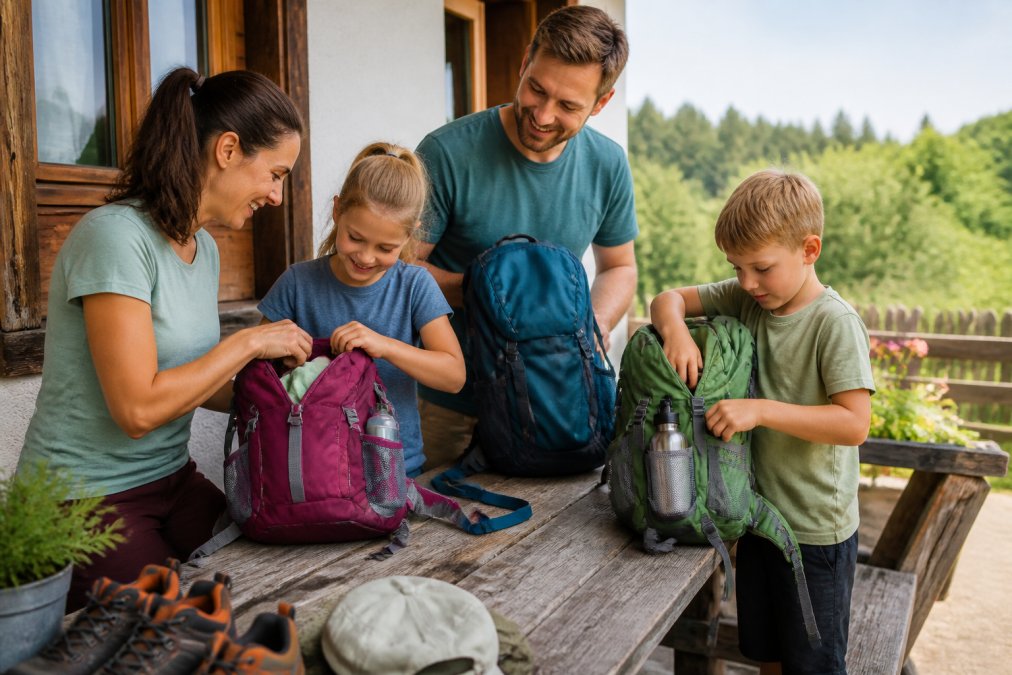
Hiking boots should fit snugly and be broken in. Wearing new boots on a hike is a common cause of blisters and bad moods. Layering your hiking clothes allows you to adjust quickly in case of heat or rain.
Hiking poles are optional for children, but they can provide stability on longer hikes. Every backpack should contain a first-aid kit, regardless of the length of the hike.
Hiking boots, clothing, and the layering principle
The layering principle means wearing several thin layers instead of one thick jacket. A base layer next to your skin, a warm layer on top of that, and a weatherproof layer on the outside. This allows you to adapt flexibly to temperature fluctuations and sudden changes in the weather.
Food for Hiking with Kids: Snacks and Light Meals
Snacks aren't a luxury on family hikes—they're a source of motivation. Kids need small snacks at regular intervals; otherwise, their spirits will drop faster than their stamina. Nuts, dried fruit, fresh fruit, granola bars, and sandwiches have proven to be good choices.
It's important to bring enough water. Allow about half a liter to one liter per child, depending on the weather and the length of the route. Sugary drinks are no substitute for water and actually make you thirstier.
Don't put snacks in plain sight at the top of the backpack. If kids can see all the snacks, they'll eat them all within the first half hour. Divide the snacks into small portions for each break.
Motivational Tips for Young Hikers: How to Keep Everyone in Good Spirits
Motivation comes from experiences, not from rewards. Children are more likely to keep moving if the hiking trail has something to offer: a stream, a meadow, a lookout point, or a cave. The nature of the experience is more important than the length of the trail.
A common mistake is mismanaging expectations. If you promote the hike as a „great adventure“ but then just walk straight ahead, you’ll quickly lose the kids’ interest. It’s better to announce small highlights and build them into the route.
Age-Appropriate Activity Ideas for When You're Out and About
For children between the ages of three and six, scavenger hunts work well: „Who can find the biggest rock?“ „How many birds can you hear?“ For children between the ages of six and ten, treasure hunts, nature bingo, or small tasks like collecting leaves for a herbarium are great options. Older children enjoy taking on responsibilities, such as leading the way with a hiking map or carrying the first-aid kit.
Making the Most of Breaks: Relaxation for Young and Old
When hiking with children, breaks are more important than the walking itself. Plan a short break every 30 to 45 minutes—don't wait until the children are tired. A break should last ten to fifteen minutes and include a snack and water.
Choose rest areas with places to sit, shade, and something to explore. A meadow with a stream is better than a bench by the side of the road. After a break, children often need a few minutes to get moving again.
Mountain Safety: What Families Should Keep in Mind
Safety starts with planning. Check the weather forecast, trail conditions, and the length of the hiking route in advance. Let someone know your destination and when you plan to return. Hiking apps and maps can help, but a charged cell phone is no substitute for proper preparation.
Children should never walk out of sight. On sections with limited visibility, one adult should walk in front and another behind. Sure-footedness can be practiced, but it cannot be forced.
Emergency Management with Children on a Hike
In an emergency, every minute counts. That’s why every hiking backpack should include a first-aid kit with band-aids, blister patches, bandages, a thermal blanket, and tick tweezers. Make sure you know the emergency number 144 for the ambulance service and save the number for mountain rescue, which can be reached throughout Austria by dialing 140. Both numbers work even without credit or a SIM card, as long as there’s cell service available.
The most common incidents on family hikes aren't dramatic falls, but rather minor problems that can escalate if not addressed in time. Here are four situations worth preparing for in advance:
Abrasions and scratches. Clean the wound with drinking water, then cover it with a bandage or a sterile compress. If the wound is bleeding heavily, apply direct pressure to it with a compress and apply a pressure bandage before continuing on or turning back.
Bubbles. Blisters are caused by friction and moisture, not by the distance walked alone. As soon as a child complains of pressure on the heel or toe, stop immediately, take off the shoe and sock, dry the area, and apply a blister bandage. If you wait until after two kilometers to take action, you’ll often find that your child no longer wants to keep walking.
Insect bites. In forests and meadows, ticks and horseflies are the most common culprits. Remove ticks with tick tweezers or a tick card as close to the skin as possible and as soon as possible. Cool the bite site if it itches or swells. If you’re stung in the mouth or throat, or if you’re having trouble breathing, call 144 immediately.
Twist your ankle. If someone sprains an ankle, follow the RICE rule: Rest, Ice (or cold water from a stream), Compression (bandage), Elevation. If the child can no longer walk, the hike is over; in that case, organize your way back instead of continuing on.
A first-aid kit is only useful if you know how to use it. Refresh your knowledge of the basics every two years, for example, by taking a first-aid course for emergencies involving children. Austrian emergency response organizations offer such courses on a regular basis.
Weather Changes and Abortion Criteria
A sudden change in the weather is the most common reason for cutting a hike short. Thunderstorms are often preceded by cumulus clouds gathering, a sudden increase in wind speed, and falling temperatures. During a thunderstorm, seek shelter in a hollow or dense forest, and avoid mountain peaks, open meadows, isolated trees, and streams.
Before the hike, work with the children to decide what constitutes a clear signal to stop: rain that won’t let up, a child who stumbles twice in a row, or a child who stops answering questions. If you discuss these signals in advance, you won’t have to debate them along the way.
The most important safety rule is: Turn back before the situation becomes critical. Abandoning the climb is not a failure—it’s the right decision. A sudden change in weather, exhaustion, or injury are clear signs that it’s time to head back.
Travel and Logistics: A Relaxed Start to the Day of Hiking
A relaxing day of hiking starts with a relaxed trip there. Plan your trip so you don’t have to rush, and pack your gear the night before. If you stay overnight in the region, you’ll save yourself the long trip on the day of the hike.
For families who want to stay for several days, vacation apartments with a kitchen-dining area and bedrooms are convenient. Ferienwohnungen Gutenbrunn in Gutenbrunn offers four apartments, some of which are wheelchair-accessible, and wheelchair accessible, with direct access to nature and personalized attention from Anna and Herbert. Dogs are welcome, which makes things much easier for dog owners.
| Task | When to do it | Why |
|---|---|---|
| Check the route and weather | The night before | Allows for last-minute changes to plans |
| Packing backpacks | The night before | Less Stress in the Morning |
| Plan Your Trip | Two days before | Buffer for Traffic Jams and Detours |
| Prepare snacks | On Hiking Day | Fresh and Easy Distribution |
| Save Emergency Numbers | Before Departure | Quick Access in an Emergency |
Common Mistakes When Preparing for a Hike with Children
The most common mistake is choosing a route that’s too long. This is followed by taking too few breaks, wearing the wrong shoes, and not bringing enough snacks. People also often only glance at the weather forecast, even though a sudden change in the weather can quickly affect their mood and safety.
Another mistake is failing to manage expectations. Children who don’t know how long the hike will take keep asking where they’re going. If you tell them in advance, „We’re going to the stream, then we’ll take a break, and then we’ll head back,“ things will be much easier.
Conclusion: With good preparation, the hike becomes a family adventure.
A successful hike with children isn't a matter of physical fitness, but of preparation. Short distances, realistic walking times, good gear, regular breaks, and clear agreements make all the difference.
For anyone planning to spend several days in the region, accommodations with direct access to nature are well worth considering. Ferienwohnungen Gutenbrunn offers barrier-free and wheelchair-accessible apartments with a kitchen-diner and bedrooms, personalized service from the hosts, and a peaceful location in the Waldviertel region—the perfect starting point for hikes and excursions. If you’d like to book directly, you’ll find all the information you need on the Ferienwohnungen Gutenbrunn website.
The biggest challenge when hiking with children isn’t the route itself, but the expectation that you have to plan everything perfectly. With short stretches, realistic time estimates, and accommodations that serve as a quiet base, your hiking day will be much more relaxing. Ferienwohnungen Gutenbrunn offers accessible apartments, personalized service from Anna and Herbert, and a location that makes hikes and excursions possible without a long commute. Plan your next family hike with Ferienwohnungen Gutenbrunn as your starting point and head straight out into nature.
Frequently Asked Questions
How long should a hike with children last?
As a general guideline, children walk about two to three kilometers in an hour, depending on their age and fitness level. For a relaxed family hike, it’s best to plan for two to three hours of walking time, plus plenty of breaks. For younger children under five, shorter routes of three to five kilometers are recommended. It’s better to plan a shorter hike and extend it if everyone’s in good spirits than to have to cut a hike short because it’s too long.
What gear is essential for children when hiking?
Good footwear with a treaded sole is the most important investment, along with weatherproof clothing layered according to the “onion principle.” Having their own small hiking backpack fosters a sense of responsibility and should contain a water bottle, snacks, and a rain jacket. Hiking poles help on steep sections and take some of the strain off the knees. Just in case, adults’ backpacks should include a first-aid kit, sunscreen, and an emergency medicine kit.
How can I get kids excited about hiking?
Motivation works best when it’s based on the experience itself rather than on performance. Plan in intermediate goals—such as a stream, a lookout point, or a cabin—that the children can work toward. Games along the way, like collecting special leaves or counting animals, help keep their attention engaged. Praise each section completed and let the children help decide where to take the next break. This way, the hike becomes an adventure rather than a chore.
What should be included in a first-aid kit for family hikes?
A good first-aid kit should include band-aids in various sizes, blister bandages, antiseptic, gauze bandages, and a thermal blanket. Additional essentials for children: a thermometer, pain relievers in child-appropriate doses (as prescribed by a doctor), insect bite ointment, and sunscreen with a high SPF. When hiking at higher elevations or in case of a sudden change in weather, be sure to pack an emergency contact list with the numbers for mountain rescue and your parents.

![”Couple by the lake: A woman in a wheelchair is being pushed by her husband in front of a forest and the water; an advertisement for accessible vacations by the lake."], ,](https://www.ferienwohnungen-gutenbrunn.at/wp-content/uploads/2026/09/Barrierefreie-Wohnungen-see-anna-und-herbert-2-150x150.png "Accessible Apartments \"See Anna and Herbert\" - Vacation Rentals in Gutenbrunn")
Comments are closed, but trackbacks and pingbacks are open.