


Table of Contents
- Safety Tips for Bicycle Tours in the Waldviertel: Why Preparation Makes All the Difference
- Bike Check Before Your Ride: Check the Brakes, Tires, and Lights
- Bike Tour Packing List: What to Pack in Your Saddle Bag
- Planning Bike Tours in the Waldviertel: Choosing a Route, Elevation Profile, and Navigation
- How many kilometers should you ride a bike each day?
- Forest-Specific Hazards and Behavior on Forest Roads
- Rules and Consideration in the Forest
- Weather, Visibility, and Remote Routes
- Emergency Planning and Assistance on a Bicycle Tour
- Safety Tips for Bicycle Tours in the Waldviertel: Conclusion and Next Steps
- Frequently Asked Questions
Last updated: October 15, 2026
Safety Tips for Bicycle Tours in the Waldviertel: Why Preparation Makes All the Difference
Safety tips for bike tours in the Waldviertel begin long before you take your first pedal stroke. If you know the route, check your bike, and prepare for emergencies, you’ll be able to enjoy the quiet forests between the Thaya and Kamp rivers in a relaxed, rather than stressed, state of mind. Good preparation makes all the difference: Visitors who set out in the morning and return relaxed in the evening almost always have one thing in common—they are planning their tour.
The Waldviertel isn’t high mountains, but it’s not flat city terrain either. There are long gravel sections, secluded forest trails, and stretches where you won’t see a soul for hours. That’s exactly what makes the region so beautiful. But it also makes it a place where a flat tire or a sudden change in weather can quickly become a problem if you’re not prepared.
This guide takes you step by step through the most important safety checks. You’ll learn how to inspect your bike, what to pack in your saddle bag, how to choose a safe route, and what to do in an emergency. The following nine sections cover everything you need to know for a safe bike ride.
The three biggest risks on bike tours in the Waldviertel aren't traffic, but poorly maintained brakes, underestimating the length of the route, and sudden changes in the weather on remote stretches. If you take these three points seriously, you've already taken care of most of the safety considerations.
Bike Check Before Your Ride: Check the Brakes, Tires, and Lights
A bike check before your ride takes ten minutes and prevents most breakdowns. Check your brakes, tire pressure, tread depth, lights, and reflectors before you set off. This quick routine is especially worthwhile in the Waldviertel, where help can be far away on remote forest roads.
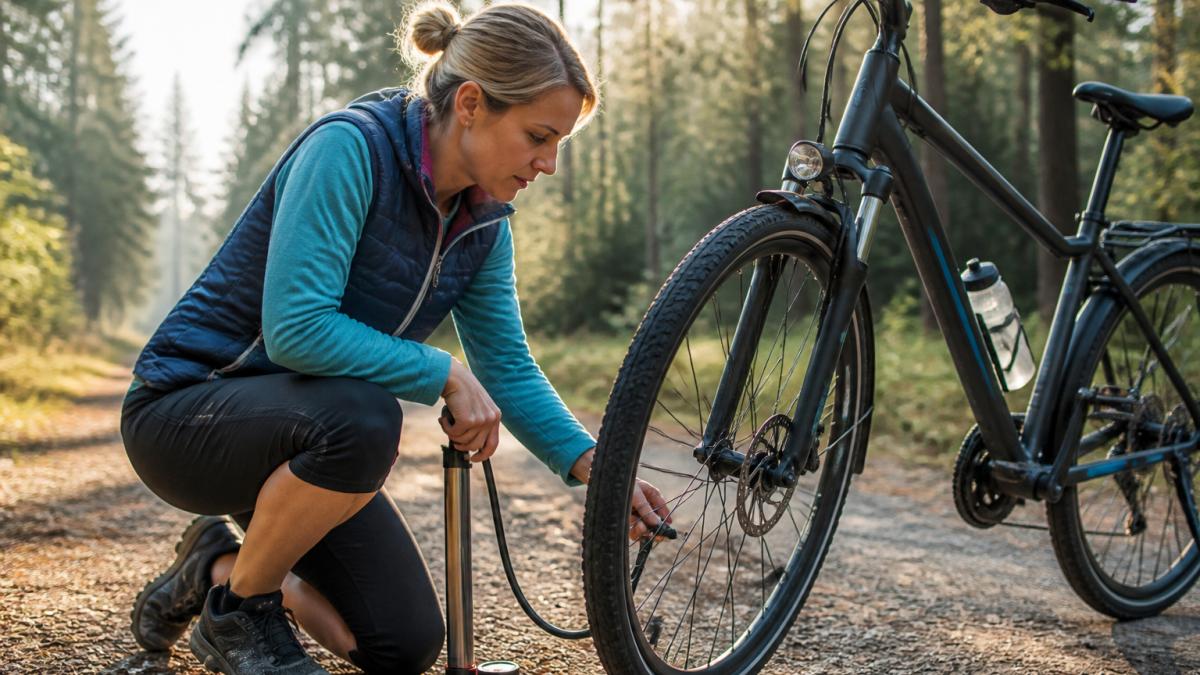
Check the brakes, tire pressure, and tire tread
Brakes are the most important safety feature on a bike. Squeeze both brake levers and check that they engage before the lever touches the handlebars. A spongy feel usually indicates air in the hydraulic system or worn brake pads.
For disc brakes, there’s a simple rule of thumb: If you can no longer clearly distinguish the brake pads from the backing plate, or if the brake rotor shows grooves, it’s time to replace them. For rim brakes, check the brake pads for embedded metal shavings and see if the braking surface of the rim still has a visible wear mark. If the mark is no longer visible, the rim needs to be replaced.
When it comes to tire pressure, the rule is: Too little pressure leads to punctures on gravel; too much pressure leads to poor traction on loose surfaces. The optimal pressure is usually marked on the tire sidewall. As a guideline for rides in the Waldviertel: On gravel and forest trails, set the pressure to the lower end of the recommended range; on asphalt, set it to the upper end. Check the tread depth, because worn-out tires can easily lose traction on wet forest floors. Any tire with a visible carcass or cracks in the tread should be replaced before your ride.
- The front and rear brakes bite firmly, with a consistent bite point
- Brake pads have visible remaining thickness; rotors have no grooves
- Tire pressure set according to the manufacturer's specifications and adjusted for the road surface
- Tread depth is sufficient; no cracks or visible carcass
- Quick-release levers and axles are tightened securely
- The chain runs smoothly and is oiled
- The transmission shifts smoothly through all gears without skipping
- The seatpost and handlebars are secure
Lights, Reflectors, and Bell
Visibility is more critical on forest trails than on any road. Twilight sets in earlier under the trees, and an oncoming cyclist won’t see you until it’s too late. Make sure your front and rear lights have fully charged batteries. A dim rear light is barely noticeable in daylight, but it stands out immediately in the woods at dusk.
Reflectors on pedals, spokes, and the rear of the bike are required and cost nothing. A bell isn't a luxury on shared paths—it's a matter of consideration. It lets pedestrians and horseback riders hear you early enough.
Check the e-bike battery and motor
When it comes to e-bikes, there’s one factor that many people underestimate: the battery. Check the charge level before every ride and plan your range with a buffer. Cold weather noticeably reduces battery performance, which is why your range decreases on chilly Waldviertel mornings. A rule of thumb: Never plan on more than two-thirds of the stated maximum range, because hills, headwinds, and low temperatures drain the battery even further.
Also, check the contacts on the battery and the frame for dirt and moisture. A dirty contact can cause the motor to stop working in the middle of your ride. On longer rides, bring your charger with you if you plan to stop at a place with an outlet.
Reinflate your tires before every ride, even if the bike has been sitting for just a week. Tires lose pressure over time, and a half-empty tire is the most common cause of a flat on gravel.
Make these checks part of your routine: check your brakes and tire pressure before every ride, check your chain and derailleurs once a week, and check your brake pads and tire tread once a month. That way, you’ll notice wear and tear before it becomes a problem on the trail.
Bike Tour Packing List: What to Pack in Your Saddle Bag
A good bike tour packing list is short but complete. Be sure to bring tools, a first-aid kit, water, weather gear, and a fully charged cell phone. All together, it weighs just a few kilograms, but in an emergency, it can save your entire trip.
First-aid kit and roadside assistance kit
Every trip should include a repair kit, no matter how short it is. Expect the unexpected, not the best-case scenario.
- Repair kit or spare tube
- Tire lever and small pump
- Multitool with Allen and Torx wrenches
- Chain lock as a replacement
- First-aid kit with band-aids, gauze bandages, and antiseptic
- Personal Medications
- Charged cell phone with a power bank
- Enough water and a snack
- A rain jacket and a light layer for cool wooded areas
It's a good idea to take a first-aid course before planning longer trips. You can learn the basics of wound care and the recovery position in just a few hours. For information on courses in your area, visit Austrian Red Cross.
Planning Bike Tours in the Waldviertel: Choosing a Route, Elevation Profile, and Navigation
Planning bike tours in the Waldviertel means realistically assessing the route length, elevation profile, and terrain. The Waldviertel is rolling—not steep—but the cumulative effect of many small climbs takes its toll. It’s better to plan shorter rides and enjoy them more.
Car-free routes and low-traffic routes
The region has some of the best car-free bike paths in the country. Former railroad tracks are the centerpiece, as they allow you to ride on gentle slopes without any car traffic. The Thayarunde and the Reblausexpress Bike Path are among the best known. Both run along old railroad tracks for long stretches.
For Families with children These routes are ideal. They are wide, well-paved, and have very few inclines. The Iron Curtain Trail along the former border also offers long, peaceful stretches.
Routes by Bike Type: Road Bike, Gravel Bike, Mountain Bike, and E-Bike
Not every route is suitable for every bike. Choose your surface based on your bike type.
| Bicycle Type | Suitable Substrate | Suitability for the Waldviertel Region |
|---|---|---|
| Road Bike | Asphalt, slippery side streets | Performs well on paved roads; avoid gravel |
| Gravel Bike | Gravel, forest trails, asphalt | Ideal for the region |
| Mountain Bike | Forest trails, tree roots, coarse gravel | Perfect for remote routes |
| E-bike | All paved paths | Good for long trips; plan your battery usage |
The route planner of your choice should display the elevation profile and surface conditions. Check in advance to see if any sections are closed or might be closed. You can find up-to-date information on bike paths in the region at Lower Austria Tourism.
How many kilometers should you ride a bike each day?
How many kilometers should you ride a bike each day? For recreational cyclists, 40 to 60 kilometers a day is a good guideline; for families with children, 20 to 35 kilometers is more appropriate. Longer distances are possible on e-bikes, but the battery limits the range.
The number on the odometer says little about the actual exertion. In the Waldviertel, elevation gain and terrain matter more than sheer distance. Ten kilometers of gravel with climbs take just as much energy as twenty kilometers of flat asphalt.
An honest test: Ride half the planned distance and see how you feel. If you’re still up for more afterward, the distance is right. If not, cut it short. It’s not a competition—it’s a vacation. If your energy starts to flag, take a look at the Essential Bicycle Tools, so you can get back on the road quickly in the event of minor breakdowns and continue your trip safely.
The most common mistake is planning the first ride to be too long. If you push yourself too hard on the first day, you’ll spend the rest of your trip dealing with sore muscles instead of riding your bike. Start with a short ride and work your way up.
Forest-Specific Hazards and Behavior on Forest Roads
Hazards specific to the forest differ significantly from those encountered in road traffic. On forest roads, you’ll encounter gravel, roots, wildlife crossings, and sometimes heavy equipment. If you’re aware of these hazards, you’ll drive with foresight and safety in mind.
Gravel, Roots, and Forest Roads
Loose gravel is the most common cause of falls. When cornering, it causes your front wheel to drift outward. Brake before the turn, not into it, and keep your upper body relaxed.
Tree roots can be especially dangerous after it rains. They’re slippery and often covered by leaves. Ride with slightly higher tire pressure and, whenever possible, drive over roots at a right angle.
Forest traffic is rare, but serious. A loaded timber truck takes up the entire width of the road and cannot brake quickly. Expect oncoming traffic on curves and at the tops of hills.
- Drive based on visibility, not on time
- Ring your bell before blind curves
- When you encounter someone, stay on the right
- Get off when the path gets too narrow
- Be prepared for wildlife crossing the road at dusk
A loaded logging truck has a stopping distance that is many times longer than your own. If you hear it but can't see it, pull over to the side of the road and wait. A few seconds cost nothing; a collision costs everything.
Rules and Consideration in the Forest
In Austria, biking in the forest is generally permitted on designated trails. Outside of these trails, you need the landowner’s permission. The exact rules are set forth in the Forestry Act, which can be found at Federal Ministry of Agriculture and Forestry.
Forests are first and foremost places of work and habitats, not sports facilities. Foresters, hunters, and forest workers have priority. Hikers and horseback riders are slower users of the trails and deserve consideration.
- Stay on the marked trails
- Close the pasture gate behind you
- Please take your trash with you
- Do not drive through young trees
- Keep Your Distance from Wild Animals
- Greet people coming toward you
These rules aren't just a formality. They ensure access for everyone who comes after you.
Weather, Visibility, and Remote Routes
The weather in the Waldviertel can change quickly. Fog, rain, and cold are more common here than in the lowlands. Check the forecast in the morning and allow for some extra time.
Visibility is crucial on remote routes. Wear light-colored clothing and reflective elements, even during the day. Under a dense canopy of leaves, it gets dusky sooner than you might think.
Cold is an underestimated risk. On long descents, you can quickly get chilled, especially if you're sweaty. A lightweight windbreaker in your saddle bag weighs almost nothing and keeps you warm.
Plan your trip so that you’ll be back at least two hours before sunset. In the Waldviertel, it gets dark much earlier under the trees than in open areas, and the last few kilometers in the twilight are the most dangerous.
Emergency Planning and Assistance on a Bicycle Tour
Emergency planning starts with a simple question: What if something happens? Let someone know where you’re going and when you plan to be back. That’s the most important safety measure of all. A quick message with the route name, planned route, and estimated return time is enough—and a second call if you take a shortcut or change your plans while on the way.
Save the emergency number 112 and the mountain rescue number in your cell phone. Check in advance to see if your route has cell service. There are dead zones in some wooded areas, so plan your route accordingly.
When There's No Signal: Here's How to Make an Emergency Call Anyway
In Austria, the 112 emergency number works even without a home network, provided that any other network is available—the cell phone will then connect to a different network. This requires that a SIM card be inserted and the device be turned on. Without a SIM card, it is not possible to make an emergency call.
If you’re in a dead zone, simply moving around can often help: Take a few steps, find a clearing, or head to higher ground. Dense tree canopies and narrow valleys block the signal. If there’s no signal at all, you have two options: Wait in a spot where you can be heard or seen, or set off on foot toward the nearest settlement—leave your bike behind as a marker.
Send Your Exact Location
When reporting an incident, your exact location is important. If possible, provide the name of the road or route, the nearest town, and the direction you’re traveling. Use your cell phone’s emergency coordinates: On most devices, the emergency call feature or a map app displays your current coordinates, which you can provide to the dispatch center.
A screenshot of the Maps app showing your location is a quick alternative when you're messaging someone. Before your trip, save the most important waypoints along your route so you can find your way even without a network connection.
First Aid and What to Do at the Scene of an Accident
If you come across an accident, provide first aid to the best of your ability. Secure the area, call emergency services, and stay with the person. Check for consciousness and breathing, keep the person warm, and do not move them unnecessarily if you suspect a spinal or head injury.
It's a good idea to take a first-aid course before planning longer trips. You can learn the basics of wound care and the recovery position in just a few hours. For information on courses in your area, visit Austrian Red Cross.
Breakdowns and Self-Help
Not every breakdown is an emergency. A flat tire, a broken chain, or a dead battery can often be fixed on your own if you have the right tools with you. Before you set out, check to make sure you have a repair kit, a spare inner tube, a tire lever, a pump, and a multitool.
If you get stuck, the nearest rest stop or bike rental shop in the area is often the quickest way to get help. Ask there for a repair shop or a taxi that can transport your bike. In case of major breakdowns, it’s a good idea to save the number of a local taxi company that transports bikes in advance.
Don't count on your cell phone having service in the woods. Plan every hike as if there were no cell service: share your route, bring a charged power bank, pack enough water, and aim to return before dusk.
- Share your route before you leave
- Save emergency numbers offline
- Check network coverage and plan for dead zones
- Bring a power bank with you
- Save the coordinates of important waypoints
- Stay with injured people until help arrives
- Have a phone number on hand for bike transport
Safety Tips for Bicycle Tours in the Waldviertel: Conclusion and Next Steps
Safety tips for bike rides in the Waldviertel can be summed up in one sentence: If you set out prepared, you’ll have a better time. A well-maintained bike, a realistic route, and a plan for emergencies can turn an uncertain ride into a relaxing tour.
The following are great starting points for your next bike ride: Vacation Rentals in Gutenbrunn. Our four accessible apartments are located in a quiet setting in the heart of the Waldviertel region. We provide personalized service and are happy to give you tips on tours that suit your bike and fitness level. You’re also welcome to bring your dog, as many of the quiet side roads are perfect for taking a break with your four-legged friend.
Plan your trip, check your bike, and start the season well-prepared. Book directly with us and look forward to a bike tour you’ll remember because it was wonderful—not because something went wrong.
Frequently Asked Questions
Which bike trails in the Waldviertel are suitable for a safe ride?
For a safe bike ride in the Waldviertel, car-free paths and routes with little traffic are particularly suitable. The Thayarunde follows a former railroad right-of-way and is therefore wide and easy to ride on. The Reblausexpress Bike Trail and sections of the Iron Curtain Trail also offer peaceful riding conditions. If you’re traveling with children, it’s best to choose flat loop routes with minimal elevation gain. Check the route length, difficulty level, and surface conditions in advance to ensure the route suits your fitness level and bike type.
What equipment is essential for a bike ride in the woods?
You’ll need more gear on forest trails and in wooded areas than you would on paved roads. A bike helmet, working lights, and reflectors are required, especially at dusk. Bring a repair kit with a spare inner tube, tire levers, and a pump. A first-aid kit, plenty of water, and fully charged navigation devices are also essential. For longer tours in the Waldviertel, a rain jacket is also recommended, as the weather can change quickly on remote routes.
How do I prepare my bike for a long ride?
A bike check before your ride takes only a few minutes and prevents most breakdowns. First, check the brakes: Both brake pads should apply even pressure. Check the tire pressure and tread depth, especially if there’s gravel or tree roots on the route. Test your lights and reflectors. Check that the gears, chain, and all bolts are tight. If you ride regularly, you should perform this check before every long bike ride in the Waldviertel.
How do I plan a bike ride that suits my fitness level?
Plan your route length realistically. Untrained cyclists often manage only 30 to 40 kilometers per day on hilly terrain, while experienced cyclists can cover significantly more. In the Waldviertel region, the elevation profile and road surface also come into play, which can extend the duration of the ride. Plan breaks and choose loop routes with options to cut the ride short. A route planner can help you estimate the distance and difficulty level in advance. Start with shorter rides and work your way up, rather than pushing yourself too hard on the first day.

Comments are closed, but trackbacks and pingbacks are open.