


Table of Contents
- Why the Waldviertel Is the Perfect Hiking Destination for Families
- Stroller-Friendly Hiking Trails in the Waldviertel
- Hiking with Kids: Practical Tips for Successful Family Hikes
- Nature Experiences and Viewpoints for Children
- Circular Hiking Trails with an Adventure Element
- Logistical Details for Parents: Travel and Places to Stop for Refreshments
- Seasonal Recommendations for Family Outings
- Your base for hikes in the Waldviertel
- Conclusion
- Frequently Asked Questions
Last updated: September 25, 2026
Why the Waldviertel Is the Perfect Hiking Destination for Families
The Waldviertel is one of the most diverse hiking regions for families with children. The region offers an impressive mix of child-friendly trails, nature experiences, and the practical amenities parents need. Whether you’re out and about with toddlers in a stroller or want to explore more challenging trails with older children—the The Five Best Hiking Trails in the Waldviertel for Families cover all requirements.
What makes this region special is not only the variety of hiking trails, but also the balance between unspoiled nature and comfort. Many routes are stroller-friendly, while others offer an adventurous experience that really motivates children. Ferienwohnungen Gutenbrunn is centrally located in the Waldviertel, making it the ideal base for your family outings—with personalized service from Anna & Herbert and accessible accommodations that welcome families with a variety of needs.
The Waldviertel has less mass tourism than well-known hiking regions, which means more peace and quiet, fewer crowds on the trails, and more authentic nature experiences for your family.
Stroller-Friendly Hiking Trails in the Waldviertel
Ednesberg Lake Loop Trail
The Edlesberger See Loop Trail is one of the most popular hiking trails for families with young children. The trail is fully stroller-friendly, well-marked, and offers consistent views of the lake. The total distance is about 4 kilometers, and the walking time is approximately 60 to 90 minutes—depending on how often you take breaks.
What makes this trail special: There are several places to stop right by the lake where you can take a break and let the kids play. The terrain is mostly flat and well-maintained. For families with babies or toddlers, this is one of the safer options, as the route is close to amenities and you’re never far from a place to take a break.
Litschau Themed Trail
The Litschau Themed Trail combines the joy of hiking with a learning experience—a great benefit for children who love to discover new things. The route is about 5 kilometers long and takes an average of 90 to 120 minutes to complete. The trail is also suitable for strollers, although some sections can be a bit more challenging.
What makes this trail special are the informational signs along the route, which teach children interesting facts about the flora, fauna, and local history. This turns the hike into more than just a walk—it becomes an expedition. Many parents report that children are much more motivated on themed trails because they know there’s something to discover.
| Hiking Trail | Distance | Walking time | Baby carriage | Difficulty |
|---|---|---|---|---|
| Ednesberg Lake Loop Trail | 4 km | 60–90 min | Yes | Light |
| Litschau Themed Trail | 5 km | 90–120 min | Conditional | Easy-Medium |
Hiking with Kids: Practical Tips for Successful Family Hikes
Checklist for Parents: What You Really Need
Most hiking guides list what you should bring along. But parents need more than that: They need to know, where they can change diapers, whether the stroller fits on this route, and such as They motivate the children when their energy levels drop.
Here is a practical checklist that goes beyond the usual tips:
Before the hike:
- Check the route for stroller accessibility: path width (at least 1.2 m for a buggy), surface (asphalt, gravel, forest soil?), inclines greater than 5 %
- Find out where there are changing facilities: Which inns along the route have changing tables? (Many small restaurants in the Waldviertel have them, but not all.)
- Identifying drinking water sources: wells, inns, lakes with drinking water taps
- Mark emergency turnaround points: Where can I quickly get back to the car if a child can't go any further?
Equipment by Age:
- Babies (0–2 years): A lightweight stroller or baby carrier (better for forest trails). Changing pad, wet wipes, and diapers for twice the duration of the planned trip. Sunshade for the stroller.
- Toddlers (ages 2–5): A lightweight backpack for the child (with their favorite toy), a water bottle with a handle, and snacks in bite-sized portions. A spare T-shirt (kids get wet).
- School-age children (ages 6 and up): A small backpack of their own with water and snacks, so they can take on some responsibility. Binoculars or a magnifying glass for observing nature.
Meals that work:
- Not: Chocolate, gummy bears (sugar crash after 30 minutes)
- Yes: apple slices, nuts, cheese cubes, whole-grain granola bars, dried fruit
- Drink: Water with lemon juice (tastes better, so kids drink more)
- Schedule: Take a short break every 30–45 minutes to have some water and a snack—don't wait until the child is tired
Motivation Through Gamification: How Children Really Keep Going
The biggest secret: Kids don't go hiking for the sake of nature. They go hiking because there's a game along the way.
Incorporate scavenger hunt elements:
- Before the hike: Print out or write down some simple tasks („Find a rock that looks like a heart,“ „Count how many different kinds of birds you hear,“ „Collect three different leaf shapes“)
- Along the way: Have the kids collect or observe things; at the end, there’s a small reward (not candy—more like an extra story at bedtime, a sticker, or an entry in the hiking log).
Nature Bingo for Longer Hikes:
- Create a simple bingo card with pictures: squirrel, mushroom, feather, anthill, stream, flower (red/yellow/blue), beetle, bird
- Children check off what they see
- Five in a row = a little surprise
Goal Motivation:
- Not: „We’re going for a 5-kilometer hike“
- Yes: „We’re going to the lake, where we can throw rocks into the water“ or „We’re going to look for the old castle on the hill“
- On the Way: Mention the destination regularly („15 minutes until we reach the lake“)
Making the Most of Breaks:
- Passive breaks (just sitting) lead to impatience
- Active breaks: Throwing pebbles into the stream, playing hide-and-seek, climbing trees, observing insects
- Duration: 10–15 minutes, then move on (longer breaks make children sluggish)
A tried-and-true tip: Let the kids help plan the route. If they know that she Since they chose this route, they're much more motivated to walk it. Show them the map and let them pick the destination.
Realistic Time Management and Breaks
The rule of thumb „double the time with children“ is a good starting point, but it’s imprecise. A better approach:
- With toddlers (under 4 years old): Estimate 2–3 km per hour, plus a 10-minute break for every 30 minutes of hiking
- With school-age children (ages 5–10): 2.5–3.5 km/hour, plus a 5–10-minute break for every 45 minutes of hiking
- With older children (ages 10 and up): 3–4 km/hour, with breaks as needed
Example: A 4-km walk with toddlers takes not 60 minutes, but 90–120 minutes (including breaks). Plan generously—a relaxed day is better than stress and tears.
Common mistake: Setting goals that are too ambitious. A child who is overwhelmed won't go faster—they'll actually slow down and get tired. It's better to take a shorter route that's fun than a long one that's frustrating.
Nature Experiences and Viewpoints for Children
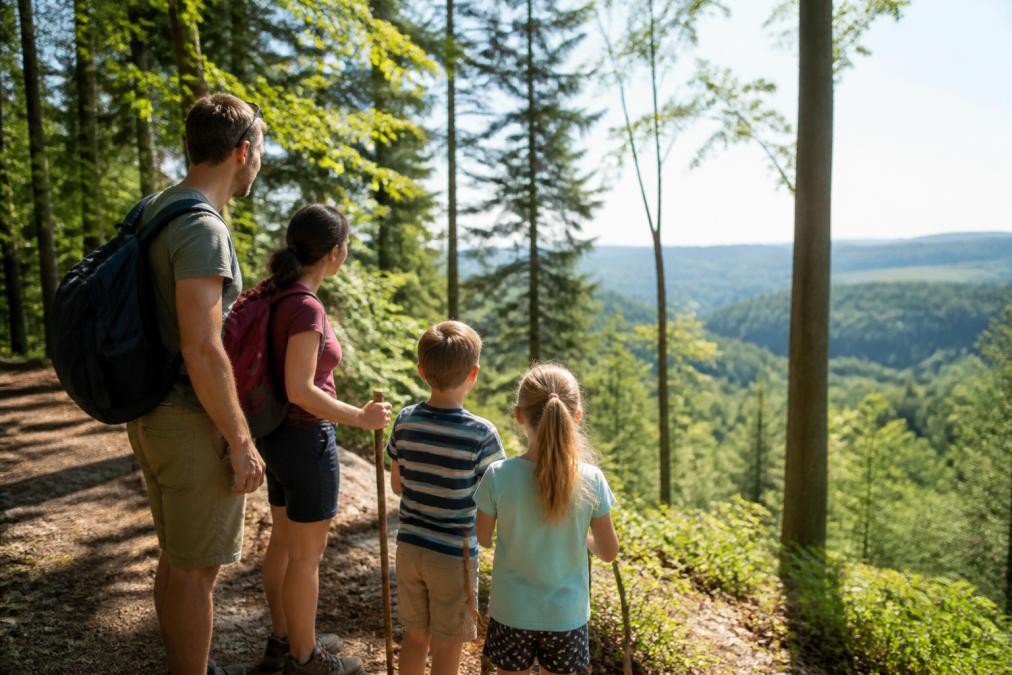
The best hiking trails aren't just long—they also offer authentic experiences of nature. In the Waldviertel, there are several lookout points that are especially exciting for children—not just because of the view, but because they can discover something special there.
A natural landmark is often a large tree, a rock formation, or a geological phenomenon. For children, it’s a place of adventure. A lookout point isn’t just a vantage point—it’s a place where you can see the world from above. This psychological aspect—the change in perspective—is incredibly important for children’s perception.
Many hiking trails in the Waldviertel are specifically designed as adventure trails. That means there’s more to see and discover than just trees and meadows. Streams, forest paths with unique features, and little surprises—these are what really keep kids engaged.
Circular Hiking Trails with an Adventure Element
Rocky Paths and Forest Trails
A loop trail has the great advantage that you end up back at the starting point—no need to walk back the same way. This is psychologically important for children, who might otherwise feel like they „have to walk the whole way again.“.
The so-called “wobbly rocks” are geological curiosities in the Waldviertel: large boulders balanced on top of other rocks that sometimes actually wobble. For children, this is both fascinating and a little spooky. Forest trails that wind through natural woods offer a change of pace from the wide forest road—narrow paths, stepping over roots, ducking under branches. It’s adventure tailored to their age level.
Castle Ruins and Natural Landmarks
Castle ruins are a magnet for children. Exploring an old castle and getting a sense of its history—that’s no longer just an abstract hike, but a journey through time. In the Waldviertel, there are several castle ruins that are accessible via hiking trails and, in some cases, can be explored on foot.
The journey to a castle ruin is often the real adventure. A path that leads uphill, a view that changes with every meter, and then the ruin itself—a real destination that children understand and that motivates them to keep going.
Logistical Details for Parents: Travel and Places to Stop for Refreshments
Directions and Parking: Practical Information
Most of the hiking trails in the Waldviertel are easily accessible by car. This is a big advantage for families who don’t want to spend hours driving. The region is centrally located in Lower Austria and can be reached from Vienna in about 90–120 minutes (depending on the starting point).
Important for parents:
- Parking spots right at the trailhead save energy. A child who has to walk 500 meters to the actual trail before the hike even begins will already be tired by the time they start.
- Many popular Waldviertel trails have small parking lots (often free), but they can get full when the weather is nice. On summer weekends, start early (before 9 a.m.) or go on weekdays.
- Parking lots with restrooms are a plus—not all of them have them. Be sure to check in advance.
Traveling with young children:
- Long car rides + hiking = too much. Better: Stay in the Waldviertel and explore different trails from there over several days.
- If you're traveling from out of town: Your first route should be short (2–3 km) so that the children aren't overwhelmed after the ride.
Places to Stop for Refreshments: More Than Just Breaks
Places to stop for a break aren’t a luxury—they’re essential. A child who knows they’ll reach a lake with an inn in 45 minutes hikes differently than a child who doesn’t know when they’ll get water.
Types of places to stop for refreshments in the Waldviertel:
Inns and Restaurants:
- Many inns in the Waldviertel region are child-friendly (high chairs, changing tables, quick meals)
- Typical dishes: Wiener schnitzel, potato pancakes, Waldviertel specialties
- Please note the opening hours: Many places are closed between 2:00 p.m. and 5:00 p.m. (lunch break)
- Reservations are recommended, especially on weekends
Cafés and snack spots:
- Smaller, more informal options
- Often with a yard or patio (important for children who need to run around)
- Drinks and simple snacks (cakes, breads)
Lakes with swimming areas:
- Many lakes in the Waldviertel have small kiosks or restaurants
- Perfect for families: Combine a hike, a swim, and a stop for refreshments
- Summer season: May through September (it can get crowded outside of these months)
Changing stations and restrooms:
- Not all inns have changing tables—ask in advance
- Public restrooms: Available at larger lakes and in towns, but not everywhere
- Tip: Bring a small, portable changing pad (fits in any backpack)
Seasonal Variations in Dining Options
Spring (April–May):
- Many inns are reopening after winter
- Patios aren't open for use everywhere yet (due to the weather)
- Fewer tourists = easier reservations
Summer (June–August):
- All restaurants are open, but they're often full
- Lakes with swimming areas are major attractions (arrive early or avoid midday)
- Ice Cream Cafés at Tourist Attractions
- Extended Hours
Fall (September–October):
- Ideal: Fewer crowds, all restaurants still open
- Pleasant temperatures for longer hikes
- Many inns offer fall specialties (mushroom dishes, potato soup). The crisp fall air is the perfect incentive to fine-tune your gear for extended hikes, and Ergonomic backpacks for hiking offer the necessary amenities to allow you to enjoy the region's culinary treasures without a care in the world.
Winter (November–March):
- Many inns have reduced hours or days when they are closed
- Places to stop for a bite to eat are less reliable
- Hikes should be planned to be shorter (less daylight)
Plan your hike around the places to stop for a break, not the other way around. If you know there’s a lake with an inn 90 minutes away, you can structure your route accordingly: hike for 90 minutes, take a 30-minute break to eat and play, then—depending on your energy level—continue on or head back.
Accommodations as a Logistical Base
For family trips lasting several days, staying at a central location in the Waldviertel is a big advantage. You’ll save time on travel and can explore different routes with flexibility.
Important considerations when choosing:
- Accessibility: Not only for wheelchair users, but also for families with strollers and small children (ground-floor rooms, wide doors, an elevator if there are multiple floors)
- Features: Kitchen or kitchenette (for babies: boiling water, warming baby food), washing machine (kids get dirty), changing table
- Local Expertise: A place to stay where the owners know the region and can offer specific route recommendations is priceless. They know which trails are currently in good condition, which inns are truly kid-friendly, and where there are hidden playgrounds.
- Flexible Meal Options: Families with children have irregular mealtimes. Accommodations that offer self-catering or flexible meal options are more practical than those with fixed meal times.
Good accommodations aren't just a place to sleep—they're the base from which you can relax and explore the Waldviertel for several days.
Seasonal Recommendations for Family Outings
The Waldviertel offers different advantages for family hikes in every season. Spring brings blossoms and longer days. Summer allows for longer hikes and swimming in lakes along the way. Fall offers pleasant temperatures and fewer insects. Winter is quiet, but snow and ice require extra caution when hiking with children.
Many parents underestimate fall as a hiking season. The temperatures are ideal—not too warm, not too cold—and the vegetation is less dense, which means the trails are safer and the views are better. Spring and fall are often the best times for family hikes.
In the summer, you can combine hiking trails with swimming spots—which is an added incentive for children. Many lakes in the Waldviertel have designated swimming areas, and a dip in the water after a hike is a real highlight for children.
Your base for hikes in the Waldviertel
Gutenbrunn Vacation Apartments is more than just a place to stay—it’s the ideal base for your family outings in the Waldviertel. The accessible apartments are comfortably furnished and can accommodate families of various sizes. The personal attention you’ll receive from Anna and Herbert means that you’re not just staying at a place—you’re staying with people who know the area well.
This is especially helpful if you're hiking in the Waldviertel for the first time. Anna & Herbert can recommend routes that are suitable for your children, give you tips on which places to stop for a break are kid-friendly, and share local information you won't find in any hiking guide.
The central location makes it easy to explore various hiking trails without having to deal with long drives every time. This is convenient if you’re spending several days in the Waldviertel and want to try out different routes.
According to Austria Tourism: Travel Trends Families are increasingly looking for accommodations that offer not only a place to sleep, but also genuine hospitality and local expertise. That's what sets a good vacation rental apart from a large, anonymous resort.
Conclusion
The The Five Best Hiking Trails in the Waldviertel for Families offer options suitable for every age group and fitness level. From lake trails accessible to strollers to adventure trails featuring castle ruins and natural landmarks—the Waldviertel has the variety families need.
The most important thing is to plan realistically, build in the right breaks, and choose destinations that truly motivate children. Good accommodations with personalized support make all the difference—not only in terms of logistics, but also in ensuring that you choose the right itinerary for your family.
Frequently Asked Questions
Which hiking trails in the Waldviertel are particularly suitable for strollers?
The Edlesberger See Loop Trail and the Litschau Theme Trail are among the best stroller-friendly hiking trails in the Waldviertel. These routes feature flat, well-maintained paths that are easily navigable with a stroller. The distances are moderate (between 3 and 5 km), and there are places to stop for refreshments and rest areas along the way. Before setting out on your hike, we recommend checking the current trail conditions, as weather and maintenance can affect the trail’s condition.
What makes a hike in the Waldviertel appealing to families?
The Waldviertel offers a variety of nature experiences: quiet forests, clear lakes, castle ruins, and themed trails designed for adventure. The hiking trails are mostly family-friendly, with moderate difficulty levels and distances suitable for children. Particularly appealing are the many lookout points, natural landmarks, and interactive elements along the trails, which invite children to explore.
How do you plan a relaxing day of hiking with kids in the Waldviertel?
Choose a route of moderate length (3–5 km for younger children), plan for regular breaks, and bring plenty of water and snacks. Start early in the day to avoid feeling rushed, and find out in advance about places to stop for refreshments and rest areas. Make the hike fun—look for special viewpoints or interesting details in nature. With the right preparations, your hiking day will turn into a relaxing family outing.
What gear is recommended for family hikes in the Waldviertel?
Sturdy shoes for all family members, weather-appropriate layered clothing, and a backpack with water, snacks, and a hiking map or GPS app are essential. For younger children, a stroller or a child carrier backpack is a good idea. Be sure to pack a small first-aid kit, sunscreen, and diaper-changing supplies (if needed). A hiking app with GPS data helps you stay on track and plan your walking time realistically.
Book directly with Ferienwohnungen Gutenbrunn and enjoy the benefits of its central location in the Waldviertel region. Anna & Herbert know the best hiking trails for families and are happy to offer personalized advice. Enjoy a relaxing vacation with accessible accommodations that are truly designed with your family in mind.


Comments are closed, but trackbacks and pingbacks are open.