


Table of Contents
- What does “accessible” specifically mean for a vacation rental?
- Checklist for Accessible Vacation Rentals: What You Should Check
- The Garden as an Accessible Outdoor Space
- Accessible Vacations with Your Dog: What You Need to Know
- Recognizing Certifications and Quality Seals
- Tips for Booking and Doing Research in Advance
- Legal Claims and Reimbursement of Expenses
- Using Assistive Technology On Site
- Conclusion: Finding the Right Accessible Accommodation
- Frequently Asked Questions
Last updated: September 26, 2026
What does “accessible” specifically mean for a vacation rental?
Barrier-free means that accessible lodging Garden for People with Mobility Challenges, is accessible and usable by people in wheelchairs and those with physical disabilities. An accessible lodging with a garden not only offers rooms with ground-level access but also specially equipped bathrooms, ample space to move around, and an outdoor area that people in wheelchairs can use independently.
In practical terms, this means: no steps at the entrance; wide doors that a wheelchair can fit through; grab bars in the bathroom and bedroom; flooring that is neither too soft nor too uneven; and a level yard that can be explored without assistance.
The Austrian standard ÖNORM B 1601-1 defines the requirements for accessible construction. Many vacation rentals advertise accessibility but only meet the basic requirements. A truly accessible vacation rental with a garden goes beyond that: it also takes freedom of movement outdoors into account and offers practical features such as benches, shade, and safe pathways.
An accessible vacation rental with a garden is not only wheelchair-accessible; it is designed so that people with various mobility impairments can enjoy their vacation on their own terms.
Checklist for Accessible Vacation Rentals: What You Should Check
Before you book accessible accommodations with a garden Before booking, you should systematically review these points. A good checklist helps prevent unpleasant surprises upon arrival.
Level Access and Door Widths
Access to the vacation rental must be completely at ground level. This means there should be no difference in height between the outdoor area and the front door. There should be no threshold—not even a small one measuring two centimeters—as that can quickly become a tripping hazard.
Door widths are crucial. A standard door width of 75 centimeters is not wide enough for many wheelchairs. The ideal clear width is at least 80 centimeters, or better yet, 85 centimeters. This applies to all doors in the house: the front door, bedroom doors, bathroom doors, and patio doors.
Check with your landlord:
- Are there any door thresholds or steps at the entrance?
- Exactly how wide is the front door?
- Are all the doors in the house the same width?
- Are door handles easy to use?
Wheelchair-Accessible Bathroom Fixtures
The bathroom is the most important room. It requires special equipment so that you can wash and care for yourself safely and independently.
The following are essential:
- Wheelchair-accessible sink (so a wheelchair can fit underneath)
- Shower seat or shower chair (not just for walk-in showers)
- Handrails at the correct height (about 75–85 centimeters)
- Sufficient space in front of the toilet and shower (at least 1.5 meters)
- Flooring that is slip-resistant and not too soft
While many rental properties have a walk-in shower, they often lack grab bars and a seat. That’s not enough. Ask specifically about the exact amenities—don’t just ask, „Is the bathroom accessible?“
A common mistake: Landlords say „walk-in shower“ and mean it’s wheelchair-accessible. But without a seat and grab bars, a walk-in shower isn’t usable for many people. Always ask about the full set of amenities.
Activity Areas and Floor Coverings
Wheelchair users need space to move around. This means there must be sufficient clear space in every room. There should be at least 1.5 meters of space in front of doors to maneuver a wheelchair.
Flooring is often underestimated. Carpets are problematic—wheelchairs sink into them, making it difficult to maneuver. The ideal options are:
- Tile or Laminate
- Flat, non-slip surfaces
- No transitions or very slight transitions between rooms
Ask about:
- How large is the living space in the bedroom and living area?
- Are there any rugs?
- What are the transitions between rooms like?
The Garden as an Accessible Outdoor Space
A garden is what makes a vacation truly relaxing. But an accessible garden isn't always a given. Many gardens have uneven paths, gravel instead of pavers, or are simply too overgrown to be used by someone in a wheelchair.
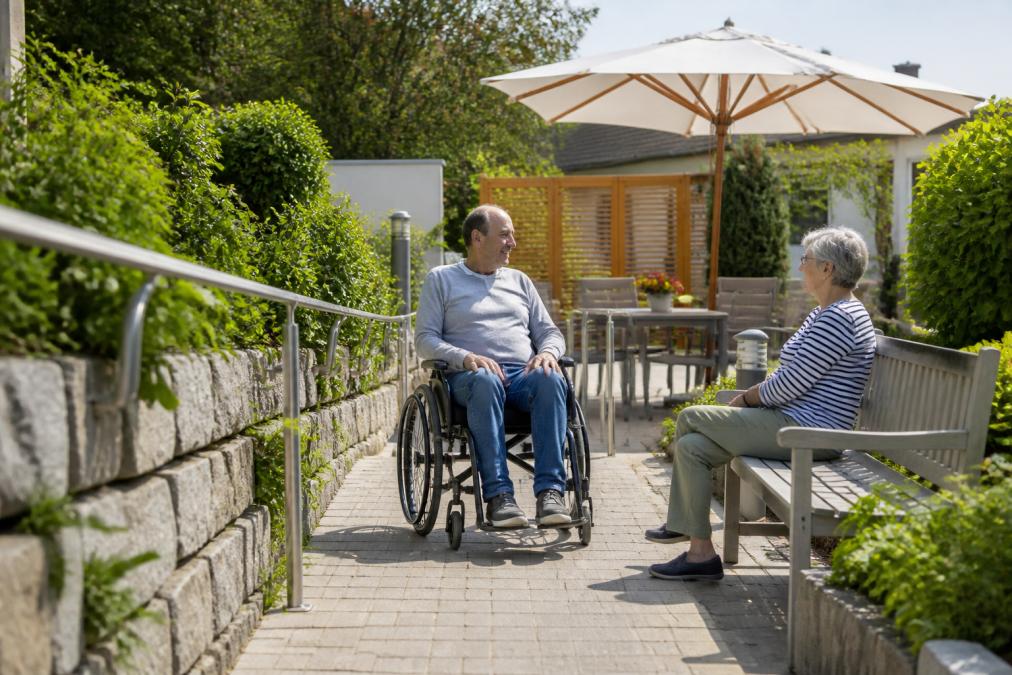
One accessible lodging with a garden designed for people with mobility impairments:
- Paved or asphalted paths (at least 1.2 meters wide)
- Flat terrace with a table and chairs
- Benches with backrests at several points
- Shade from trees or umbrellas
- No tripping hazards such as roots or rocks
- Ideally, handrails along the paths as well
How can I tell if a garden is wheelchair-accessible?
Not every garden is wheelchair-accessible. A wild, natural garden with gravel paths is beautiful, but it isn't accessible. Ask the landlord specifically:
- Are the paths paved or gravel?
- How wide are the paths?
- Are there any flat areas where you can sit?
- Are roots or rocks a problem?
- Are there any shaded spots?
- Can you access the entire garden, or just part of it?
This is especially important: Ask to see photos of the garden. Don't just ask for a photo of the flowers in summer—also ask for photos of the paths and the patio area. That way, you can see if the garden is truly wheelchair-accessible.
Access to the Terrace and Pathways
The patio is the centerpiece of the garden. It needs level access from the apartment—no steps, not even a small one. The patio area should be large enough to allow for maneuvering in a wheelchair.
Ideal route planning means:
- A main path connecting the patio to the rest of the garden
- No dead-end streets where you can't turn around
- Wide enough for people to pass each other
- No steep slopes
Many gardens have narrow paths that can only be used on foot. This is not accessible. Ask about the exact width and the material of the paths.
Here's an insider tip: Ask the landlord if he can use the garden himself in a wheelchair or if he knows anyone who can. That often says more than any description.
Accessible Vacations with Your Dog: What You Need to Know
Many people with limited mobility have a service dog or would like to bring their own dog along. An accessible lodging with a yard is ideal for this—the dog can run around in the yard without you having to go on long walks.
Important questions on this topic:
- Are dogs allowed in the lodging?
- Is there a fenced-in yard to keep the dog from running away?
- How big can the dog be?
- Is there water and a shaded spot for the dog in the yard? A well-maintained outdoor area contributes significantly to well-being, which is why a Professional Garden Maintenance ensures a consistently safe and attractive environment, even for rental properties.
A fenced-in yard is especially valuable for dog owners with limited mobility. The dog can move around freely while you relax on the patio.
Recognizing Certifications and Quality Seals
Various organizations issue certifications for accessible accommodations. A certification mark is a good indicator, but not all accessible accommodations are certified—some meet the standards without having the official certification mark. It’s important to know the differences between the certifications and to understand what they really mean.
Austrian Standards and Certificates
The most reliable certificates come from established organizations:
Austrian Accessibility Seal – The best-known seal of approval, awarded by the Austrian Association for Rehabilitation (ÖAR). The plaque is awarded only after an in-person on-site inspection. The inspector specifically checks:
- Door widths and threshold heights
- Bathroom fixtures (grab bars, shower seat, wheelchair-accessible sink)
- Open spaces in all rooms
- Garden Access and Path Conditions
The seal is awarded in three categories: Gold (highest standard), Silver (good standard), and Bronze (basic standard). Ask the landlord which category the accommodation falls into.
ÖNORM B 1601-1 – This isn't a sticker; it's the Austrian standard for accessible construction. Many landlords claim that their accommodations meet this standard without having it verified by an independent body. The standard specifies specific dimensions:
- Door widths: at least 80 cm clear width
- Clearance areas: at least 1.5 m in front of doors and restrooms
- Ramp slope: maximum 6 % (i.e., a 6-centimeter elevation difference over a 1-meter length)
- Handrails: 75–85 cm high, 4–5 cm in diameter
If a landlord refers to ÖNORM B 1601-1, ask for proof or an inspection by an expert.
Regional and Specialized Certificates
Some federal states and tourism associations have their own certification programs:
- Accessible Salzburg – Salzburg Tourism has its own seal of approval for accessible accommodations
- Accessible Tyrol – A similar program for accommodations in Tyrol
- Accessible Vorarlberg – Regional certification with stricter requirements for garden areas
These regional certifications are often more stringent than national standards, as they are specifically tailored to the region's geography and infrastructure.
What a Certificate Does NOT Guarantee
A certificate indicates that the accommodation met the standards at the time of the inspection. However, it does not guarantee:
- The fact that the facilities have not deteriorated since then
- That the accommodation is suitable for ALL types of mobility impairments (a wheelchair-accessible apartment is not automatically optimized for people with visual impairments)
- That the garden is well-maintained or that the paths are still passable
A certificate issued three years ago is less reliable than one issued a year ago. Ask for the date of issuance.
Warning Signs When Certificates Are Missing
Not all good accommodations are certified—some hosts are unfamiliar with the system or find the costs too high. That isn't automatically a reason to reject the accommodation. But watch out for these red flags:
- The landlord cannot provide specific measurements („Yes, the doors are wide enough“)
- There are no photos of the bathroom or the garden
- The landlord has never had guests with mobility impairments
- The accommodation is advertised as „wheelchair-accessible,“ but there are no details about the amenities
In these cases, you should ask especially detailed questions and request references from previous guests.
Here’s an insider tip: Many landlords who are truly committed to accessibility are members of organizations such as the ÖAR or the Austrian Council for People with Disabilities. This is often a better indicator than a certificate—it shows that the landlord is actively addressing the issue.
Tips for Booking and Doing Research in Advance
Good preparation helps avoid disappointment. Before you book, you should do thorough research.
Here's how to conduct research properly:
-
Ask for specific details. Not „Is the accommodation accessible?“ but „How wide is the front door?“ and „Are there grab bars in the bathroom?“
-
Ask for photos. Not just beautiful shots, but also photos of doors, bathrooms, and the garden.
-
Call the landlord. Emails are too easy to misinterpret. A phone call will show whether the landlord really knows what they're talking about.
-
Ask about their experiences. Has the landlord had guests in wheelchairs before? What did they say?
-
Assess the situation. How far is it to the nearest doctor? Are there any places to shop nearby?
-
Book directly with the property owner. This is often more affordable, and you'll have a direct point of contact for any questions before and during your stay.
One Accessible lodging with a garden is an investment in your vacation. The time you spend researching will be well worth it.
Legal Claims and Reimbursement of Expenses
In Austria, people with disabilities are entitled to assistance when traveling on vacation. This is governed by various laws and regulations.
Key points:
- Disability ID Card: If you have a valid disability card, you are eligible for subsidies for vacation trips. The amount varies by state.
- Social Security: Some health insurance providers cover rehabilitation stays. Check with your health insurance provider.
- Tax breaks: Under certain conditions, the cost of accessible housing may be claimed as a tax deduction.
Check with your local municipality or the Ministry of Social Affairs for the latest regulations. Eligibility requirements and subsidies change regularly.
For specific questions about reimbursement, we recommend contacting an advisory center. The Austrian Council for People with Disabilities provides information on entitlements and available support options.
Using Assistive Technology On Site
Many people with mobility impairments bring their own assistive devices on vacation—wheelchairs, walkers, shower stools. This is often impractical: long travel distances, risk of damage, and extra weight. A good, accessible lodging facility provides assistive devices on site that you can use. This not only saves space in your suitcase but also gives you flexibility.
What resources should be available on site?
The most important amenities for a comfortable stay:
For mobility:
- Wheelchair ramps (for stairs or steps that cannot be avoided)
- Crutches or walking frames
- Wheelchair (available for rent if you don't have your own)
For the bathroom:
- Raised toilet seats (10–15 cm higher)
- Shower stool or shower bench
- Bathtub lift (for accommodations with a bathtub instead of a shower)
- Retrofit grab bars (if not permanently installed)
- Non-slip bath mats
For the bedroom:
- Nursing bed or adjustable bed (with adjustable head and foot sections)
- Bed rails or bed guards
- Bedside Table Riser
For the garden:
- Garden wheelchair (more sturdy than an indoor wheelchair, with larger wheels for uneven terrain)
- Wheelchair ramps for small height differences
- Garden chair with armrests (to help you stand up)
Where You Can Rent Assistive Devices
If the lodging doesn't have a particular assistive device, you can often rent it on site. This is cheaper and more convenient than bringing your own:
Medical supply stores and specialty rehabilitation stores – In larger towns, there are specialty stores that rent out assistive devices. You can contact them before your arrival to reserve equipment. The cost depends on the provider and the rental period.
Ask the landlord which medical supply stores are nearby and if he has any contacts there.
Health Insurance and Social Security – Under certain conditions, your health insurance provider will cover the cost of assistive devices while you’re on vacation. This is especially important if you need a nursing bed or a bathtub lift. Before you travel, check with your health insurance provider to find out which costs will be reimbursed.
Mobility Services – In tourist areas, there are specialized services that deliver assistive devices directly to your lodging and pick them up again. These services are more expensive, but very convenient if you need something on short notice.
How to Organize Assistive Devices Locally
Plan ahead:
-
Make a list – Make a note of the assistive devices you need (e.g., shower stool, raised toilet seat, nursing bed).
-
Ask the landlord – Share the list and ask what is available on site. Ask for photos of the assistive devices so you can see what condition they’re in.
-
Search for medical supply stores – Search online for medical supply stores or rehabilitation specialty shops near your accommodations. Write down their phone numbers and hours of operation.
-
Contact your health insurance provider – Ask whether rental costs for assistive devices are reimbursed and what documentation you need.
-
Book early – If you would like to rent an assistive device, please reserve it at least two weeks before your arrival. During peak season, devices may be fully booked.
Quality and Safety of Rental Equipment
Not all rental equipment is the same. Be sure to:
- Condition – Ask about the age of the device and when it was last inspected. A wheelchair should not be more than 5 years old.
- Hygiene – Rental equipment should be disinfected. Ask if the equipment will be cleaned before your arrival.
- Functionality – Test the device as soon as it arrives. If something isn't working, contact the rental company or medical supply store immediately.
- Insurance – Ask whether damage to the rental equipment is covered by insurance or whether you are liable.
A common mistake: People assume that a rental device is automatically safe and clean. That is not always the case. Always inspect rental devices immediately upon receipt and report any defects to the rental company or medical supply store.
Items you should always bring with you
There are some items you should always bring with you, even if they are available on site:
- Custom Orthotics or Prosthetics – These are custom-made and cannot be borrowed.
- Medical Devices – Please bring a sufficient supply of catheters, ostomy bags, and incontinence products.
- Special pillows or mattresses – If you need a pressure-relief cushion, please bring it with you. Rental equipment often does not meet your personal needs.
Ask your doctor or therapist which medical aids you should be sure to bring with you.
Conclusion: Finding the Right Accessible Accommodation
Accessible accommodations with a garden aren't a luxury—they're a fundamental right. A vacation should be relaxing, not stressful.
A summary of the key points:
- Ask for specific details—don't just ask, „Is it accessible or not?“
- Check door widths, bathroom fixtures, and garden paths
- Ask for photos and talk to the landlord
- Use certifications as a guide, but don't rely solely on them
- Book directly with the property owner for better communication
One Barrier-free vacation apartment A place with a garden should give you freedom, not create additional hurdles. With good preparation, you'll find the right place to stay for your vacation.
Frequently Asked Questions
What is the specific difference between "barrier-free" and "accessible"?
"Barrier-free" means that the accommodation is accessible without steps, with sufficiently wide doors (at least 80 cm) and level floors. "Wheelchair-accessible" goes a step further and refers to specific features such as wheelchair-accessible sinks, shower seats, or grab bars. A barrier-free vacation rental offers basic accessibility, while a disability-accessible one is specifically designed to accommodate mobility impairments.
What certifications are available for accessible accommodations in Austria?
In Austria, there are various certifications for accessible accommodations issued by established organizations and tourism associations. Many federal states also maintain their own directories of accessible accommodations. Ask the provider about these certifications—they provide assurance regarding the actual amenities available.
Can I communicate directly with the host if I have specific questions about accessibility?
Yes, direct contact with the host is often more informative than standardized descriptions. Ask about exact door widths, ramps, space for moving around in the bathroom, and details about the garden. A personal conversation also reveals how experienced and attentive the host is when dealing with special needs—which is crucial for a relaxing vacation.
What should I pay special attention to when designing the garden for an accessible vacation rental?
Check whether the garden is accessible from the patio at ground level, what kinds of paths are available (paved or gravel), and whether they are wide enough for a wheelchair. Ask about seating, shade, and whether handrails or ramps are available. For dogs, it’s important that the garden is fenced in and offers enough space to run around.
It’s hard to find truly accessible accommodations with a garden, but that’s what makes all the difference. Ferienwohnungen Gutenbrunn offers four lovingly furnished apartments with ground-level access, wheelchair-accessible bathrooms, and a paved garden. The personal attention you’ll receive from Anna & Herbert means that if you have any questions, there’s always someone you can reach. Book directly with us and enjoy a vacation without compromises in a peaceful natural setting.


Comments are closed, but trackbacks and pingbacks are open.