



Table of Contents
- Planning a Weekend Outing with Kids: How to Make the Trip Relaxing
- Places to Visit in the Waldviertel with Kids: Nature Experiences and Hiking
- Waldviertel Adventure Trails for Kids: Routes Even Little Legs Can Handle
- The Waldviertel with Kids When It Rains: Bad-Weather and Alternative Options
- Museums, zoos, and cultural attractions for families
- A specific weekend plan with a daily schedule
- Practical Family Travel Planning: Packing List, Safety, and Timing
- Conclusion: A Weekend Getaway with Kids in the Waldviertel
- Frequently Asked Questions
Last updated: October 14, 2026
Planning a Weekend Outing with Kids: How to Make the Trip Relaxing
A weekend trip with the kids to the Waldviertel is most successful when, if you plan two real activities per day and make sure to take breaks in between. If you pack your day with five activities, you'll usually end up with tired, cranky kids in the afternoon.
The Waldviertel is a region in northwestern Lower Austria. Gentle hills, dark forests, granite cliffs, and small towns characterize the landscape. It is precisely this mix that makes the region so attractive to families with children.
Why this matters: A well-planned schedule determines whether a weekend will be relaxing or end in stress. That’s why we’ll show you below what a realistic daily schedule looks like, which activities are appropriate for different age groups, and what you can do if it rains.
How many activities per day are realistic?
Two activities a day is just the right amount for most families. One morning activity and one afternoon activity are more than enough.
It all comes down to timing. The drive there, looking for a parking spot, bathroom breaks, and meal times take up more time than you’d think. A single destination, including the drive there, can easily take up half a day.
- Children under 4 years of age: One activity per day, plenty of time to play outdoors
- Children ages 4 to 8: two activities, with a break in between
- Children ages 8 and up: Two to three activities; longer walks are possible
A common misconception is the assumption that children constantly need new stimuli. In practice, a single stream where children can stack rocks is often enough to keep them engaged for two hours.
The Right Foundation for Two Days
Having a permanent place to stay near the attractions can easily save you an hour of travel time each day. If you travel to a new location every day, you’ll spend that time in the car instead of enjoying nature.
We recommend staying in the heart of the Waldviertel region. From there, you can reach most destinations in 20 to 40 minutes. That may not sound like much, but in the end, it makes all the difference between a relaxed trip and a rushed one.
For families with young children, it's worth choosing accommodations with a kitchen. Breakfast in your pajamas and a dinner that doesn't have to be ordered at a restaurant can significantly reduce stress levels.
Places to Visit in the Waldviertel with Kids: Nature Experiences and Hiking
The best places to visit in the Waldviertel with kids are outdoors: forests, cliffs, marshes, and lakes. The Waldviertel is This isn't a region for amusement parks with roller coasters. It's a region to explore with your hands and feet.
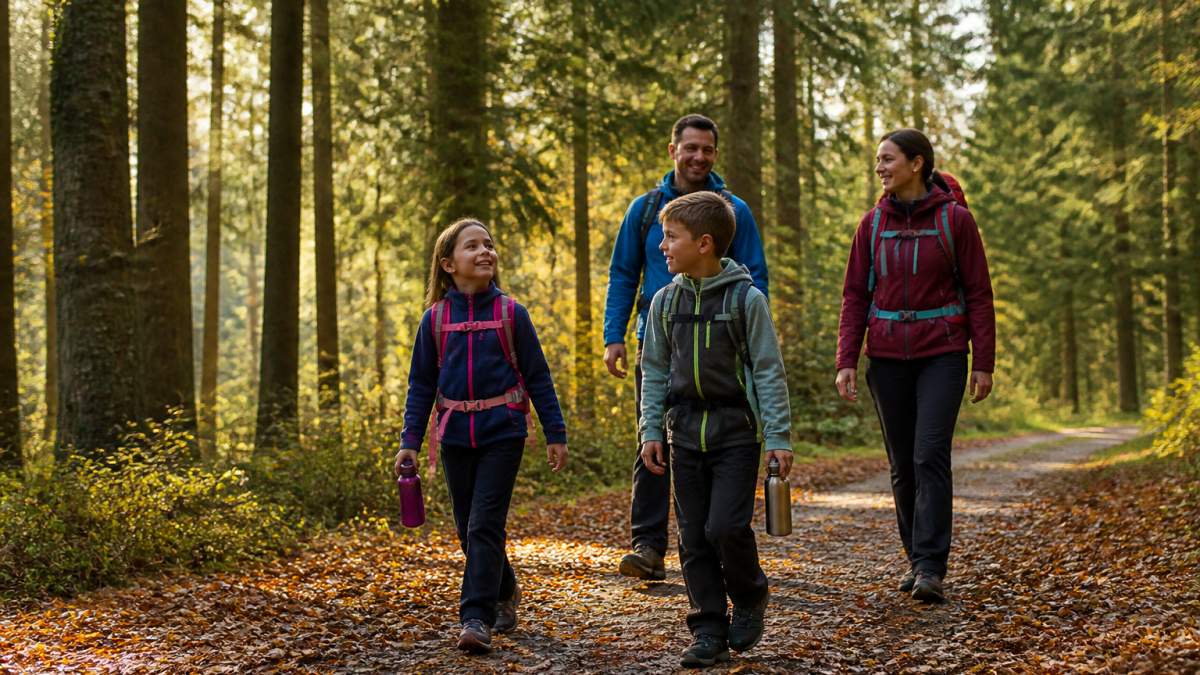
A typical afternoon looks like this: a short 45-minute hike, a break by a rock, and then free play. No time pressure, no destination that absolutely has to be reached.
What most guidebooks fail to mention: The trails are often narrower and more rutted than they appear in photos. Plan to allow more time for small children than the walking time alone would suggest.
Rocking stones, rock formations, and castle ruins
Wobbly stones are large granite boulders that have been balanced by weathering in such a way that they can be moved with very little effort. For children, they offer an unforgettable experience.
The most famous rocking stones in the Waldviertel region are located near Groß Gerungs and in the area around Zwettl. They are usually accessible via short hiking trails.
There are also numerous castle ruins. A ruin is more than just an old wall: Children can climb on it, make up stories, and enjoy the view. It’s important to wear sturdy shoes and check that the walls are safe.
When it comes to boulders and ruins, never let children climb on the rocks unsupervised. Although the boulders are stable, their surfaces can be damp and slippery. A fall from just one meter is enough to ruin an afternoon.
Waldviertel Adventure Trails for Kids: Routes Even Little Legs Can Handle
The Waldviertel Children's Nature Trails are short themed trails, which combine learning and physical activity. They are usually between two and five kilometers long, making them manageable even for preschoolers. The difference from a regular forest trail is that there are stations, information boards, playground equipment, and hands-on activities that break the trail down into small segments. For children, that matters more than the distance alone.
What most guides leave out are the key planning details: length, elevation gain, terrain, stroller-friendliness, and estimated walking time with children. It’s precisely these factors that determine whether a trail is right for your family. The following table summarizes typical categories commonly found in the Waldviertel; be sure to check the specific details on-site at the information board, as signage and trail conditions are subject to change.
| Route Type | Length | Elevation gain | Substrate | Baby carriage | Walking Time with Children |
|---|---|---|---|---|---|
| Flat Loop Trail Around a Pond or Lake | 2 to 3 km | less than 30 m | Gravel, partly asphalt | Yes, easy to drive on | 45 to 70 min. |
| Bog and Nature Trail | 3 to 4 km | 30 to 60 m | Wooden planks, meadow paths | In some places, the planks are often too narrow | 1.5 to 2 hours. |
| Forest Nature Trail with Stations | 2 to 4 km | 40 to 80 m | Forest floor, roots | no | 1 to 1.5 hours. |
| Rock and Scenic Trail | 4 to 6 km | 80 to 150 m | Granite, Roots, Steps | no | 2 to 2.5 hours. |
| Circular Trail with a Swimming Area | 4 to 5 km | 30 to 70 m | Gravel, riverside path | usually yes | 1.5 to 2 hours. |
Here's How to Read the Table Correctly
- Elevation gain are the most reliable indicator. At altitudes of about 100 meters or higher, children under six take noticeably longer than the walking time alone would suggest.
- Substrate Decide whether to bring a stroller or a wheelchair. Gravel paths are usually easy to navigate, but sections with tree roots and wooden planks are not.
- Walking Time with Children This estimate is intentionally generous. Rule of thumb: Multiply the walking time for an adult by 1.5 to 2, plus breaks at every point of interest.
Signage and Map
What many people don't know: The signage isn't equally good everywhere. Some trails are marked throughout, while others are marked only at intersections. Bring a map or an offline map on your phone, even if the trail is marked. Especially on scenic trails with turnoffs to various stops, it’s easy to lose your way without a map.
Which path is right for which age?
- Toddlers (under 4): Flat walking trails around ponds and lakes, 2 to 3 km, stroller-friendly, with plenty of benches
- Preschoolers (ages 4 to 6): Forest nature trails with interpretive stations, 2 to 4 km, not suitable for strollers
- Schoolchildren (ages 7 to 10): Bog and nature trails, as well as the first rock trails, 3 to 5 km
- Older children (ages 10 and up): Rock trails and scenic trails, 4 to 6 km, with elevation gain and scenic overlooks
Always allow an extra 30 minutes for adventure trails. Children tend to stop at every station, and the return trip often takes longer than the way there. You’ll get more out of it if you think of the trail as a half-day activity rather than a workout.
Rest Stops and Snack Spots
Many nature trails have a rest area with a bench and table at the start or end. Places to stop for a bite to eat are few and far between, so be sure to pack your own snack. If you want to stop for lunch, choose a trail where the start or end is in a town with a restaurant.
The Waldviertel with Kids When It Rains: Bad-Weather and Alternative Options
Just because it's raining in the Waldviertel with kids doesn't mean the day is ruined. The key difference from a sunny day isn't the destination, but the structure: shorter routes, more indoor activities, an earlier start, and a clear Plan B. Anyone who tries to follow the same daily routine in the rain as they do in the sun will run into trouble with wet shoes, cold hands, and tired kids.
The basic rule when it rains
Swap “outdoors” for “indoors,” but keep the two-activity structure. One indoor activity in the morning, a warm lunch break, and either another indoor activity in the afternoon or a short, weather-proof walk. The mistake is to schedule three indoor activities in a row when it rains; kids still need to move around even when it’s raining, otherwise their mood will take a turn for the worse in the late afternoon. If you’re looking to focus on creative activities, you’ll find plenty of ideas in our overview for Screen-free activities for children Lots of ideas for channeling the little ones' energy in a meaningful way, even when they're not using digital entertainment.
Options, sorted by weather intensity
- Drizzle, light rain: Short, weatherproof trails with solid footing—gravel instead of roots, loop trails around ponds instead of rocky paths. Rain jacket, rubber boots, and a change of clothes in your backpack. Duration: 45 to 60 minutes, no more.
- Heavy rain, prolonged rain: All indoors. A museum with interactive exhibits in the morning, an indoor pool or spa in the afternoon. In between, a hot lunch at the lodging or a restaurant.
- Variable with sunny spells: Plan your day in 90-minute blocks. Go outside as soon as the sun comes out, and go back inside as soon as it starts pouring again. A weather app with a rain radar is more important here than any plan.
A Typical Day During the Rainy Season
- 8:30 a.m.: Breakfast at the lodging, check the weather app, decide on the day's destination
- 10:00 a.m.: Museum with a hands-on area, 1.5 to 2 hours
- 12:30 p.m.: Hot lunch, break
- 2:30 p.m.: Indoor pool or spa, 2 hours
- 5:00 p.m.: Back to the lodging, playtime, dinner
What Works Reliably in the Rain
- Regional museums with hands-on stations: Many places have areas where you can touch and try things out; call ahead and ask if there's a family or children's program.
- Demonstration Workshops: Artisan shops that display glass, paper, or ceramics are often sheltered from the weather and exciting for children because they get to see something being created
- Indoor pool or spa: Physical activity and warm water on rainy days, especially for children under 8 years of age
- Indoor playgrounds in larger towns: Good for children under 8, but noisy and crowded on rainy days—arrive early
- Castle or palace tours: Mostly sheltered from the weather and told in an engaging way, but be sure to check the scheduled tour times
What Often Disappoints When It Rains
- Long hikes on root-covered trails: slippery, slow, and the kids get wet and cold
- Rocky trails and lookout points: no view, no experience—but there’s a risk of slipping
- Zoos with large outdoor enclosures: Animals retreat, paths become muddy
During a thunderstorm, get out of the woods immediately and stay away from rocks and loose stones. Granite is slippery, and a thunderstorm in open terrain is no place for experiments. Always plan for an indoor option within easy reach in case this happens.
Keep an „emergency bag“ ready for every rainy day: a deck of cards, a coloring book, a few snacks, and warm socks. If the mood takes a turn for the worse, you’ll have something on hand right away without having to search for it first. A change of clothes for children under six is always a must—wet clothes are the most common reason for cutting a rainy-day outing short.
Hours of Operation and Days Closed
Many museums and demonstration workshops have days when they’re closed, and some are only open seasonally. Check the opening hours the night before, not the morning of; on rainy days, the few indoor attractions are quickly booked up or packed. If you want to stay flexible, have two options ready for each half of the day.
Museums, zoos, and cultural attractions for families
Museums, zoos, and cultural attractions are the perfect complement to nature, especially when the weather is changeable. They’re best suited for a half-day outing, not a full day.
When visiting museums, it’s worth checking the program. Guided tours for children are usually shorter and more interactive than regular tours. Ask in advance if there are any special family activities.
Zoos and wildlife observation stations are often the highlight of a trip for children. In the Waldviertel, there are enclosures with native animals, as well as opportunities to observe birds and wildlife in their natural habitats.
- For toddlers: Small zoos with petting areas
- For schoolchildren: Museums featuring technology, crafts, or natural history
- For everyone: Gardens and parks with playgrounds and seating areas
If you plan to visit several cultural attractions, you should check their hours of operation in advance. Many venues have days when they are closed, and some are open only seasonally.
A specific weekend plan with a daily schedule
A good weekend plan with kids follows a simple pattern: head out in the morning, take a break at noon, and head to a second destination in the afternoon. Here's an example you can use right away.
Saturday
- 8:00 a.m.: Breakfast at the lodging, pack backpacks
- 9:30 a.m.: Short hike to a rocking stone, 45-minute walk
- 11:00 a.m.: Break with a snack and free play by the rocks
- 12:30 p.m.: Lunch and break
- 3:00 p.m.: Nature trail or loop trail around the lake, 2 to 3 km
- 5:30 p.m.: Dinner, followed by free play
Sunday
- 8:30 a.m.: Breakfast, a slow start
- 10:00 a.m.: Tour the castle ruins, followed by a picnic
- 12:30 p.m.: Lunch break
- 2:00 p.m.: A museum or zoo as an alternative destination
- 4:30 p.m.: Return trip or final walk
The plan intentionally has gaps. These gaps aren't a mistake—they're the most important part of the weekend.
The best weekend plan with kids includes two set activities each day and plenty of free time in between. Everything else is up for discussion.
Practical Family Travel Planning: Packing List, Safety, and Timing
Practical family logistics often play a bigger role in determining success than the choice of destination. If you pack well and allow for some leeway, you'll have less stress.
Packing List for a Day Trip
- Water bottles for everyone; at least 1 liter per person
- Snack: Bread, fruit, nuts, something sweet
- Rain jackets, even when the sun is shining
- A change of clothes for children under 6 years of age
- First-aid kit with bandages and tick tweezers
- Map or offline map on your cell phone
- Sunscreen and a cap
- Garbage Bags
Safety in the Forest
- Stay on marked trails, especially when traveling with small children
- Let someone know your route if you'll be away for a while
- After the outing: Check all family members for ticks
- During a thunderstorm, leave the forest immediately and stay away from rocks
Timing
Start early. Between 9 and 10 a.m., you'll have most destinations almost to yourselves. Starting at noon, the parking lots and trails start to fill up.
When traveling here, keep in mind: Allow more time than the navigation app indicates. Taking a break halfway through the trip makes the journey much more enjoyable for children.
If you're traveling with a dog, check in advance to see if your destination allows dogs. In nature parks and on hiking trails, this is usually not a problem, but it often is at museums and zoos.
Conclusion: A Weekend Getaway with Kids in the Waldviertel
A weekend getaway with kids in the Waldviertel thrives on the right balance: two activities a day, short distances, plenty of time in nature, and a plan that leaves room for spontaneity. If you keep this in mind, you’ll return home more relaxed than when you left.
That's exactly what Ferienwohnungen Gutenbrunn is for. Our four lovingly furnished, wheelchair-accessible vacation apartments offer families, wheelchair users, and dog owners a peaceful retreat in the heart of the Waldviertel region. You’ll be personally looked after by Anna and Herbert, and you can book directly with us—no third-party platform involved.
The biggest challenge of a weekend getaway with kids in the Waldviertel isn’t choosing where to go, but resisting the temptation to pack too much into the trip. If you’re looking for a peaceful base with easy access to nature’s highlights, Ferienwohnungen Gutenbrunn is the perfect choice. With accessible apartments, personalized service from Anna and Herbert, and the option to bring your dog, the trip itself becomes the first relaxing part of your weekend. Book directly with us and kick off your getaway without the stress of tight schedules.
Frequently Asked Questions
Which nature trails in the Waldviertel are suitable for children?
Short loop trails with soft ground, gentle inclines, and stops along the way—such as wobbly rocks or lookout points—are ideal. Aim for a trail length of 2 to 5 kilometers so that even younger children can keep up. An adventure trail should offer something new to discover every 20 to 30 minutes—such as rock formations, a stream, or a bench for a break. For a weekend outing like this with children in the Waldviertel, it’s best to plan a shorter loop and allow more time for play.
What are some things to do with kids on a weekend in the Waldviertel?
A typical weekend can be easily divided into two main activities: On the first day, go on a hike to the Wackelsteine or a castle ruin; on the second day, visit a museum, a zoo, or a nature park. In between, there’s time for the playground and a picnic. It’s important not to pack too many activities into the day. Two to three activities per day are plenty to ensure the children don’t get too tired and the parents can enjoy the outing as well.
What are some good places to visit in the Waldviertel when it rains?
When it rains, museums, exhibitions, and indoor activities are your best bet. A visit to a zoo with covered areas or a cozy morning in your vacation rental playing games, followed by an outing for lunch, is also a great option. Rain gear still makes short walks in the woods possible, since the woods often offer better protection from light rain than open areas. Always plan an alternative for days when the weather is bad.
How do I plan a weekend trip with kids in the Waldviertel?
Start by planning your accommodations, as short travel distances make your daily schedule easier. Then choose one main destination per day and an alternate destination in case of bad weather. Check opening hours and whether a reservation is required, pack weather-appropriate clothing and snacks, and be sure to schedule breaks. A weekend trip with kids in the Waldviertel works best when the plan allows for flexibility and isn’t tightly scheduled hour by hour.


Comments are closed, but trackbacks and pingbacks are open.