



Table of Contents
- Family-Friendly Hiking Trails in the Waldviertel for Beginners: An Overview
- Comparison Table: Easy Hiking Trails in the Waldviertel at a Glance
- What Makes for an Easy Family Hike
- Child-Friendly Hikes in the Waldviertel: 5 Tours to Get You Started
- Hiking with Kids in the Waldviertel: Planning, Breaks, and Provisions
- Directions, Parking, and Public Transportation
- Seasonal Conditions, Trail Closures, and Safety
- Equipment and Packing List for Your First Family Hike
- Conclusion: How to Get Started with Hiking in a Relaxed Way
- Frequently Asked Questions
Last updated: October 7, 2026
Family-Friendly Hiking Trails in the Waldviertel for Beginners: An Overview
Family-friendly hiking trails in the Waldviertel for beginners are, above all, short, well-marked, and free of steep climbs. That’s exactly what matters when young children or inexperienced adults are along for the hike.
The Waldviertel is perfect for this. Gentle hills, vast forests, moss-covered granite cliffs, and peaceful trails characterize the landscape. Anyone visiting for the first time with children Hikers will find conditions here that are rare elsewhere: short distances, very little elevation gain, and plenty of rest stops along the way.
In this guide, we'll show you which easy hiking trails are truly suitable for beginners. We'll explain how to identify a family-friendly hike, how to plan breaks, and what to pack in your backpack.
An easy family hike in the Waldviertel is usually 3 to 6 kilometers long, takes 1 to 2 hours, and has an elevation gain of less than 100 meters. If a hike doesn’t fit this description, it’s too challenging for first-time hikers with children.
Comparison Table: Easy Hiking Trails in the Waldviertel at a Glance
This overview summarizes the key statistics so you can quickly compare them. The figures are typical guidelines for easy family hikes in the region and are not a substitute for a current hiking map.
| Tour Type | Route Length | Walking time | Elevation gain | Substrate | Baby carriage |
|---|---|---|---|---|---|
| A short walk by the lake | 2–3 km | 45–60 min | less than 30 m | Asphalt, Gravel | well-suited |
| Themed Trail in the Forest | 3–4 km | 1–1.5 hours | 30–60 m | Forest trail, well-maintained | suitable to a limited extent |
| Circular Hike Around a Marsh | 4–5 km | 1.5–2 hours | 40–80 m | Wooden walkway, meadow | not suitable |
| Panoramic Trail on the High Plateau | 5–6 km | 2 h | 60–100 m | Gravel, meadow | suitable to a limited extent |
| Nature Trail with Stops | 3–5 km | 1.5–2 hours | 40–70 m | mixed | not suitable |
The table shows that the shorter the route, the easier it is to plan. For your first outing with a stroller, it's best to choose a route from the first row.
What Makes for an Easy Family Hike
An easy family hike is a trail that children and untrained adults can complete without getting exhausted. It is short, flat, and well-marked. These three characteristics are exactly what determine whether the outing remains relaxing or ends up being stressful.
Many families overestimate their children's stamina. A child walks significantly less in an hour than an adult does. Therefore, it's better to plan for a shorter walk than a longer one.
The following are also important:
- A trail marker that even children can recognize
- Rest areas with benches at short intervals
- No work areas with a risk of falling
- A way out in case the kids don't want to continue
The most common mistake first-time hikers make is planning a hike that's too long. A child who gets tired after two hours will have to be carried. Plan a hike that's half the distance you think you can handle, and you'll return feeling relaxed.
Age, Fitness Level, and Suitability for First-Time Hikers
Children around four years old and older can easily manage short, flat routes of 2 to 3 kilometers. Children between the ages of six and ten can usually run 4 to 6 kilometers without any problems. It’s not age that matters, but physical fitness.
For adults with no hiking experience, a hike with less than 100 meters of elevation gain and less than 6 kilometers in length is a good place to start. If you're unsure, start with a short walk and work your way up from there.
Here's a simple test to start with: Can your child walk for an hour without needing to be carried? If so, they're ready for an easy hike.
Trail Conditions and Accessibility in Detail
The surface determines whether a path is suitable for strollers. Firm gravel and asphalt are good options. Forest trails with roots, wooden walkways, and damp meadows are not suitable for strollers.
For wheelchair users and people with limited mobility Wide, paved paths without steps are important. You’ll find such paths mainly around lakes and on plateau trails. It’s best to avoid narrow forest trails with exposed roots.
Check the following before every ride:
- Is the path paved all the way?
- Are there steps, railings, or walkways?
- How wide is the path at its narrowest points?
If you're unsure, ask someone there. Information you get in person is often more accurate than any map.
Child-Friendly Hikes in the Waldviertel: 5 Tours to Get You Started
Hikes Suitable for Children in the Waldviertel You'll find them in almost every community. The following five types of tours are especially well-suited for beginners. Instead of just listing the distance and duration, we specify for each tour its suitability in terms of age, fitness level, stroller access, and trail conditions—so you can immediately choose the right route for your family.
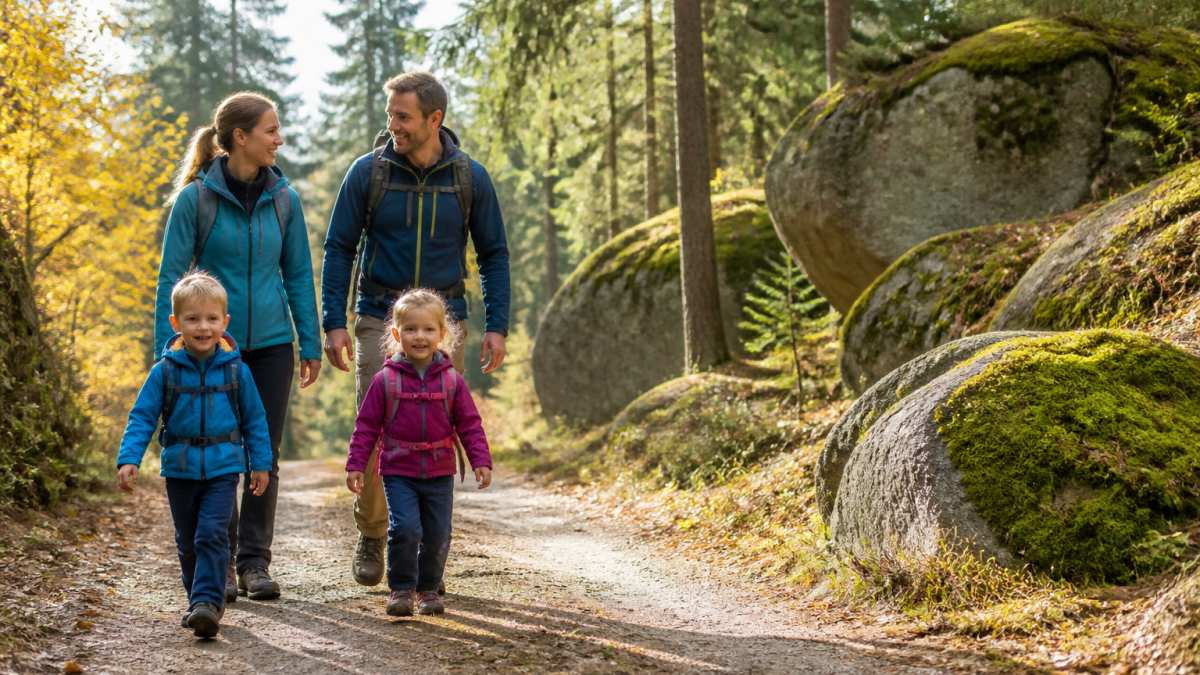
Tour 1: A short walk along the lake
- Length and Duration: 2 to 3 km, 45 to 60 minutes
- Elevation gain: less than 30 m, flat throughout
- Background: Asphalt and compacted gravel, paved throughout
- Strollers: well-suited, even for balance bikes and wheelchairs
- Age and physical condition: Ages 3 and up; ideal for first-time hikers and inexperienced adults
- Special feature: Benches spaced close together, usually with a place to stop for refreshments nearby
This tour is the classic starting point. Because the path is paved and flat, it’s also suitable for families with strollers or for guests with limited mobility.
Tour 2: Themed Trail in the Forest
- Length and Duration: 3 to 4 km, 1 to 1.5 hours
- Elevation gain: 30 to 60 m, gentle waves
- Background: solid forest trail, partly gravel
- Strollers: Somewhat suitable; rolls well on dry ground
- Age and physical condition: For children ages 4 and up who can walk for an hour without being carried
- Special feature: Stations designed for exploration keep children engaged
The themed trail is the best choice if children want to see and try things along the way. The stations make the distances feel much shorter.
Tour 3: Circular Hike Around a Marsh
- Length and Duration: 4 to 5 km, 1.5 to 2 hours
- Elevation gain: 40 to 80 m
- Background: Wooden walkways, meadow, partly marshy
- Strollers: Not suitable—narrow paths and soft ground
- Age and physical condition: Ages 6 and up; children should be able to walk safely and steadily
- Special feature: Fascinating nature, but only pleasant in dry weather
Moorland trails are scenic but more challenging than they appear. After rain, the boardwalks are slippery, and the ground gives way. This trail is not suitable for strollers or balance bikes.
Tour 4: Panoramic Trail on the High Plateau
- Length and Duration: 5 to 6 km, about 2 hours
- Elevation gain: 60 to 100 m
- Background: Gravel and meadows, wide paths
- Strollers: Somewhat suitable; wide sections roll well
- Age and physical condition: Ages 8 and up, for families with some hiking experience
- Special feature: Wide-open views, good places to rest
This tour is the next step once you've gotten the hang of the shorter routes. The elevation gain is moderate but noticeable—be sure to plan a break halfway through.
Tour 5: Nature Trail with Stops
- Length and Duration: 3 to 5 km, 1.5 to 2 hours
- Elevation gain: 40 to 70 m
- Background: Mixed—gravel, forest trail, meadow
- Strollers: Not suitable due to the varying terrain
- Age and physical condition: Ages 5 and up, for curious children
- Special feature: Lots of variety, ideal for kids who get bored easily
The nature trail combines a short distance with plenty to see and do. The varied terrain makes it unsuitable for strollers, but especially exciting for children who can walk.
Which tour is right for which family?
| Family | Recommended Tour |
|---|---|
| With a stroller or balance bike | Tour 1, when the ground is dry; Tour 2 |
| With children ages 3 and up, first hike | Tour 1 |
| For children ages 4 and up who love to explore | Tour 2 or Tour 5 |
| For children ages 6 and up; requires stamina | Tour 3 |
| For children ages 8 and up, with some experience | Tour 4 |
| With limited mobility | Tour 1 |
Start with Tour 1 or 2. If that goes well, try the longer routes. What matters isn't the number of kilometers, but that everyone is happy in the end.
Plan only one hike per outing. Two short hikes in one day might sound tempting, but they can be too much for first-time hikers. It’s better to take it easy once than to rush through it twice.
Hiking with Kids in the Waldviertel: Planning, Breaks, and Provisions
Hiking with children in the Waldviertel works best when you have a clear plan for breaks. Children need breaks more often than adults. Plan a short rest every 30 to 45 minutes.
Good planning involves four key points:
- Start time: Leave early so you'll have enough time.
- Breaks: Short stops for a drink and a snack.
- Supply: Plan to stop for a meal or bring your own food.
- Restrooms: Use before departure and at familiar rest stops.
There aren't places to stop for a break along the way everywhere in the Waldviertel. So be sure to pack some water and a small snack, even if you plan to stop at a restaurant. That way, you'll be self-sufficient.
A quiet starting point makes planning easier. If your lodging is close to the trails, you'll save yourself long drives with tired kids.
Make a point of planning your return a little earlier than necessary. A one-hour buffer takes the pressure off. If you end up leaving later, it's no problem. If you leave earlier, you'll have time for some ice cream.
Directions, Parking, and Public Transportation
You can reach the hiking trails in the Waldviertel by car or train. Many starting points are located on quiet streets with parking available. If you’re traveling without a car, take the bus or train and plan for the walk from the station. This section provides specific tips to ensure your trip there isn’t a source of stress.
By Car: Parking and Starting Points
For families with a car, the following applies:
- Start early: On weekends and during school breaks, parking spots at popular starting points are usually available until around 9 a.m. After that, they start to fill up.
- Set the starting point and destination in advance: On loop hikes, you return to your car; on out-and-back hikes, you'll need a way to get back.
- Check parking lot type: Some starting points have a designated parking lot, while others have only a pull-off on the side of the road. A pull-off is impractical when you have a stroller and luggage.
- Plan for an alternate parking spot: If the first parking lot is full, there's a second starting point nearby. Check in advance to see if there is one.
- The way back from the parking lot: Be sure to factor in the walk from the parking lot to the actual trailhead. For some hikes, this takes 10 to 15 minutes.
One advantage of the Waldviertel: The roads are often quiet. You rarely have to look for a parking spot if you set out early.
Without a Car: Train and Bus
If you're traveling without a car, it's best to plan your trip in advance:
- Check connections: Some routes run infrequently, and some don't run at all on weekends. Check the connections for the outbound and return trips separately.
- Plan your walk from the train station: It's often a 15- to 30-minute walk from the train station to the trailhead. With small children, that's an event in itself.
- Choose short tours near the train station: If you have a long trip to get there, stick to tours that start near the train station.
- Make sure you have a ride home: Check the last connection of the day and allow for some extra time. Missing a bus with tired kids is no fun.
- Customize Equipment: Without a car, you'll have to carry everything yourself. Keep your luggage and weight to the bare minimum.
Traveling with Children: Practical Tips
- Start time: Leave early so there's plenty of time and the kids are well-rested.
- Stops along the way: Plan a short break before the hike begins. This will help the kids arrive feeling more relaxed.
- Using the restroom before takeoff: Use the last restroom before you set out. There isn't always one along the way.
- Water and a snack: Be sure to bring enough with you, even if you plan to stop for a bite to eat. There aren't restaurants along the way everywhere in the Waldviertel.
A quiet starting point makes planning easier. If your lodging is close to the trails, you'll save yourself long drives with tired kids.
Timetable Information for Trains and Buses in the Region
Seasonal Conditions, Trail Closures, and Safety
Hiking trails in the Waldviertel change with the seasons. In the spring, there may still be snow on the ground; in the summer, it’s warm; in the fall, the ground is often wet; and in the winter, some trails are closed.
Check the following before every ride:
- Current Weather Forecast
- Information on road closures, such as those caused by severe weather
- Condition of the trail after heavy rain
Safety Tips for Beginners with Children:
- Sturdy shoes with treads
- Enough water, even in cool weather
- Cell phone with a fully charged battery
- Keep an eye on the 112 emergency number
After a storm, there may be branches lying on the path. In that case, it's better to take a different route. Safety comes before speed.
Don't underestimate the wet conditions. A dry forest trail can become slippery after rain, especially on roots and granite rocks. For children, this is the most common cause of accidents on easy hikes.
Equipment and Packing List for Your First Family Hike
You don't need expensive gear for your first family hike. The important things are comfortable shoes, water, and weatherproof clothing. Everything else is optional.
Our packing list to check off:
- Sturdy Shoes for Everyone
- A rain jacket and a light jacket
- Water for every family member
- A light snack and fruit
- Sunscreen and a cap
- First-aid kit with band-aids
- Cell phone with a fully charged battery
- Hiking map or map app
- Baby sling or back carrier for small children
For stroller walks: Check the ground conditions beforehand. Firm gravel and asphalt are easy to walk on, but forest trails with roots are not.
Conclusion: How to Get Started with Hiking in a Relaxed Way
A short, flat hike and realistic planning are the keys to a relaxed start to hiking. Start with a 2- to 3-kilometer hike, plan in breaks, and choose a paved trail. That way, your first hike will be an enjoyable experience rather than a struggle.
That's exactly why Ferienwohnungen Gutenbrunn is the perfect starting point. Our barrier-free and wheelchair-accessible vacation rentals are situated in a quiet, natural setting and are ideal for families, hikers, and Guests with Dogs. Anna and Herbert will personally take care of you and give you tips on trails, places to stop for a bite to eat, and excursions in the region. After your hike, you can relax in the kitchen-diner and the bedrooms.
Book directly with us and start your first family hike in the Waldviertel on a relaxed note.
Frequently Asked Questions
Which hiking trails in the Waldviertel are suitable for families with children?
For families with children, short loop hikes and themed trails with gentle elevation changes, wide paths, and rest areas are particularly suitable. Look for routes that are three to six kilometers long, with walking times under two hours, and trails that are stroller-friendly. Many family-friendly hiking trails in the Waldviertel lead past streams, ponds, or granite cliffs and can easily be combined with a stop for refreshments. Check the trail markings in advance and make sure the trail is currently accessible.
How long should a hike with children be for beginners?
To start out, a distance of two to four kilometers—taking about an hour to walk—is ideal. Toddlers can often manage less, while school-age children can go farther. Plan for plenty of breaks at rest areas or lookout points, and tailor the route length to the youngest child. A short, enjoyable walk is better than a long hike that leaves everyone exhausted. You’ll find many such short hikes suitable for children in the Waldviertel region.
What should you pack for an easy family hike?
Bring water, a small snack, sun and rain protection, a light jacket, band-aids, and a cell phone. Sturdy shoes with tread are recommended for children, even on easy hiking trails in the Waldviertel. A hiking map or an offline map on your cell phone will help you find your way. If you’re traveling with a stroller, check the terrain in advance. Remember to bring a seat pad for breaks and a change of clothes for the little ones.
Are the paths suitable for strollers or wheelchairs?
Not every trail is suitable for strollers or wheelchairs. Wide, paved trails with a gentle incline are best, while narrow forest paths with roots and rocks can be challenging. Check the trail conditions before your hike and ask the local municipality or tourist information office about accessible sections. For families with strollers, it’s worth doing a little research beforehand to ensure the hike remains stress-free.


Comments are closed, but trackbacks and pingbacks are open.