


Table of Contents
- Why a Checklist for Accessible Vacation Rentals Is Essential for Seniors
- Legal and Regulatory Foundations of Accessibility in Austria
- Understanding Different Mobility and Sensory Needs
- Barrier-Free Access to Vacation Rental: Check the Entrance, Hallways, and Doors
- Senior-Friendly Vacation Rental Amenities: Living Area and Bedroom
- Accessible Bathrooms in Vacation Rentals: Key Considerations
- Kitchen and Dining Area: Safety and Accessibility for Everyone
- Checking for Accessible Accommodations Before Booking: Asking the Right Questions
- Room-by-Room Checklist for Vacation Rentals (Printable)
- Prioritizing by Effort and Impact: Where Landlords Should Start
- Practical Test with Elderly Guests: Test Instead of Guessing
- Tourism Offerings and Market Opportunities for Accessible Accommodations
- Avoiding Common Mistakes When Planning Accessible Vacation Rentals
- Conclusion: Use the right checklist to improve accessibility and guest satisfaction
- Frequently Asked Questions
Last updated: October 7, 2026
Why a Checklist for Accessible Vacation Rentals Is Essential for Seniors
A Checklist for accessible vacation rentals For seniors, this is the most effective tool for comparing a lodging's promises with reality before guests arrive.
This is exactly where most disappointments arise.
At Ferienwohnungen Gutenbrunn, we have been welcoming guests with a wide variety of needs for years—from families with strollers to guests who use wheelchairs.
The demand is real: Accessible travel is no longer a niche market, but a growing segment of the tourism industry.
A good checklist doesn't just cover the entryway, but checks each room individually: hallways, bathroom, bedroom, kitchen. Most defects only become apparent upon closer inspection, not in the listing description.
Legal and Regulatory Foundations of Accessibility in Austria
The main standards governing accessible construction are ÖNORM B 1600 and the OIB guidelines.
ÖNORM B 1600 is the Austrian standard for accessible construction. It specifies minimum dimensions for doors, hallways, restrooms, and circulation areas, and serves as the basis for planning new construction and renovations.
The OIB Guidelines are published by the Austrian Institute for Construction Engineering and incorporated into the building codes of the federal states.
It is important for vacation rental owners to note: Not every apartment has to be formally „accessible“ as defined by the standard.
Anyone who advertises an apartment as „accessible“ without checking the key dimensions risks more than just disappointed guests. If complaints arise, this could be considered a misleading statement. It’s better to check beforehand than to have to explain afterward.
ÖNORM B 1600 and OIB Guidelines: What Landlords Need to Know
In practice, three questions are enough to start with: Is the entrance step-free? Are the doors wide enough? Is there enough space to move around in the bathroom, and are there grab bars?
The exact dimensions and areas of application are subject to change from time to time. Reliable information is available from the Austrian Institute for Construction Engineering on the OIB Guidelines as well as the current versions of ÖNORM B 1600 from Austrian Standards. For specific renovation projects, it is also worth consulting with the relevant building authority in your state.
When an apartment May Be Advertised as Accessible
There is no central authority that certifies a vacation rental as „accessible.“ The term is not legally protected, but it is not arbitrary either. Anyone who uses it should be able to explain what it means. A three-step self-assessment has proven effective:
- Level 1, accessible without steps: Step-free access; apartment door with a clear width of at least 80 cm; no threshold higher than 2 cm.
- Level 2, limited usability: In addition, grab bars in the bathroom, a walk-in shower, and a clear space next to the toilet.
- Level 3, wheelchair accessible: Additionally, a turning radius of 150 cm, a wheelchair-accessible sink, and wider interior doors.
If you only meet Level 1 requirements, you should not describe your property as „accessible“ but rather as „accessible without steps.“ This distinction helps prevent complaints and assists guests in making booking decisions more effectively than any blanket statement.
Grants and Consulting Services for Renovations
Accessibility renovations are supported in Austria at several levels. The specific programs, funding rates, and application deadlines vary by federal state and change regularly, so it is not practical to make a general statement here.
A common process in practice: First, a consultation with the municipality or the housing subsidy agency; then, a proposal from a specialist planner; and only after that, the application. Those who proceed in the reverse order often waste time because subsidies are tied to specific design specifications.
Take photos of the current condition before any renovation, making sure to include a measuring tape in the frame. This documentation is helpful not only for processing grant applications but also for communicating with guests later on.
Duties to Inspect and Liability in Everyday Life
A vacation rental is a lodging facility and is therefore subject to certain duties of care. These include ensuring safety on access routes and within the rented premises, as well as the obligation to eliminate or mark any obvious hazards.
In practical terms, this means: Don’t inspect the apartment just once—do it before every season. Document the inspection with the date. This routine isn’t a bureaucratic burden; it’s proof that you’re fulfilling your duty of care.
Understanding Different Mobility and Sensory Needs
Accessibility is not a single state but a spectrum. If you think only of wheelchair users, you overlook most guests who benefit from good accessibility.
These needs can be broadly divided into four groups:
- Mobility impairments: Wheelchairs, walkers, walking aids, temporary injuries. Requires step-free access, wide doors, and handrails.
- Visual impairments: Requires high-contrast markings, good lighting, tactile guidance, and clearly labeled switches.
- Hearing impairments: Requires visual cues instead of just doorbells or alarm sounds, as well as clearly legible information.
- Cognitive impairments: Requires simple wayfinding, clear signage, and no cluttered spaces.
The same apartment can be suitable for one group but challenging for another. A wide hallway helps a person in a wheelchair, while a non-slip floor with a contrasting edge helps a person with a visual impairment. That is why it is so important to assess each room individually: Each need places different demands on the same room.
When planning, don’t ask, „Is it accessible?“ but rather, „For whom, exactly, is it accessible?“ This question reveals gaps that a blanket “yes” answer hides.
Barrier-Free Access to Vacation Rental: Check the Entrance, Hallways, and Doors
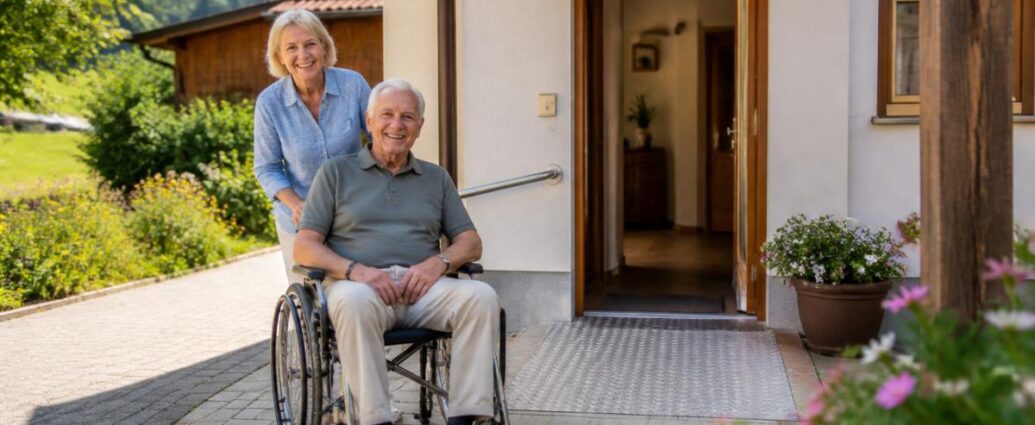
Barrier-free access is the first criterion by which a Barrier-free vacation apartment is measured. Without it, even the best interior is of little use.
Check the path from the parking lot or the street to your front door. Even a single step just a few centimeters high can be insurmountable for a wheelchair or walker. Be sure to:
- Thresholds and Edges at the House Entrance
- The width of the front door and all interior doors
- The surface of the access path—non-slip and free of loose stones
- Lighting the path for those arriving in the evening
- A flat area in front of the door for maneuvering
Inside, the hallway serves as a distribution point. If it’s too narrow, you won’t be able to enter any room, no matter how well-equipped it is. Check the turning radius and passage widths, not just the door itself.
Overview of Minimum Widths and Threshold Heights
The following guidelines are based on current accessibility standards for construction. For binding dimensions, the current standard and the building code of the respective federal state always apply.
| Element | Guideline | Why It Matters |
|---|---|---|
| Apartment door | 80–90 cm clear width | Wheelchairs and walkers pass by |
| Interior Doors | at least 80 cm clear width | Accessibility of Each Room |
| Hallway width | at least 120 cm | Encounters and Maneuvers |
| Threshold Height | max. 2 cm, ideally 0 | Rollability |
| Tropic | 150 cm in diameter | Turning in a Wheelchair |
| Bathroom Activity Area | 150 x 150 cm | Use of the Restroom and Shower |
These figures are planning guidelines, not legal advice. Anyone undertaking a renovation should consult with the building authority and a professional planner to determine the specific requirements.
Senior-Friendly Vacation Rental Amenities: Living Area and Bedroom
The design of a senior-friendly vacation rental determines whether guests can move around safely and independently. In the living and sleeping areas, the main priorities are accessibility and fall prevention.
In the living area, what matters is:
- Seating with armrests and a fixed seat height to make it easier to stand up
- Clear pathways between the sofa, table, and window
- Easily accessible light switches and outlets
- Non-slip flooring without loose rugs
- Remote controls and control panels with clear labeling
In the bedroom, the bed is the key factor. A mattress that’s too low makes it hard to get out of bed, while one that’s too high makes it hard to get into bed.
Also, make sure that the bedside lamps are within reach without having to twist your body, and that there is a clear path from the bed to the door.
Accessible Bathrooms in Vacation Rentals: Key Considerations
The accessible bathroom in a vacation rental is the one area where most accommodations fall short.
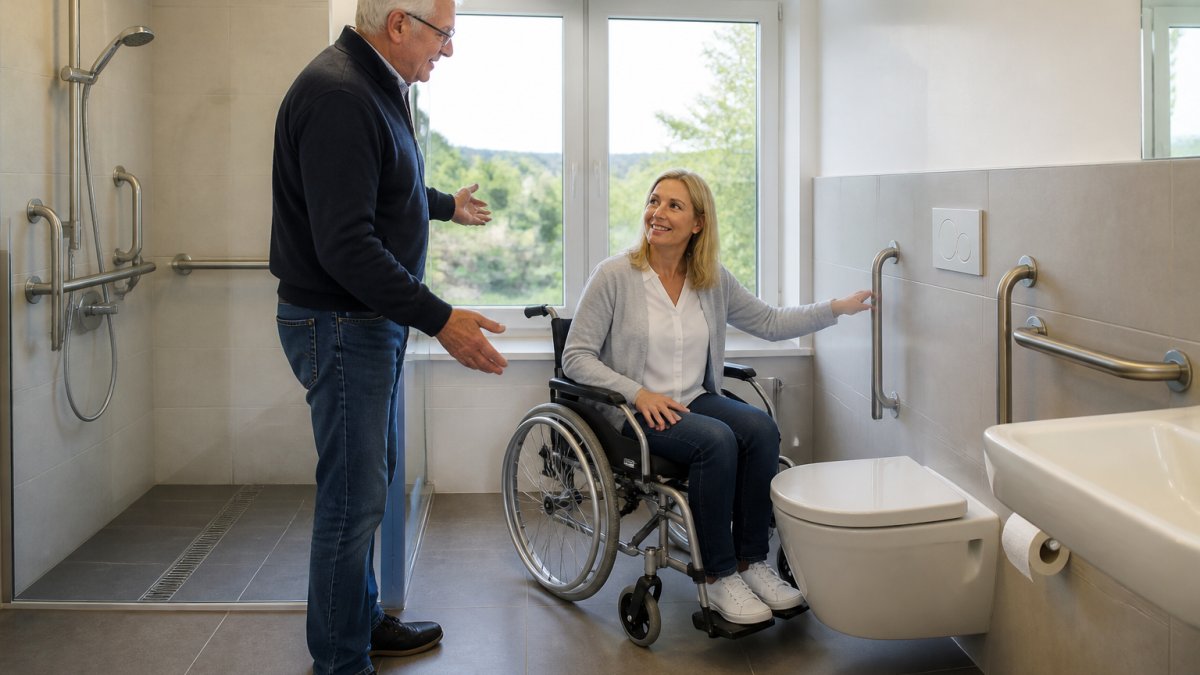
First, check the shower. A walk-in shower without a tub is essential. A shower stool or a folding seat makes it much safer for guests with limited mobility to use the shower.
When it comes to the toilet, it's the space around it that matters, not just the toilet itself. Without room for a wheelchair or walker, a grab bar is virtually useless.
Grab Bars, Shower Area, and Toilet: Measurable Criteria
| Element | Guideline | Exam Note |
|---|---|---|
| Shower Access | At ground level, with a threshold no more than 2 cm high | Without a tub rim |
| Toilet Grab Bar | on both sides, approx. 70 cm high | Within reach of the seat |
| Shower Grab Bar | At least 1, within reach | When getting in and out of the car |
| Toilet Activity Area | at least 150 x 150 cm | Wheelchair or walker |
| Sink | accessible from below | For seated use |
| Flooring | non-slip, matte | Safe Even When Wet |
The height of grab bars and fixtures should be appropriate for the actual users. What is comfortable for a person of average height may be too high for a shorter person.
A common mistake: Grab bars are installed based on appearance rather than grip height. A grab bar that is too high or too far from the seat does not provide support and becomes a fall hazard rather than a safety aid.
Kitchen and Dining Area: Safety and Accessibility for Everyone
The kitchen is often overlooked when it comes to accessibility, even though it’s used every day. Anyone who can’t move around safely in the kitchen loses a significant amount of their independence.
What matters:
- Work surfaces at a height that can be used while sitting or standing
- Cabinets and appliances that can be reached without having to bend down deeply or reach overhead
- Clear space in front of the stove and sink
- Non-slip floor, even when liquids are spilled
- Clearly labeled controls on the stove and oven
The dining area should provide enough space to roll a wheelchair or walker up to the table. A table with a central leg is unsuitable for this; a table with legs at the corners is easier to roll under. Chairs with armrests make it easier to stand up.
Checking for Accessible Accommodations Before Booking: Asking the Right Questions
Checking whether a place to stay is accessible before booking means asking specific questions instead of relying on general information. Most disappointments arise because no one asked.
Here are some questions you should ask before making any reservation:
- How many steps are there from the parking lot to the front door, and is there a path without steps?
- What is the clear opening width of the front door and the interior doors?
- Is the shower walk-in, and is there a shower stool or grab bars?
- How much open space is there next to the restroom?
- Are there thresholds between the rooms, and how high are they?
- Are there grab bars, and at what height?
- Is there an elevator if the apartment isn't on the ground floor?
- What is the flooring like—non-slip or slippery?
Anyone who answers these eight questions will have a realistic picture of the apartment. Missing or evasive answers are, in themselves, a form of information.
Transparent Accommodation Descriptions and Guest Communication
For landlords, providing an honest description is the easiest way to build trust. Give specific measurements instead of using general terms. Don’t write „accessible“; instead, write „step-free access, 90 cm door width, walk-in shower with grab bar.“.
Effective communication with guests begins before they arrive. Let them know exactly where to park, how to get to the door, and whether you can help them carry their luggage. Find out in advance what assistive devices guests will be bringing and whether there is room for them in the apartment.
A quick phone call before booking says more than ten lines of description. Landlords who are easy to reach and provide honest information will attract guests who otherwise would have kept looking.
Room-by-Room Checklist for Vacation Rentals (Printable)
This checklist can be worked through room by room. It is suitable for landlords to use for self-inspection and for guests to use for advance inquiries. Each item lists a guideline value and, where applicable, the method for checking it. Use a folding ruler or measuring tape—not just a rough estimate—since the difference between „wide enough“ and a clear width of 78 cm determines whether the space is usable.
Entrance and Hallway
- A smooth, step-free path from the parking lot to the apartment door (Test: actually navigate the path using a walker or wheelchair; don't just look at it)
- Apartment door with a clear width of at least 80 cm (Check: Measure between the door frames, not the door panel)
- No threshold higher than 2 cm; ideally 0 (Test: Measure at the highest point)
- Hallway at least 120 cm wide (measure at the narrowest point, e.g., next to a closet)
- A turning radius of 150 cm is possible in the hallway or entryway
- Lighting is provided along the access path, with a motion sensor or switch in front of the door
- Non-slip surface on the access path; no loose stones or gravel
Living Area
- Clear pathways between pieces of furniture, with a minimum clearance width of 90 cm
- Seating with armrests and a fixed seat height (Test: It is possible to stand up without using the table for support)
- Non-slip flooring; no loose rugs or runners
- Light switches and outlets at a comfortable height, accessible without bending over
- TV and heating controls with clear labels
Bedroom
- A bed at the right height to make it easy to get out of bed (check: feet flat on the floor, knees at a right angle)
- Access to the bed from both sides, with at least 80 cm of space on one side
- Bedside lamp within reach without having to turn around
- Unobstructed path from the bed to the door, at least 90 cm
- No tripping hazards from bedside rugs
Bathroom
- Walk-in shower without a shower pan rim; threshold no more than 2 cm
- Shower stool or folding seat available
- Grab bars in the shower and bathroom, installed at a comfortable height (Test: reach while seated, not while standing)
- A clear space next to the toilet measuring at least 150 x 150 cm
- Wheelchair-accessible sink for use while seated
- Non-slip, matte flooring that provides a secure footing even when wet
- Single-handle faucets that can be operated even with limited hand strength
Kitchen and Dining Area
- Work surfaces that can be used while sitting or standing
- Cabinets accessible without reaching overhead; frequently used items are between 40 and 140 cm in height
- Clear space in front of the stove and sink, at least 120 cm
- Table with legs at the corners, wheelchair-accessible
- Chairs with armrests
- Stove with clearly labeled burners and an automatic shut-off feature
Outdoor area
- Terrace or balcony accessible without steps
- Thresholds leading to outdoor areas: maximum 2 cm
- Outdoor seating with armrests
- Lighting for evening use
How to Grade Properly: Method Over Judgment
The most common source of error is estimation. Three rules have proven effective:
- Always measure at the narrowest point. A door is as wide as its narrowest component, which is usually the frame, not the door panel.
- Check while sitting, not while standing. Handrails, switches, and fixtures must be within reach from the actual position of use.
- Test using assistive technology. A walker or wheelchair reveals barriers that remain invisible when walking.
For each item, record the measured value—not just „met“ or „not met.“ These numbers will later serve as the basis for communicating with guests and for prioritizing actions.
A checklist without measurements is just an opinion. A checklist with measurements in centimeters serves as proof—for guests, for funding agencies, and in the event of damage.
Prioritizing by Effort and Impact: Where Landlords Should Start
Not every measure costs the same, and not every measure yields the same results. Prioritizing based on effort and impact saves money and addresses the most important issues first.
The following order has proven effective in practice:
| Priority | Action | Effort | Effect |
|---|---|---|---|
| 1 | Installing Grab Bars in the Bathroom | low | high |
| 2 | Remove or flatten thresholds | low to moderate | high |
| 3 | Shower stools and non-slip mats | low | high |
| 4 | Widening Doors | moderate to high | high |
| 5 | Improve Lighting and Contrast | low | medium |
| 6 | Wheelchair-accessible sink | medium | medium |
| 7 | Complete Bathroom Renovation | high | high |
If you're on a tight budget, start with the first three points. They're inexpensive and eliminate the most common fall hazards.
It is important to be honest. An apartment with grab bars but without step-free access is not accessible. It is simply equipped for seniors. This distinction should be clear in the description.
Practical Test with Elderly Guests: Test Instead of Guessing
The most effective way to evaluate accessibility is to conduct a practical test with the people who will actually be using the apartment. Assumptions about accessibility almost always lead to misjudgments.
Invite older guests or people with limited mobility to test the apartment before you advertise it.
Pay special attention to:
- The moment they arrive: Can the person find their way to the door without any instructions?
- The path to the bathroom at night: Is it lit and clear?
- Using the Shower: Is there a need for help that isn't available?
- Getting out of bed and out of a chair: Can you do it without help?
Make a note of any concerns. Often, it's the small details—a missing handle, a slippery spot, a switch that's too high—that make all the difference.
Tourism Offerings and Market Opportunities for Accessible Accommodations
Accessible accommodations are a growing market. Those who invest early will attract guests who can't find what they're looking for elsewhere.
Families with strollers, people with temporary injuries, groups of older travelers, and guests with permanent disabilities are all looking for the same features: step-free access, safe restrooms, and clear information.
Market opportunities arise primarily from reliability. Guests who have been disappointed once will, the next time, only book accommodations that can back up their claims.
This is an advantage for small and medium-sized businesses in the tourism industry: accessibility can be implemented gradually, one step at a time, without having to overhaul the entire operation. The Austrian Hotel Association on Tourism and Accessibility Regional tourism associations also offer advice and information on funding opportunities.
Accessibility is not merely a matter of cost. It is a quality feature that appeals to multiple target groups at the same time and helps stabilize occupancy rates during the off-season.
Avoiding Common Mistakes When Planning Accessible Vacation Rentals
Most mistakes aren't caused by a lack of willingness, but by a lack of knowledge. If you're aware of common pitfalls, you can avoid costly rework.
These are the errors we encounter most often:
- Check only the input. Accessibility doesn't end at the front door. Hallways, bathrooms, and bedrooms are just as important.
- Estimate dimensions rather than measure them. „Wide enough“ is not a sufficient specification. Measure the clear opening width of each door.
- Install the grab bars according to their appearance. A handle that isn't within easy reach isn't helpful to anyone.
- Shower with a tub rim. A low shower rim, just a few centimeters high, makes the shower unusable for wheelchair users.
- Contradictory description. Anyone who writes about „accessibility“ and then mentions steps loses credibility.
- Do not seek advice. Funding agencies and specialized planners are familiar with the requirements and often save more than their consulting services cost.
Another common mistake: accessibility is treated as a one-time project. In practice, it is an ongoing process. Guests report areas for improvement, standards are updated, and each season brings new insights.
Conclusion: Use the right checklist to improve accessibility and guest satisfaction
A checklist for accessible vacation rentals for seniors is more than just a formality. It’s the difference between a rental that guests can actually use and one that only looks that way.
The key points can be summarized in a few sentences: Check each room individually, measure rather than estimate, prioritize based on effort and impact, and test with real guests.
Landlords who communicate honestly and provide specific measurements build trust, which translates into bookings and referrals. Accessibility pays off—for guests and for the business.
Accessibility on vacation starts with your accommodations. At Apartments Gutenbrunn Everyday life here includes barrier-free access, thoughtfully designed bathrooms, and personalized assistance from Anna and Herbert, so that families, wheelchair users, and dog owners can feel at home from the very first minute.
Frequently Asked Questions
How can you tell if a vacation rental is accessible?
An accessible vacation rental is characterized by step-free access, sufficiently wide doors (at least 80 cm), and an accessible bathroom. Look for walk-in showers, grab bars, and enough space to move around. The kitchen and bedrooms should also be accessible to wheelchair users or people with walkers. A detailed checklist helps you verify the most important criteria before booking.
What amenities should a senior-friendly vacation rental have?
Vacation rentals designed for seniors should have non-slip floors, easily accessible light switches and electrical outlets, and a comfortable seat in the shower. Good lighting in hallways and bathrooms is important, as are grab bars. The furniture should be sturdy and equipped with armrests.
What should be included in the bathroom of an accessible vacation rental?
An accessible bathroom should have a walk-in shower with a folding seat and grab bars. The sink area must be wheelchair-accessible so that wheelchair users can reach it. The toilet requires side grab bars and sufficient space for transfers. Check whether these features are available before booking.
How wide should doors be in an accessible accommodation?
For accessible housing, doors should have a clear width of at least 80 cm, preferably 90 cm. This allows wheelchair users and people with walkers to pass through. Hallways should also be at least 120 cm wide to allow people to pass each other. Thresholds should be no more than 2 cm high and beveled to prevent tripping hazards.
What questions should I ask before booking an accessible vacation rental?
Ask about the exact door width, the height of thresholds, and whether the entrance is step-free. Find out if the bathroom has a walk-in shower and grab bars. Ask about the height of the bed and seating, as well as whether light switches are within easy reach. The surrounding area is also important: Are there paved paths? Have the accessibility features confirmed in writing.
How can I check whether the vacation rental really has step-free access?
Ask the landlord for photos of the entrance area and the driveway. Ask about the number and height of any steps, as well as whether there are any alternative ramps. Looking at the floor plan will help you assess the layout. If possible, tour the apartment in advance or ask previous guests for their feedback. A written confirmation provides additional reassurance.
What should be included on a checklist for accessible travel for seniors?
A checklist for accessible travel for seniors includes items such as step-free access, door widths, bathroom amenities, lighting, and non-slip floors. You should also check the accessibility of stores, restaurants, and public transportation. Write down important phone numbers and check in advance whether assistive devices such as wheelchairs are available on site. Plan for breaks.
What are the minimum dimensions for accessible vacation rentals?
In Austria, accessible vacation rentals must comply with the ÖNORM B 1600 standard. Doors should be at least 80 cm wide, and hallways 120 cm wide. In the bathroom, a turning radius of 150 cm is recommended for wheelchairs. The shower should be walk-in and at least 90 x 90 cm in size. Grab bars should be installed at a height of 85 cm. These dimensions make the apartment easier to use for seniors.


Comments are closed, but trackbacks and pingbacks are open.