


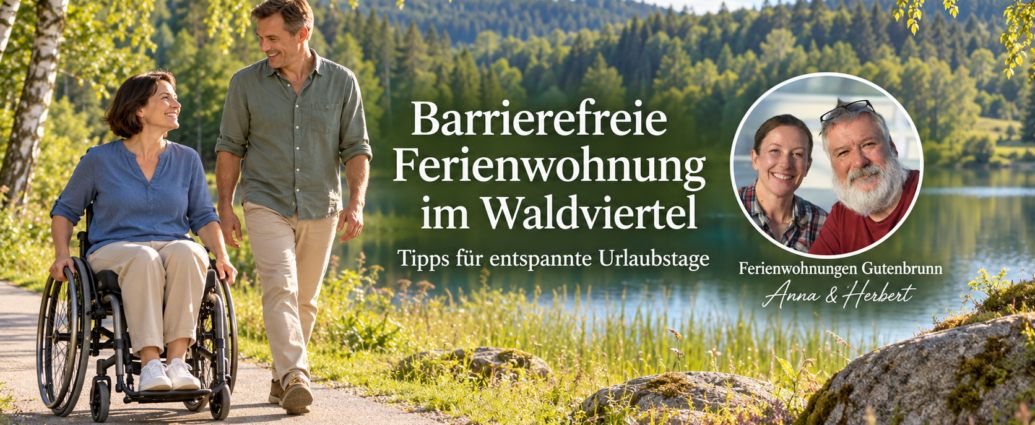
Why the Waldviertel is ideal for barrier-free vacations
Finding an accessible vacation rental in the Waldviertel is easier than you might think.
It also becomes clear why this region is so well-suited for a barrier-free vacation.
The Waldviertel is located in the northwest of Lower Austria. It is one of the quietest tourist regions in the state. Vast plateaus, dark forests, and clear ponds characterize the landscape. The infrastructure is geared toward recreation rather than through traffic. Particularly peaceful trails invite visitors to take walks. This makes the area especially pleasant.
It is precisely this combination that makes the region attractive to people with limited mobility. The focus is on accessible experiences.
The good news: In the Waldviertel There are businesses that offer true accessibility. The bad news: the term isn’t protected. Any host can call their vacation rental „accessible,“ even if there are three steps at the entrance.
This guide will show you which criteria really matter, how to ask the right questions before booking, and what to look out for when it comes to travel, amenities, and leisure activities.
What Makes a Vacation Rental in the Waldviertel Truly Accessible
In practice, accessibility means you can reach, use, and leave the apartment independently, without needing assistance. That sounds obvious, but it isn’t. Accessibility isn’t just a list of features; it’s a chain of door widths, thresholds, clear spaces, and bathroom layouts. If one link breaks, the chain breaks.
The ÖNORM B 1600 on Accessible Construction describes the dimensions considered accessible in Austria. Many hosts are familiar with this standard but only partially adhere to it. That’s why it’s worth asking for specific measurements in centimeters before booking, rather than relying on the term „accessible.“.
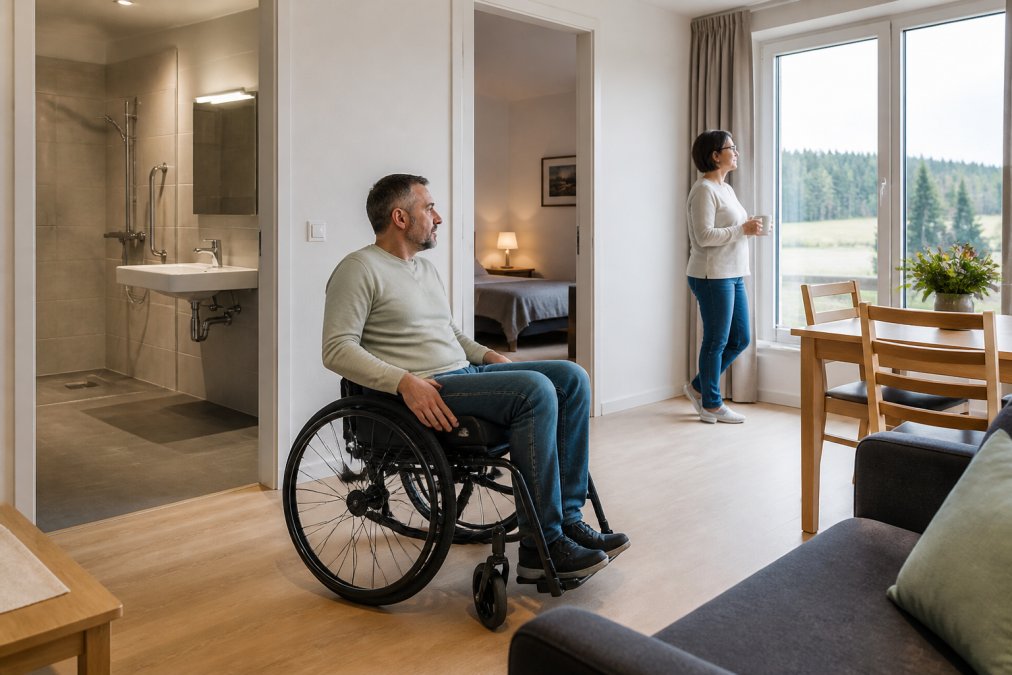
Door widths, thresholds, and clearance areas: the strict criteria
The key dimensions relate to four areas: door widths, thresholds, clearance areas, and turning circles.
A door width of at least 80 centimeters is considered wheelchair accessible. 90 centimeters is more comfortable.
For thresholds, the requirement is that they be threshold-free or no more than two centimeters high with a ramp. Clear spaces in front of doors, beds, and bathroom fixtures must provide enough room to maneuver. In the bathroom, there should be enough space to turn around within a 150-centimeter radius.
The most common mistake: A host measures the door width, including the frame, and says it’s 90 centimeters. In reality, the clear width is often only 72 centimeters. Be sure to ask specifically for the clear passage width—that is, the width that is actually left open between the open door leaves.
Bathroom: Access to the shower, grab bars, and a wheelchair-accessible sink
The bathroom plays a key role in daily life.
For wheelchair users, a floor-level shower entrance without a shower pan is often a requirement.
In addition, grab bars should be installed next to the toilet and shower.
A wheelchair-accessible sink with open space underneath allows for use while seated.
Make sure that handrails are securely anchored to the wall.
Glued-on handles cannot support a person's body weight.
The Waldviertel Accessible Vacation Rental thus meets these requirements.
Accessible Accommodations Checklist: 12 Things to Consider Before Booking
The Accessible Accommodations Checklist is your most important tool because it helps structure your conversation with the host. Don’t just ask, „Is it accessible?“—instead, go through the items one by one. Hosts who offer true accessibility will be happy to answer these questions precisely. Evasive answers are a red flag.
- Clear opening width of all doors (at least 80 cm)
- Thresholds at the entrance, in hallways, and leading to the bathroom (threshold-free or ramp)
- Turning space in the bathroom (at least 150 cm)
- Flat-floor shower access, no step into the tub
- Grab bars in the toilet and shower, securely anchored
- Wheelchair-accessible sink
- Space for movement next to the bed (at least 90 cm)
- Access to the apartment without steps or via a ramp
- Parking space right next to the apartment; paved and level
- Kitchen with a wheelchair-accessible work area
- Lighting and Contrasts in the Hallway and Bathroom
- A local contact person, not just a hotline
Questions You Should Ask the Host
Phrase your questions so that they cannot be answered with a simple „yes“ or „no.“ “How wide is the clear opening of the bathroom door?” yields a number. “Is the bathroom wheelchair-accessible?” yields an opinion. Also, ask for recent photos of the entryway, bathroom, and bedroom, taken without a wide-angle lens. Wide-angle shots make rooms appear larger than they actually are.
Accessible Vacation Rental for Couples: What Matters When You're a Couple
When it comes to an accessible vacation rental for couples, the focus shifts. If only one person has limited mobility, the rental must work for both: ample space, separate areas for privacy, and a location that’s also comfortable for the companion. A bathroom that’s too small can quickly become a source of conflict if one person needs assistance.
What works well in practice: a bedroom with space to move around on both sides of the bed, an open-concept kitchen and living area as a shared focal point, and an entrance that’s easily accessible without having to go out of your way. Couples seeking peace and quiet also benefit from a location away from busy thoroughfares.
Accessible Travel to the Waldviertel: Car, Train, and Shuttle Service
Accessible travel begins long before you reach your accommodations, and this is where most plans fall through—not because there are no solutions, but because they are rarely documented. The following sections describe which routes in the Waldviertel actually work and which questions you need to clarify in advance.
By car: the last kilometer makes all the difference
The Waldviertel is easily accessible via the A22 and the B-roads. The key factor isn’t the highway, but the final stretch leading to the apartment. A paved, level access road is essential for wheelchairs and walkers; gravel, crushed stone, or steep ramps quickly become impassable after rain.
Ask the host not only about the surface but also about the slope. Many wheelchair users cannot navigate an access ramp with a slope of more than six percent on their own without assistance. Ask for a photo of the driveway taken in daylight. If possible, indicate whether there is a turning circle next to the vehicle for getting out.
By Train: ÖBB Assistance Service and What You Need to Register in Advance
You can reach the region by train via the rail lines to Krems and onward toward the Waldviertel. The key mechanism is the ÖBB Assistance Service for Travelers with Limited Mobility: ÖBB offers free assistance with boarding, help with transfers, and support with getting on and off trains. This assistance is not provided automatically; it must be requested in advance, generally at least 24 hours before the planned trip, and even earlier for international connections. Requests can be made by phone or via the ÖBB’s online form.
Before booking, make sure to clarify three things:
- Is the destination station accessible without steps, and is there an elevator or ramp leading to the platform?
- Is there an accessible restroom at the train station?
- How high is the platform, and is the boarding height compatible with your mobility aid (wheelchair, walker)?
Not every train station in the Waldviertel region is completely barrier-free. Some small stations have only a low platform without a ramp. Check directly with the ÖBB, not through third-party websites, whose information is often out of date.
Transfer from the train station to the lodging
The transfer is the most commonly underestimated part of the trip. A transfer arranged in advance is almost always less stressful than trying to find one once you arrive, because accessible taxis and rental cars with ramps or lifts aren’t always available on short notice. Ask your host if they can arrange a transfer or if they know a provider with a wheelchair-accessible vehicle. Also, clarify whether the transfer is available around the clock or only at certain times—otherwise, a train arriving late at night could become a problem.
Agree on an arrival time window with the host and ask for directions for the final stretch—not just the address. A phrase like „turn right after the bridge, then 200 meters on a gravel road“ is the kind of information that can make the difference between a relaxed and a frustrating start. Also ask for a brief description of the first 50 meters from the last paved road.
Traveling with a tour guide or assistant
If you are traveling with a companion, please check in advance whether they can be seated in the same compartment or car. With ÖBB, this is usually possible if you make your reservation in advance. Also, bring a written list of your assistive devices (wheelchair dimensions, weight, and whether it’s foldable) so that the train staff can prepare the appropriate boarding assistance. This list is also useful during transfers and at your accommodations.
Accessible Destinations in the Waldviertel: Nature, Lakes, and Culture
Accessible Places to Visit in the Waldviertel The best way to find these is through the tourism region itself and by contacting the provider directly. The following examples show what you should look for when making your selection and which specific questions can make the difference between a relaxing and a stressful trip.
Nature Destinations: What Matters When It Comes to Trails and Shores
Many natural sites in the region are accessible via wheelchair-accessible paths, but „wheelchair-accessible“ rarely means the same thing here. Four characteristics are key:
- Tire tread: Asphalt or finely compacted gravel are easy to drive on; coarse gravel, meadows, and forest floors are not.
- Width: The path must be at least 120 centimeters wide so that two wheelchairs can pass each other.
- Gradient: A slope of less than six percent is considered safe for independent travel; anything steeper requires pushing or assistance.
- Places to take a break: Benches with armrests and backrests placed at regular intervals, ideally every 200 to 300 meters.
The Lake Edlesberg is an example of a destination with paved paths and flat terrain. Before your visit, ask about the exact length of the loop trail, the type of surface, and whether there is a gentle slope into the water at the shore; for wheelchair users who want to swim, a gentle slope into the water is often more important than the trail itself.
Cultural Attractions: Monasteries, Museums, and Exhibitions
The region also has much to offer culturally: monasteries, museums, and exhibitions in the Waldviertel are increasingly providing step-free access and accessible restroom facilities. Before your visit, check the details about the facilities directly with the provider, as information on websites is often out of date. Be sure to ask specifically about:
- step-free access or a ramp at the main entrance,
- Elevator to all exhibition levels (not just the ground floor),
- accessible restroom with a turning circle,
- Seating in the exhibition halls,
- Parking situation and distance from the parking lot to the entrance.
A common situation: The main entrance is step-free, but some exhibition rooms or the courtyard are accessible only via steps. Therefore, instead of asking, „Is the museum accessible?“ ask, „Which areas are accessible without steps, and which are not?“
Planning Wheelchair-Accessible Outings: Daily Schedule and Breaks
An accessible outing works best when you tailor your daily schedule to your stamina. Plan shorter segments with scheduled breaks, and check in advance whether there are accessible restroom facilities along the way—this isn’t always a given in rural areas. Bring a rain jacket: Many trails are much harder to navigate when wet, and a wet surface can turn a flat path into a slippery one.
For every destination, ask about the surface, the grade, the path width, and accessible restrooms. These four factors have a greater impact on the success of an outing than the distance or the attraction itself. A quick phone call beforehand can often save you a disappointing trip.
Accessible Attractions Near the Accommodation
If you’re staying in a vacation rental in the region, it’s a good idea to organize your excursion destinations by distance: shorter destinations for days when you have less energy, and farther destinations for days when you have more energy. Ask your host about destinations they know from their own experience with guests with limited mobility; these recommendations are often more specific than any brochure because they’re based on real feedback.
Barrier-Free Farm Vacations: What Rural Accommodations Offer
Farm stays are very common in the Waldviertel, and the range of accessibility options is wide. Some farms have specifically renovated individual apartments to include threshold-free access, wide doors, and adapted bathrooms. Others are traditionally built and not wheelchair-accessible.
The advantage of rural accommodations is the personal attention and the peaceful setting. The downside: The paths around the farm are often unpaved. Therefore, be sure to check not only the accommodations but also the surrounding area. If you’re traveling in a wheelchair, you’ll need a paved path at least as far as the nearest street.
Certified Businesses and What the Austrian Ecolabel Means
Certifications help provide guidance, but they do not replace your own assessment. The Austrian Ecolabel is awarded by the Federal Ministry for Climate Protection and evaluates businesses based on environmental and quality criteria, including aspects of accessibility. Austrian Eco-Label for Tourism Businesses lists certified businesses and their criteria.
Important: Certification is not a substitute for actual measurements. A facility may be certified but still have an apartment that is too small for your wheelchair. Use the certification as an initial screening tool and the checklist as a second step in your evaluation.
Amenities that make everyday life easier: nursing bed, grab bars, kitchen-dining area
A nursing bed is essential for some guests, but irrelevant for others. If you need one, be sure to ask specifically about height adjustability and whether it is a nursing bed or a regular bed with a lift-assist feature. These are two different things.
For many guests with limited mobility, an open-concept kitchen is more practical than separate rooms because it shortens the distance they have to travel. The height of the countertops is crucial, as is whether there is enough space underneath for a wheelchair. Grab bars in the bathroom and a non-slip floor significantly reduce the risk of accidents, especially for those with limited balance.
Amenities don't make or break a vacation, but they do make a difference in everyday life. Ask about the three things you need every day, and have them describe the rest. If you can manage on your own in the morning and evening, you'll feel more relaxed for the rest of the day.
Travel Planning for People with Limited Mobility: Preparation and Travel Assistance
Planning a trip with limited mobility follows a simple principle: take care of everything that can’t be quickly resolved on site. This includes transportation to the destination, accommodations, restroom facilities, and the question of who will provide assistance in an emergency. A travel companion can be someone traveling with you, but it can also be a contact person who can be reached locally.
A written summary has proven to be very helpful: What dimensions do you need, what assistive devices will you bring, and which pathways need to be accessible? Send this overview to the host before booking. It saves time by preventing follow-up questions and provides clarity for both parties. Also, make sure to check whether medical care and pharmacies are within easy reach.
How to Read Testimonials and Reviews Correctly
Reviews are helpful, but they rarely answer the most important question. Look specifically for reviews from guests with needs similar to yours. A review that says „I had a nice weekend“ tells you nothing about door widths. A review that says, „I had no trouble getting into the bathroom in my wheelchair,“ tells you a lot.
Look for recurring patterns. If several reviews mention the same limitation, it's real. If a single review praises something that no one else mentions, you should be cautious.
Common Mistakes When Booking an Accessible Vacation Rental
The most common mistakes stem from time pressure and a reluctance to ask for clarification. People who book at the last minute skip asking questions and rely on the term „accessible.“ That’s exactly where the disappointments arise.
| Error | Why Things Go Wrong | Better |
|---|---|---|
| Just ask if it's „accessible“ | The term is not protected | Ask for clear door widths |
| Do not review photos | Wide-angle lenses can make things appear larger than they are | Please provide recent photos taken without a wide-angle lens |
| Ignore surroundings | Trails that are unpaved or steep | Ask about the road surface and access |
| Overlooking the restroom area | The Bathroom Shapes Everyday Life | Clarify shower access and grab bars |
| No contact person | Problems Remain Unresolved | Ask for a local contact |
| Last-minute booking | No time for follow-up questions | Inquire early and compare options |
Book a Barrier-free vacation apartment Never base your decision solely on a photo from a real estate listing site. These sites rarely show bathrooms and entryways in detail. Always ask for a photo of the bathroom showing the shower entrance and a photo of the front door with the door open.
Conclusion: Here's How to Enjoy a Relaxing, Accessible Vacation in the Waldviertel
When looking for an accessible vacation rental in the Waldviertel region, choose your accommodation based on specific measurements rather than keywords.
Also, ask about clear door widths, thresholds, shower access, and grab bars.
Plan your trip down to the last detail, and look for accommodations with a personal contact person on site.
Frequently Asked Questions
What makes a vacation rental in the Waldviertel truly accessible?
True accessibility is demonstrated by specific measurements: doors at least 80 cm wide, threshold-free entrances, step-free shower access, and grab bars in the bathroom. Wheelchair-accessible sinks and sufficient space to move around next to the bed are also part of this. Ask the host about these details before you book, rather than relying solely on the term ‚accessible.‘.
What criteria are important when looking for accessible accommodations?
Pay attention to door widths, threshold clearance, shower access, and the number of grab bars. Also check whether the apartment is on the ground floor and whether a nursing bed is available. A checklist covering these points will help you compare accommodations objectively. Also ask about the hosts’ availability to ensure someone is on site in case of an emergency.
Are there accessible tourist attractions for wheelchair users in the Waldviertel region?
Yes, the Waldviertel region offers several attractions with wheelchair-accessible paths and entrances. Nature destinations around Lake Edlesberg and well-maintained hiking and biking trails are suitable for guests with limited mobility. Ask your hosts for current recommendations, as paths and access points may change. Plan your route to these destinations in advance to ensure the local infrastructure meets your needs.
What should couples look for when booking an accessible vacation rental?
Couples will benefit from an accessible vacation rental that’s both quiet and easily accessible. Look for an open-concept kitchen, a comfortable bedroom, and a bathroom with shower access. If only one person has limited mobility, the apartment should offer enough space for both. Ask about personalized assistance from the hosts in case support is needed.
How can I find accommodations that are both accessible and dog-friendly?
Ask the host directly if Dogs are allowed and whether there are suitable walking trails nearby. The Waldviertel region has many quiet trails away from busy roads. Check in advance whether the apartment has its own entrance so that the dog can go outside without having to climb stairs. A personalized booking request helps ensure that both requirements are met at the same time.
What are the advantages of an accessible vacation rental compared to a hotel?
A vacation rental offers more space, a private kitchen, and often direct access to the outdoors without long hallways. For families and couples, this offers more flexibility than a hotel room. Personal assistance from the hosts replaces the front desk and is often more helpful when it comes to questions about accessibility. In addition, you can clarify the amenities in more detail before booking.
How do guests with limited mobility get to the Waldviertel?
Traveling by car is usually the most flexible option, since you can park right in front of your lodging. Check in advance to see if the parking lot is paved and if the path to the entrance is free of curbs. If you’re traveling by train, it’s a good idea to arrange transportation from the train station to your lodging in advance. Ask your hosts about the best route and accessible transfers.
What should I find out before booking an accessible vacation rental?
Check the door widths, threshold clearance, shower access, and whether the accommodation is on the ground floor. Ask about grab bars, a nursing bed, and wheelchair-accessible furniture. Also, confirm whether you can book directly with the host and how the reservation is secured. A written confirmation of the key amenities will give you peace of mind when planning your trip.
Finding the right place to stay takes time, and asking the right questions before booking is exactly what will save you that time. Vacation Rentals Gutenbrunn Offers accessible apartments with personalized support, a quiet location in the Waldviertel region, and direct booking with Anna and Herbert. If you value accurate information, responsive hosts, and accommodations that fit your daily life, book directly with us and enjoy a barrier-free stay.
Comments are closed, but trackbacks and pingbacks are open.