


Last updated: October 23, 2026
Quick Overview
A secure garden fence for dogs at a vacation home must meet three requirements: sufficient height depending on the dog’s size, a solid bottom section to prevent digging under or slipping through, and sturdy fastening of the posts and panels. Without these three elements, the fence is not secure enough.
- Small dogs need a fence that is at least 60–75 cm high, medium-sized dogs need a fence that is 75–100 cm high, and large dogs need a fence that is 100–120 cm high or taller.
- The fence must extend at least 15–20 cm into the ground at the bottom or be secured to a solid foundation to prevent animals from digging under it.
- Before you arrive, check the entire fence for gaps, loose panels, and missing fasteners, especially in the corners.
- Portable fences with ground stakes or tent pegs provide low-impact solutions for rented properties without the need for drilling or causing damage.
Table of Contents
- A Safe Garden Fence for Dogs at a Vacation Home: What Matters Most
- Fence Height for Dogs: Choosing the Right Size
- Securing a Garden Fence Against Being Dug Under: The Bottom Edge
- Suitable Types of Fences and Materials
- Portable Dog Fences for Vacation: Flexible Solutions
- Safety Check Before Arriving at the Vacation Home
- Questions for the Landlord About Dog Safety
- Check for stability and secure fastening
- Avoiding Common Mistakes When Making Your Yard Dog-Safe
- Conclusion: Planning for Dog Safety in a Vacation Home
- Frequently Asked Questions
A Safe Garden Fence for Dogs at a Vacation Home: What Matters Most
A secure garden fence for dogs at a vacation home isn’t just like the one you have at home. The requirements are different, the risks are greater, and the solutions need to be flexible. At Gutenbrunn Vacation Rentals, we know from experience: Dog owners planning a secure garden fence for their dogs at a vacation home need practical solutions, not just general tips.
The problem is real. A dog in unfamiliar surroundings behaves differently. Stress, excitement, new smells—all of these can turn an otherwise well-behaved dog into a runaway. An unreliable fence leads to escape attempts, lost pets, and vacation stress instead of relaxation.
This guide shows you what really matters when it comes to setting up a safe garden fence for dogs at your vacation home. We’ll cover fence height, preventing dogs from digging under the fence, materials, and portable solutions. By the end, you’ll know the mistakes others make—and how to avoid them.
Fence Height for Dogs: Choosing the Right Size
Fence height is the first thing many hosts and dog owners get wrong. A fence that looks safe to people isn't safe for a dog that can jump.
Take the dog's size and jumping ability into account
The right fence height depends on three factors: the dog's size, jumping ability, and temperament. A small dachshund needs a lower fence than a large German shepherd. But jumping ability is not proportional to size.
Small dogs can jump surprisingly high. A terrier often jumps higher, relative to its size, than a large dog. Temperament also plays a role: A nervous, fearful dog is more likely to try to run away than a calm one.
The rule of thumb is simple: When measuring your dog's shoulder height, add at least 30 to 40 centimeters. So a dog with a shoulder height of 50 centimeters needs a fence that's at least 80 to 90 centimeters high.
Minimum Requirements by Dog Type
For small dogs (under 30 centimeters at the shoulder), 60 to 75 centimeters is often enough. But keep in mind: Small dogs are sometimes the best jumpers.
Medium-sized dogs (30 to 50 centimeters) need 75 to 100 centimeters. That is the standard range for most garden fences.
Large dogs (over 50 centimeters) require at least 100 to 120 centimeters. Very large or athletic breeds may need as much as 130 to 150 centimeters.
But height alone isn't enough. A dog can also dig. That brings us to the next point.
Securing a Garden Fence Against Being Dug Under: The Bottom Edge
That's the mistake most people overlook. A tall fence doesn't stop every dog; many would rather dig than jump.
How to Properly Install a Base and Foundation
The bottom edge is crucial. A secure garden fence for dogs at a vacation home must be tightly sealed at the bottom. No gaps, no openings.
The best solution is a base or foundation. The fence should extend at least 15 to 20 centimeters into the ground or be secured to a solid surface. Concrete is ideal. If that’s not possible, place a metal grid or wire mesh around the base and anchor it with ground anchors.
Many vacation home fences don't have a proper foundation. That's the main problem. A dog that can dig will do just that.
Anti-slip protection
Some dogs are small enough to slip through openings. Check the fence for gaps between the panels or under the fence. Any opening larger than a fist is a risk.
If the fence has openings, fill them with boards, slats, or wire mesh. Also pay attention to the corners; gaps often form there if the fence isn't secured properly.
A portable fence requires special attention here. If it isn't properly anchored, dogs can move it and slip through.
Suitable Types of Fences and Materials
Not all types of fences are equally suitable for dogs. The material and construction make a difference—but the key factor is whether the fence is a good fit for the dog, the ground, and the intended duration of use. A general recommendation for materials isn’t very helpful at a vacation home, because you usually won’t be building the fence yourself but will have to work with what’s already there.
A Comparison of Materials: What They Can Do and Where They Fall Short
Wooden Fence: Classic, visually appealing, and popular as a privacy screen. A solid wooden fence without gaps can be an advantage for insecure or easily agitated dogs because it blocks the view and thus reduces triggers that might cause barking. Disadvantage: Wood splinters, weathers, and expands and contracts with moisture. Gaps between the boards develop over the years, and a dog that scratches or digs at them will damage the material more quickly than metal. For vacation homes with rotating occupants, wood requires more maintenance.
Metal fence (galvanized or powder-coated): More sturdy and durable than wood, harder to damage, and dimensionally stable. A close-mesh metal fence is the safest, most secure option to prevent animals from slipping through. Downside: Dogs can see through it, which may trigger barking and territorial behavior in some animals. If you have a dog that’s sensitive to stimuli, combine the metal fence with an opaque privacy screen at the bottom. Such privacy solutions not only work well along the fence but also help minimize visual overstimulation when you Securing a Dog in the Car, to ensure a stress-free trip to your vacation destination.
Plastic Fence: Low-maintenance, durable, and attractive for vacation rentals because it requires virtually no upkeep. A continuous plastic fence with no gaps is secure, provided it is firmly anchored. The weak points are the connections: plastic panels can become brittle in extreme heat or frost and pop out of their mounts.
Wire mesh (chain-link or hexagonal mesh): Inexpensive, flexible, and well-suited for filling gaps at the bottom. As a standalone fence, it is usually too unstable for large dogs or those that jump a lot, unless it is stretched over a sturdy frame.
Choosing a Fence Based on Your Dog's Breed and Behavior
The key question isn't ‚Which material is best?‘ but ‚Which fence is right for this dog?‘ Here's a simple guide to help you decide:
| Dog Type / Behavior | Critical Point | Appropriate Fencing Solution |
|---|---|---|
| Small dog (less than 30 cm at the shoulder) | Slipping Through Gaps | Tight mesh or solid panels, openings smaller than a fist |
| Medium-sized dog (30–50 cm) | Jumping and Digging | 75–100 cm tall, with a solid bottom edge and sturdy posts |
| Large dog (over 50 cm) | Tipping Over and Pushing Through | 100–120 cm high, bolted joints, posts set in concrete or ground anchors |
| A dog that jumps high | Skip | At least 130–150 cm, or inward-facing anti-climb protection |
| Dog Digging | Undermining | Base, foundation, or recessed grille at the base of the fence |
| Anxious or easily excited dog | Fleeing in Response to Stress, Barking Triggers | Lower area is not visible from the street, quiet corner location, no view of the street or neighboring dogs |
| Young, boisterous dog | Bumping and Scratching | Metal or sturdy plastic panels, no splintering wood |
This table is not a substitute for an individual assessment, but it provides some initial guidance before you evaluate the existing fence at your vacation home.
What Matters in Design
The most important thing isn't the material, but the design. A safe garden fence for dogs at a vacation home must:
- Be at least the recommended height
- Sealed at the bottom (no slipping through, no digging underneath possible)
- Be stable and firmly anchored
- Do not have any large gaps or openings
- Must not have any sharp edges or splinters
- Have screw connections instead of just plug-in connections
Check every fence at the vacation home yourself before letting the dog inside. Many fences look secure but have hidden weaknesses. Walk all the way around the fence and look for gaps, holes, and loose panels—and pay special attention to the corners, because that’s where the joints are most likely to give way.
Portable Dog Fences for Vacation: Flexible Solutions
Sometimes the existing fence isn't secure enough. Or there isn't a fence at all. In that case, a portable dog fence can be helpful for your vacation—provided it's suitable for the ground and your dog, and doesn't leave any permanent marks on the rental property.
System Comparison: Plug-in Fence, Mesh, Foldable Panel, and Lightweight Metal Fence
Mobile systems vary significantly in terms of setup time, packed dimensions, stability, and suitability for the ground surface. Here is a guide based on typical operating data:
| System | Typical setup time | Packed Size / Transport | Stability | Suitable Substrate |
|---|---|---|---|---|
| Picket fence (metal or plastic panels with ground stakes) | 15–30 minutes for a typical section of the garden | Several poles that can be easily stowed in the trunk | Moderate, depending on soil strength | Lawn, soft ground; not for gravel or patios |
| Portable Fence (Small Animal Fence with Posts) | 10–20 minutes | Very lightweight, compact when packed | Low to moderate; for small, calm dogs | Lawn, meadow; additional securing required in windy conditions |
| Foldable Panel System | 5–15 minutes | Folds flat, often comes with a carrying bag | Average, but excellent for large dogs | Flat, solid surface; secure to the lawn with tent stakes |
| Lightweight metal fence with a snap-together system | 20–40 minutes | Heavier and bulkier; usually requires a vehicle | High—best suited for large dogs or those that jump high | Solid ground, concrete slabs, patios with support feet |
These figures are based on practical experience and vary depending on the terrain, fence length, and physical condition. It is important to select the system based on these criteria before arriving, rather than improvising once you’re on site.
Low-residue mounting without drilling
For rental and vacation homes, it is crucial that the portable fence does not permanently alter the property. The landlord will not accept drill holes, damaged lawns, or scratches on patios.
Proven low-residue solutions:
- Ground stakes and tent pegs on the lawn: they leave only small holes, which can be filled with soil after your vacation.
- Floor anchor with screw thread They hold more securely than smooth ground stakes, but can be removed without tools.
- Rubber protective feet Placing them under metal stands prevents scratches on patios and concrete slabs.
- Sandbags or weights Foldable panels stabilize the structure at the corners without touching the ground.
- Tension straps on existing posts additionally secure the net without drilling new holes.
If the ground is very hard, it helps to tap the stakes into the ground with a small rubber mallet instead of forcing them in. After your vacation, fill the holes with soil; the lawn will usually recover within a few weeks.
Setup and Check Before the First Free Run
A portable fence is only as secure as its anchoring. Before letting your child play unsupervised for the first time:
- Check that all connections are secure.
- Check that the bottom edge is in contact with the floor—there should be no gaps larger than a fist.
- Check corners and goals separately, because that's where the biggest weaknesses lie.
- If the ground slopes, install the fence in steps so that there is no gap at the bottom.
- At first, allow the dog to stay in the portable enclosure only under supervision and for short periods of time.
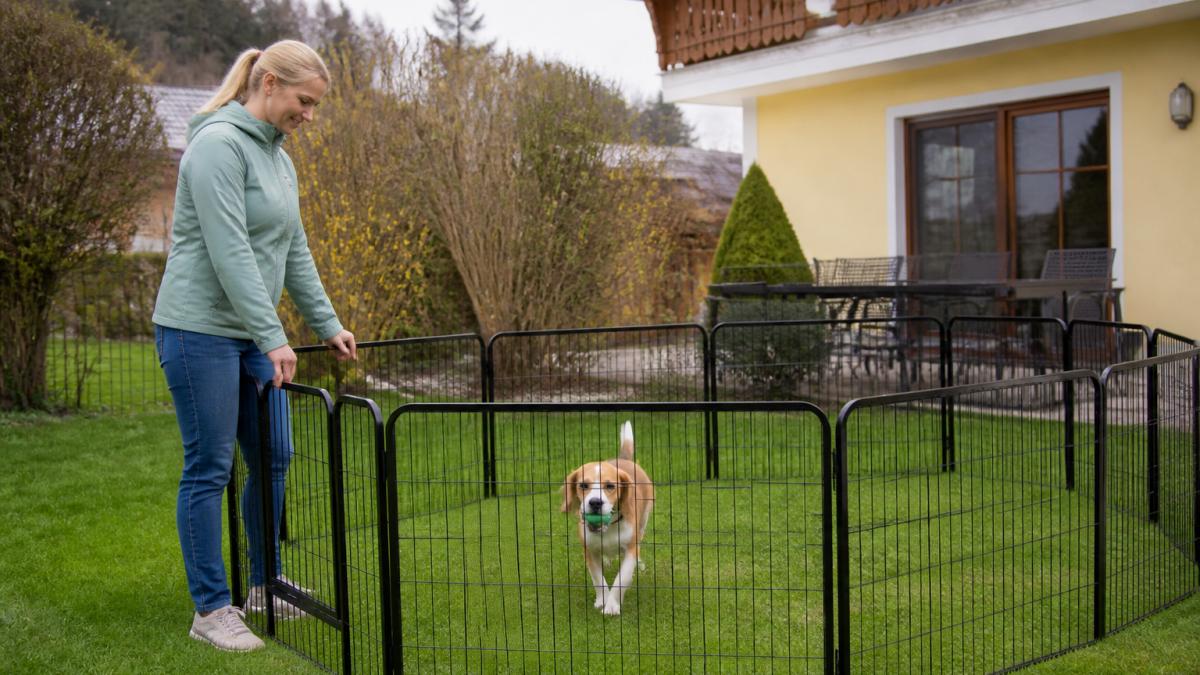
A portable fence is no substitute for supervision. The risk of the dog running away is especially high during the first few hours in an unfamiliar environment. Never leave the dog unattended in the fenced-in area until you are sure it accepts the boundaries.
A portable dog fence for vacation is a good solution when a permanent fence isn't enough. You can Find affordable vacation rentals for families with pets, where you can easily set up flexible solutions like portable fences. But it’s only safe if it’s suitable for the dog, the ground, and the rental period, and can be removed without leaving any residue.
Safety Check Before Arriving at the Vacation Home
Before the dog comes to the vacation home, you need to check the yard. With a Checklist for Your First Vacation with Your Dog You can make sure you think of all the important points. This isn't optional.
Walk around the entire garden. Look for:
- Gaps or cracks in the fence
- Loose panels or boards
- Areas where the fence is not firmly anchored to the ground
- Openings under the fence
- Damaged material or splinters
- Corners where the fence isn't properly secured
- Gates or fences that do not close properly
Also check the area. Are there any spots where a dog might dig? Is the ground soft or hard? It's easier for a dog to dig in soft ground.
Also check neighboring properties. Are there any dogs there that cause trouble? Are there any hazards, such as roads right next to the fence?
If you find anything unsafe, fix it before the dog arrives. A loose fence or a gap in the fence poses a risk of escape. The dog could get lost or injured.
At Ferienwohnungen Gutenbrunn, we understand the needs of dog owners.
Questions for the Landlord About Dog Safety
Not every landlord is familiar with dog safety. Ask the right questions.
Ask the landlord: Be sure to find out about the Safety Rules for Dogs in Vacation Rentals, in order to gain a comprehensive understanding of the requirements.
- Exactly how tall is the fence?
- Is there a base or foundation for the fence?
- Are all the panels securely fastened?
- Are there any gaps or openings?
- How old is the fence? Is it in good condition?
- Was the fence built specifically for dogs?
- Can I set up a portable fence if necessary?
- What should I do if the dog runs away?
Don't just take the statement „The fence is dog-proof“ at face value. Check it out for yourself.
Also ask about the property. Are there any hazards? Do any neighbors have dogs? How close is the nearest street?
A good landlord will be happy to answer these questions. If he gives evasive answers or becomes impatient, that's a red flag.
Check for stability and secure fastening
A fence that isn't stable isn't safe. Stability isn't just a matter of height, but also of how it's secured.
Check how the fence is secured. Are the posts set in concrete? Or are they just stuck in the ground? Posts set in concrete are more stable.
Check the joints between the panels. Are they screwed or nailed together? Screwed joints hold better.
Also check to see if the fence wobbles. Press against different spots with your hand. The fence should not give way.
A wobbly fence will be knocked over by a large dog. That's not safe.
If the fence isn't sturdy, you'll need a portable fence as a supplement, or you'll have to choose a different place to stay.
A safe garden fence for dogs at a vacation home must have three things: the right height, a solid bottom, and sturdy fastenings. If any one of these elements is missing, the fence isn't safe enough.
Avoiding Common Mistakes When Making Your Yard Dog-Safe
Many vacation home fences are unsafe because owners make these mistakes:
The fence is too low. The owner thinks, „My dog doesn’t jump that high.“ But the guest’s dog might. Every dog is different.
There are gaps under the fence. The owner never checked. A dog dug its way out and ran away.
The fence is not securely anchored. The posts are loose, and the panels are wobbly. A large dog knocks the fence over.
There are gaps between the panels. The fence is old and weathered. Small dogs slip through it.
The fence has sharp edges or splinters. The dog gets hurt.
There are dangers in the garden. Poisonous plants, open pits, tools. The dog could get hurt.
The landlord never checked. He's relying on statements from five years ago. The fence has since fallen into disrepair.
These mistakes can be avoided. Check the fence regularly. Repair any damage right away. Ask questions before guests arrive with their dogs.
| Error | Episode | Solution |
|---|---|---|
| Fence is too low | Dog jumps over | Raise the fence or use a portable fence |
| Gaps under the fence | Dog Digs Through | Attach a base or grille |
| Fence not anchored | Fence is wobbling or falling over | Setting Posts in Concrete |
| Gaps between panels | Dog slips through | Fill gaps with boards or mesh |
| Sharp Edges | Dog Gets Hurt | Sand down the edges or replace the fence |
Conclusion: Planning for Dog Safety in a Vacation Home
It is possible to have a safe garden fence for dogs at a vacation home. It just takes some planning and checking.
The basic rules are simple: sufficient height, a solid bottom edge, and secure fastening. If these three things are in place, the fence is secure.
Check the fence before booking. Ask the rental owner any questions you may have. If the fence isn't sufficient, use a portable fence as a supplement.
At Ferienwohnungen Gutenbrunn in the Waldviertel, we understand the needs of dog owners. Our gardens are dog-friendly, and we'll help you find the right place for your vacation with your dog. Find a dog-friendly place to stay in the Waldviertel and enjoy a relaxing vacation with your dog.
A secure garden fence for dogs at a vacation home is the key to a stress-free vacation. Dog owners who are aware of these requirements can choose the right accommodations and let their dogs play safely. Ferienwohnungen Gutenbrunn offers accessible vacation rentals with dog-safe gardens, personalized service from Anna & Herbert, and a quiet location in the Waldviertel—ideal for families and dog owners looking for a relaxing vacation in nature. Book directly with us and start your vacation worry-free.
Frequently Asked Questions
How can I tell if the garden fence at a vacation home is dog-proof?
A dog-proof garden fence must meet several criteria: sufficient height, a solid bottom section with no gaps or openings for the dog to slip through, sturdy fastenings that don’t wobble, and no sharp edges or holes. Inspect the fence on site for damage, rust spots, or loose posts. Ask the landlord how long the fence has been in place and whether it is maintained regularly.
Is a portable dog fence suitable for a vacation at a vacation home?
Yes, portable dog fences are a good addition or alternative if your existing garden fence has gaps or is missing sections. Freestanding, foldable systems can be set up without tools and won’t damage your property. It’s important that the portable fence is stable, tall enough, and won’t tip over even when pressure is applied. Before purchasing, check to make sure the panels are close enough together so the dog can’t slip through.
How do I secure gaps under a garden fence at my vacation home?
Digging under the fence is a common escape method. Secure the bottom of the fence with a base made of stones, concrete, or sturdy boards that extends at least 15–20 cm into the ground. Alternatively, lay a close-mesh metal grid along the base of the fence and secure it with ground anchors. Check regularly to see if the dog has already started digging. For portable fences, use ground anchors or weigh down the base with stones.
What is the appropriate fence height for a dog at a vacation home?
The height of the fence depends on the dog's size and jumping ability. High-energy dogs, such as Border Collies or Jack Russell Terriers, can jump surprisingly high and therefore need a taller fence. If in doubt, choose a taller fence to prevent escape attempts.


Comments are closed, but trackbacks and pingbacks are open.