



Table of Contents
- Checklist for Your First Vacation with Your Dog: How to Plan It Step by Step
- Travel Preparation: Veterinarian, Vaccinations, and EU Pet Passport
- Packing List for a Vacation with Your Dog: What You Really Need to Pack
- Printable Checklist for Vacationing with Your Dog: A Quick Reference Guide
- Transporting Your Dog Safely in the Car: Crate, Harness, and Breaks
- Travel First-Aid Kit for Dogs: What to Bring in Case of an Emergency
- Stress, Anxiety, and Motion Sickness: How to Stay Relaxed on Your First Vacation with Your Dog
- Check that accommodations and travel destinations are dog-friendly
- Arrival, Settling In, and Emergency Plan at Your Vacation Destination
- Bottom line: With the right checklist, your first vacation with your dog will be stress-free
- Frequently Asked Questions
Last updated: October 17, 2026
Checklist for Your First Vacation with Your Dog: How to Plan It Step by Step
The First Vacation with a dog This often determines whether traveling with your four-legged friend will be a relaxing or stressful experience in the future. This checklist for your first vacation with your dog, provided by Ferienwohnungen Gutenbrunn, guides you through eight weeks of preparation—from your vet appointment to an emergency plan at your vacation destination. The earlier you start, the more relaxed your trip will be.
The good news: With a clear schedule, preparing for a trip isn't rocket science. The bad news: Many pet owners start too late. That's exactly where the problems arise—problems that are nearly impossible to solve once you're on the road.
Below, we'll show you exactly which documents, vaccinations, and supplies you really need. And something most guidebooks overlook: settling in after you arrive.
A checklist for your first vacation with your dog isn't a pile of paperwork. It's a schedule. If you start eight weeks in advance, you'll have all the deadlines under control without any stress.
The Schedule: 8 weeks before departure through the return
If you start preparing eight weeks before departure, you can divide up the tasks sensibly and avoid last-minute rush. The following overview shows what needs to be done and when, so that the checklist for your first vacation with your dog doesn't turn into a last-minute scramble.
| Time | Task | Why Now? |
|---|---|---|
| 8 weeks in advance | Health Checkup at the Veterinarian's Office | Check vaccination status and travel eligibility |
| 6 weeks in advance | Check and Update Your Rabies Vaccination | Vaccine protection must take effect in a timely manner |
| 4 weeks in advance | Check the EU pet passport and microchip | Border documents require advance preparation |
| 2 weeks in advance | Check that accommodations and travel destinations are dog-friendly | Plan to follow up with hosts |
| 1 week in advance | Go through the packing list, stock the first-aid kit | A moment of calm before departure |
| Arrival Day | Breaks, Water, Safety in the Car | Avoiding Stress |
| After returning | Tick Control, Follow-Up Care, Recovery | Protecting Your Health |
The most important point is listed at the very top. If you wait until just before departure to visit the veterinarian, you won’t have time to take action if your pet isn’t up to date on its vaccinations.
Travel Preparation: Veterinarian, Vaccinations, and EU Pet Passport
Travel preparations start at the vet’s office, not with packing your suitcase. A health check will determine whether your dog can handle the trip and the new environment well. At the same time, the vet’s office will check your dog’s vaccination status and make sure all the paperwork is in order.
For travel within the EU, your dog needs a EU Pet Passport, a valid Rabies Vaccination and a Microchip Identification. The specific requirements are set forth in EU regulations, which you can find at the Official information from the European Commission on the movement of pet animals can read about.
During the appointment, bring up three things:
- Is my dog able to travel, even on longer trips?
- Have all vaccinations been entered correctly?
- Do I need additional products to protect against ticks and parasites?
A common mistake: Pet owners rely on their old vaccination record and don't realize until they reach the border that an entry is missing. Be sure to have the document checked well in advance.
If your pet does not have a valid rabies vaccination or an entry in its pet passport, entry may be denied. Check the documents weeks in advance, not on the day of travel.
Check the microchip, rabies vaccination, and border documents
The microchip, rabies vaccination, and pet identification card must all match. The microchip number on the pet passport must match the number actually implanted; otherwise, the documentation is considered invalid. For dogs with older tattoos, it’s a good idea to consult your veterinarian to see if additional identification is advisable.
Place all your travel documents in a waterproof folder. These include:
- EU Pet Passport with all entries
- Vaccination Record as a Supplement
- Insurance policy number for pet owner liability or travel insurance
- Veterinarian's Emergency Contact
This folder belongs in your carry-on, not in the trunk.
Packing List for a Vacation with Your Dog: What You Really Need to Pack
A Good Vacation Packing List with a dog It involves more than just food and a leash. It covers food, water, grooming, safety, and comfort, and it varies depending on whether you’re traveling by car, train, plane, RV, or ferry. If you pack systematically and tailor the amount to the day of travel and the mode of transportation, you won’t forget either the portable water bowl or your pet’s favorite blanket.
The packing list can be divided into five sections:
Food and Water
- Your pet's usual food for the entire trip, plus enough to last at least two additional days
- Portable Water Bowl and Water Bottle
- Food and Water Bowls
- Treats as a reward when you're out and about
Safety and Transportation
- Carrier or safety harness
- Leash and spare leash
- Muzzle, if required or advisable
- Collar with current address and phone number
Care and Hygiene
- Brushes and Grooming Products
- Towels for wet paws and fur
- Poop Bags
- A blanket and a place to sleep for a sense of familiar peace
Health
- Travel First-Aid Kit for Dogs
- Tick Remover
- Medications, if prescribed
Comfort
- Toys
- Backpack or bag for outings
Additions Specific to Each Type of Trip
The basic checklist always applies. However, depending on the mode of transportation, additional items may apply because safety and documentation requirements vary:
| Type of Trip | Add to Cart | What to Look For |
|---|---|---|
| Car | Safety harness or sturdy crate, sunshade for the rear window, water for the trip | Take a break every two to three hours; don't drive during the midday heat |
| Rail | Short leash, muzzle for crowded compartments, blanket as a mat | Check in advance whether reservations are required and what the carry-on restrictions are |
| Airplane | Travel box with IATA-compliant dimensions, document folder in carry-on luggage | Clarify airline rules and obtain a veterinarian's certification of fitness to travel well in advance |
| Camping | Long leash or spiral anchor, tick protection, extra blanket | Plan for nighttime cold and dampness; store feed in a dry place |
| Ferry | Muzzle, short leash, blanket for the living area | Check in advance regarding the rules for staying on board and wait times at the terminal |
Calculating Quantities Correctly
The most common packing mistake isn’t forgetting something, but packing too little. When packing food, calculate the daily requirement multiplied by the number of travel days, plus two extra days. For water, use this guideline: at least half a liter per ten kilograms of body weight per day while traveling; more in hot weather. Pack medication for the entire trip plus a week’s supply, in the original container with the veterinarian’s label.
Pack a small bag with just the essentials for the first night: food, a bowl, a blanket, a leash, and the document folder. That way, you won’t have to unload the entire car after you arrive before the dog has a chance to settle down.
Don't change your dog's diet while on vacation. Bring along the food your dog is used to; a sudden change at your destination can cause diarrhea in many dogs and make the first few days stressful.
Printable Checklist for Vacationing with Your Dog: A Quick Reference Guide
This printable "Vacation with Your Dog" checklist summarizes the most important points on a single page. Check off each item before you leave.
- Attended a vet appointment; health check documented
- Rabies vaccination is valid and recorded in the pet passport
- Microchip number matched with ID card
- EU Pet Passport and Vaccination Record in a Waterproof Folder
- Insurance number and emergency contact information noted
- Accommodation as dog friendly confirmed
- Transport crate or safety harness certified
- Packed food, water, and bowls
- Complete Travel First-Aid Kit
- Prepared for tick and parasite protection
- Bring a blanket, a place to sleep, and toys
- Route planned with breaks
- Emergency Plan Developed for the Vacation Destination
Print out the list and keep it with your travel documents. That way, you'll have a clear order to follow when packing.
Transporting Your Dog Safely in the Car: Crate, Harness, and Breaks
Transporting a dog safely in a car means keeping it secured, cool, and allowing for enough breaks. Dogs traveling loose in the vehicle pose a danger to themselves and all passengers if the car brakes suddenly. A sturdy carrier or an approved safety harness keeps the dog in place.
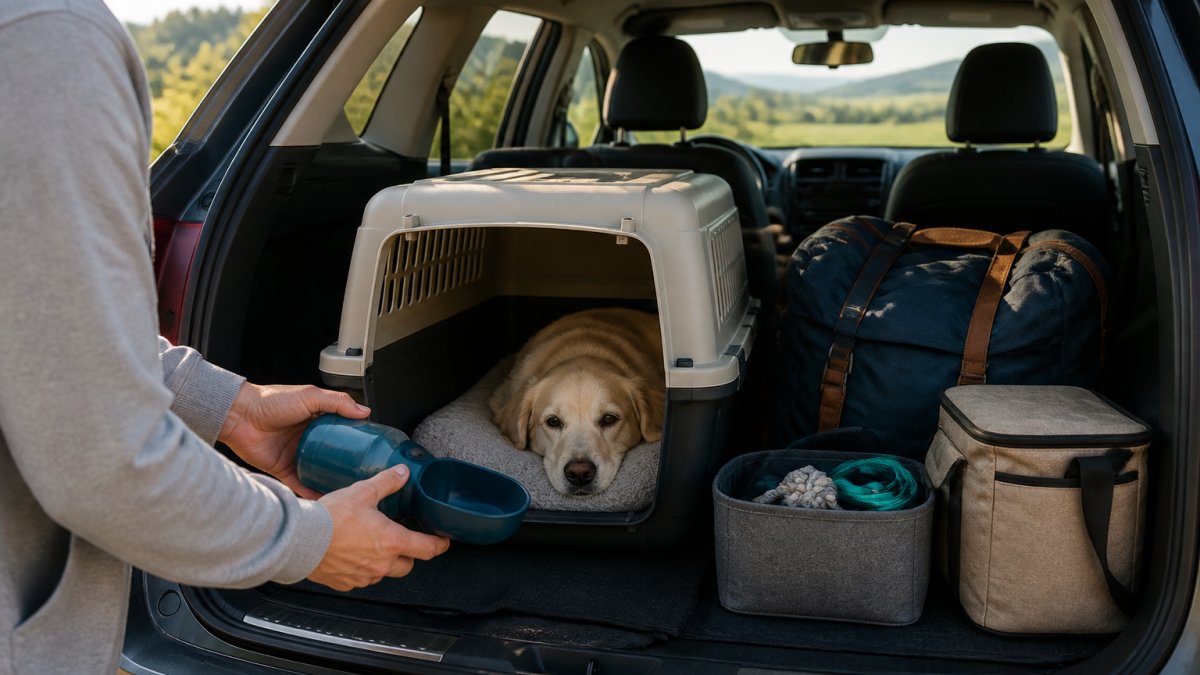
This order has proven to be effective:
- Test the crate or carrier before you leave—don't wait until the day of the trip
- Adjust the windows and ventilation so that there are no drafts
- Plan to take a break every two to three hours to drink some water and go for a short walk
- If possible, avoid driving during the midday heat
For longer trips, it’s best to leave early and take more breaks. This takes time, but it reduces stress for both people and animals.
Travel First-Aid Kit for Dogs: What to Bring in Case of an Emergency
A first-aid kit for dogs covers minor injuries, stomach problems, and tick bites. It is not a substitute for a veterinarian, but it can help you get by until you can see one.
The following are useful:
- Tick tweezers or tick removal card
- Wound Disinfection and Sterile Compresses
- Bandages and Band-Aids
- Digital Clinical Thermometer
- Medication for diarrhea, after consulting with a veterinarian
- Prescribed long-term medications in their original containers
- Copy of the vaccination records
Before your trip, ask your veterinarian which medications are appropriate for your dog. Dosages vary greatly depending on weight and health status.
Never give your dog human pain relievers without consulting a veterinarian. Some active ingredients are toxic to dogs.
Stress, Anxiety, and Motion Sickness: How to Stay Relaxed on Your First Vacation with Your Dog
Many dogs experience stress and motion sickness on their first vacation. The reason is rarely the trip itself, but rather a lack of acclimatization. If you practice riding in the car, using a crate, and getting used to unfamiliar noises beforehand, you’ll take a lot of the pressure off the first day.
A step-by-step adjustment plan can help:
- Four weeks beforehand: Set up the crate in the living room and make it a quiet spot
- Three weeks beforehand: short rides lasting five to ten minutes
- Two weeks beforehand: longer runs with breaks
- A week earlier: The walk along the usual route was a positive experience
Travel sickness often manifests as drooling, restlessness, or vomiting. If this happens, drive calmly, avoid heavy meals right before the trip, and plan frequent breaks. If your pet is experiencing severe symptoms, it’s a good idea to consult your veterinarian.
Check that accommodations and travel destinations are dog-friendly
Accommodations often play a bigger role in determining the success of a vacation than the destination itself. Before booking, check to see if dogs are truly welcome and what rules apply. Be sure to ask specifically about:
- Are dogs allowed in the apartment and on the property?
- Are there fenced-in areas or safe paths right outside the door?
- Are there places where you can take peaceful walks without much traffic?
- Are there any rules about leaving pets alone or requiring them to be on a leash?
At Ferienwohnungen Gutenbrunn, vacations with dogs are expressly permitted. The quiet location in the Waldviertel It offers easy access to nature and thus ideal conditions for leisurely walks. This is a real advantage for families and active vacationers looking for a base from which to go hiking.
Preliminary Checklist for Accommodations
These points can be clarified by email or phone before booking, which will help avoid any surprises on the day of arrival:
- Have the dog rules confirmed in writing: Number of dogs allowed, size or breed restrictions, leash requirements on the premises, permitted areas.
- Clarify what it means to be left alone: Is the dog allowed to be left alone in the apartment for a short time, and are there any guidelines regarding a crate or tying the dog up?
- Leakage and Safety: Is the property fenced in? How high is the fence? Are there any gaps or access points that need to be secured?
- Surroundings: Are there paved paths for hot days, shaded areas, and water sources within walking distance?
- Veterinary Care: How far away is the nearest veterinary clinic, and is there an emergency service available on weekends?
- Heat and Climate: Are there any shady spots to retreat to, a tiled floor, or a cool place to sleep on hot days?
Check the destination yourself
In addition to accommodations, it’s worth taking a look at the surrounding area. Check in advance whether attractions are dog-friendly, whether there are shaded areas and water stations, and what the trails are like. In hot weather, paved paths are unsuitable for dogs’ paws; plan walks for the morning and evening hours, and before setting out, use the back of your hand to check whether the ground is too hot.
A common mistake is assuming that „dog-friendly“ automatically means „dog-appropriate.“ Many accommodations allow dogs but do not provide a fenced-in area for them to run around or cool, shaded spots for them to rest. Clarifying this before booking helps avoid conflicts with hosts and neighbors and protects your dog from stress and heat.
Ask your hosts for a recommended veterinarian's office and for the nearest emergency clinic. Locals usually know of a practice that can accommodate last-minute appointments; write the number down right in your document folder.
Arrival, Settling In, and Emergency Plan at Your Vacation Destination
The first few hours at your vacation destination determine how quickly your dog will settle in. Give him some time before you plan any outings. A designated sleeping spot, familiar food, and a quiet walk nearby work wonders.
The emergency plan for your vacation destination should include three things:
- Address and phone number of a nearby veterinary clinic
- Emergency number for weekends and holidays
- Copies of key documents and insurance information
Keep this plan in a visible place in your lodging. In an emergency, every minute counts.
Bottom line: With the right checklist, your first vacation with your dog will be stress-free
Your first vacation with your dog will go smoothly if you start preparing early and write down the most important details. The vet, vaccinations, documents, packing list, and transportation are all interconnected. If you also think about helping your dog adjust to the new environment and having an emergency plan in place, you’ll travel with much greater peace of mind.
Frequently Asked Questions
What do you need for your first vacation with your dog?
For your first vacation with your dog, you’ll need, above all, valid documentation: the EU Pet Passport with a valid rabies vaccination and a microchip for identification. You’ll also need a packing list that includes food, bowls, a blanket, a leash, a safety harness, and toys. A first-aid kit for dogs, including bandages, tick tweezers, and any medications recommended by your veterinarian, is just as essential as a portable water bowl for when you’re on the go. Also, check whether your lodging allows dogs and if there are good walking trails nearby.
How do I prepare my dog for its first trip?
Get your dog used to traveling gradually: Short car rides of 10 to 15 minutes can help before you tackle a long trip. Practice getting into the carrier or putting on the safety harness at home, without actually driving anywhere. Pack a blanket and some toys in the travel bag a few days in advance so the familiar scent comes along. For your first vacation with your dog, it’s better to plan for a quiet place to stay with a quiet spot for your dog to retreat to rather than a destination packed with activities, so your dog can settle in peacefully after you arrive.
What documents should you bring along when going on vacation with your dog?
Be sure to bring the EU Pet Passport, which lists the rabies vaccination and the microchip. You’ll also need the vaccination record, the dog liability insurance number, and, if necessary, veterinary certificates regarding chronic conditions or medications. Make copies of all documents and save a digital version on your cell phone in case the originals are lost. When crossing a border, check the current entry requirements in advance, as your border documents must be complete and valid.
How do I transport my dog safely in the car?
Secure your dog in the car either in a properly fitting travel crate or with a safety harness that attaches to the seatbelt system. The crate should be stable and large enough for the dog to stand up and turn around. Plan a break every two to three hours to give your dog water and take a short walk. Never let your dog ride in the car unsecured, and do not leave your dog alone in the vehicle in warm weather. For longer trips, it helps to use positive reinforcement training with the carrier at home beforehand.
Are you planning your first vacation with your dog and looking for a peaceful retreat surrounded by nature? Dogs are welcome at Ferienwohnungen Gutenbrunn; the four lovingly furnished apartments offer space for families and those seeking relaxation, and Anna and Herbert will personally take care of you on site. The accessible facilities and the option to book directly with the hosts make planning a breeze. Book directly and start your first vacation with your dog on a relaxed note.

Comments are closed, but trackbacks and pingbacks are open.