


Table of Contents
- Adventure Hiking Trails for Kids in the Waldviertel: Discovering Nature Through Play and Action
- Family-Friendly Hiking Trails in the Waldviertel with Exciting Experiences
- Hiking Trails in the Waldviertel Suitable for Strollers: Which Routes Are Truly Suitable
- Popular Adventure Hiking Trails: Specific Routes with Walking Time and Distance
- Planning Hiking Trips with Children: Duration, Breaks, and Realistic Expectations
- Hiking with Kids: Packing List—What to Pack in Your Backpack
- Getting There, Parking, and Practical Tips for Family Outings
- Safety and Preparation on the Adventure Hiking Trail
- Your starting point for adventures in the Waldviertel
- Frequently Asked Questions
Last updated: October 16, 2026
Adventure Hiking Trails for Kids in the Waldviertel: Discovering Nature Through Play and Action
Nature is the best playground—and there are plenty of them in the Waldviertel Adventure Hiking Trails for Kids, which offer exactly that. These trails combine classic hiking with interactive stations, puzzles, and nature explorations that children love. At Ferienwohnungen Gutenbrunn, we understand that families need accommodations that are perfectly located to set out on such adventures—and, above all, a place to relax afterward.
This guide shows you the best Adventure Hiking Trails for Children in the Waldviertel Region, specific routes with walking times and practical tips for your family outings. Whether you're out and about with toddlers, preschoolers, or older children—here you'll find routes that really work.
Family-Friendly Hiking Trails in the Waldviertel with Exciting Experiences
Not every hiking trail is suitable for children. A good family-friendly hiking trail The Waldviertel has certain features that make the adventure both safe and entertaining.
What makes a trail family-friendly?
A family-friendly trail isn't just a trail that children can walk on. It's about finding the right balance of length, difficulty, and variety.
Good family-friendly hiking trails have:
- Signage that is clear and consistent
- Flat sections that allow for breaks
- Shaded areas for hot days
- Water nearby for playing or drinking
- Rest areas with benches every 15–20 minutes
A trail is stroller-friendly if the surface is compacted (no loose gravel), the gradients are less than 5%, and there are no stairs or steps. Many trails in the Waldviertel meet some of these requirements—it’s important to know which ones are truly suitable.
Adventure Stops and Nature Experiences Along the Trails
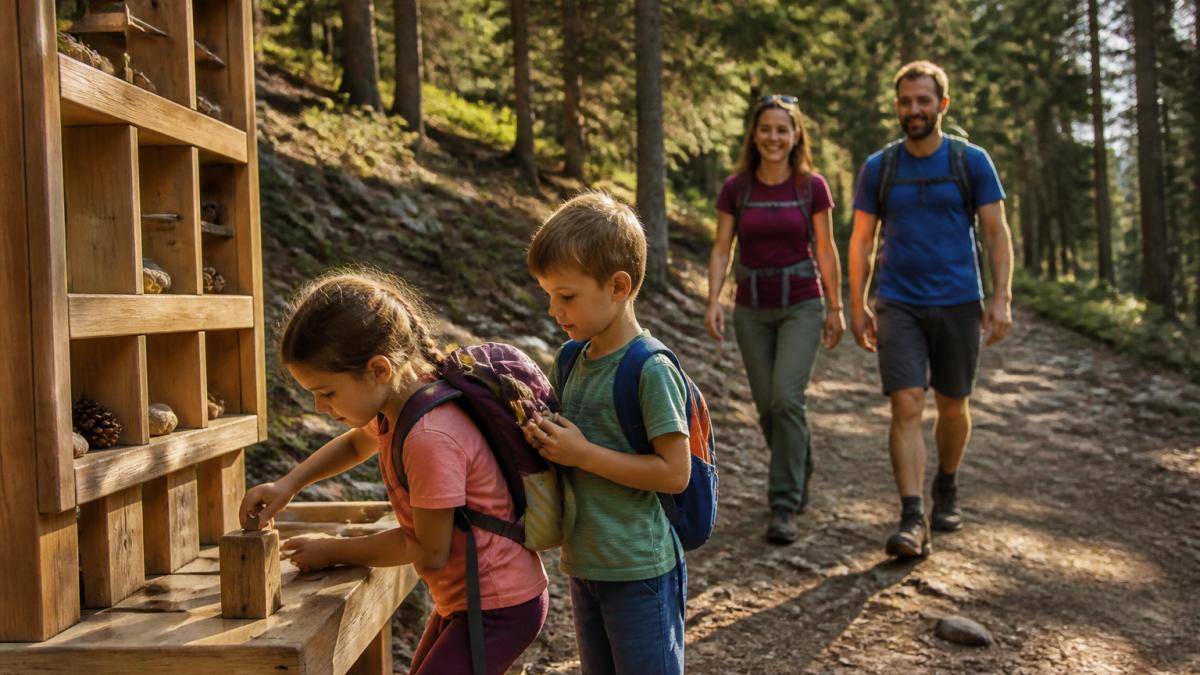
What really excites children are adventure stations. These stations turn a simple walk into a real adventure.
Typical adventure stops include:
- Playgrounds with swings, slides, or climbing structures
- Puzzle stations where children solve problems
- Stamp stations for a hiking journal
- Nature Exploration Activities (Collecting Leaves, Listening to Bird Sounds)
- Water play areas or sections of streams for wading
- Viewing platforms with telescopes
These stops keep children engaged and make the walking time seem like a minor detail. There are several trails in the Waldviertel that have successfully incorporated such elements—we’ll introduce them to you below.
Use hiking journals or stamp books. Many trails offer these—kids love documenting their progress and getting a reward at the end.
Hiking Trails in the Waldviertel Suitable for Strollers: Which Routes Are Truly Suitable
If you're out and about with a stroller, you need paths that are truly accessible. Not all Hiking Trails Suitable for Strollers in the Waldviertel Region are feasible—some routes are too steep or the terrain is too rough.
Accessible and stroller-friendly routes
A stroller-friendly path meets the following criteria:
- Compacted surface (asphalt, compacted gravel, no loose gravel)
- Gradients below 4%
- At least 1.5 meters wide
- No stairs or steps higher than 2 cm
- Rest areas with level surfaces
In the Waldviertel, the following types of trails are stroller-friendly:
- River landscapes with riverside paths
- Marshlands with boardwalks and wooden paths
- Circular Walks Through Garden Villages
- Flat forest trails without roots
Important: Do your research before the tour. Many trails are only partially stroller-friendly—a 500-meter climb at the end can turn the whole adventure into a frustrating experience. Ask when you arrive or check out reviews from other parents.
Many trails are soft and slippery after rain or in the spring. A stroller with wide tires is a big advantage. Check the ground before setting out on a long hike.
Popular Adventure Hiking Trails: Specific Routes with Walking Time and Distance
Here are the most well-known ones Adventure Hiking Trails for Children in the Waldviertel Region with comparable information. All routes are loop trails, unless otherwise noted. The walking times are based on a leisurely pace with children; breaks, playtime, and dawdling are not included.
The Berry Bear Trail: A Playful Journey Through Nature
The Berry Bear Trail is one of the most popular trails for families with children ages 4 to 10.
Route: Circular Trail Through Meadows and Forests
Walking time: 2.5 to 3 hours (walking time only)
Distance: 7.5 km
Elevation gain: Approx. 120 hm of ups and downs
Difficulty level: Easy to moderate
Age appropriateness: Ages 4 and up (with assistance for shorter sections); ideal for ages 6–10
Strollers: Not suitable for the entire route—compacted ground, but with some inclines and sections with tree roots
Adventure Stations: Puzzle stations featuring stories about bears and berries, stamp stations for the hiking journal, two playgrounds with climbing structures and slides, and berry-picking areas depending on the season
Special Features: At the end, depending on the season, there’s a small reward at the stamp station. The trail tells a continuous story; children complete a task at each station.
The tour takes longer with toddlers—expect it to take 4 to 5 hours, including breaks. The trail is only suitable for strollers in certain sections; a baby carrier is recommended.
The Hundertwasser Trail: Art and Nature Combined
This trail combines art with a nature hike—ideal for children who want more than just nature.
Route: Circular Trail with Art Installations
Walking time: 1.5 to 2 hours
Distance: 4.5 km
Elevation gain: Approx. 40 hm, mostly flat
Difficulty level: Light
Age appropriateness: Ages 3 and up; also suitable for balance bikes and strollers
Strollers: Generally suitable—compacted ground, no stairs, a few narrow sections
Adventure Stations: Colorful art objects you can touch, interactive stations with painting and craft activities, a lookout point with a telescope
Special Features: The path is flat and well-marked. The art installations make the walk interesting; for younger children, the short distance is an advantage.
The Rock Trail: Geological Adventures for Little Explorers
This trail is exciting for children who are interested in rocks and geology.
Route: Circular Trail Through a Quarry Landscape and Wooded Area
Walking time: 2 to 2.5 hours
Distance: 6 km
Elevation gain: approx. 150 hm
Difficulty level: Average
Age appropriateness: Ages 6 and up
Strollers: Not suitable—uneven surfaces, slopes, individual steps
Adventure Stations: Information signs about rocks and the Earth's history, rock formations you can touch, lookout points, short climbing sections
Special Features: The trail has a few inclines, and the ground is uneven in places. Information signs explain the rocks and the Earth's geological history—which makes the trail educational.
Circular Hikes Through Moorlands and River Walks
The Waldviertel region has moorlands and rivers that are ideal for family hikes.
Moorlands:
- Boardwalks and wooden paths make it safe to walk through marshlands
- Walking time: 1.5 to 3 hours, depending on the trail
- Distance: 4 to 8 km
- Elevation gain: mostly under 80 hm
- Difficulty level: Easy to moderate
- Recommended age: 4 years and up; for strollers, only the secured sections of the bridge
- Highlights: Rare plants, birdwatching, flat trails; wooden walkways can be slippery after rain
River Hikes:
- Waterfront paths are usually flat and suitable for strollers
- Walking time: 2 to 4 hours
- Distance: 6 to 12 km
- Elevation gain: mostly under 50 hm
- Difficulty Level: Easy
- Recommended age: 3 years and up
- Special features: Water features, shallow swimming areas, picnic areas; avoid during high water levels after rain
Moors are ideal for trails suitable for toddlers—the ground is firm on the boardwalks, and the distances are often short enough not to test their patience. Check the weather conditions before setting out: After heavy rain, boardwalks can be slippery and riverbanks may be flooded.
Planning Hiking Trips with Children: Duration, Breaks, and Realistic Expectations
Most parents underestimate how long a hike with children takes. Realistic planning is the key to a relaxing day.
Calculate walking time and accurately assess the level of difficulty
A simple rule of thumb:
- Children under 5 years of age: Halve the listed walking time
- Children ages 5 to 8: Add 50% to the specified time
- Children ages 9 and up: Add 25% to the specified time
So a hike that takes 2 hours to walk takes 4 hours with toddlers—including breaks, playtime, and dawdling.
The level of difficulty is often underestimated. What is „easy“ for adults can be exhausting for children. Keep the following in mind:
- Elevation gain, not just distance
- Surface conditions (loose gravel is more strenuous)
- Shaded vs. sunny sections
- Availability of Rest Areas
Seasonal Conditions and Weather in the Waldviertel Region
The season has a big impact on your hike.
Spring (April through May):
- Advantage: Flowers, birdsong, pleasant temperatures
- Downside: Trails are often still wet, and ticks are active
- Tip: Long pants, tick protection
Summer (June through August):
- Advantage: Long days, warm water to play in
- Disadvantage: Heat, overcrowding on popular trails
- Tip: Start early, bring plenty of water, and use sunscreen
Fall (September through October):
- Advantage: Pleasant temperatures, fewer insects
- Disadvantage: Shorter days, slippery leaves
- Tip: Wear sturdy shoes and bring a flashlight in case of an emergency
Winter (November through March):
- Advantage: Quiet, clear view
- Disadvantages: Slippery trails, short days, cold weather
- Tip: Hike only when conditions are good; wear reflective gear
Hiking with Kids: Packing List—What to Pack in Your Backpack
A good packing list is the key to a relaxing hike.
Essential Equipment and Safety
Bring these items with you:
- Backpack (15–20 liters for parents, 5–10 liters for children)
- First-aid kit with blister bandages
- Sunscreen and sunglasses
- Insect Protection (Tick Removers, Mosquito Repellents)
- Rain jacket (even in good weather)
- Flashlight or headlamp
- Cell phone with a fully charged battery
- Emergency contacts printed out or written down
Safety equipment:
- Good footwear with good traction
- Reflective vest or armband for children
- Whistle for Emergencies
- Hiking map or GPS device
Many accidents happen because of poor-quality shoes. Invest in good hiking boots for kids—cheap sneakers can cause blisters and injuries. Try the shoes on before your big hike.
Food and drinks for longer hikes
Food and drink keep children motivated.
Beverages:
- At least 1.5 liters of water per child
- Plus fruit juice spritzer or tea (cold in the summer)
- Small bottles are easier to carry
Snacks:
- Energy bars or granola bars
- Nuts and Dried Fruit
- Fruit (apples, bananas, berries)
- Cheese and bread for breaks
- pretzel sticks or nuts for electrolytes
Rule of thumb: Take a short break every 1.5 hours to have a snack and a drink.
Getting There, Parking, and Practical Tips for Family Outings
Proper planning before your hike will save you stress on the day of the hike. This section summarizes the practical logistics that are often missing from most articles on the topic.
Public Transportation and Directions
Many hiking trails are accessible by public transportation. This saves you the trouble of looking for parking and makes for a stress-free experience.
Rail:
- The Franz-Josefs Railway connects Vienna with towns in the Waldviertel region (including Gmünd and Sigmundsherberg)
- Regional trains stop at smaller stations; schedules are available online
- Family tickets and free rides for children are common on the Austrian Federal Railways—check the current terms and conditions before booking
Bus:
- Regional buses connect smaller towns and hiking trailheads
- Schedules are available online; service is often reduced on weekends
- For groups, it’s worth taking a shared taxi or a call-a-taxi (AST)—practices vary by location
Car:
- Parking is free or requires a fee at most hiking trailheads—follow the on-site signage
- Arrive early, especially on weekends and during the school holidays
- Bring a return ticket or a parking ticket in case the parking lots are metered
Tip: Combine your trip there with your return trip. Some loop trails allow you to take the bus there and drive back—which saves time. Check in advance to see if the last bus leaves before dark.
Stops and Breaks Along the Way
A nice break makes for a perfect day.
Dining Options:
- Many trails have inns or cafés along the way
- Check the opening hours in advance—especially outside the peak season
- Children's menus aren't available everywhere—ask about them or choose smaller portions
- A picnic is a good alternative; many rest areas allow you to eat food you've brought with you
Rest areas:
- Use rest areas with tables and benches
- Many have restrooms; not all are open year-round
- Some offer water for refilling—check on site to see if it's safe to drink
Practical tips for getting here:
- Download the schedules in advance, as cell service can be weak in some valley areas
- Bring cash—not every place you stop at accepts card payments
- For larger groups, be sure to reserve a table in advance
- Ask your lodging provider for up-to-date tips on places to stop and how to get there; local knowledge is often more up-to-date than online maps
Combine your trip with a stop for refreshments: If you’re traveling by bus, you can combine your return trip with a visit to a restaurant to pass the time while you wait. Check the last departure times before your trip.
Safety and Preparation on the Adventure Hiking Trail
Security isn't glamorous, but it's important.
Avoiding Common Beginner Mistakes
These mistakes happen often:
- Choosing routes that are too long for the children's age
- Not bringing enough water
- Wearing poor-quality shoes
- Hiking without a map and getting lost
- Leaving too late and driving in the dark
- Do not involve children in the planning (less motivation)
Prevention:
- Choose a path that you think is feasible for you
- Start early so you'll have enough light
- Involve the kids: Let them choose the route
- Take breaks before the children get tired
Emergency Contacts and First Aid
In an emergency, you need help right away.
Important Numbers:
- Emergency number: 112 (throughout Europe)
- Emergency Services: 144
- Mountain Rescue: Conditions Vary by Location—Check in Advance
- Poison Control Hotline: 01 406 43 43
Preparation:
- Carry your cell phone with a fully charged battery
- Know the name and coordinates of your starting point
- Tell someone where you're going
- Learn the basics of first aid
A first-aid course for outdoor activities is a good investment. Many Red Cross chapters offer courses specifically designed for hiking.
Your starting point for adventures in the Waldviertel
The Adventure Hiking Trails for Children in the Waldviertel Region offer families countless opportunities to explore nature. With the right preparation, realistic expectations, and good gear, these hikes will become memories that children will cherish for a lifetime.
Gutenbrunn Vacation Rentals is your perfect starting point for these adventures. Our accessible vacation rentals offer you and your family a comfortable retreat after a long day of hiking. With personalized service from Anna & Herbert, a quiet location in the heart of the Waldviertel, and ideal proximity to the region’s best hiking trails—here you can relax while the kids plan their adventures. Book directly with us and start your Waldviertel experience right away.
Frequently Asked Questions
Which adventure trails in the Waldviertel are suitable for children ages 4 and up?
The Berry Bear Trail and the Hundertwasser Trail are ideal for children ages 4 and up. Both offer short sections lasting 1–2 hours, clear signage, and adventure stations where children can play. The Steinwanderweg is suitable for children ages 5 and up, as it requires a bit more stamina. Choose routes with gentle trails and plan for regular breaks.
How long should a hike with children in the Waldviertel last?
Plan for a maximum of 1–2 hours of walking time for children ages 4 to 6, and 2–3 hours for children ages 7 and up. The actual duration doubles due to breaks, playtime at adventure stations, and exploration. Allow for plenty of flexibility and end the hike before fatigue sets in—that way, the adventure stays a positive experience.
Which hiking trails in the Waldviertel are truly suitable for strollers?
The Gartendorf Loop Trail and selected sections of the Kremstal Trail are stroller-friendly, with flat, paved paths. Avoid marshlands and steep forest trails—these are unsuitable for strollers. Check the trail conditions and elevation gain before setting out on your hike. Many trails offer stroller-friendly sections ranging from 2 to 4 kilometers.
What should you include on a packing list for a hike with kids?
Essential items include water (at least 0.5 liters per child), snacks (granola bars, fruit), sunscreen, insect repellent, and a small first-aid kit. Pack weather-appropriate clothing, sturdy shoes, and a backpack with a seat for tired children. Binoculars or a magnifying glass for observing nature will make the adventure even more exciting.
The Waldviertel is one of Austria's most beautiful natural landscapes, and the Adventure Hiking Trails for Kids make it a paradise for families. With the right trails, good planning, and comfortable accommodations like the Gutenbrunn vacation apartments, your family vacation will be an unforgettable experience. Contact us directly to learn more about our apartments and how to best prepare for your hiking adventures.


Comments are closed, but trackbacks and pingbacks are open.