


Quick Overview
An accessible vacation rental for families needs step-free access, doors that are wide enough, a floor-level shower with a permanently mounted shower seat, and a kitchenette that’s wheelchair-accessible. Equally important are child-safe features such as outlet covers and window handles. Check these points using specific measurements, not just based on the description „accessible vacation rentals.“.
- Check that the clear door width is at least 80 cm, preferably 90 cm.
- A walk-in shower with a floor area of at least 90 × 90 cm.
- Have the shower seat permanently installed; don't just place it in the shower.
- A work surface that allows for access underneath, with a minimum clearance height of 70 cm.
- Request safety outlets and child-proof window handles.
Table of Contents
- What Accessible Vacation Rentals Must Offer Families
- Check for barrier-free access, ramps, and door widths
- Movement Areas and Turning Circles in the Living Space
- Accessible Bathroom in a Vacation Rental: Shower, Toilet, and Grab Bars
- Wheelchair-Accessible Vacation Rental: Kitchen Amenities
- Bedrooms, beds, and space for children's items
- Designing a space that is both child-friendly and accessible
- Clarify care equipment and assistive devices before arrival
- Safety and Emergency Planning for Families
- Accessible Vacation Rental Checklist by Room
- Verify the host's information: what should be reliably documented
- Message to the Host: Questions Before Booking
- Inquire about the apartment and confirm the amenities before booking
- Frequently Asked Questions
What Accessible Vacation Rentals Must Offer Families
An accessible vacation rental for families needs to offer more than just a ramp at the door. It must accommodate strollers, wheelchairs, walkers, and luggage all at once, and it must allow parents to take a break every now and then. At Gutenbrunn Vacation Rentals, we therefore design our amenities not just to meet individual standards, but to accommodate the everyday life of a family, where not everyone’s needs are the same.
Requirements change with the children’s age and their need for assistance. A toddler needs safe flooring and protection from sharp edges, while a teenager needs a shower they can operate on their own. The housing should therefore accommodate not only wheelchair users but also families with a variety of needs.
The number of rooms doesn't necessarily indicate the quality of the amenities. If you're planning to book, you should therefore check the individual rooms rather than just reading the buzzwords on a booking site.
The following checklist will help you systematically review the accessibility features of family-friendly vacation rentals before you make a reservation. A complete List of Amenities for Accessible Vacation Rentals You can use them right away.
Check for barrier-free access, ramps, and door widths
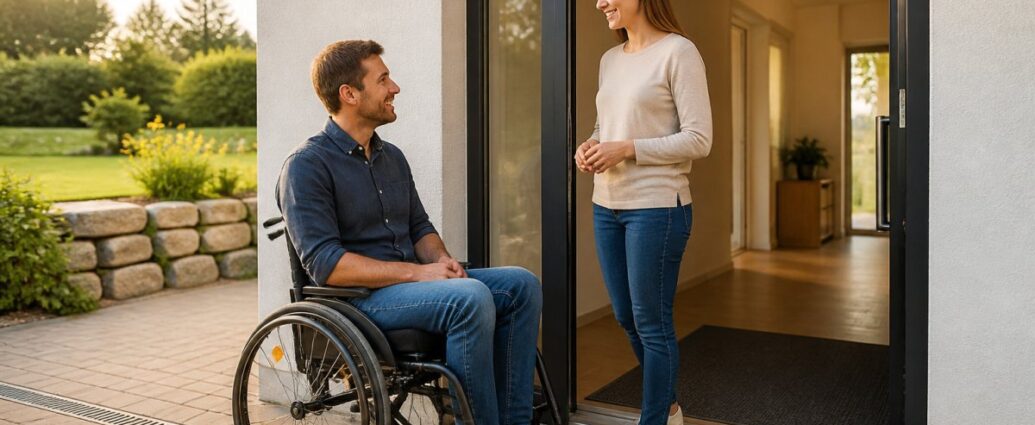
Barrier-free access determines whether a place to stay is usable at all. Even a single threshold just a few centimeters high can stop a wheelchair or tip over a stroller. Therefore, check the path from the parking lot to the apartment door first.
Please note the following points:
- Entrance without steps or with a permanently installed ramp with a gentle slope
- Door widths that allow wheelchair access
- Thresholds that are flush with the floor or equipped with a low-profile ramp
- An elevator, if the apartment is on an upper floor
Door width is a detail that is often underestimated. A door that is wide enough for pedestrians is often too narrow for a wheelchair. Therefore, be sure to ask specifically about the clear passage width and not just whether the door is „wheelchair-accessible.“ A Detailed instructions for checking door widths and steps You can also find them on our website.
Door handles are also important, as they should be easily within reach even when seated.
If you bring a dog with you, be sure to keep the thresholds and entrances in mind as well. Even a large dog needs a safe path without any obstacles.
Movement Areas and Turning Circles in the Living Space
An apartment may appear accessible on paper but still fall short when it comes to clear space. A wheelchair needs room to turn, and the furniture must not block that space. Anyone viewing the apartment or examining photos should pay close attention to open spaces.
In everyday life, this means you should be able to move around freely in the hallway, living room, and in front of the bed. A couch placed in the middle of the room or a dining table that narrows the passageway can quickly make the apartment uncomfortable. Ask your host if the furniture can be moved or if there’s a turning space in the kitchen.
Here's a practical tip: Make a note in advance of the paths you'll be taking each day—from the bedroom to the bathroom, from the kitchen to the living area. Then check to see if these paths remain clear when all family members are in the room.
Accessible Bathroom in a Vacation Rental: Shower, Toilet, and Grab Bars
In most accessible vacation rentals, the bathroom is the area where the fixtures are both the most important and the most likely to be defective. If you don’t check this area thoroughly, you risk falls and hours-long arguments on the first day of your vacation. Pay equal attention to the shower, toilet, and grab bars.
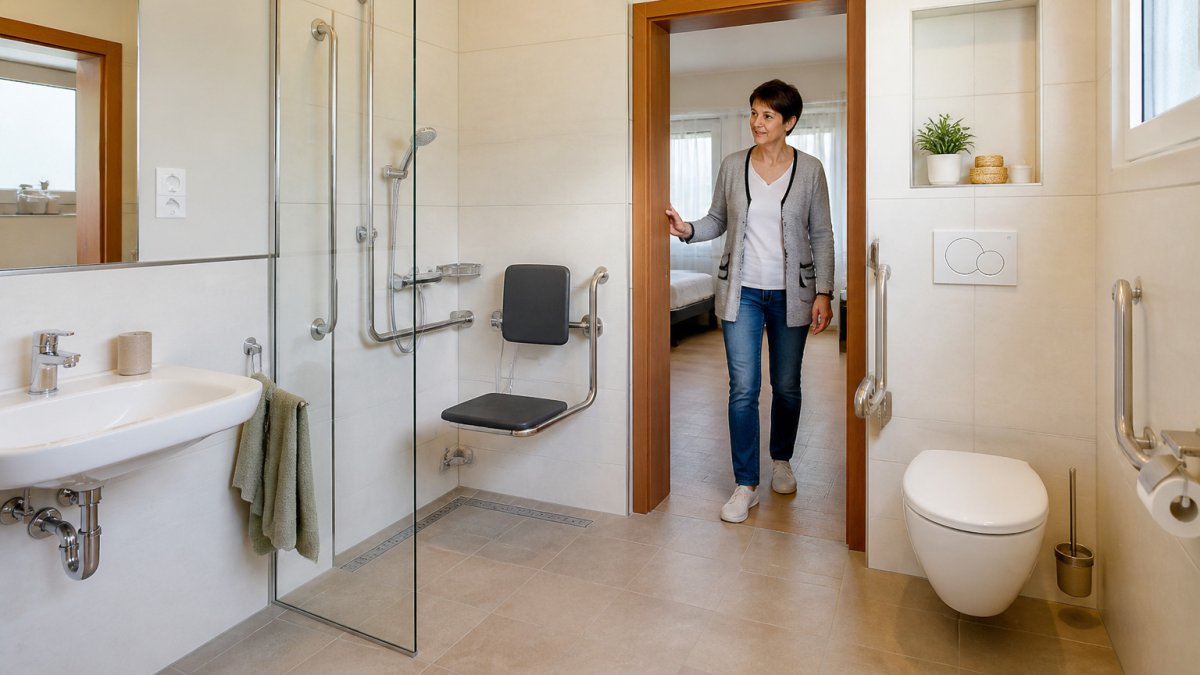
An accessible bathroom typically includes walk-in showers, sturdy grab bars, and a toilet with the appropriate seat height. You can confirm whether these features are available before booking. Be sure to ask specific questions rather than relying on the general description „accessible.“.
Flooded shower and shower seat
A walk-in shower is equally important for wheelchair users and families with small children. It has no threshold, and you can roll right into it with a wheelchair or a shower chair. A shower seat makes showering easier for people who can’t stand for long periods of time.
Check to see if the shower is slip-resistant, if there is a handheld showerhead, and if the shower seat is securely mounted or movable. A movable seat can slip when wet, so it should be firmly anchored.
Many families forget that children also need something to hold onto when showering. A shower with a fixed grab bar at child height makes bathing easier and reduces the risk of falls.
Mounting Heights for Handles and Faucets
The installation height of handles and faucets determines whether they can be reached while sitting or standing. For sinks, faucets, and grab bars, the rule is: They should be positioned where they can be reached without straining.
A quick on-site check can help: Sit in a wheelchair or on a chair and try to reach the faucet, mirror, and toilet paper holder. Anything you can’t reach while sitting will quickly become a problem in everyday life.
You can specifically check the bathroom's key features before booking:
| Characteristic | Guideline | Note |
|---|---|---|
| Shower area | at least 90 × 90 cm | preferably 100 × 100 cm |
| Shower | at floor level | without a step |
| Shower Seat | permanently mounted | not just pickled |
| Handrails | firmly established | with a shower and toilet |
| Sinks and Faucets | accessible while seated | Don't set the mirror too high |
| Floor tiles | non-slip | even in wet areas |
Wheelchair-Accessible Vacation Rental: Kitchen Amenities
The kitchen is the room where families spend the most time, and where accessibility truly proves its worth in everyday life. A kitchen that can only be used while standing excludes wheelchair users and people with limited mobility. Therefore, make sure to include wheelchair-accessible countertops, reachable cabinets, and appliances at the right height—as well as child-safe features that are often missing from most equipment lists.
Work surface with clearance for wheelchairs and freedom of movement
A wheelchair-accessible kitchen has at least one wheelchair-accessible countertop.
The distance between the kitchen units determines whether the kitchen is functional for everyday use. Ask the host for these measurements—don’t just rely on the „wheelchair-accessible“ label.
Cabinets, Equipment, and Controls
Drawers instead of deep base cabinets aren’t a luxury—they’re the difference between cooking on your own and needing help from others. A pull-out that slides out completely makes the contents visible even while sitting down. The oven and dishwasher should be installed so that the controls are not above head height and the door does not swing open downward when a child is standing next to it.
A stove with controls that are easy to reach on the front edge and a child safety lock is especially important for families with small children. Also ask if there’s a dishwasher—it makes everyday family life much easier and reduces the need to carry dishes, which can be risky for people with balance issues.
Meals Based on Age and Support Needs
The requirements vary depending on the child’s age. For babies and toddlers, the most important factors are safe edges, a child safety lock on the stove, and a spot for the high chair that doesn’t block the doorway. School-age children benefit from a low, easily accessible shelf for dishes and cutlery so they can help set the table. Teenagers who use wheelchairs, on the other hand, need a work surface where they can cut and plate food independently—and this is where many kitchens fall short.
For families who need care, there’s also the issue of power outlets and storage space for assistive devices: Where can a shower chair or a lift be stored temporarily without blocking the way? Check this before you arrive, because a kitchen that’s cluttered with everyday items can quickly become a tripping hazard.
Before booking, measure the following: countertop height, clear height underneath, the distance between rows, and the width of the most frequently used pathways. These four measurements say more about the unit’s suitability for everyday use than any description ever could.
A practical tip: Not every kitchen in an accessible accommodation is fully wheelchair-accessible. Be sure to ask specifically about the dimensions and features rather than simply accepting the label „accessible.“ If you’re cooking with children or sharing the kitchen, it’s worth asking for a child safety lock on the stovetop and non-slip mats in front of the sink. Details like these lay the foundation for a relaxing stay where the How to Plan a Family Vacation the Right Way ensures that things run smoothly for everyone involved, even when the needs of different generations vary.
Bedrooms, beds, and space for children's items
The bedroom is all about rest, safety, and space. A bed that’s suitable for an adult who needs care may not be suitable for children, and vice versa. Therefore, check in advance how many beds are available and how high they are. More information on accessible kitchen-dining area and bedroom can be found on our website.
The beds should be easily accessible by wheelchair, and the sides should not be too close to the wall. For families with toddlers, a loft bed or a bed with a safety rail is often not suitable; for older children, however, a loft-style bed can save space. Ask how the bed is configured for your specific situation.
Space for children's items is also important: strollers, high chairs, and travel cribs all take up space. Make sure there's enough room without blocking walkways.
Designing a space that is both child-friendly and accessible
Many recommendations for accessible accommodations are geared toward adults with mobility impairments. Families with children also need protection from sharp edges, child-safe electrical outlets, and windows that cannot be opened accidentally. These two considerations do not have to be mutually exclusive.
A good solution is to pad the edges of furniture, install protective covers on electrical outlets, and fit window handles with child safety locks. These measures are unobtrusive, but they make all the difference in everyday family life. Before you arrive, ask whether the accommodations are child-friendly.
Special attention should be given to accommodations based on the child’s age and support needs. A child in a wheelchair requires different solutions than a toddler with a walking disability. Accommodations that take both into account are rare, but they are worth the search.
Clarify care equipment and assistive devices before arrival
Many families travel with special care needs or with assistive devices that aren’t always available in a vacation rental. Therefore, before booking, find out what amenities the accommodation offers and what you should bring yourself. A checklist can help ensure you don’t forget anything.
Typical questions include: Is there a nursing bed or a height-adjustable bed? Is there a shower chair? Are there grab bars by the toilet? If you need assistive devices that aren’t available on site, check to see if you can rent them before you arrive. On our page about Assistive Device Rental for Your Vacation in a Vacation Rental Find out what assistive devices you can borrow.
Safety and Emergency Planning for Families
An accessible vacation also requires a plan for emergencies. This includes falls, illnesses, power outages, and situations where you need help quickly. Find out in advance who can be reached and what emergency exits are available.
It’s important to have an emergency number, a local contact person who can be reached, and an overview of the nearest medical facilities. Ask your host if they can be reached in an emergency and how to get to the nearest hospital.
Also, check to see if there are smoke detectors and a fire extinguisher, and make sure the escape routes remain clear. A clearly marked escape route is especially important for families with children or people with limited mobility.
Accessible Vacation Rental Checklist by Room
A checklist helps you systematically review the equipment. Go through each room, note the dimensions, and mark what’s available. This way, you can identify any gaps before you arrive. The following guidelines are intentionally formulated as questions to consider—not as standards, but as a framework for your discussion with the host.
Entrance and Hallway
- Step-free access or a fixed ramp with a gentle slope
- Clear width of the apartment door: at least 80 cm, preferably 90 cm
- Thresholds at floor level or with a low ramp, maximum 2 cm
- Clear space in the hallway: turning radius of at least 120 cm
- Door handles at a height of about 85 cm, accessible even from a seated position
- Enough space for strollers and luggage without blocking the emergency exit
Bathroom
- Floor-level shower with no threshold
- Shower area at least 90 × 90 cm, preferably 100 × 100 cm
- Sturdy grab bars in the shower and bathroom, securely anchored
- Shower seat permanently installed, not just placed inside
- Toilet seat height is appropriate; grab bars are within reach on the sides
- Sink and faucets within reach while seated; mirror not too high
- Non-slip floor tiles, even in wet areas
- Space for a shower chair or a changing pad
Kitchen
- Work surface with space underneath for wheelchairs; top edge approximately 80–85 cm; clear height underneath at least 70 cm
- Sufficient space between the kitchen units to allow for turning (recommended: 150 cm)
- Drawers Instead of Deep Base Cabinets
- Cooktop with child lock; controls accessible from the front
- Dishwasher available
- Space for a high chair that doesn't block the doorway
Bedroom
- Beds at the right height, easily accessible by wheelchair
- Clear space around the beds, at least 90 cm on each side
- Space for children's items: travel crib, stroller, diaper-changing supplies
- No loft beds without safety rails for young children
- Height-adjustable bed or nursing bed—available upon request
Living Area
- Furniture can be moved or placed freely; the turning radius remains unobstructed
- Safe outlets with child safety features, no loose cords
- Padded or Rounded Edges on Furniture
- Window handles with child safety locks
- Emergency contact information or a contact person who can be reached is known
Safety and Emergencies
- Smoke detectors are installed and in working order
- Fire extinguishers are available, and escape routes are unobstructed and clearly marked
- Emergency number and nearest medical facility known
- Slip-resistant flooring in the hallway and bathroom as well
Print out this list and fill it out while talking with your host. If you have the measurements in writing, you can compare them when you arrive—and quickly see whether the accommodations really suit your family’s daily life.
The checklist is no substitute for an on-site visit, but it turns general information into verifiable questions. Especially for families with diverse needs—such as a child in a wheelchair, a toddler, and an adult using a walking aid—it’s worth comparing each room individually, because certain features can interfere with one another.
Verify the host's information: what should be reliably documented
Not all information in a booking request is equally reliable. Pay attention to whether amenities are specified in detail or described only in general terms as „accessible.“ Specific details such as door widths, installation heights, or the type of shower can be verified, but general descriptions cannot.
Information is considered reliably documented if it can be verified with photos, measurements, or an on-site inspection. Ask for recent photos of the bathrooms and the entrance area, and request the measurements of key doors.
That is why you should specify your specific needs rather than relying solely on a standard.
Message to the Host: Questions Before Booking
A well-worded inquiry saves time and prevents disappointment. Formulate your questions as specifically as possible so the host can give you an accurate answer. General questions like „Is the apartment wheelchair-accessible?“ rarely yield reliable answers.
Questions like these can be helpful: How wide is the front door? Are there steps in the entryway or in the bathroom? How high are the beds? Is the shower at floor level? Is there a wheelchair-accessible countertop in the kitchen? How far away is the nearest hospital?
Be sure to ask about the pet policy if you're bringing a dog, and about the host's availability during your stay.
Inquire about the apartment and confirm the amenities before booking
Before you book, ask for written confirmation of the most important amenities. An email with specific details serves as a good reference in case there are any discrepancies upon arrival. For vacation rentals in Gutenbrunn, you can contact the hosts directly.
If you contact us directly, you’ll receive a personal response from your hosts, Anna and Herbert. The apartments are barrier-free and wheelchair-accessible. Booking directly with the hosts also gives you the opportunity to discuss your specific needs in advance.
For current terms and conditions and a personalized quote, please contact us directly through our website.
Frequently Asked Questions
What amenities should an accessible vacation rental for families have?
An accessible vacation rental for families requires step-free access to the entrance and living area, doors with sufficient clearance, space for a wheelchair to maneuver, a bathroom with a floor-level shower and grab bars, and a kitchen countertop that is wheelchair-accessible. In addition, there should be child-friendly features such as suitable sleeping arrangements and safe storage spaces. It is crucial that these features be specifically listed and confirmed before booking, rather than simply being advertised in general terms as “accessible.”.
How can you tell if a vacation rental is wheelchair-accessible?
You can identify a wheelchair-accessible vacation rental by verifiable details: a step-free entrance or ramp, door widths, clear spaces in front of the bathroom and kitchen, and wheelchair-accessible sinks and countertops. Vague descriptions such as “barrier-free” without specific measurements should prompt you to ask for more details. Photos of the bathrooms and a floor plan help you verify the details before planning your trip.
What should an accessible bathroom in a vacation rental look like?
An accessible bathroom in a vacation rental has a walk-in shower, a fixed or fold-down shower seat, grab bars by the shower and toilet, and sufficient space to move around. The toilet should be at the appropriate height, and the sink should be wheelchair-accessible. For families with small children, a non-slip floor and an easily accessible shelf for toiletries are also helpful.
What dimensions and maneuvering spaces are important for wheelchairs in a vacation rental?
It is important to have doorways wide enough for a wheelchair to pass through safely, as well as turning spaces so that the wheelchair can turn around in the bathroom, kitchen, and bedroom. It is also crucial to avoid thresholds. Since individual needs vary, families should ask the host for specific measurements and not rely solely on standard specifications.
How can you design a vacation rental to be both accessible and child-friendly?
Accessibility and child-friendliness are not mutually exclusive. It is important that sleeping areas, storage spaces, and play areas are arranged so that they remain accessible without obstacles. A loft bed is usually unsuitable for wheelchair users, whereas a ground-level family bed with side rails can meet both requirements.
What information should hosts provide about the accessibility of their vacation rental?
Hosts should provide measurements for doors, bathrooms, and circulation areas, share photos of the relevant rooms, and clearly indicate any steps or thresholds. Information about grab bars, shower seats, and wheelchair-accessible furniture should also be included. Information is considered reliable if it can be specifically verified and confirmed before booking.
What should a family ask before booking accessible accommodations?
Families should ask about step-free access, door widths, the bathroom, the kitchen, and sleeping arrangements. It’s also important to get information about how to reach the host, emergency options, and the surrounding area—such as walking routes and places to visit. Receiving written confirmation of the key amenities before booking provides peace of mind.



Comments are closed, but trackbacks and pingbacks are open.