



Table of Contents
- Booking Accessible Vacation Rentals for Large Families: The Complete Guide
- Accessible Accommodations Checklist: These 12 Points Are Key
- Finding Accommodations for Large Families: Beds, Rooms, and Group Trips
- Accessible Vacations with Children: What Families Really Need
- Legal Framework and Certifications in Austria
- Transportation and Travel Logistics for Families with Limited Mobility
- On-site medical equipment rental: nursing beds, shower chairs, and more
- Financial Assistance and Long-Term Care Insurance: What Subsidies Cover
- 7 Steps to Booking: How to Find the Right Vacation Rental
- Avoiding Common Mistakes When Booking Accessible Accommodations
- Frequently Asked Questions
Last updated: October 2, 2026
Booking Accessible Vacation Rentals for Large Families: The Complete Guide
An accessible vacation rental for large families Booking rarely fails due to a lack of availability, but rather because of the logic behind the booking portals’ questionnaires: They ask for the number of people and travel dates, but not for clearance width, a nursing bed, or an emergency call button. In the worst-case scenario, this very gap can cost families their entire vacation. This guide from Ferienwohnungen Gutenbrunn shows you how to go from your initial inquiry to a confirmed booking in seven steps, which twelve amenities really matter, and what the legal requirements are in Austria. The good news: If you know which questions to ask, you’ll find accommodations that deliver on their promises.
Why the booking process is different from that of a standard apartment
Standard booking sites filter by price, location, and number of beds. Accessibility is usually just a box to check, with no actual verification. That is the heart of the problem: Accessibility in housing means that a person with limited mobility can use the apartment without assistance from others, from ground-level access to the clear path in the bathroom to an accessible light switch. In practice, there’s a world of difference between „wheelchair-accessible“ and „barrier-free.“.
So here’s the rule: Call before you book. Three questions are all it takes to tell a truly accessible vacation rental from one that’s just called that.
- How wide is the narrowest door on the way to the bedroom?
- Is there a walk-in shower with a shower chair, or is there a bathtub in the way?
- Who can be reached on-site if something goes wrong at night?
The third question is often overlooked. A hotline in a different time zone isn't much help if the shower chair is missing.
The most common disappointment: In many listings, „accessible“ simply means „ground-level.“ Missing grab bars, bathrooms that are too narrow, or a toilet without grab bars often aren’t noticed until you’re there in person. Ask for specific measurements in centimeters, not just descriptive terms.
Accessible Accommodations Checklist: These 12 Points Are Key
A checklist for accessible accommodations is useful if it includes measurable criteria. Twelve points cover what matters in everyday life: access, mobility, restroom facilities, and safety.
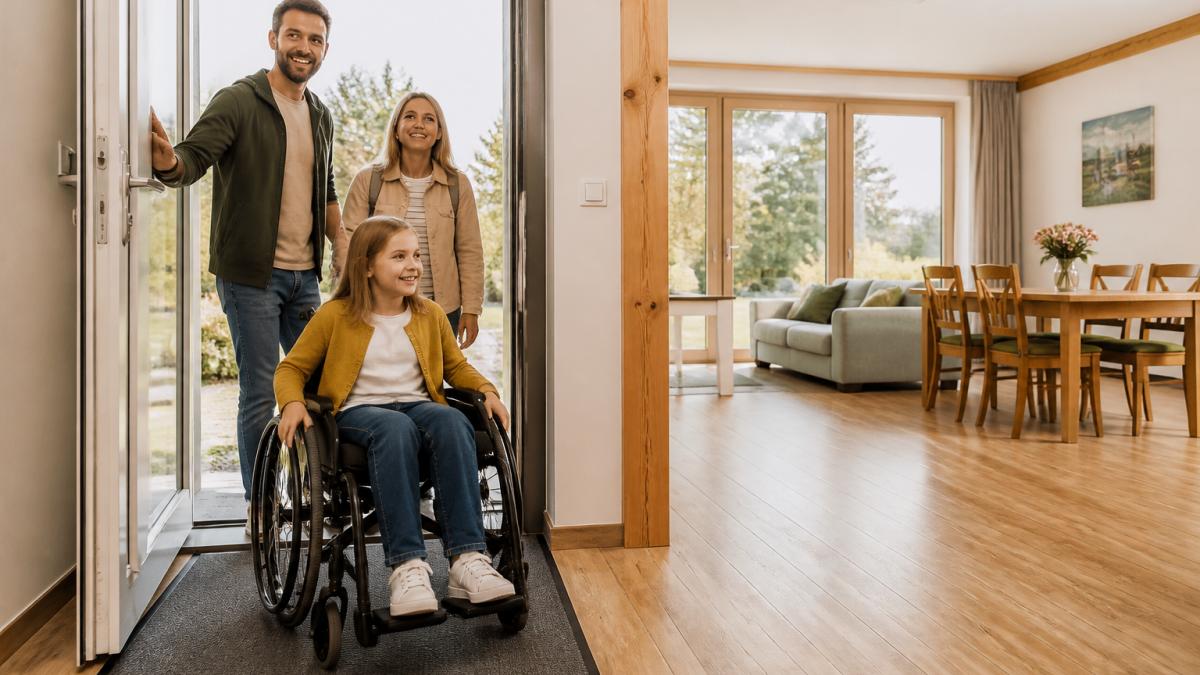
- Level access with no steps at the entrance
- Door widths of at least 80 centimeters throughout the living area
- A 150-centimeter turning radius in the bathroom
- Walk-in shower with a shower chair and grab bars
- Wheelchair-accessible sink in the bathroom
- Grab bars next to the toilet and shower
- Nursing bed or height-adjustable bed available upon request
- Non-slip Flooring in the Bathroom and Kitchen
- Emergency number or on-site contact person who can be reached
- Sufficient space to move between the bed and the wall
- Parking right at the entrance
- Lighting with switches at a convenient height
This list can be used as an email template for any host. If you get twelve checkmarks, you have a firm commitment.
Passage widths, circulation areas, and ground-level access
Passage widths are the first exclusion criterion. A wheelchair needs at least 80 centimeters of clear width; 90 is more comfortable. Hallways, bathroom doors, and the path to the bed are the typical bottlenecks. Ask about the narrowest passage, not the widest.
"Mobility space" refers to the clear area available for moving around. There should be enough space in front of the bed, in front of the toilet, and in the shower to turn around. Level access without a threshold is essential; a ramp with a slope steeper than 6 percent becomes an obstacle for many people.
Bathroom amenities: shower chair, grab bars, wheelchair-accessible sink
Bathroom fixtures are key to maintaining daily independence. A shower chair with non-slip feet, grab bars at a comfortable height, and a wheelchair-accessible sink make the difference between needing help from others and maintaining your own routine.
Also ask about the floor surface. Smooth tiles can be hazardous when your feet are wet; matte surfaces or bath mats are safer. An emergency call button in the bathroom isn't a luxury—it's a basic necessity.
Ask for a photo of the bathroom with a folding ruler against the shower wall. Hosts who send it without hesitation have the measurements memorized. Everyone else is just guessing.
Finding Accommodations for Large Families: Beds, Rooms, and Group Trips
Finding accommodations for large families means considering both the number of beds and accessibility. Both factors narrow down the options, and that’s exactly where most search filters fall short. Expect fewer results, but better ones.
Pay attention to how the sleeping arrangements are set up. A family bed plus two single beds in separate rooms is often more practical for six people than an open sleeping loft. For multigenerational group trips, it’s worth checking whether two apartments are located next to each other. That way, you can have both privacy and time together.
If nursing care is needed, a nursing bed will be required, which is usually not included in the standard equipment. Find out whether one is available on site or can be rented, and who will set it up.
Accessible Vacations with Children: What Families Really Need
Accessible Vacations with Children It requires both: consideration for mobility limitations and for children who want to run, climb, and touch things. The solution rarely lies in special equipment, but rather in the layout of the home.
The following have proven effective in practice:
- A living area with plenty of open space so that wheelchairs and toys don't get in each other's way
- Non-slip floors that remain safe even after splashing around
- Kitchens with low countertops so children can help out
- A separate sleeping area for parents that is also close enough to the children
If you're traveling with children, you'll also want to keep travel distances short. A secluded accommodation may sound idyllic, but it means longer drives to activities. Check out the local amenities before you decide on a secluded spot.
Legal Framework and Certifications in Austria
In Austria, there is no uniform government certification for accessible vacation accommodations. Binding requirements are found primarily in the building codes of the federal states, which regulate accessibility standards for construction, as well as in the relevant ÖNORM standards for accessible design. These standards are not automatically mandatory for hospitality businesses, but they serve as a recognized benchmark. The ÖNORMEN Standards for Accessible Construction from Austrian Standards summarize the technical requirements.
In accounting practice, there are three levels that are relevant but are often confused:
- State Building Laws: It applies to new construction and major renovations and establishes minimum requirements. A facility built decades ago may be legal but still not wheelchair-accessible.
- ÖNORMEN: They provide detailed descriptions of dimensions and amenities, such as circulation areas, door widths, and restroom facilities. While they are not automatically mandatory for hospitality establishments, they are considered the recognized state of the art.
- Voluntary Certificates and Awards: They are awarded by tourism organizations, associations, or certification bodies, and are only as good as the certification process behind them.
Therefore, don't rely on a logo alone. Ask for the specific dimensions and, if available, for an independent assessment. In the event of a dispute, written confirmation of the equipment is worth more than any award.
How to Recognize a Reliable Certification
A certificate without a test report is a marketing ploy. Three characteristics distinguish a credible certification from a mere sticker:
- Collected on site: The rating is based on a visit, not on information provided by the business itself.
- Broken down by need groups: Reputable systems distinguish between wheelchair-accessible, accessible to people with mobility impairments, and other categories, rather than grouping everything under the term „accessible.“.
- Verifiable: There is a place you can contact, and a date indicating when the last check was performed.
Ask the host who awarded the certification, when it was last reviewed, and what criteria were used. Anyone who can answer these three questions has given serious thought to their own accessibility.
Ask for the audit report or the list of criteria on which it is based. Companies that have genuine certification will send it to you without hesitation; often, it’s already available in digital form anyway.
What this means for your request
The legal situation does not provide a guarantee, but rather places an obligation on you as a guest: You must inquire about the dimensions that are relevant to your specific needs. A facility may meet all standards and still be unsuitable for a certain group of people—for example, if the turning radius in the bathroom meets the standard but a nursing bed does not fit inside.
Therefore, please include the dimensions you need in your request and ask for written confirmation. This will turn a non-binding quote into a verifiable commitment.
Transportation and Travel Logistics for Families with Limited Mobility
The journey itself is the most frequently underestimated part of travel planning. It doesn’t begin at your destination, but at your front door. First, figure out how to load your luggage, wheelchair, or assistive devices into the vehicle and whether accessible rest stops will be available along the way.
If you're traveling by train, it's a good idea to contact the provider in advance so that assistance is available when you transfer trains. If you're traveling by car, the "last mile" is especially important: Is the parking lot paved, and does the path from there lead to the front door without any steps? A gravel-covered area in front of the building is often impassable for wheelchairs and walkers.
Plan to arrive while it's still light out. In the dark, steps, curbs, and uneven paths can easily become tripping hazards.
On-site medical equipment rental: nursing beds, shower chairs, and more
Renting assistive devices locally saves space in the car and reduces stress during the trip. In many regions, nursing beds, shower chairs, toilet seat risers, and walkers can be rented by the day through medical supply stores or assistive device rental companies. Ask your host if they can provide the contact information and coordinate delivery.
This is one of the areas where personalized service makes all the difference. Ferienwohnungen Gutenbrunn can put you in touch with rental shops in the region upon request. Be sure to clarify in advance who will set up the equipment and whether instruction is included.
| Resources | Typical needs | Clarify in advance |
|---|---|---|
| Shower Chair | Walk-in shower | Height, Slip Resistance |
| Nursing Bed | Nighttime Care Needs | Installation, Delivery |
| Toilet Seat Riser | Limited mobility | Compatible Toilet Shape |
| Walking frame | Trails in the Area | Paved paths |
| Emergency Call System | Solo travelers | Reach, Support |
Financial Assistance and Long-Term Care Insurance: What Subsidies Cover
Whether a subsidy is available depends on the individual’s care needs and the insurance provider. In Austria, under certain conditions, you can apply for benefits from the long-term care insurance fund or subsidies for additional care-related expenses associated with travel. The conditions vary depending on the type of benefit and your specific situation.
In practice, three methods are used most frequently:
- Care Allowance: It is granted based on care levels and is not earmarked for a specific purpose. Whether and to what extent it can be used to cover travel expenses depends on the individual’s situation.
- Respite Services for Family Caregivers: People who care for a family member may, under certain circumstances, be eligible for substitute or respite care benefits. A vacation with a companion may qualify, but it is not guaranteed.
- Grants for accessible travel: Individual federal states, tourism regions, and social insurance agencies offer support for accessible travel or assistive devices for vacations. These programs change frequently and are not standardized across Austria.
Determine your needs early on, preferably before making your reservation. The appropriate agency can advise you on the current requirements and the necessary documentation; only they can provide definitive information. Allow for processing time, and collect receipts for assistive devices and care services during your trip.
What documentation is typically required
Grants are rarely paid out without supporting documentation. Therefore, keep track of what you spend and on what from the very beginning:
- Proof of the need for care: A notice of care allowance or a doctor's note confirming the disability.
- Invoices for assistive devices: Rental of a nursing bed, shower chair, or walker, including the date and purpose of use.
- Proof of care: If a companion is traveling with the patient, proof of the nature and extent of the care provided may be required.
- Booking Confirmation: Accommodation, including the date, location, and details of accessible amenities.
File these documents in an organized manner—preferably digitally—so that you can submit them immediately if any questions arise.
What is typically not covered
Do not count on having the trip itself reimbursed. As a rule, costs for travel, lodging, or meals are not covered; only certain care-related additional expenses or assistive devices are reimbursed. The costs for an accompanying person are also eligible for reimbursement only in exceptional cases.
This means: Plan your vacation so that it’s affordable even without a subsidy, and treat any potential subsidy as a way to ease the financial burden, not as a source of funding. If you clarify the subsidy before booking, you can factor it into your plans; if you apply for it afterward, you’ve already booked.
Programs that support accessible travel change frequently and vary by region. Don't rely on outdated information from forums or guidebooks; instead, check with the appropriate agency directly to find out the current status.
Practical Steps for Filing an Application
- Assess Your Needs: What assistive devices and what kind of assistance will you need during your trip?
- Determine which agency is responsible: Depending on the type of benefit, this may be the long-term care insurance fund, the social insurance agency, or a state agency.
- Ask about the requirements: Get written confirmation of what documentation is required.
- Keep receipts: Save invoices and receipts starting from the first day of planning.
- If possible, submit your request before booking: That way, you'll know what contribution to expect.
If you follow this order, you’ll avoid the most common mistake: posting the entry before the funding has been approved.
7 Steps to Booking: How to Find the Right Vacation Rental
The booking process follows a set sequence. If you follow the steps, you'll avoid common mistakes.
- Determine needs: Note the number of people, beds, care needs, and assistive devices
- Prioritize criteria: Check passage width, bathroom, and access first
- Preselect accommodations: only providers with specific measurements
- Inquire directly: by phone or email instead of using the portal form
- Have the equipment specifications confirmed in writing: dimensions, emergency contact, contact person
- Organizing Assistive Devices and Travel Arrangements: Arranging Rentals and Parking
- Confirm the reservation: written confirmation including all agreed-upon details
Step five is the most important one. Make sure you get the promised amenities in writing, not just verbally. With Ferienwohnungen Gutenbrunn, you book directly with the hosts, Anna and Herbert, so the confirmation comes straight from them. That way, there are no unanswered questions, and the reservation delivers what it promises.
If you book directly and receive written confirmation of the amenities, you’ll have something to fall back on in the event of a dispute. Portals act as intermediaries; hosts are liable.
Avoiding Common Mistakes When Booking Accessible Accommodations
The most costly mistake is making a reservation based on a symbol. A wheelchair icon says nothing about door widths, turning circles, or shower facilities. Always ask for specific measurements.
Other pitfalls:
- Waiting too long to make a reservation. Accessible apartments for large groups are hard to come by, especially during the vacation season.
- Filter by price only. The cheapest option is rarely the right one.
- Ignore the surroundings. A beautiful garden isn't much use if the nearest path is gravel.
- Organize assistive devices only once you arrive on site. Rental agencies need advance notice.
- Underestimating the trip there. The last mile sets the tone for the start of your vacation.
One final point concerns expectations. Perfect accessibility is rare, but good hosts are open about where the limitations lie. This openness is a sign of quality, not a shortcoming.
The challenge isn't just finding a place to stay, but finding accommodations that live up to their promises. That’s exactly why the accessible vacation apartments at Ferienwohnungen Gutenbrunn were built: wheelchair-accessible apartments with a kitchen-dining area and separate bedrooms, personalized support from Anna and Herbert, and a quiet location that offers easy access to hikes and excursions. If you book directly with the hosts, you’ll receive a written confirmation of the amenities and a place to stay that answers all your questions before you arrive. Start your inquiry with Ferienwohnungen Gutenbrunn and secure the perfect getaway for your family.
Frequently Asked Questions
What should I keep in mind when booking an accessible vacation rental?
Look for specific measurements rather than buzzwords: passageways at least 80 to 90 centimeters wide, a maneuvering space of 150 x 150 centimeters in front of the bed and in the bathroom, and level access without steps. Ask about grab bars, a shower chair, and a wheelchair-accessible sink. Have the amenities confirmed in writing and clarify whether an emergency call system is available. A checklist for accessible accommodations helps ensure you don’t overlook anything.
How do I find wheelchair-accessible accommodations for several people?
Look specifically for accommodations that are both wheelchair-accessible and suitable for groups. Check how many people an apartment can accommodate and whether the bed configuration suits your family’s needs. Booking directly with hosts often offers more flexibility because you can discuss special requests—such as a nursing bed or a ramp—in advance. Ask about the number of bedrooms and whether a family bed is available.
What does “accessible” actually mean when it comes to vacation rentals?
Accessibility doesn’t just mean no steps; it also includes clear passage widths, space for movement, restroom facilities with grab bars, and level access. A wheelchair-accessible vacation rental also features a wheelchair-accessible sink, a shower chair, and sufficient space to maneuver. The location and surroundings of the accommodation also play a role: Is it possible to reach the nearest town or tourist attractions without encountering obstacles? If in doubt, ask for specific measurements.
What factors are important to consider when planning a family vacation with a wheelchair user?
Several factors are important for an accessible vacation with children: the apartment’s amenities, the number of sleeping arrangements, the location and surroundings, and the accessibility of recreational activities. Check whether a nursing bed or shower chair is available and whether the kitchen is wheelchair-accessible. Find out in advance whether assistive devices can be rented on site and whether your long-term care insurance provides subsidies for travel expenses or an attendant.


Comments are closed, but trackbacks and pingbacks are open.