


Table of Contents
- What You Need for Your First Fishing Trip with Kids
- Fishing Licenses for Children: What Parents Need to Know
- Choosing the Right Fishing Set for Kids
- Water Safety for Children
- Choosing the Right Body of Water for Your First Trip
- Choosing Lures for Beginners: Simple and Effective
- Patience and Managing Expectations: Keeping Kids Happy
- Weather, Fish Species, and the First Catch
- Conclusion: An unforgettable day by the water
- Frequently Asked Questions
Last updated: October 4, 2026
What You Need for Your First Fishing Trip with Kids
A fishing trip with kids goes well when the gear is lightweight, safe, and easy to use. To keep the day relaxed, you don't need professional gear—just the right basics.
People who go fishing with children for the first time usually underestimate two things: the weight of the gear and the kids’ patience. The two are directly related.
The Right Basic Equipment
A short, lightweight rod is all you need to get started. A telescoping rod about 2.10 to 2.40 meters long is ideal. It fits in any backpack and sets up quickly.
In addition:
- A simple stationary castor with a front brake
- Monofilament line with a diameter of 0.20 to 0.25 millimeters
- A few finished montages featuring Pose
- Crochet hooks, sizes 8 through 12
- A hook remover and a landing net
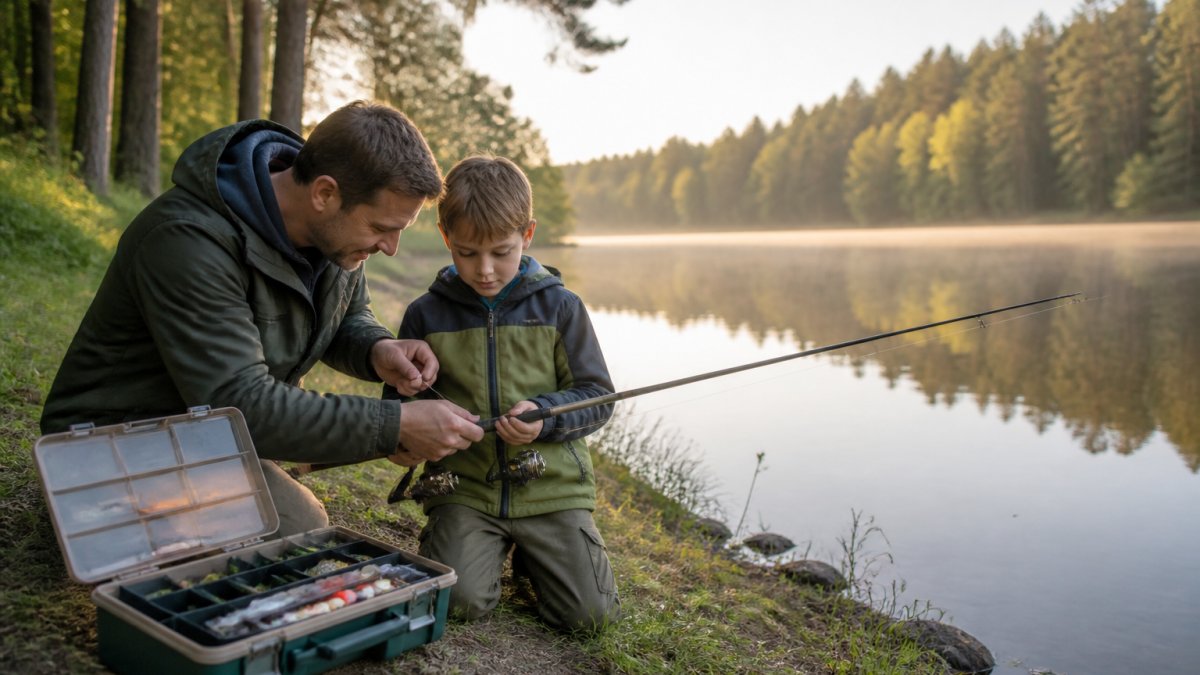
- A small box for bait and accessories
It's important that children be able to hold the rod on their own. A rod that's too long quickly becomes a burden.
Clothing and Food
Children rarely sit still. Be sure to pack clothes that can get dirty. Rubber boots, a lightweight rain jacket, and a hat should go in your backpack.
Food: A light meal, water, and a few snacks. Hungry children lose interest in the water faster than tired children.
Fishing Licenses for Children: What Parents Need to Know
In most federal states, children under a certain age do not need their own fishing license. However, the exact rules vary depending on the federal state and the body of water.
Therefore, be sure to check the Water Resources Regulations in your preferred area. Many clubs offer a Youth Fishing License that is designed specifically for children.
Key points:
- Children are often only allowed to fish if accompanied by an adult with a valid license
- Some areas require a separate children's ticket
- Day passes are often available directly from the Fishing Club or tenant
- The adult is responsible for the Fair Hunting Practices
Check with your local club. It takes five minutes and will save you trouble on the shore.
Choosing the Right Fishing Set for Kids
A good Fishing Set for Kids It is lightweight, sturdy, and ready to use right away. Ready-to-use sets consisting of a rod, reel, and a few accessories are for the It's usually the best choice to start with.
Look for these characteristics:
- Total weight under 300 grams
- A rod handle that’s easy for even small hands to grip
- Reel with a simple drag system, no frills
- No sharp edges or pointed ends
Rods, Reels, and Accessories
A medium-action rod is forgiving of minor casting mistakes. That's worth its weight in gold for beginners.
The reel should spin smoothly. A brake that's too tight causes line breaks and frustration. It's better to set the brake a little looser.
Accessories also include a small Fishing net and a Hook Release. Both make all the difference when a fish actually takes the bait.
Water Safety for Children
Water safety for children starts with clear rules that are discussed before they first go in the water. Children understand rules better, if she know the reason. The key point is that the rules are tailored to age; a five-year-old needs different reference points than a ten-year-old.
The Three Basic Rules That Always Apply
These three points are non-negotiable and will be discussed before the rod is set up:
- Wear a life jacket, especially in flowing bodies of water and along riverbanks with a defined riverbed edge. For children up to about ten years old, a properly fitting life jacket that complies with EN ISO 12402-4 (100 N buoyancy) is the safest choice; it stays securely in place without restricting arm movement.
- Stay at least three meters away from the water, as long as no adult is standing right next to them. This number was chosen deliberately: it is easy for children to grasp and can be marked on the shore using a step measure.
- Never walk to the shore alone. Not even „just for a moment.“ Children underestimate the risk of slipping on overgrown slopes.
Why These Rules Work, and How to Make Them Stick
Children are more likely to follow rules when they understand the reason behind them. Explain the reason in one sentence: „The life jacket will keep you afloat if you slip into the water.“ Or: „Stay three meters away because the slope continues underwater farther than you can see.“
A tried-and-true method: Have your child repeat the rules out loud before the outing. Saying them aloud helps them remember them better later on. Once you’re at the water’s edge, a quick glance is all it takes to remind them—no need for a loud reminder.
Rod tip, hook, and neighbor
Two rules do not concern the water, but rather the handling of the equipment:
- Always point the tip of the divining rod away from your neighbor. When throwing and catching, point the tip forward or to the side—never behind your child.
- Remove the hook only with the hook remover. Children's fingers are small and tend to slip off easily. A hook remover with a long handle keeps the hand away from the hook.
For multi-hook rigs (e.g., Hegene), it's best to use single hooks on the first fishing trip. They're less likely to snag and cause less injury to the fish.
Choose a Safe Fishing Spot
Select one Fishing Spot with a flat Waterfront area. The risk there is low, and the children have a firm footing. A quiet spot with a place to sit is better than a steep bank with plenty of fish.
Also be sure to pay attention to:
- Gravel or grass strips Instead of a muddy riverbank, no one slips there.
- No flow edge right on the shore; even a calm lake can have a current where a stream flows into it.
- Visual contact with the child from your seat, without having to get up.
- Distance from piers and boat docks, where fishing is often prohibited.
What to Do If Something Happens
Stay calm and follow these steps in this order:
- Secure the child, pull it out of the water or pull it away from the shore.
- Heat, take off your wet clothes, wrap yourself in a jacket or blanket, and find shelter from the wind.
- Emergency Number 144 (First aid) for hypothermia, loss of consciousness, or difficulty breathing.
- Hook injury, Do not pull the hook out if it is deeply embedded; keep the wound still and seek medical attention.
A quick look at the Water Resources Regulations Check with the local fishing district in advance to see if fishing is even allowed at the chosen spot. Many leaseholders mark protected areas and spawning grounds, which are unsuitable for children anyway.
Choosing the Right Body of Water for Your First Trip
For your first fishing trip, a small, quiet lake is a better choice than a large river. Still waters are safer, and the fish are easier to find.
Good criteria for the Choosing a Body of Water:
- Shallow shore with no current
- Seating area or grassy area near the shore
- Accessible parking nearby
- Restrooms not too far away
- Good Fish stock with species that are easy to catch
A Fishing Vacation Families with young children benefit from short distances. The shorter the walk, the better everyone’s mood.
Ask the tenant about bodies of water that are recommended for families.
Choosing Lures for Beginners: Simple and Effective
For beginners, a simple bait is better than a complicated one. Corn, dough, or a worm usually yield quick results. The real key, however, isn't the bait itself, but the fact that children use it Install and replace it yourself ...that's the difference between watching and fishing along.
A Comparison of the Four Beginner Lures
|
Bait |
Target Species |
Advantage |
Disadvantage |
|---|---|---|---|
|
Canned corn |
Whitefish, small carp |
Stays securely on the hook; very easy to attach |
softens after a long time |
|
Pre-made dough in ball shape |
Carp, Tench |
malleable, adheres well |
dries on your hands |
|
Earthworm |
Trout, Perch, Eel |
moves, highly attractive |
slippery, difficult for little hands |
|
Floating Bread |
Carp, Chub |
floats on the surface, clearly visible |
Only works if the throw is smooth |
For the first outing, Corn Usually the best choice: You can slide a single grain onto the hook with your fingers without the bait falling apart. Dough is the second option if children enjoy playing with playdough. Worm Save it for that moment when you haven't gotten a bite and a change of pace is just what you need.
Installation: As Simple as Possible
The Assembly It should be simple: rig, sinker, hook. Done. The fewer knots, the less frustration.
For children ages eight and up, this order has proven effective:
- Pose With a carrying capacity of 2 to 4 grams, it's light enough not to fly too far when cast.
- Lead shot just above the vertebra so that the bait sinks naturally.
- Crochet hooks sizes 8 through 12, Size 10 is a good compromise for corn and dough.
- Leader Made of monofilament line, about 0.18 mm, length approximately 30 cm.
A Palomar Knot This is enough to get started and is easy enough even for children's hands: Make a loop, thread it through the eye twice, tie an overhand knot, and tighten it. Teach the children The Science of Knots Once they can cast safely, have them tie the knots themselves.
Presenting Bait in an Age-Appropriate Way
Children learn best about bait when they understand its purpose. Explain in one sentence why each type of bait works:
- „Corn smells sweet—white fish like that.“
- „The worm is moving; the trout can see it.“
- „Bread floats to the top, so you can see the bite right away.“
Let children choose the treat themselves if there are several options available. When children get to choose, they stay engaged longer.
Ethics on the Hook: Ethical Fishing Practices
Fair Hunting Practices and Nature Conservation are part of it from the very beginning. Children learn best by example. When it comes to bait, it starts with three simple rules:
- Take only as many fish as you need. A fish that is released is handled gently.
- Gently release undersized fish. If your hands are wet, use the hook remover to remove the hook, then hold the fish briefly in the water until it swims away on its own.
- Do not keep fish out of the water for any longer than necessary. A child who understands the reason will follow the rule even without supervision.
Explain why these rules are important: A fish that is released can continue to grow and reproduce. This way, the Fishing Trip with Kids More than just a hobby—it's becoming a Love of Nature, which remains.
Patience and Managing Expectations: Keeping Kids Happy
Patience is the most important virtue when fishing, and that's exactly what children lack. So make sure to plan a short and varied outing.
Set realistic expectations:
- The first fishing trip doesn't have to result in a catch
- Two hours are more than enough
- Breaks are allowed and important
- A Sense of accomplishment It can also be a bite without a catch
It's perfectly normal for children to get restless after an hour. Plan some games for when things start to get quiet.
Psychological Support: What Children Really Need
When it comes to fishing, children need one thing above all else: the feeling that they are being taken seriously. Praise every attempt, not just the catch.
Don't say, „Just be patient.“ Instead, say, „Look how calm the water is.“ That way, you'll redirect their attention.
If a child is crying because the fish aren't biting, help them with their next cast. Doing something together is more comforting than words.
Interactive Educational Games by the Water
Waiting time becomes playtime. Here are some ideas that work on the shore:
- Who can spot the most birds?
- Who hears a bubble pop first?
- Who can find the prettiest rock?
- Who counts the waves to ten?
So the Experiencing Nature It's a positive experience, even if no fish bite. And the kids get to learn about their local waters along the way.
Weather, Fish Species, and the First Catch
The Fishing Weather often determines success. Overcast days with a light breeze are better than blazing midday sun.
Please check the following in advance:
- Wind Speed and Wind Direction
- Air Pressure and Its Changes
- Water Temperature
- Probability of Rain
For your first success, try fish that are easy to catch Fish Species. Whitefish, small carp, or trout usually bite reliably.
The Drill Catching even a small fish is exciting enough for kids. A big fish tends to overwhelm beginners.
If it's raining or stormy, it's best to stay at your lodging. A canceled outing isn't a wasted day.
Sustainability and Ethics by the Water
Fair Hunting Practices and Nature Conservation They've been part of it from the very beginning. Children learn best by example.
Please share these rules:
- Take only as many fish as you need
- Gently release undersized fish
- Take your garbage back with you
- Do not keep fish out of the water for any longer than necessary
- Do not trample the vegetation along the shore
Explain why these rules are important. A child who understands the reason behind them will follow them even without supervision.
That's how the Fishing Trip with Kids more than just a hobby. It's becoming a Love of Nature, which remains.
Conclusion: An unforgettable day by the water
The first Fishing Trip with Kids It doesn't have to be perfect. It just has to be relaxed.
Lightweight gear, safe waters, and realistic expectations make all the difference. The rest will come with time.
If you’re looking for a peaceful base for your excursions, you’ve come to the right place. Our wheelchair-accessible vacation apartments can accommodate the whole family—including your dog. Our peaceful location in the Waldviertel region puts you just minutes away from tranquil bodies of water and hiking trails. And if you have any questions about places to visit, Anna and Herbert will be happy to help you personally.
Frequently Asked Questions
At what age can children start fishing?
There’s no set age limit, but most kids have the necessary patience and fine motor skills starting around age six. In Austria, children under 14 are often allowed to fish when accompanied by an adult with a valid fishing license. The key is whether your child can sit still and follow instructions. Start with short outings lasting one to two hours and gradually increase the duration. This will help keep the fishing trip fun for your children.
What do you need for your first fishing trip with your kids?
The basic gear includes a lightweight fishing rod with a simple float, a landing net, a hook remover, and a small assortment of bait such as worms or corn. You’ll also want sunscreen, weather-appropriate clothing, drinks, and a snack. A fishing tackle box for kids helps keep all the gear organized. A fishing set for kids is ideal because it’s usually designed to fit children’s size and strength and includes everything they need in one package.
What legal regulations apply to children when fishing?
In Austria, the federal states regulate fishing. In Lower Austria, children under 14 generally do not need their own fishing license, but may only fish under the supervision of someone with a valid fishing license. Starting at age 14, a youth fishing license is usually required. Check with the relevant district administration office or your local fishing club in advance to find out the exact rules for your fishing waters. This will help you avoid problems and allow you to enjoy your outing stress-free.
How do I keep my kid entertained while fishing?
Plan breaks and make the outing varied. Bring binoculars to watch birds, or play simple nature games. Praise your child for being patient, even if no fish are biting. A short walk along the shore or a picnic can lighten the mood. It’s important to remember that the success of your first fishing trip with children doesn’t depend solely on catching fish, but on the time you spend together in nature. That way, the memory will be a positive one.
Your first day by the water will be one to remember if the setting is right. That’s exactly what we provide at Ferienwohnungen Gutenbrunn: accessible apartments, personalized service, and a location that caters to families, wheelchair users, and dog owners. Book directly with us and start your first fishing trip with the kids on a relaxed note.


Comments are closed, but trackbacks and pingbacks are open.