


Table of Contents
- Why the Right Amenities Are Crucial for Accessible Vacation Rentals
- Accessible Vacation Rental Checklist: From Entrance to Patio
- Wheelchair-Accessible Vacation Rental Amenities: Rooms and Living Area
- Accessible Bathroom in a Vacation Rental: Grab Bars and Amenities
- Kitchen: Functionality for People with Various Mobility Limitations
- Equipment for Special Needs: Nursing Beds and Assistive Devices
- Checking for Accessible Accommodations Before Booking: Questions and Transparency
- Dimensions and Recognized Standards for Accessible Vacation Rentals
- Identifying and Avoiding Common Defects
- Frequently Asked Questions
Last updated: October 19, 2026
Why the Right Amenities Are Crucial for Accessible Vacation Rentals
The right one Amenities for Accessible Vacation Rentals It’s not just a nice extra—it’s essential for ensuring that people with limited mobility can truly enjoy their vacation. Without well-designed amenities, what was supposed to be a relaxing vacation can quickly turn into a struggle with stairs, doors that are too narrow, and inaccessible bathrooms.
Guests with different needs require different solutions. Wheelchair users need different amenities than people with mobility impairments or older adults who rely on walking aids. A truly accessible vacation rental takes these differences into account from the very beginning.
The good news: With the right planning and the right features, an accessible vacation rental can become a place where all guests can move around safely and independently. Below, we’ll show you a complete checklist for the Features of Accessible Vacation Rentals – from entryways to bedrooms, bathrooms, and kitchens.
Accessible Vacation Rental Checklist: From Entrance to Patio
A systematic checklist is the best way to ensure that your vacation rental is truly accessible. Many operators overlook individual details that are crucial for guests. The following checklist is organized by room and covers not only mobility impairments but also visual, hearing, and cognitive needs—because accessibility doesn’t end with wheelchairs.
Print out this checklist and go through it room by room. That way, you'll spot any gaps before your guests do.
Entrance Areas and Access Points
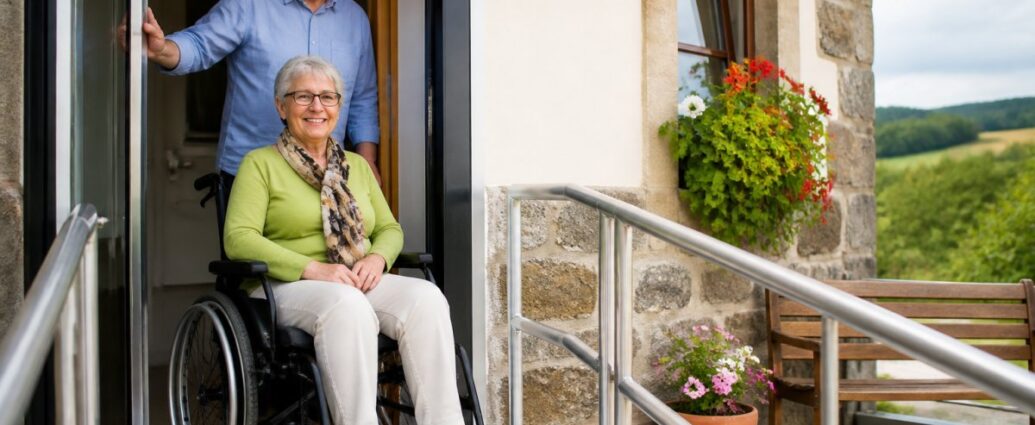
Access to the accessible vacation rental It starts right outside. Barrier-free access is non-negotiable—every step excludes people in wheelchairs.
Key points:
- A ramp or level surface instead of stairs (maximum slope of 1:12, or 8.3 percent)
- A solid, non-slip surface in the entryway
- Sufficient space in front of the entrance door (at least 1.5 m × 1.5 m for turning maneuvers)
- An easily accessible doorbell and door opener (at handle height, about 85–105 cm)
- Lighting in the Entrance Area for Safety
- High-contrast markings on the entrance door and the first step (if any) for people with visual impairments
- Door sign with tactile or easily legible letters
Door Widths and Door Handles
Doors that are too narrow are one of the most common reasons why an apartment that’s supposed to be accessible doesn’t actually work out. Wheelchairs need space.
Door widths should be at least 80 cm (preferably 90 cm). Door handles must:
- Must be mounted at a height of 85–105 cm
- Easy to grip (round or elongated handles work better than small knobs)
- Be operable with one hand (twist handles are often difficult for people with limited grip strength)
A common mistake: doors that are hard to open. An automatic door opener—or at least a door that opens with minimal resistance—makes a big difference. For people with visual impairments, a high-contrast door frame or a tactile door sign can be helpful.
Open Spaces in Living Areas
Wheelchair users need space to maneuver. This means not only wide doors, but also enough space inside the rooms themselves.
Minimum Requirements:
- A space of at least 1.5 m × 1.5 m in each room for turning around
- Hallways should be at least 90 cm wide
- No tripping hazards such as door thresholds or uneven transitions
- Flooring should be non-slip and level
- High-contrast marking of edges and changes in level for people with visual impairments
- Adequate lighting, ideally without glare
Bedroom
A wheelchair-accessible bedroom needs space to maneuver—not just next to the bed, but all around it.
Key Features:
- A bed that is 45–50 cm high (so it can be reached from a wheelchair)
- Free space on at least one side of the bed (ideally 1.5 m × 1.5 m)
- Nightstands of the appropriate height and depth (wheelchair-accessible)
- Closet with accessible hanging rods (no higher than 160 cm)
- Light switches and outlets at hand height (85–105 cm)
- For people with hearing impairments: visual signals (e.g., a light signal when the doorbell rings) and easily visible alarm clocks
- For people with cognitive impairments: clear, simple labels and a well-organized layout
People with limited mobility also appreciate beds with bed rails that are easy to access—this makes getting out of bed much easier.
Bathroom
The bathroom is often the most critical room. This is where most accidents happen, and this is where having the right equipment is most important.
Key points:
- Toilet height of at least 46–48 cm (raised toilet seats can help)
- Grab bars on both sides of the toilet (sturdy, at a height of 60–65 cm)
- Wheelchair-accessible sink (minimum height 67 cm, minimum depth 30 cm)
- Mirror at a reachable height (bottom edge no higher than 100 cm)
- Walk-in shower with a non-slip floor and grab bars
- Shower wheelchair or shower stool, if needed
- For people with visual impairments: high-contrast fixtures and tactile markings
- For people with hearing impairments: visual signals for water alarms or doorbells
Kitchen
The kitchen is often an underappreciated room. People with limited mobility want to cook and eat—not just pick up meals.
Key Features:
- Work surfaces with clearance for wheelchairs (height 80–85 cm, depth at least 60 cm)
- Stove and oven at a comfortable height (no higher than 90 cm)
- Refrigerator with a freezer compartment at a convenient height
- Wheelchair-accessible sink (height 80–85 cm)
- Cabinets with handles, not push-to-open handles
- Sufficient space to turn around (at least 1.5 m × 1.5 m)
- For people with visual impairments: high-contrast markings on the stove and faucets, tactile labels
- For people with cognitive impairments: simple, clear controls
Patio or outdoor area
The outdoor area is part of the vacation rental and should be just as accessible.
Key points:
- Step-free access to the patio or balcony
- Non-slip surface, even when wet
- Ample space for a wheelchair or walking aids
- Handrails or railings, where necessary
- For people with visual impairments: high-contrast markings on edges and steps
A good checklist covers all rooms and takes into account different types of disabilities. Go through it regularly—even small changes can affect accessibility.
Wheelchair-Accessible Vacation Rental Amenities: Rooms and Living Area
Bedroom with plenty of space
A wheelchair-accessible bedroom needs space to maneuver—not just next to the bed, but all around it.
Key Features:
- A bed that is 45–50 cm high (so it can be reached from a wheelchair)
- Free space on at least one side of the bed (ideally 1.5 m × 1.5 m)
- Nightstands of the appropriate height and depth (wheelchair-accessible)
- Closet with accessible hanging rods (no higher than 160 cm)
- Light switches and outlets at hand height (85–105 cm)
People with limited mobility also appreciate beds with bed rails that are easy to access—this makes getting out of bed much easier.
Wheelchair-accessible tables and work surfaces
An often-overlooked detail: tables that you can roll your wheelchair under. This makes a big difference in terms of independence.
Requirements:
- Dining table with at least 67 cm of clearance underneath
- A desk or work surface that a wheelchair can fit under
- Height between 70 and 80 cm for comfortable use
- Adequate legroom (at least 30 cm deep)
Accessible Bathroom in a Vacation Rental: Grab Bars and Amenities
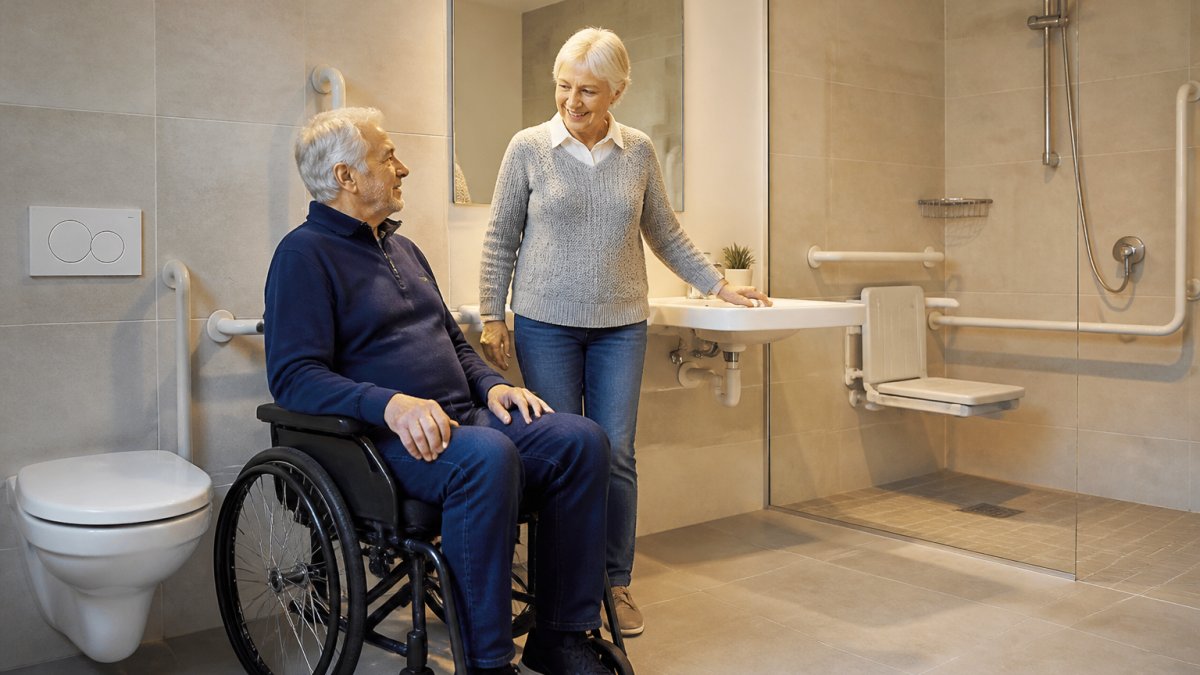
The bathroom is often the most critical room. This is where most accidents happen, and this is where having the right equipment is most important.
Toilet and Sink: Height and Handle Systems
The toilet is a key piece of bathroom equipment. Many standard toilets are too low for people who need help getting up.
The Right Equipment:
- Toilet height of at least 46–48 cm (raised toilet seats can help)
- Grab bars on both sides of the toilet (sturdy, at a height of 60–65 cm)
- Handles should have a diameter of 32–35 mm (easy to grip)
- Wheelchair-accessible sink (minimum height 67 cm, minimum depth 30 cm)
- Mirror at a reachable height (bottom edge no higher than 100 cm)
- Soap dispensers and towel racks at handle height
One important point: The handrails must be truly sturdy—they must be able to support a person's full body weight.
Shower and Bathtub Safety
Shower or bathtub—or ideally both? That depends on the guests. An accessible solution should be flexible.
Requirements for the shower:
- Level-entry access (no steps, no shower threshold)
- Non-slip flooring
- At least 1.5 m × 1.5 m of space for maneuvering
- Grab bars on the walls (L-shaped or U-shaped)
- Shower seat or shower stool for people who cannot stand
- Faucet with easy-to-use handles (single-lever faucets are better than twist handles)
- A shower curtain or glass door that doesn't get in the way
For a bathtub:
- Bathtub Step Aid or Bathtub Lift
- Handrails all around
- Non-slip mat on the inside
Kitchen: Functionality for People with Various Mobility Limitations
The kitchen is often an underappreciated room. People with limited mobility want to cook and eat—not just pick up meals.
Key Features:
- Work surfaces with clearance for wheelchairs (height 80–85 cm, depth at least 60 cm)
- Stove and oven at a comfortable height (no higher than 90 cm)
- Refrigerator with a freezer compartment at a convenient height
- Wheelchair-accessible sink (height 80–85 cm)
- Cabinets with handles, not push-to-open handles
- Sufficient space to turn around (at least 1.5 m × 1.5 m)
People who use wheelchairs also appreciate storage surfaces at different heights—this makes working in the kitchen safer.
Equipment for Special Needs: Nursing Beds and Assistive Devices
Not all guests have the same needs. Some need a nursing bed, others a shower wheelchair or special lifting aids. It’s crucial that, as a host, you clarify these needs before the booking and provide the appropriate equipment—or know where it can be arranged on short notice.
Nursing Beds and Sleep Comfort
A nursing bed is more than just an adjustable bed. It allows people with limited mobility to lie down, sit up, and receive care safely.
What you should keep in mind:
- Adjustable height (for guests and caregivers)
- Electric or manual adjustment of the head and foot sections
- Built-in side rails or bed rails that prevent falling out
- Enough space next to the bed for transfer aids (e.g., patient lifts)
- Mattress with proper pressure distribution
Nursing beds are available in a variety of styles—from simple adjustable slatted-base models to fully equipped nursing beds with built-in sit-up aids. Compact, height-adjustable models are often a good choice for vacation rentals, as they can be easily integrated into a standard bedroom.
Shower wheelchairs and transfer aids
A shower wheelchair allows users to bathe while seated and is indispensable for many guests with limited mobility.
Key Features:
- Suitable for wet areas (stainless steel materials)
- Suitable for the shower size (at least 1.5 m × 1.5 m)
- Adjustable backrest and armrests
- Parking brakes
- Optional: Toilet function for combined use
In addition, transfer aids such as sliding boards, turntables, or lifting slings can make it easier to move from a wheelchair to a bed or to the toilet. These aids are often inexpensive and take up little space.
Lifting Aids and Lifts
For guests who are unable to move around on their own, lifting aids or patient lifts provide significant relief—both for the guest and for family members providing care.
Possible solutions:
- Mobile patient lifts (e.g., ceiling lifts or floor-mounted lifts)
- Wall-mounted lifts, if structurally feasible
- Lifting straps and transfer aids for manual transfers
Important: Lifts must be maintained regularly, and guests must be instructed on how to use them before use. As a host, you should determine whether the guest is familiar with the equipment or needs instruction.
Toilet seat risers and other assistive devices
Small tools often make all the difference:
- Toilet seat risers with or without armrests
- Shower stools and shower chairs
- Non-slip mats for the shower and bathtub
- Gripping Pliers and Long Handles
- White cane holders or tactile markings
- Vibrating alarm clocks or light signals for people with hearing impairments
Personalized Needs Assessment Before Booking
The most important step is personalized coordination. Before booking, ask your guests specific questions about their needs—and offer concrete solutions rather than just making general promises about „accessibility.“.
A simple questionnaire can help:
- What type of mobility limitation do you have (wheelchair, walking aid, temporary)?
- Are transfer aids needed?
- Are there any special requirements for the bathroom (shower wheelchair, grab bars)?
- Are assistive devices needed for visual or hearing impairments?
- Is a caregiver traveling with you who needs specific equipment?
Assistive devices such as patient lifts or nursing beds must be safe and properly maintained. Before providing them, determine whether training is necessary, and document the handover.
Some vacation rentals are happy to provide these special amenities—a quick phone call ahead of time makes all the difference. This way, you can ensure that the amenities truly suit your guests.
Checking for Accessible Accommodations Before Booking: Questions and Transparency
The most important thing: Don't just take the term „accessible“ at face value. Ask specific questions before you book.
Questions you should ask:
- Are there any steps or stairs in the entryway?
- How wide are the doors (exact measurements)?
- Is the bathroom truly accessible, or only partially so?
- Are there grab bars in the shower and bathroom?
- Is the bedroom big enough to turn around in?
- Can I see photos or take a virtual tour before booking?
- How does the landlord respond to detailed questions—does he give specific answers or dodge the questions?
A good landlord answers these questions openly and in detail. If the answers are vague, that's a red flag.
Dimensions and Recognized Standards for Accessible Vacation Rentals
There are standards in Austria. The Austrian standard ÖN B 1600-1, „Accessible Construction,“ defines specific requirements. The Austrian standard ÖN B 1600-1 establishes standards for accessible construction
Key Dimensions at a Glance:
| Element | Minimum size | Note |
|---|---|---|
| Door width | 80 cm | 90 cm is better for wheelchairs |
| Activity Area | 1.5 m × 1.5 m | Required for turning |
| Handle Height | 85–105 cm | Standard available |
| Toilet Height | 46–48 cm | With a raised seat |
| Ramp slope | 1:12 (8,3 %) | Maximum allowed |
| Hallway width | 90 cm | Minimum Exercise Requirement |
| Bed Height | 45–50 cm | Wheelchair accessible |
These standards are not arbitrary—they are based on years of research and practical experience working with people with various disabilities.
Identifying and Avoiding Common Defects
Some mistakes come up time and time again. Here are the biggest pitfalls:
Steps Instead of Ramps: A single step at the entrance makes the entire apartment inaccessible. No exceptions.
Doors that are too narrow: A width of 75 cm isn't enough. Wheelchairs are often wider, and people need room to maneuver.
Handrails that don't hold: Handles that are screwed into drywall without proper anchoring are dangerous. They must be anchored into wooden studs or concrete.
Bathrooms with limited space: Even a small bathroom with grab bars is still too small if you can't turn around.
Underestimated Thresholds: Even small thresholds (2–3 cm) can be problematic for wheelchairs. The goal is to have level transitions.
Countertops that are too high: A kitchen with a standard countertop (90 cm) is not accessible to wheelchair users.
A truly accessible vacation rental is a place where people with different abilities can move around independently and safely. This requires planning, the right dimensions, and well-thought-out amenities—but the effort is worth it. At Ferienwohnungen Gutenbrunn, we’ve carefully planned these features and regularly reviewed them. If you’re looking to book an accessible vacation rental that truly works, contact us directly—we’ll answer your questions in detail and show you exactly what we offer.
Frequently Asked Questions
How can I tell if a vacation rental is truly wheelchair-accessible?
Before booking, ask about step-free access, door widths of at least 80 cm, clear spaces of about 150 x 150 cm in front of furniture, and grab bars in the bathroom. Ask to be sent photos or request a video tour. Truly accessible accommodations can provide specific measurements and display them openly. Be skeptical of vague promises—reliable hosts document their amenities in detail.
What dimensions are important for an accessible bathroom in a vacation rental?
The bathroom should provide at least 2.25 m² of floor space for movement; the toilet should be 20 cm away from the wall and have grab bars at a height of 75–80 cm. The shower must have step-free access, a width of at least 90 cm, and enough space for a shower wheelchair. The sink should be wheelchair-accessible (height approximately 80 cm). These standards are based on Austrian accessibility guidelines.
What amenities make the stay easier for people with limited mobility?
It’s important to have step-free entrances, wide doors (at least 80 cm), wheelchair-accessible tables in the kitchen and living area, grab bars in the bathroom and on stairs, non-slip floors, and good lighting. In addition, nursing beds, shower wheelchairs, raised toilet seats, and support aids can be helpful. Ask which assistive devices are available—not every facility offers all of them.
What specific questions should I ask before booking an accessible vacation rental?
Ask about: exact door widths, steps at the entrance, space to move around in each room, the type and height of grab bars, shower type (tub or walk-in shower), the height of the toilet and sink, available assistive devices, and how to contact the hosts in an emergency. Request photos or videos and verify whether the description matches the current reality. Reputable providers respond in detail and in a timely manner.


Comments are closed, but trackbacks and pingbacks are open.