


Table of Contents
- Family-Friendly Bicycle Trails in the Waldviertel: Overview and Initial Guidance
- Easy bike trails in the Waldviertel for casual cyclists
- Family Bike Rides in the Waldviertel: Routes by Age Group
- Planning a Bike Ride with Kids: Distance, Duration, and Breaks
- Low-Traffic Routes and Safety on Family Bike Rides
- Nature experiences along the bike routes: forests, streams, and places to visit
- Packing List for a Cycling Vacation with Kids: What to Bring
- Practical Tips: Train Travel, Places to Stop for Refreshments, and Flexible Route Planning
- Frequently Asked Questions
Last updated: October 13, 2026
Family-Friendly Bicycle Trails in the Waldviertel: Overview and Initial Guidance
The Waldviertel is one of the best destinations for family-friendly bike paths in Austria. The region offers flat, low-traffic routes that are perfect for children and casual cyclists. Whether you’re cycling with toddlers in a trailer or accompanying school-age children on their first longer rides—here you’ll find routes that are fun and not too challenging.
Here at Ferienwohnungen Gutenbrunn, we know these bike tours firsthand. Our guests use the family-friendly bike paths every day to explore nature and enjoy the Waldviertel region. Most of the routes start right from our lodging or are just a short drive away.
What makes a bike route truly family-friendly? It's not just about the length. Other important factors include:
- Little traffic and safe routes
- Regular breaks and places to stop for refreshments
- Interesting places for kids (lakes, playgrounds, animals)
- Flat or slightly hilly route
- Good tires for various types of bicycles
The family-friendly bike paths in the Waldviertel meet these criteria. Many follow old railroad tracks or river courses. This makes them not only safe but also exciting for children.
It's best to plan your bike ride with children for the morning. Children have more energy then, and you can take a longer break at a restaurant around noon.
Easy bike trails in the Waldviertel for casual cyclists
Not everyone is an ambitious cyclist. Many casual and recreational cyclists prefer a relaxed pace. They want to enjoy the scenery without overexerting themselves. For this group, the lightweight Bicycle Trails in the Waldviertel ideal.
These routes have the following characteristics:
- Maximum gradient of approximately 3–5%
- Asphalt or a well-paved surface
- Length between 15 and 40 kilometers
- Flat to gently rolling terrain
- Many rest areas and scenic viewpoints
The riverside bike path along the Kamp is a classic example. The route winds through green valleys and past historic monasteries. The path is paved throughout, and the inclines are minimal. It’s perfect for leisure cyclists.
The bike trails around Lake Edlesberg are also excellent. The lake is situated in a beautiful natural setting. The trails are wide and have little traffic. Children and beginners feel safe here.
A tip for casual cyclists: Combine your bike ride with a train trip. That way, you can ride a longer distance without having to worry about the return trip.
Family Bike Rides in the Waldviertel: Routes by Age Group
The best bike ride is the one that suits your child’s age and riding experience. A two-year-old in a bike trailer has different needs than a school-age child riding their own bike or a teenager who’s already used to longer distances. Three factors are key: elevation gain, terrain, and whether the child is pedaling on their own or just riding along.
As a guide for classification based on age and driving experience:
| Age group | Driving Experience | Realistic Daily Distance | Elevation Gain (Total) | Suitable Substrate |
|---|---|---|---|---|
| 2–4 years | Trailer or child seat | 15–20 km | less than 80 hm | Asphalt, fine gravel |
| 5–7 years | Balance Bike and First Bicycle Experience | 15–25 km | 80–150 hm | Asphalt, well-maintained gravel |
| 8–10 years | A safe bike of their own, elementary school children | 25–40 km | 150–250 hm | Asphalt, gravel, short forest trails |
| Ages 11 and up | experienced cyclists | 40–60 km | 250–400 hm | All paths except those with large roots |
These figures are guidelines, not limits. A child who rides a bike regularly can cover more distance; a child who rarely rides a bike can cover less.
Tours for Toddlers and Child Trailers
Young children can't ride on their own yet. They sit in a bike trailer or a child seat. This means the bike ride should be comfortable for the parents, not for the child. Make sure the road surface is good and take regular breaks.
Good routes for toddlers are short—no more than 20 kilometers and, if possible, with less than 80 meters of elevation gain. The surface should be flat and paved. Gravel roads or forest trails are uncomfortable when pulling a trailer, as every bump is felt by the child.
The bike route around Lake Edlesberg is a classic example. The route is flat, the surface is in good condition, and there are several playgrounds where you can take a break. Along the way, you’ll find restaurants that offer children’s menus. The entire loop takes about 1.5 to 2 hours—ideal for toddlers.
Rail-to-trail bike paths are also an excellent choice. These old railroad tracks are perfectly maintained and completely flat. Children in bike trailers enjoy the peaceful ride. Make sure the trailer hitch is compatible with your bike type—for e-bikes, a sturdy hitch with sufficient load capacity is important.
Routes for Schoolchildren and Beginner Cyclists
Schoolchildren ride on their own—but often not very far yet. Realistic distances for beginners are 20 to 35 kilometers. Important: Take regular breaks and choose interesting destinations along the way.
For schoolchildren, the Bicycle Trails in the Waldviertel have little traffic. Wide bike paths next to the road are better than narrow paths with car traffic. This promotes safety and self-confidence.
A great route for schoolchildren is the Kamp Bike Trail from Gars to Horn. The route is about 30 kilometers long. The trail follows the river. There are streams, forests, and, every so often, small villages with places to stop for a break. Children find this exciting. Along the way, they can watch ducks or take a break on the boardwalks.
The bike routes around the abbey landscapes are also suitable for schoolchildren. They ride past abbeys, explore old castles, and enjoy the cultural landscape. This turns biking into an adventure, not just a sport.
How to Tell If a Route Is Right for Your Child
Before you choose a route, check four things:
- Elevation Profile: Is the steepest climb appropriate for your child's fitness level? A single climb with a 100-meter elevation gain can be more strenuous for an elementary school child than a consistently flat route of the same length.
- Background: Asphalt and fine gravel are suitable for children's bikes and trailers. Coarse gravel, tree roots, and deep trails are reserved for experienced teens.
- Bicycle type: A sturdy children's bike with good brakes is more important than a lightweight bike. If you're using a trailer, you'll need a tow bike with sufficient braking power.
- Return trip option: Is there a train station or a shortcut in case your child gets tired early? That takes some of the pressure off when planning.
Schoolchildren need destinations along the way—not just the journey itself. A lake, a playground, or a café serving ice cream can turn a bike ride into an adventure. Check the elevation gain and terrain in advance to make sure the route is suitable for your child’s riding ability.
Planning a Bike Ride with Kids: Distance, Duration, and Breaks
Good planning is essential. Many families underestimate the time and energy children need when biking. Then the bike ride becomes exhausting instead of relaxing.
Here are some realistic estimates for travel time:
| Age | Daily travel time | Recommended route length | Pause Interval |
|---|---|---|---|
| 2–4 years (trailer) | 1.5–2 hours | 15–20 km | After 1 hour |
| Ages 5–7 (Beginners) | 2–3 hours | 20–30 km | After 1–1.5 hours |
| Ages 8–10 (Advanced) | 3–4 hours | 30–45 km | After 1.5–2 hours |
| Ages 11 and up | 4+ hours | 45+ km | After 2 hours |
These times refer to travel time, not total duration. You'll need to add in breaks, stops for refreshments, and photo stops.
Here's a practical example: A 25-kilometer bike ride with a school-age child takes about 2 to 2.5 hours. With two 20-minute breaks and a 45-minute lunch break, you'll be on the go for a total of 4 to 5 hours. Plan accordingly.
Breaks aren't a waste of time. They're necessary. Children need water, snacks, and the freedom to move around. A child who gets to rest will be ready to ride again with renewed energy. An exhausted child becomes cranky and refuses to ride.
Choose places to stop strategically. A restaurant with a playground is ideal. The playground lets the child burn off some energy. You can eat in peace. Everyone will feel refreshed afterward.
Don't underestimate the heat. On hot days, children are less eager to ride and get tired more quickly. Starting early in the morning and taking a long break at noon is the better strategy.
Low-Traffic Routes and Safety on Family Bike Rides
Safety is the most important factor for family bike rides. A child who feels unsafe won't have any fun. That's why you should avoid routes with car traffic and pay attention to the specific infrastructure along the route.
The best family-friendly bike paths in the Waldviertel are former railroad tracks or river bike paths. These paths are separated from car traffic. Children can ride freely without having to constantly watch out for traffic.
What to Consider When Choosing a Route
- Wide, well-maintained bike paths (at least 2 meters)
- Separate paths, not next to the road
- Good visibility—no tight curves that obstruct the view
- Few intersections with car traffic
- Clear markings and good signage
Rail-to-trail bike paths generally meet these criteria. They are wide, flat, and usually completely free of traffic. Children can ride side by side and play.
Check specific infrastructure: crossings, rest areas, restrooms, and water
What’s missing from most route descriptions are the details that actually shape everyday family life on a bike. Check the following in advance:
- Crosswalks: How many crossings with vehicle traffic are there, and are they protected by traffic lights, traffic islands, or visual barriers? A route with two clearly visible crossings is safer for schoolchildren than one with five intersections that are difficult to see.
- Rest areas: Are there benches, tables, and shaded areas spaced at child-friendly intervals? As a rule of thumb, there should be a rest area for children up to age 10 every 5 to 8 kilometers.
- Restrooms: Public restrooms are usually found at train stations, lake access points, and larger restaurants. Plan your route so that you can reach a restroom no later than halfway through your trip.
- Water stations: Drinking fountains or fountains with drinking-quality water are not available everywhere. Bring at least 1 liter per person and refill your water at restaurants.
- Playgrounds: A playground during recess or lunch break gives children a chance to get some exercise and gives parents a quiet break.
Types of Bicycles and Equipment
There are also differences when it comes to types of bicycles. A sturdy children's bike with good brakes is more important than a lightweight road bike. Good tires with sufficient tread provide safety on various types of terrain.
For trailers and child seats, check the maximum load capacity and how they attach to your bike. With e-bikes, a sturdy coupling is important to ensure the trailer follows safely even during braking maneuvers. For children who ride on their own, coaster brakes or properly adjusted hand brakes are crucial—a child who knows how to use their brakes rides more safely.
Don't forget safety gear: helmets for everyone, reflectors, and a bell. A child who wears a helmet feels taken more seriously and rides more carefully.
Before setting out, check to see if there are any construction zones, road closures, or detours along your planned route. Road conditions change with the seasons, and a last-minute detour can turn an easy family route into a challenging one.
Nature experiences along the bike routes: forests, streams, and places to visit
The Waldviertel is famous for its natural landscapes. Forests, streams, lakes—nature is everywhere. That’s what makes bike tours in the Waldviertel so exciting for families. It’s not just about exercise; it’s about the experience.
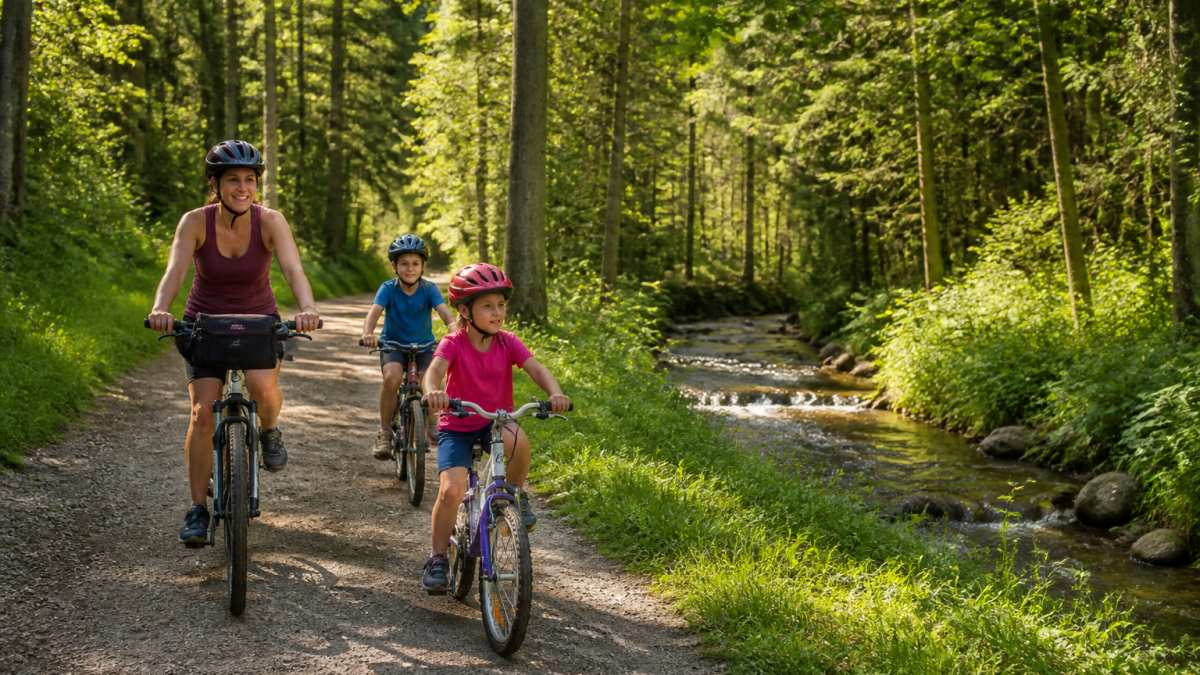
Many bike routes wind through dense forests. The forest is cool and shady—a pleasant escape on hot days. Children discover animals, plants, and little adventures. A stream you ride across becomes a highlight of the trip.
The Kamp Bike Trail is a classic example. The river runs alongside you the entire way. Along the way, you’ll see herons, ducks, and sometimes even beavers. There are many spots where you can stop and watch the water.
Lake Edlesberg is a natural wonder in its own right. The lake is nestled in a lush valley. All around it, there are swimming spots, playgrounds, and picnic areas. A bike ride around the lake combines exercise with the enjoyment of nature.
The abbey regions also offer opportunities to experience nature. Ancient monasteries and castles are nestled in beautiful countryside. Children are fascinated by the buildings, the history, and the people who once lived there.
Here's a tip: Bring along a field guide to plants and animals. Kids love learning about what they see. This turns the bike ride into both an adventure and a learning experience.
Packing List for a Cycling Vacation with Kids: What to Bring
A good packing list is half the battle. If you have everything you need, your bike trip will be more relaxing.
Here's what should be in every backpack for a family bike trip:
- Water and beverages (at least 1 liter per person)
- Snacks (fruit, nuts, granola bars, bread)
- Sunscreen and a hat
- First-aid kit with bandages
- Repair Kit (patch kit, mini pump, spare chain)
- Cell Phone and Emergency Numbers
- Rain jacket (the weather changes quickly)
- Dry towels and a change of clothes
- Wet wipes and toilet paper
- Small Toys for Recess
For longer outings, be sure to pack a lunch. A picnic by the lake or in the woods is a real treat for kids. Bring some light snacks—sandwiches, cheese, fruit.
Don't forget about the trip back. If a child gets tired, taking the train might be the solution. Many trains allow bicycles on board, which gives you flexibility.
Pack a small backpack for your child. Kids enjoy riding when they carry something themselves—even if it's just a little something. It makes them feel like they're part of the adventure.
Practical Tips: Train Travel, Places to Stop for Refreshments, and Flexible Route Planning
Cycling tours in the Waldviertel are even more enjoyable when you plan them wisely. Take the train to make your routes more flexible.
Many trains in the Waldviertel carry bicycles. That means you can ride part of the way and take the train back. This is especially convenient when it’s windy or the weather is bad. Even when children get tired, the train is a good option.
Taking your bike on the train is easy. You pay a small fee per bike. The bikes are stored in special compartments. This allows you to plan your family-friendly bike trip with flexibility.
There are places to stop for a break all over the Waldviertel. Small taverns, cafés, and restaurants are located right along the bike paths. Many have playgrounds or gardens where children can play. That makes taking a break a real pleasure.
Here's a handy tip: Make a reservation in advance at larger restaurants. That way, you'll secure a table and know that the kitchen will be open for you.
Flexible route planning also means that not every planned route has to be followed to the letter. If your child gets tired, just take a different route or take the train. The goal isn't to cover a certain distance—the goal is for everyone to have fun.
Exploring family-friendly bike trails in the Waldviertel is a real adventure. The region offers perfect conditions: quiet trails, interesting Nature Experiences and plenty of places to take a break. With good planning and the right routes, every bike ride becomes the highlight of your vacation.
If you’d like to go cycling with your family in the Waldviertel region, Ferienwohnungen Gutenbrunn is the perfect base. Our wheelchair-accessible vacation apartments are centrally located and offer personalized service from Anna & Herbert. From here, you can easily access all the major bike trails and nature experiences. Book directly with us and enjoy a family vacation without the pressure of a tight schedule—filled with peace and quiet, nature, and daily support from your hosts.
Frequently Asked Questions
Which family-friendly bike trails in the Waldviertel are suitable for beginners and young children?
The easy bike paths in the Waldviertel—along former railroad tracks and river trails—are ideal for beginners. These routes have few hills, little traffic, and are often paved. Routes along streams and through flat wooded landscapes offer a chance to experience nature without much effort. Child trailers can be used on most of these paths without any problems. Plan for 2–3 hours of riding time with several breaks.
How long should a bike ride with kids in the Waldviertel be?
For children between the ages of 4 and 7, tours of 15–25 kilometers with 2–3 hours of actual riding time are suitable. Schoolchildren ages 8 and up can manage 30–40 kilometers in a day. Plan for an extra 30–50 percent of time for breaks, photo stops, and rest stops. Start with shorter routes and gradually increase the distance. Regular breaks at interesting spots (a tavern, a stream bed, a tourist attraction) help keep motivation high.
What attractions can you visit on a bike tour through the Waldviertel?
Many bike routes pass by monasteries, castles, nature parks, and idyllic inns. Lake Edlesberg is a popular spot for a swim break. Small museums, arts and crafts, and local places to stop for a bite to eat invite you to explore. Plan specific stops that will interest your family—this makes the tour more varied and gives children something to look forward to.
Can I combine my bike ride with a train trip?
Yes, many bike routes in the Waldviertel are connected to train stations. You can arrive by train, bring your bikes with you, and start biking from there. At the end of the tour, you can take the train back to the starting point. This allows for flexible tour planning without having to ride back and is especially convenient for families who don’t want to ride the entire route. Be sure to check in advance about bike transport rules and seat reservations.

Comments are closed, but trackbacks and pingbacks are open.