



Table of Contents
- Relaxing Days in the Waldviertel: How to Make the Most of Your Getaway
- The Most Beautiful Places to Visit in the Waldviertel for Peaceful Days
- Weekend in the Waldviertel: The Final Itinerary
- Hiking and Long-Distance Hiking: Exercise That Helps You Relax
- Mindfulness, Meditation, and Slowing Down in the Waldviertel Region
- Vacation Rental in the Waldviertel: What to Consider When Choosing One
- Accessible Vacation Rental in the Waldviertel: Vacations for Everyone
- Season, Weather, and Practical Preparations
- Common Mistakes to Avoid During a Relaxing Getaway in the Waldviertel
- Conclusion: Recovery starts with proper planning
- Frequently Asked Questions
Last updated: October 12, 2026
Relaxing Days in the Waldviertel: How to Make the Most of Your Getaway
A relaxing getaway in the Waldviertel starts with a simple principle: plan less, just be. Those who consciously plan their time off return feeling more at peace than after any beach vacation. At Ferienwohnungen Gutenbrunn, guests arrive with one goal in mind: to unwind, take a deep breath, and spend time with their family. This guide offers seven tips to help make your getaway a true success.
The region is perfect for this. The Waldviertel is located in northwestern Lower Austria and is one of the most peaceful landscapes in the state. Forests, marshes, and rock formations alternate, with small villages and quiet roads in between.
Lower Austria Tourism on the Waldviertel Region
The question we're asked most often: Is it too remote for activities? with children? No. The region has short distances, plenty of natural areas, and activities that work well even with small children. What it doesn't have is hustle and bustle. That's exactly the point.
The seven tips in this article:
- Plan for a two- to three-day break, not just one day
- Choose one or two places to visit per day, not five
- Choose hiking trails based on length, not difficulty
- Plan for intentional breaks
- Choose accommodations that suit your needs
- Check the season and weather in advance
- Avoiding Common Planning Mistakes
If you keep these points in mind, you won't need a strict schedule. Recovery happens almost on its own.
The Most Beautiful Places to Visit in the Waldviertel for Peaceful Days
The Best Places to Visit in the Waldviertel These are the ones you can visit at a leisurely pace. One destination per morning is more than enough. If you try to check off three places in a single day, you’ll end up sitting in the car by evening without having seen anything.
The region can be roughly divided into two types of experiences: tranquil landscapes in the interior and waterfront areas on the outskirts. Both are ideal for peaceful days; the only difference is the pace.
Discover nature parks, bogs, and rock formations
Bogs and raised bogs are among the region’s unique features. They are quiet, cool, and rarely crowded. A walk along a wooden boardwalk through a bog often takes only half an hour, but its impact lingers long afterward.
Rock formations can be found in many places throughout the forest. Many are accessible via short loop trails. This is convenient for families because the children can climb on the rocks along the way, and the hike is still short.
A few practical tips:
- Trails through the bog are often damp, so sturdy shoes are a good idea
- Avoid rocky areas when it's wet; the rocks get slippery
- Stay on the marked trails in protected areas
- Do not disturb the wildlife and plant life, especially in the spring
Lakes, reservoirs, and waterfalls for a refreshing break
On warm days, water is the best starting point for an outing. Lakes and reservoirs offer shallow shorelines that are ideal for families. Waterfalls and gorges are usually located in the woods and are pleasantly cool.
Lake Edlesberg is located near our apartments and is a great example of a hassle-free outing. You park, walk a few minutes, and you're at the water's edge. No shuttle, no lines.
If you're traveling with a dog, you should check in advance whether swimming is allowed at the lake in question. In some areas along the shore, dogs must be kept on a leash; in others, dogs are not allowed at all.
Weekend in the Waldviertel: The Final Itinerary
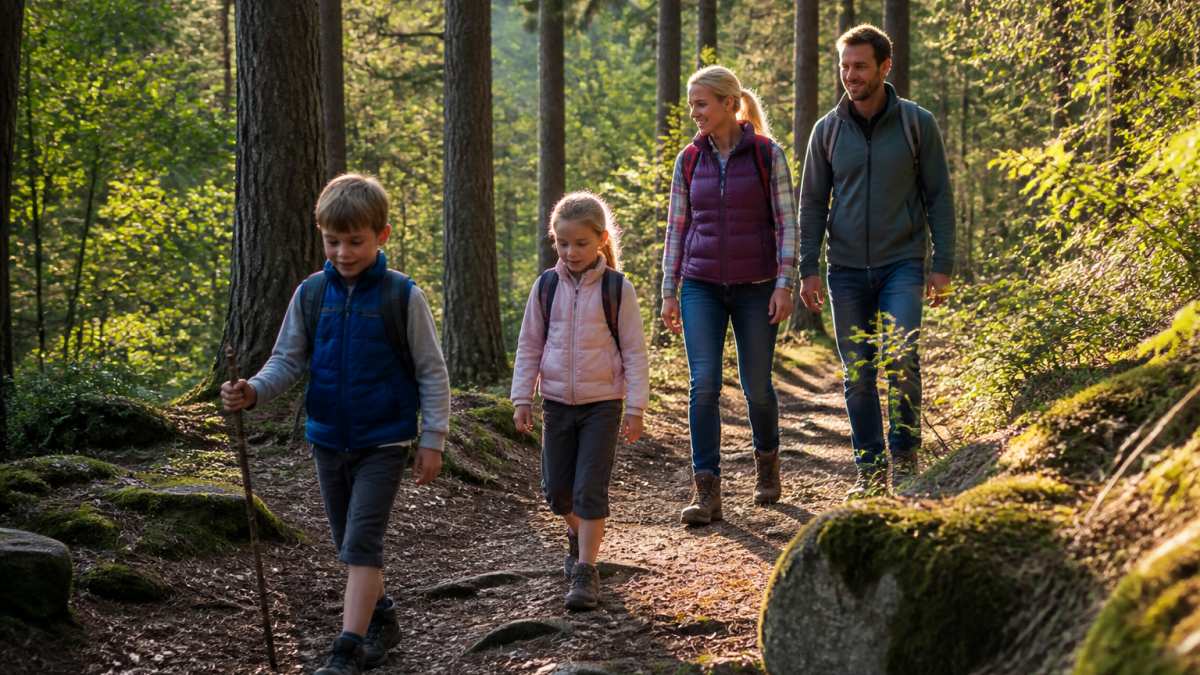
A weekend works best with a loose framework. Two nights, two outings, and plenty of time in between. If you arrive on Friday evening and leave on Sunday at noon, you’ll have two full days. The difference from other guides: Here you’ll find ready-made itineraries with durations, sequences, and breaks that you can follow right away.
The itinerary: two nights, two excursions
If you plan more than two outings per weekend, you’ll spend most of your time in the car. The towns in the region are far apart, even though the individual trips are short. So here’s the rule: one outing per day, plus short walks around your lodging.
Day 1: Arrive and Settle In
Friday, starting at 4 p.m.
- Arrival in the late afternoon, not in the evening
- Unpack it, set it down for a moment, and don't do anything
- A walk in the area, 20 to 30 minutes, with no specific destination
- Dinner at home, go to bed early
The first evening sets the tone for Saturday. If you don't arrive until 9 p.m., you'll start the only full day of the weekend feeling tired.
Day 2: Saturday is the highlight of the weekend
Morning, 9 a.m. to 12 p.m.
- A two- to three-hour hike on a marked loop trail
- A break about halfway through, lasting 15 to 20 minutes, with no specific goal
- No second long walk in the morning
Noon, 12:00 p.m. to 2:00 p.m.
- Eating at the lodging or in town
- Make a point of setting aside an hour without any plans
Afternoon, 2:00 to 5:00 p.m.
- A lake or a lookout point—no need to go a long way
- Keep the commute short—preferably under 20 minutes
- Spend an hour by the water or at the lookout, then head back
Evening, starting at 5 p.m.
- Stop doing anything
- If you want to cook, cook. If you want to eat out, go early.
Saturday sets the tone for the weekend. If you pack it too full, you’ll miss out on rest. If you keep it low-key, you’ll still have energy on Sunday.
Day 3: A Relaxing Finale
Sunday, 8 a.m. to 11 a.m.
- A short, one-hour loop hike or a visit to the local market
- Do not set a new destination
- Then pack up and leave
Anyone who plans to visit another major attraction on Sunday will arrive home feeling stressed. The last morning should be spent relaxing, not sightseeing.
Travel and Local Transportation
The easiest way to get there is by car. From Vienna, the drive takes about one and a half to two hours, depending on your destination. Public transportation serves the larger towns, but for some of the more remote natural sites, you’ll usually need a car or a bike.
Here’s what you need to know: The distances between destinations are short, but the towns are far apart. An e-bike is therefore a good option if you’re planning longer trips. If you’d rather not ride, it’s best to plan one outing per day and stay close to your lodging.
A simple rule of thumb can help with planning: Travel time and walking time combined should not exceed four hours per day. Anything more than that takes away from your rest.
Breaks and Alternatives in Case of Rain
Every daily schedule needs a backup plan in case of rain. Dividing the day into three blocks has proven to be effective:
- A quick look outside: a 30-minute walk, even in a light drizzle
- Go straight through inside: an hour at the lodging, reading, cooking, relaxing
- Optional for outdoor use: a second short walk in the late afternoon, when the sky clears up
If you view your home merely as a place to sleep, you’ll miss out on your most important retreat on rainy days. An apartment with an open-concept kitchen and separate bedrooms can make even a rainy day bearable.
If you plan to arrive late in the evening, you'll often find that kitchens in smaller towns are no longer open. Plan to arrive in the afternoon, or bring something to eat with you.
Hiking and Long-Distance Hiking: Exercise That Helps You Relax
Hiking in the Waldviertel is mostly gentle. There are hardly any steep climbs, but plenty of long, winding trails through forests and fields. This makes the region well-suited even for people who aren't in great shape.
For a relaxing day, it's the distance that counts, not the difficulty. An eight-kilometer hike on flat terrain is relaxing. An eight-kilometer hike with constant ups and downs is tiring.
Here's how to choose the right path:
- Circular routes are better than round-trip routes because you don't have to plan a return trip
- Two to three hours enough for a morning, including breaks
- Marked Hiking Trails save you the trouble of a long search
- Long-distance hiking It's only worth it if you stay overnight; otherwise, it'll be a hassle.
If you want to go on a long-distance hike, it’s best to plan two to three stages with fixed accommodations. A daypack is enough; leave your luggage at the apartment. That way, the hike remains enjoyable and your back stays free of strain.
A common mistake: planning your first hike to be too long. By the second day, you'll already be tired. Start with a shorter hike than you planned.
Mindfulness, Meditation, and Slowing Down in the Waldviertel Region
Slowing down doesn’t require courses or an app. It requires time without tasks and a place where nothing is happening. The region offers the perfect setting for this because it’s quiet and has few distractions. The difference from other guides: This isn’t about mindfulness as a concept, but about the practical question of where, when, and for how long.
Finding Quiet Places: Three Characteristics Rather Than Chance
If you're looking for a truly quiet place, you can filter by three criteria instead of hoping for luck:
- No through traffic: Trails that end at a dead end, a parking lot, or a lookout point are quieter than loop trails that connect two locations.
- Not a culinary highlight: Wherever there's a cabin with a kitchen, there's almost always activity. Anyone looking for peace and quiet deliberately avoids these spots.
- No cell phone reception as a sign of quality: In lower-lying valley areas and in some marshlands, reception is weak. This isn't a drawback—it's an advantage if you want your digital break to remain peaceful.
A tried-and-true routine: head to the same bench, the same rock, or the same clearing every morning and sit there for ten to twenty minutes. Over time, the place becomes an anchor, and your mind winds down more quickly because the surroundings are familiar.
Taking Breaks the Right Way: The 20-20 Rule
Many visitors plan their breaks too late and too short. A simple rule of thumb: after about twenty minutes of walking, take twenty minutes to just wander aimlessly. No walking further, no taking photos, no checking the time. If you follow this rule twice in the morning, you’ll return feeling more relaxed than if you’d stuck to a tightly scheduled itinerary.
The order is important: take a break first, then decide what to do next. If you decide first and then take a break, you’ll already be planning your next move during the break and won’t be able to relax.
Putting a Digital Break into Practice
Taking a digital break doesn't mean leaving your cell phone at home. It means setting ground rules in advance. Here are three recommended options:
- Fixed windows: The cell phone stays in the backpack during the morning activity; only the map is allowed. It will be available again in the afternoon.
- Airplane Mode Instead of Turning Off: If you're using the device as a camera or a map, just turn off the connection. That takes the pressure off about missing something.
- One device for everyone: Families take one cell phone with them; the rest stay at the lodging. This immediately reduces the number of interruptions.
If you go for a walk through town in the evening with no particular destination in mind, you should leave your cell phone at home. Then the path is no longer a path leading to a destination, but simply a path.
A Day at a Leisurely Pace
Here's what a day looks like when you consciously take it slow:
- Early: Stand by the open window for ten minutes and listen, without doing anything
- Morning: A hike without headphones, with two breaks following the 20-20 rule
- Lunch: Eating without reading or using the phone
- Afternoon: an hour in a quiet place where nothing else is going on
- Evening: A walk with no destination, and then no plans for the rest of the day
That doesn't sound like much. That's exactly the point. If you fill your day with experiences, by evening you'll have seen more and noticed less.
Relaxation doesn't come from having more experiences, but from having fewer stimuli. If you plan one goal, two intentional breaks, and a digital break each day, you'll return feeling more relaxed than if you had a packed schedule.
Vacation Rental in the Waldviertel: What to Consider When Choosing One
When choosing a vacation rental in the Waldviertel, you should base your decision on your daily routine, not on the photos. If you cook in the evening, you’ll need a real kitchen. If you’re traveling with children, you’ll need space for them to play. If you’re looking for peace and quiet, you’ll need a location away from the street.
These points make all the difference in everyday life:
- Location: Short trips to nature destinations save time every day
- Kitchen: A kitchen-diner makes preparing breakfast and dinner a breeze
- Bedroom: Separate rooms help families with different bedtimes
- Supervision: An on-site contact person who is available can resolve problems more quickly than a hotline
- Reservation: Booking directly with the hosts makes reservations and arrangements easy
On rainy days, your home is an important place. If you don't have a place to relax there, you'll feel restless. An apartment with an open-concept kitchen and separate bedrooms makes even a rainy day bearable.
Ferienwohnungen Gutenbrunn offers four apartments, each with a kitchen-dining area and bedrooms. Personal attention from Anna and Herbert is part of the concept: When you arrive, you’ll receive recommendations for the region—not just a key.
| Criterion | What to Look For | Why It Matters |
|---|---|---|
| Location | Close to hiking trails and lakes | Shorter trips, more time at the destination |
| Kitchen | Fully equipped kitchen-dining area | Flexible breakfast and dinner options |
| Rooms | Separate bedrooms | Different bedtimes are possible |
| Support | On-site contact person | Quick Help with Questions |
| Reservation | Directly with the hosts | Clear agreements, no middleman |
Accessible Vacation Rental in the Waldviertel: Vacations for Everyone
In practical terms, an accessible vacation rental in the Waldviertel means: no steps at the entrance, wide doors, and a bathroom that can be used with a wheelchair. These are exactly the factors that determine whether a trip is possible or not.
Many accommodations advertise accessibility, but in practice, they don’t always live up to their promises. That’s why it’s worth asking specific questions before booking. These questions will help clarify things:
- Are there any steps at the entrance or inside?
- How wide are the doors?
- Is the bathroom wheelchair-accessible?
- Is there level-access entry to the apartment?
- Are the main paths in the area paved?
If you answer these five questions in advance, you’ll avoid the most common disappointment. At Ferienwohnungen Gutenbrunn, the apartments are barrier-free and wheelchair-accessible. This isn’t just an added feature—it’s the foundation that ensures all guests enjoy the same relaxing getaway.
This is also an advantage for families with strollers. Level entrances and wide doors are just as helpful there.
Season, Weather, and Practical Preparations
Every season in the Waldviertel has its own unique charm. Summer is warm and dry, ideal for lakes and long evenings outdoors. Fall brings crisp air and quiet trails. Winter is cold and often snowy, with short days. Spring is changeable, but green and peaceful.
Your choice of season should align with your personal goals:
- Summer: Swimming, biking, long evenings
- Fall: Hiking, photography, peaceful trails
- Winter: short walks, a warm apartment, early evenings
- Spring: Observe nature, stay flexible
When preparing for your trip, keep in mind that the weather in the Waldviertel can change quickly. Be sure to pack a rain jacket, sturdy shoes, and a warm layer. If you’re traveling with children, it’s best to have a Plan B for rainy days.
It’s also worth checking opening hours in advance. Some nature sites, adventure tours, and guided tours have seasonal hours or can only be booked on certain days. A quick look at the provider’s website will save you a wasted trip.
Weather and Climate Data for Lower Austria
Common Mistakes to Avoid During a Relaxing Getaway in the Waldviertel
The most common mistake is overbooking your schedule. If you plan to visit four destinations in a single day, you'll spend the whole day in the car. The region is quiet, but the towns are far apart.
Other errors that are frequently reported:
- Late arrival: The first night will be short; the first day will be tiring
- Wrong Shoes: Forest trails are often damp; sneakers aren't always enough
- No Plan B if it rains: Without a place to retreat to, the day drags on
- Accessibility not verified: The problem then becomes apparent on site
- Too many trips in a short period of time: There is no sign of a recovery
If you see your home merely as a place to sleep, you’re missing out on your most important retreat. On rainy days and long evenings, your home determines just how relaxing your days are.
The solution is simple. One goal in the morning, one goal in the afternoon, and some rest in between. If you stick to this, you'll come back feeling refreshed.
Conclusion: Recovery starts with proper planning
A relaxing stay in the Waldviertel isn’t about a packed schedule, but rather the right balance of activity and rest. If you plan for two to three days, choose one or two destinations per day, and make sure to take intentional breaks, you’ll return feeling relaxed.
The choice of accommodations plays a key role. At Ferienwohnungen Gutenbrunn, families, wheelchair users, and dog owners will find a peaceful retreat with personalized service, fully equipped kitchen-living rooms, and a location close to the region’s natural highlights. Those who book directly with Anna and Herbert skip the middlemen and receive recommendations tailored to their specific trip.
Plan your next getaway with Ferienwohnungen Gutenbrunn and enjoy some peaceful days free from the pressure of deadlines.
Frequently Asked Questions
How many days should you plan for a relaxing stay in the Waldviertel?
For a truly relaxing stay, we recommend at least two to three nights. A long weekend is enough to combine two day trips, a hike, and a quiet day by the lake. If you want to slow down even more, plan four to five days and intentionally leave some time for spontaneous breaks. That way, you’ll have enough time for mindfulness and exercise without letting your schedule become a burden.
Which destinations in the Waldviertel are ideal for a relaxing getaway?
Nature parks, raised bogs, and the numerous loop trails off the main roads are particularly peaceful. Lakes and reservoirs are ideal for picnic breaks, while waterfalls and gorges are perfect for short, refreshing walks. Many of these destinations in the Waldviertel can be easily combined with a leisurely stop for refreshments. If you’re traveling with children, choose shorter loop trails and allow plenty of time to explore the local flora and fauna.
What should I look for when choosing a vacation rental in the Waldviertel?
Pay attention to the actual layout: an open-concept kitchen, separate bedrooms, and enough space for the whole family. For wheelchair users, step-free access, wide doors, and an accessible shower are essential. Dog owners should check in advance whether pets are welcome and where suitable walking trails begin. On-site assistance is helpful if questions about local attractions or opening hours come up at the last minute.
What activities are available in the Waldviertel when the weather is bad?
When it rains, guided tours of museums and exhibitions, visits to local producers with tastings, or a quiet day at the vacation rental reading and cooking are all worthwhile options. Many guided tours take place even in overcast weather. On days like these, make a point of planning some downtime instead of forcing yourself to go on outings. That way, your stay remains relaxed, and you don’t lose sight of mindfulness.


Comments are closed, but trackbacks and pingbacks are open.