


Last updated: November 2, 2026
Quick Overview
It’s best to rent assistive devices for vacations with children who require care from a local provider in your vacation destination so you don’t have to transport heavy equipment such as nursing beds and patient lifts. Before booking, clarify your needs, door widths, and available space in your accommodations, and have the equipment, dimensions, and delivery date confirmed in writing.
- Determine your needs separately for day and night before you book.
- Measure the narrowest door in your apartment instead of guessing its width.
- Schedule delivery for the day before your arrival, not on the day of your arrival.
- Be sure to ask the rental company specifically whether the orientation is included in the price.
- Ask for written confirmation of the return on the day of departure.
Table of Contents
- Why Renting Assistive Devices Makes Sense for Vacations with Children Who Need Care
- Care Supplies for Vacation: What You Really Need
- Renting a Wheelchair for Vacation: Check Dimensions, Models, and Accessibility
- Renting a Nursing Bed for Vacation: Sleeping Surface, Side Rails, and Space Requirements
- Checklist for Vacationing with a Child with a Disability: From Booking to Check-out
- A Seven-Step Process: From Needs Assessment to Return
- Keep track of rental costs, security deposits, delivery fees, and insurance
- Health Insurance, Long-Term Care Insurance, and Reimbursement for Rental Equipment
- Contingency Plan in Case of Failure, Delayed Delivery, or Unsuitable Equipment
- Coordinating Accommodations and Rentals: What Hosts Should Clarify in Advance
- Frequently Asked Questions
Why Renting Assistive Devices Makes Sense for Vacations with Children Who Need Care
If you want to rent assistive devices for a vacation with children who require care, you’ll save yourself one major hassle: having to transport heavy equipment. A nursing bed and a patient lift are heavy pieces of equipment that you wouldn’t want to take with you without good reason. Hauling this load in a car or on a train is neither practical nor gentle on the child.
Who Rent assistive devices from local providers at your vacation destination, it doesn't have to transport it over long distances.
Another point: The apartment must be suitable for the equipment. A nursing bed requires space on both long sides. A wheelchair requires wide doorways. If you take care of this in advance, you’ll avoid any surprises.
Care Supplies for Vacation: What You Really Need
Care aids for vacation include all devices that ensure a child’s care at the vacation destination. These include a care bed, wheelchair, patient lift, toilet aids, and positioning aids. Not all of these need to be brought along.
The trick is in choosing the right amount. Too little gear means stress. Too much gear means a packed car and limited space to move around in your apartment.
Needs Assessment Before Booking
If you figure out what you need early on, things will be easier later.
Here's how we approach needs assessment:
- Movement: Can the child sit, stand, or turn on their own?
- Transfer: How does the child get from the bed to the wheelchair? Is a lift needed?
- Night: Does your child roll over in their sleep? If so, they need side rails.
- Restroom: Is a toilet chair enough, or do you need a shower chair?
- Duration: Two weeks require more planning than four days.
A common mistake: Parents only plan for the day. Then, at night, they realize that the travel crib is too narrow.
Renting a Wheelchair for Vacation: Check Dimensions, Models, and Accessibility
Anyone who wants to rent a wheelchair for vacation should start by considering three measurements: seat width, overall width, and turning radius. These measurements determine whether the wheelchair will fit through the apartment door and whether the child will be able to move around inside the apartment.
You should compare the overall width of a wheelchair with the door widths in the accommodation before booking. It may sound like there’s enough space, but it can get cramped if the door doesn’t open all the way, a door panel is in the way, or the frame of a bathroom entrance is narrower than the room door.
Ask the rental company about:
- Foldable or rigid? Foldable models fit in almost any car.
- Weight: A model weighing less than 15 kilograms can be loaded by one person.
- Drive: Self-propelled or manual wheelchair?
- Accessories: Footrests, brakes, seat cushions, and possibly an auxiliary drive.
What many people overlook: the path from the parking lot to the apartment. Gravel, steps, or a steep ramp can turn a short distance into an obstacle. So be sure to check not only the apartment, but also the entrance to the building and the route to your next destination.
A handy checklist for posting entries:
- Door widths: Have the narrowest door in the apartment measured; don't just guess.
- Turning radius: Is there enough space to turn around in the bedroom or bathroom?
- Flooring: Carpet increases rolling resistance; a smooth floor is better.
- Thresholds: Are there any openings between rooms or leading to the patio?
- Transfer: How does the child get from the wheelchair to bed or to the bathroom? Does he or she need a lift for that?
- Electricity: If an auxiliary electric drive is used, is there an outlet within reach?
Attention: Don't rely on the term „accessible“ in the description. Ask for specific measurements and have the narrowest passageway and the number of steps confirmed in writing.
You can use the instructions to determine whether the doors and steps in the living space are suitable for the nursing bed and wheelchair. Accessible Accommodations: Check Doors and Steps Check them off one by one.
Renting a Nursing Bed for Vacation: Sleeping Surface, Side Rails, and Space Requirements
Renting a nursing bed for your vacation means you’ll get a bed with an adjustable headrest, side rails, and often a low entry height. For children, the most important thing is protection against falling out of bed.
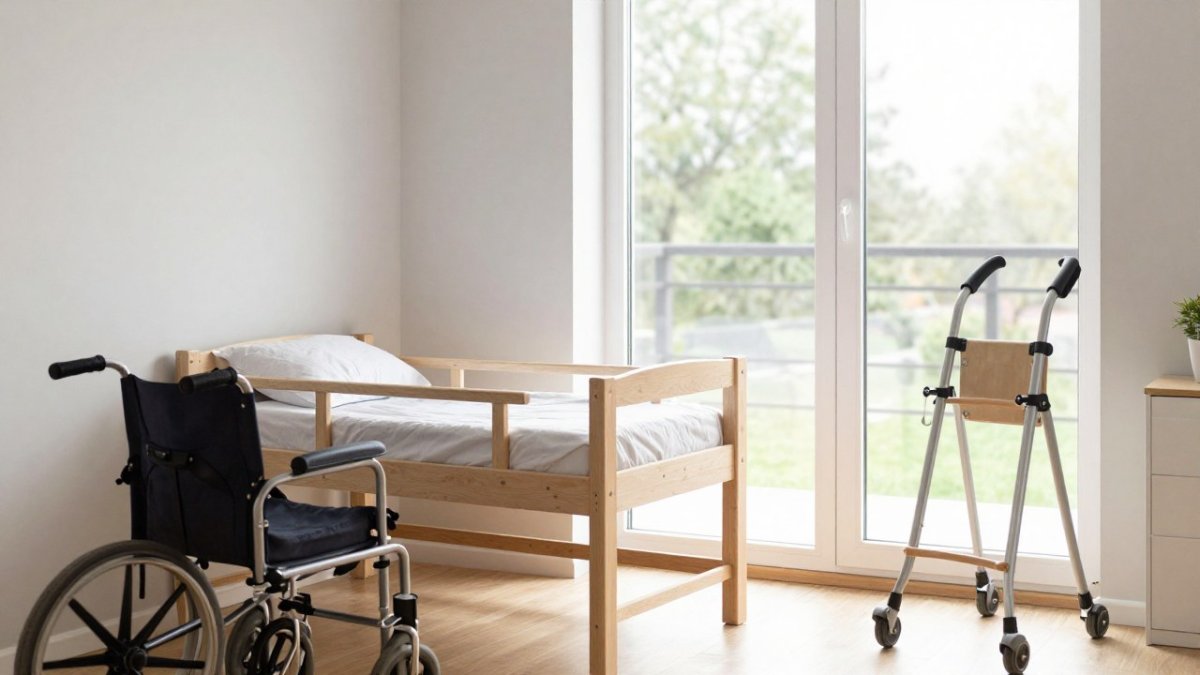
It is important to leave enough space on the long sides. You should check with the provider for the exact dimensions before booking.
Before booking, please check the following:
- Side protection: Fixed or fold-down? Fold-down is better for transport.
- Height: Can the bed be lowered to wheelchair height?
- Place: Will the bed fit next to the second bed in the room?
- Floor: Is it on a hard surface or on carpet?
You can use the step-by-step guide to accessible accommodations—"Doors and Steps"—to check whether the doors and steps in the accommodation are suitable for a hospital bed and wheelchair.
Checklist for Vacationing with a Child with a Disability: From Booking to Check-out
A checklist for vacations with a child with a disability helps prevent most problems because it addresses issues before you book, rather than waiting until you arrive. We’ve divided it into four phases.
Before booking:
- Record daily and nightly needs separately
- Ask about accommodations based on door width and steps
- Search for rental locations in the region
- Confirm the delivery date and pickup date
When booking:
- Have the devices confirmed in writing
- Coordinate the delivery address and access to the apartment
- Ask about the security deposit and insurance
- Write down the contact person's name and phone number
Before your arrival:
- Send the equipment list to the lodging
- Save the rental company's emergency contact information
- Check medications and first-aid supplies
Upon departure:
- Check devices for damage
- Have the return confirmed
- Request a Refund of the Security Deposit
If you're looking for suitable, accessible accommodations for the whole family, you can find the criteria and booking information on the website Book accessible vacation rentals for large families.
A Seven-Step Process: From Needs Assessment to Return
The process consists of seven steps. If you follow them in this order, you’ll encounter few surprises at your vacation destination.
- Record the needs. For each day, make a note of which devices are needed.
- Check accommodations. Ask about door widths, steps, and space in the bedroom.
- Select a rental store. Are you looking for a service provider in the vacation region?.
- Confirm devices. Please have the model, dimensions, and delivery date provided in writing.
- Coordinate delivery. Determine who will be on site to receive and train the new employees.
- Check on site. Test the side guards, brakes, and lift on the first day.
- Returns. Check the devices and have the return confirmed.
You can plan your entire trip with a wheelchair on the website Planning a Family Vacation with a Wheelchair: Step by Step go through.
| Step | Time | Common Mistake |
|---|---|---|
| Record needs | 8 weeks in advance | Thinking Only of the Day |
| Check Accommodations | 6 weeks in advance | Door width not specified |
| Select a rental store | 4 weeks in advance | Requested too late |
| Confirm Devices | 3 weeks earlier | Only verbally agreed to |
| Coordinate Delivery | 1 week in advance | Access not clarified |
| Check on site | Arrival Day | Tested only at night |
| Returns | Day of Departure | No confirmation |
Keep track of rental costs, security deposits, delivery fees, and insurance
Rental costs for assistive devices almost never consist of a single amount. If you only compare the weekly price, you can easily overlook the additional costs. The total cost often consists of several items, such as rental, delivery, a security deposit, and, if applicable, cleaning. By weighing the individual items against one another, you can better assess which Everyday Aids justify the effort while on vacation.
That's why it's a good idea to create a simple cost breakdown before booking and have each provider answer the same questions:
- Base rent: Is there a weekly rate instead of a daily rate? What is the minimum rental period for that rate to apply?
- Delivery and Pickup: Flat rate or per kilometer? Is the travel to the location included?
- Security deposit: How much is it, when is it due, and when and in what form will it be repaid?
- Insurance: What is covered (theft, breakage, damage during transport) and what is specifically not covered?
- Cleaning: Is a final cleaning required, and is it charged even for short-term rentals?
- Damage: What is the policy regarding scratches, broken parts, or wear and tear?
- Instructions: Is on-site training included or is there a fee?
Attention: Never compare just the rental price. Two offers with similar base rents can differ significantly in terms of delivery fees, security deposits, and cleaning costs, so always request a detailed breakdown for the specific rental period.
A second point concerns the type of contract. Get written confirmation of which devices will be delivered and their dimensions, who is responsible for setup and training, and by when the equipment must be returned. When it comes to lifts, training isn’t a luxury—it’s a safety measure: Be sure to ask explicitly whether it’s included in the price or billed separately.
Also, check whether the rental company offers liability coverage or its own insurance, and whether you have personal liability insurance that covers rented equipment at your vacation destination. It’s best to clarify this before your trip, not when you return the equipment.
Health Insurance, Long-Term Care Insurance, and Reimbursement for Rental Equipment
Whether health insurance or long-term care insurance covers the rent depends on the individual case. There is no general guarantee. If you want to be on the safe side, check this before making a reservation.
Parents often find the process of applying for assistive devices stressful. It’s therefore a good idea to clarify these matters well in advance of the trip.
Here's how to do it:
- Call ahead. Check with your health insurance provider to see if the cost of rental equipment is covered while you're on vacation.
- Have it confirmed in writing. Verbal information is rarely sufficient later on.
- Collect receipts. Keep your lease, invoice, and proof of payment.
- Provide a justification. Why is the device necessary at the vacation destination? A brief doctor's note will help.
- Be sure to meet the deadlines. Submit applications before your trip, not after.
Planning a vacation for families with children who require care means considering accommodations, support, and assistive devices as a whole. Ask them what financial assistance is available for your situation.
Contingency Plan in Case of Failure, Delayed Delivery, or Unsuitable Equipment
An emergency plan is part of travel planning. Three things can go wrong: the device arrives late, it's defective, or it doesn't fit.
A buffer helps prevent late deliveries. Schedule the delivery for the day before your arrival, not on the day of arrival.
Here's a tip to help you in case of an emergency: Save the rental company's emergency contact number and the number for your lodging. You should also have both written down on paper.
A photo can help identify an unsuitable piece of equipment. Take pictures while setting it up and send them to the rental company right away. That way, you'll have documentation of what's wrong.
Other things you should prepare:
- Replacement contact for the first day
- Tool for minor adjustments to the wheelchair
- Cell phone number the contact person at the lodging facility
- List using equipment available on site
You can find out how to plan a stress-free and hassle-free trip with a wheelchair on the page How to Plan a Stress-Free Trip with a Wheelchair.
Coordinating Accommodations and Rentals: What Hosts Should Clarify in Advance
The host and the rental company should talk to each other before the guest arrives. That may sound like extra work, but it saves both sides a lot of trouble.
Before placing an order for assistive devices, it’s a good idea to clarify three things: what devices will be delivered, who will receive them, and how the delivery person will gain access to the apartment.
What hosts should clarify:
- Access: Are there steps at the entrance? Where can a van pull up?
- Door widths: Will the hospital bed and wheelchair fit through all the doors?
- Electricity: Does a lift need a power outlet within reach?
- Floor: Carpet or hard floor in the bedroom?
- Contact: Who can be reached on the day of arrival?
What guests should provide in return: a short list of the items, the child's measurements, and the desired delivery date.
This coordination is the key factor that determines whether most trips go smoothly or fall apart. If you take it seriously, you're in for a relaxing vacation.
Planning a vacation with a child who requires care takes time and careful planning. That’s exactly where we come in: The accessible vacation rentals at Ferienwohnungen Gutenbrunn offer space for the whole family, a kitchen-dining area, and a quiet location in the Waldviertel region. For information regarding nursing beds, wheelchairs, or patient lifts, please contact the property directly to inquire about availability.
Frequently Asked Questions
What types of assistive devices can you rent for a vacation with a child who needs care?
Typical rental equipment includes nursing beds with side rails, wheelchairs and rehab strollers, patient lifts, positioning aids, toilet aids, shower stools, and medical devices. The best choice depends on the care needs, the space available in the accommodation, and the travel situation. Before making a reservation, check the child’s height and weight, as well as the accessibility of the apartment. Some of the equipment can also be rented from local providers at your vacation destination, which eliminates the need for transportation.
How far in advance should I reserve assistive devices for my vacation?
Make your reservation as early as possible, as soon as your accommodations and travel dates are set. During peak season, nursing beds, patient lifts, and special wheelchairs are often in short supply. Allow extra time to confirm measurements, delivery, and return. Clarify in writing in advance who will set up and demonstrate the use of the equipment and how pickup will be handled on the last day, so that there are no gaps in care on the day of arrival.
What information does a rental company need to provide the right assistive device?
Please provide the child’s age and weight, care needs, required lying surface or seat width, and the exact travel dates. It is also important to include the address of the lodging, the floor level, and access details (elevator, door width, steps), as well as the desired delivery and pickup dates. Please let us know if on-site training is necessary. Providing complete information helps prevent the delivery of an unsuitable device or gaps in care at your vacation destination.
How can I tell if a vacation rental is suitable for a child who needs care?
Ask about door widths, steps at the entrance, a walk-in shower, and space for a nursing bed. Ask for a detailed description of the accessibility features—don’t just settle for a vague confirmation. Find out if there’s an elevator and whether the patient lift can fit through the doors. Also, ask how you can reach the hosts if problems arise. A place to stay that provides open information and answers questions is a good sign of reliable support.



Comments are closed, but trackbacks and pingbacks are open.