



Quick Overview
There is no single law governing accessible vacation accommodations in Austria; rather, accessibility is governed by a combination of European law, federal law, and the building codes of the federal states. Guests should rely on measured values when evaluating accessibility information and not simply trust labels such as „wheelchair accessible.“ The ÖNORM B 1600 standard is frequently used as a benchmark, but it is not a regulation in the strict sense.
- There is no single regulation; European law, federal law, and state building codes are all intertwined.
- Statements such as „wheelchair accessible“ are of little value without specific measurements.
- ÖNORM B 1600 is frequently used as a benchmark by government agencies, planners, and courts.
- Guests often have no clear legal right to certain benefits, which is why written confirmations are important.
- A documented inspection by a qualified person provides a verifiable basis.
Table of Contents
- Why Accessible Vacation Rentals Are Legally Significant
- Legal Foundations and the Legal Framework in Austria
- Overview of Accessibility Requirements for Vacation Rentals
- Understanding ÖNORM B 1600: Accessible Construction
- The EU's European Accessibility Act and Its Implementation
- The Lack of Legal Rights for Travelers and What That Means
- Checklist for Landlords: Verify Legal Certainty
- Accessible Accommodations: Wheelchair Checklist for Guests
- Grants, Certifications, and Experts to Provide Support
- Plan the Next Steps for Your Accessible Accommodations
- Frequently Asked Questions
Why Accessible Vacation Rentals Are Legally Significant
Accessible vacation rentals are no longer a niche topic. This group travels, books vacation rentals, and expects the accessibility information to be accurate. This guide explains which legal standards apply in this context.
Anyone who offers accommodations has a responsibility. Marketing claims such as „fully accessible“ are not just empty phrases; they are statements that guests rely on. Anyone who makes such claims should know what they are basing them on.
Accessibility refers to the design of buildings, products, and services in such a way that they can be used without assistance from others and without undue difficulty.
The term sounds technical, but in everyday life it means: a door that a wheelchair can pass through, a bathroom where you don’t have to climb over a high tub, and information that you can understand even if you can’t see or hear.
Legal Foundations and the Legal Framework in Austria
There is no single regulation that governs all aspects of lodging in Austria. Several levels of law interplay: European law, federal law, and the building codes of the federal states. In the Waldviertel region, therefore, the laws of the federal state of Lower Austria apply.
The concept of “reasonable accommodations” is particularly important for hosts. The European Union Agency for Fundamental Rights defines them as necessary and appropriate modifications that do not impose a disproportionate burden Reasonable Accommodations for People with Disabilities. In other words: Not every renovation project is reasonable, but a reasonable assessment is.
There is an important exemption for existing buildings. Before undertaking any renovations, you should have a professional assess whether retroactive modifications are necessary in your specific case.
Overview of Accessibility Requirements for Vacation Rentals
The requirements for an accessible vacation rental can be organized by area. The following shows which doors, steps, and thresholds should be specifically inspected: This post about doors and steps In detail. It is crucial that the values are not estimated, but rather measured and documented. The following points provide an overview of typical requirements; in individual cases, state building codes and funding conditions may stipulate different or additional requirements.
Access and Directions
- Barrier-free access to houses and apartments is an important requirement for guests with limited mobility.
- Adequately large maneuvering spaces in front of doors allow a wheelchair to turn around.
- House and apartment doors that are wide enough make it easier to use a wheelchair.
- Transitions that are as free of thresholds as possible improve usability.
Living Space
- Adequate space between pieces of furniture makes it easier to move around with assistive devices.
- A suitable bed height and clear space next to the bed make it easier to get in and out of bed.
- Controls placed at an easily accessible height make the device easier to use.
Bathroom
- A walk-in shower makes it easier to get in.
- Grab bars and sufficient space around the toilet help users use it independently.
- A wheelchair-accessible sink makes it easier to use for wheelchair users.
Outdoor Area and Directions
- A parking space that is wide enough makes it easier to get out of the car.
- A ramp leading from the parking space to the entrance makes access easier.
A description such as „wheelchair accessible“ is of little value without specific measurements. Anyone who hasn’t taken the measurements themselves should ask for specific details before booking, and as a host, you should record the measured dimensions in writing in the amenities list.
For guests with limited mobility: Before booking, be sure to ask for the specific measurements—don’t just rely on the label. Landlords who document these measurements create a clear basis for providing accurate information to guests.
The most important requirements for an accessible vacation rental can be organized by category, and the relevant measurements should be recorded and documented.
| Area | Requirement | Benefits for Guests |
|---|---|---|
| Access and Directions | Barrier-free access to houses and apartments | Makes it easier for people with limited mobility to use |
| Access and Directions | House and apartment doors that are wide enough | Allows access for wheelchairs |
| Living Space | Adequate space for movement between pieces of furniture | Facilitates movement with assistive devices |
| Living Space | Appropriate bed height and clear space next to the bed | Makes getting in and out easier |
| Bathroom | Walk-in shower | Makes access easier |
| Bathroom | Grab bars and clear space around the toilet | Supports independent use |
| Bathroom | Wheelchair-accessible sink | Makes it easier to use with a wheelchair |
| Outdoor Area and Directions | Spacious parking space and a step-free path to the entrance | Makes getting out and getting in easier |
Understanding ÖNORM B 1600: Accessible Construction
ÖNORM B 1600 is an Austrian standard for accessible construction. A standard is not a regulation in the strict sense, but it is frequently used as a benchmark by government agencies, planners, and courts.
For landlords, this means that those who comply with the standard will be better able to prove, in the event of a dispute, that they acted with due care. Those who are familiar with the standard also know exactly what dimensions are meant when the term „wheelchair-accessible“ is used.
The EU's European Accessibility Act and Its Implementation
The European Accessibility Act (EAA) is an EU directive that establishes uniform requirements for products and services across the EU to promote the inclusion of people with disabilities European Accessibility Act.
The exact implementation into Austrian law should be examined on a case-by-case basis.
The Lack of Legal Rights for Travelers and What That Means
Many guests assume they have a legal right to accessible accommodations. That is often not the case. The legal framework is incomplete, and that is precisely why transparency is so important.
For guests, this means: You should ask for written confirmation of accessibility details and not rely solely on photos or descriptions. For hosts, this means: A clear, honest description helps prevent disappointment and disputes.
A real-life example: A guest in a wheelchair arrives and discovers that the shower has a threshold. Without a written confirmation, it then becomes a case of one person’s word against another’s. A detailed list of measurements prevents this from happening.
Checklist for Landlords: Verify Legal Certainty
These points will help you systematically check your own living situation:
- Are all entrances accessible via steps or a ramp?
- Have door widths and passageways been measured and documented?
- Is the bathroom equipped with a walk-in shower and grab bars?
- Are the controls installed at a convenient height?
- Do the details on the booking portal match reality?
- Has an inspection been conducted by a qualified person?
- Is there written documentation of the current status?
A detailed list of features for accessible vacation rentals helps you compare them to your own property. A complete Checklist for Accessible Vacation Rentals is available for comparison. Anyone who is unsure should seek advice from an expert before making statements such as „fully accessible.“.
Accessible Accommodations: Wheelchair Checklist for Guests
Guests who use wheelchairs should clarify the following points before booking:
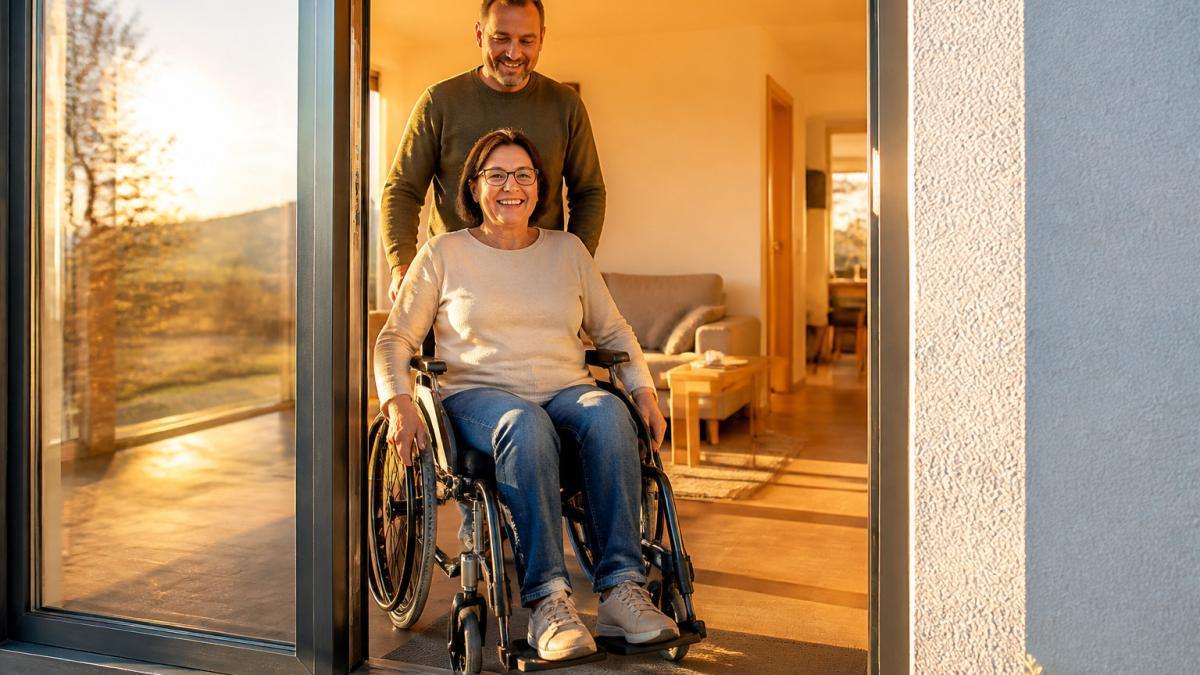
- Width of the front door and the apartment door
- Bed Height and Space Next to the Bed
- Accessibility of the pool and location of the shower
- Whether a parking space is located right at the entrance
- What resources are available on site
That last point, in particular, is often overlooked. Anyone who needs an assistive device for their vacation should check well in advance to see if it can be rented at their destination. On the page Assistive Device Rental for Your Vacation in a Vacation Rental Find out where you can borrow assistive devices.
Grants, Certifications, and Experts to Provide Support
Most guides on this topic focus solely on the legal aspects. For landlords, however, the key issue is how to finance an accessible renovation and provide external proof of it. Three strategies can help: grants, certification systems, and experts.
Grants for Accessibility Renovations
There are primarily three levels to consider for financing:
- State Housing Assistance: The requirements vary by state, so it’s worth checking the current funding guidelines issued by the relevant agency.
- Nationwide Programs: There are nationwide funding programs whose eligibility depends on the project and should be assessed before submitting an application.
- Local and regional grants: Some municipalities and tourism associations offer incentives for adapting vacation rentals; you should check with local authorities for the specific requirements.
Grant amounts and conditions change annually. Before beginning the renovation, review the current grant guidelines from the relevant agency and obtain written confirmation of the grant award before awarding any contracts.
Certification Systems as a Guide for Guests
Certifications provide guests with a reliable basis for making reservations. In Austria, the following systems are particularly common:
- ÖNORM B 1600: The standard itself is not a certificate, but it is used by experts as a benchmark and forms the basis for many certifications.
- Regional Tourism Certifications: Some individual tourism regions and associations award their own accessibility certifications; the criteria should be reviewed on a case-by-case basis.
The advantage of certification lies not only in the seal but also in a standardized examination.
Role of Experts
Experts conduct an independent inspection of the property and document its current condition. They are particularly useful when
- a renovation is planned and the existing building is to be inspected for compliance with the requirements of ÖNORM B 1600,
- if certification is being sought,
- or, in the event of a dispute, proof of the condition at the time of booking is required.
The cost of an on-site inspection depends on the scope and complexity of the property; it is advisable to obtain a binding quote in advance.
Those who combine grants, certification, and an expert inspection gain threefold assurance: financial relief, reliable information to provide to guests, and evidence in the event of a dispute.
Plan the Next Steps for Your Accessible Accommodations
Anyone planning or operating an accessible lodging facility should start by conducting an honest assessment of the current situation. This should be followed by a site inspection, documentation, and clear information in the booking description.
The apartments at Ferienwohnungen Gutenbrunn in the Waldviertel are designed for families, wheelchair users, and dog owners. The hosts, Anna and Herbert, are available to answer any questions you may have before your arrival.
Frequently Asked Questions
What legal requirements apply to accessible vacation rentals?
There is no uniform requirement for vacation rentals in Austria to make every unit fully accessible. The relevant state building codes, corporate law, and the provisions of the European Accessibility Act—which covers certain digital services and products—are the governing factors. Anyone who promises accessibility should formulate the information precisely and document the actual condition of the property. Individual legal advice from an expert or a specialized agency provides additional assurance in this regard.
Which Austrian standards address accessible construction?
The primary standard for accessible construction in Austria is ÖNORM B 1600. It outlines requirements for pathways, doors, circulation areas, restrooms, and wayfinding. For accommodations, it serves as an important guideline, even though it does not automatically make compliance mandatory for every vacation rental. Landlords often use the standard as a benchmark to ensure that information regarding accessibility is verifiable.
How can I check if a vacation rental is wheelchair-accessible?
Check door widths, barrier-free access, the amount of space to move around in the bathroom, the height of the sink and bed, and whether switches and windows are within reach. Ask the landlord specifically for measurements and request photos of the relevant areas. A checklist can help you compare the details. If in doubt, it’s a good idea to call before booking to clarify any outstanding issues directly.
What information about accessibility should a lodging facility provide?
Reputable providers list specific features rather than making general promises: step-free access, minimum door widths, bathroom amenities, and the location of parking spaces. They should also specify any restrictions that apply. Clear descriptions reduce misunderstandings and protect both guests and hosts from disappointment.



Comments are closed, but trackbacks and pingbacks are open.