



Table of Contents
- Wheelchair-Accessible Nature Experiences: What Makes Them Special
- Accessible Tourist Attractions in Lower Austria
- Wheelchair-Accessible Hiking Trails in Lower Austria
- GARTEN TULLN: Plan an Accessible Visit
- A Practical Checklist for Accessible Outings
- Travel and Local Transportation
- Balancing Family Needs and Wheelchair Accessibility
- Conclusion: Enjoying Nature for Everyone
- Frequently Asked Questions
Last updated: October 17, 2026
Wheelchair-Accessible Nature Experiences: What Makes Them Special
Wheelchair-Accessible Nature Experiences For families, these aren’t just hiking trails without steps. They are carefully designed experiences that allow people with varying mobility needs to truly connect with nature. At Ferienwohnungen Gutenbrunn, we understand that a truly accessible outing goes far beyond technical requirements—it’s about the freedom to enjoy moments in nature together.
The difference between simply being accessible and truly being wheelchair-accessible lies in the details. A wide path is a start. But a stable surface, regular rest stops, and authentic local dining options make the difference between a strenuous trip and a relaxing nature experience.
Differences Between "Barrier-Free," "Low-Barrier," and "Wheelchair-Accessible"
These terms are often confused, but they mean very different things when it comes to your travel experience.
Barrier-free means that there are no physical barriers. No steps, no curbs, no narrow doorways. This is the minimum legal standard. An accessible restroom meets specific space requirements. An accessible ramp has a specified slope.
Accessible is less challenging. There may be a small step or slightly uneven ground. Many people in wheelchairs can handle this, but not everyone. An accessible hiking trail might have gravel paths or gentle inclines.
Wheelchair accessible is the practical reality for wheelchair users. A wheelchair-accessible path isn’t just barrier-free—it’s also truly usable. That means: a stable surface, sufficient width to turn around, rest areas every 500 to 1,000 meters, and restaurants with wheelchair-accessible entrances.
For families with children and people who use wheelchairs, this makes a big practical difference. An accessible path might work in theory. A wheelchair-accessible path actually works—without detours, without frustration, and without anyone arriving exhausted.
What Families Should Look for When Making a Choice
Before you plan a trip, you should check the following:
- Road Conditions: Asphalt or a paved surface is ideal. Gravel or crushed stone require significantly more effort to roll on.
- Gradient: Even small inclines add up. A trail with a 3 % incline over 2 kilometers is exhausting.
- Rest areas: Where can you take a break? Are there benches, restrooms, and water?
- Dining: A café or restaurant with wheelchair-accessible entry makes the difference between a half-day outing and a full day out.
- Weather and Season: Wet paths become slippery. Snow makes wheelchair-accessible paths unusable.
- Accompanying Persons: Does the wheelchair user need assistance? Are caregivers welcome at your lodging?
Accessible Tourist Attractions in Lower Austria
The region offers more wheelchair-accessible nature activities than many families realize. What matters is not so much the mere existence of such destinations as whether they are suitable for one’s own family in a wheelchair, strollers, and various support needs. The following examples show what to look for when making your selection—and what information you should check in advance.
Nature parks with wheelchair-accessible entry
Several nature parks have made targeted efforts to expand their infrastructure in recent years. Many parks offer loop trails that have been specifically designed for wheelchair users. These trails are not only technically accessible but also lead past some of nature’s most stunning sights—along lakes, through forests, and to overlooks with rest areas.
For families, it’s important that a loop trail has a clear starting and ending point and doesn’t require you to retrace your steps. Look for the following information, which a good nature park will publish or provide upon request:
- Path width: At least 1.5 meters, preferably 2 meters, for passing people with strollers
- Gradient: A maximum of 3 to 5 percent; for longer sections, it's better to keep it below that
- Background: Asphalt or paved surfaces; gravel and crushed stone significantly increase rolling resistance
- Length: A distance of 2 to 5 kilometers is ideal for a half-day family outing
- Rest areas: Benches or picnic tables within sight, ideally every 500 to 1,000 meters
- Restrooms: accessible restroom at the starting point or in the park
Check for current conditions before your visit. Trails may be temporarily impassable after rain or snowfall. Many parks post up-to-date accessibility information online or provide it by phone.
Gardens and Themed Gardens for Everyone
Gardens are often the most relaxing choice for families with wheelchair users. The distances are short, the atmosphere is peaceful, and there are often places to sit. A good garden offers:
- Wide, flat paths for rolling
- accessible restrooms
- Seating available every 100 to 200 meters
- a café or restaurant with wheelchair-accessible entry
- Clear signage and information on accessibility
Many gardens also offer guided tours, workshops, or sensory experiences. This makes a visit more than just a stroll and provides variety for children. Ask in advance whether these programs are also suitable for wheelchair users and whether an accompanying person is required.
Specific examples and what they mean for families
The TULLN GARDEN is one of the region’s best-known accessible tourist destinations. The main paths are wide and level, with regular rest areas, clear signage, and on-site dining options. The grounds are large enough for a half-day to a full day; there’s no set route, so you can explore parts of it and come back later. You can find information about accessibility and mobility on the garden’s website; if you have specific questions, it’s worth giving them a call, as the staff is up to date on the current situation.
Other nature parks and gardens in the region are worth checking out. Pay attention to whether a destination is labeled as „barrier-free,“ „low-barrier,“ or „wheelchair-accessible“—these terms mean different things and should not be used interchangeably. A quick phone call to inquire about path width, slope, and restroom facilities is more helpful than relying on online reviews, which may be out of date.
Visit gardens and parks outside of peak season. Fewer visitors mean more peace and quiet, easier parking, and fewer crowds on the paths.
Suitability Based on Wheelchair Type and Support Needs
Not every wheelchair-accessible path is suitable for every wheelchair. A manual wheelchair requires a stable, level surface and as little incline as possible; an electric wheelchair can handle slightly steeper inclines but needs sufficient turning space and good drainage to prevent the tires from spinning. Families should clarify the following in advance:
- What type of wheelchair is used?
- Is there someone with you who can push or assist?
- Are there any sections that can only be navigated with assistance?
- Are rest areas located in such a way that children can also take breaks there?
These questions can usually be answered by calling the tourism office or contacting the destination directly. If you know the answers before you arrive, you’ll avoid disappointment once you’re there.
Wheelchair-Accessible Hiking Trails in Lower Austria
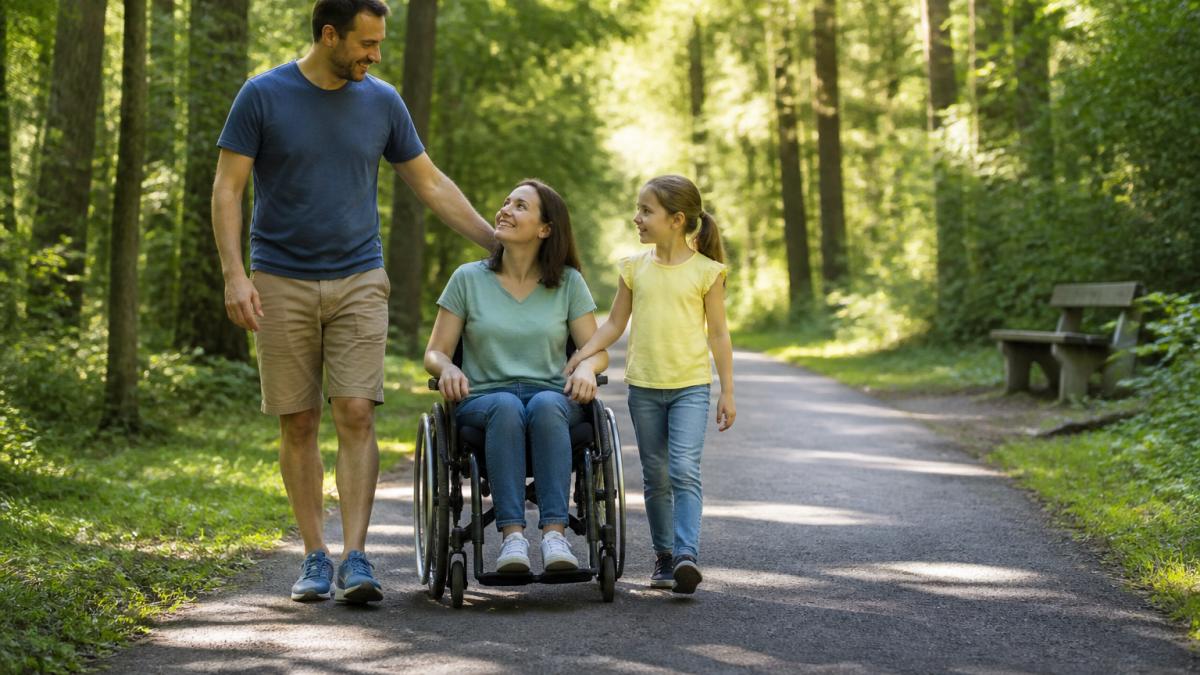
Hiking in a wheelchair is possible if the trail is truly suitable. A wheelchair-accessible hiking trail isn’t simply a regular trail without steps, but one that’s designed with rolling resistance, incline, turning radius, and the need for breaks in mind. For families, there’s the added consideration that children need variety and short stretches—even a technically suitable trail can still be exhausting if it’s monotonous.
Flat, circular trails with solid footing
The best routes for wheelchair users are loop trails with a clear starting point and endpoint. An ideal wheelchair-accessible loop trail has the following characteristics:
- Asphalt or paved surface: No gravel paths, no crushed stone
- Maximum gradient of 3 to 5 percent: All of this gets tiring over longer stretches
- Minimum width: 1.5 meters: Better to make it 2 meters wide so that strollers and wheelchairs can pass each other
- No sharp turns: Tight turns are difficult to navigate in a wheelchair
- Good drainage: The path should dry quickly after it rains
Many of these trails are between 2 and 5 kilometers long. That’s a good length for a half-day family outing. Longer trails are possible, but they require more strength and endurance—and more breaks. Check the current trail conditions before your outing. A call to the local tourism office or the nature park will provide you with up-to-date information that an online description cannot.
Trails with rest areas and dining options
The difference between a trail that is technically wheelchair-accessible and a truly enjoyable nature experience often lies in the rest areas. A good rest area has:
- a sturdy bench or a picnic table
- a trash can
- Ideally, shade from a tree or a shelter
- a beautiful view or a view of nature
Even better is a rest area with a café or restaurant nearby. That turns a walk into a real outing: take a break, eat, enjoy the view, and keep going. Several wheelchair-accessible paths lead to restaurants. Check in advance to make sure the restaurant is truly wheelchair-accessible—not just the patio, but also the restrooms and the entrance to the building.
Seasonal and weather-related conditions
A path that works well during a dry summer may become slippery or soggy after rain. Snow renders many wheelchair-accessible paths unusable, and fallen leaves can also make the surface slippery. For families, this means:
- Spring and Fall: Paths may remain damp longer after rain; check the drainage.
- Summer: The early morning hours are cooler and quieter; be sure to bring sunscreen and water.
- Winter: Many paths have been cleared, but not all of them; please check the conditions in advance.
Many parks and tourism associations publish seasonal advisories. If you stay flexible and have a Plan B, you can avoid long drives to a trail that’s closed.
Family Logistics: Children, Breaks, and Restrooms
For families with wheelchair users and children, it's not just the route that matters, but the entire daily routine. Keep the following in mind:
- Ways to play: A playground at the start or a nature discovery spot along the way offers children a change of pace.
- Changing rooms and restrooms: Accessible restrooms are important; changing stations make life easier when you have small children.
- Strollers: If you're bringing a stroller, the path should be wide enough and free of steps.
- Breaks: Plan breaks before everyone gets exhausted—not only when it becomes necessary.
- Age-appropriate activities: Short routes with interesting stops along the way (viewpoints, water, wildlife viewing) work better than long, straight stretches.
Don't rely solely on online reviews. A review from six months ago might be out of date. Call directly and ask about current conditions, trail width, incline, and restrooms.
Pre-trip Checklist
A quick checklist before you arrive will save you a lot of time once you're there:
- Checked the website for the latest accessibility information
- Asked over the phone about the trail's width, gradient, and surface
- Parking Situation and Accessible Parking Spaces Clarified
- Survey on Accessible Restrooms at the Start and Along the Route
- Restaurants Checked for Wheelchair Accessibility
- Weather and seasonal conditions taken into account
- Accompanying Persons and Support Needs Taken Into Account
- Plan B Prepared for Rain or Road Closures
If you take care of these details in advance, you'll be able to enjoy the outing more fully—and truly experience nature together as a family.
GARTEN TULLN: Plan an Accessible Visit
The GARTEN TULLN is one of the best-known accessible tourist destinations in the region. The garden demonstrates how accessibility and the experience of nature can go hand in hand.
The garden features well-designed, wheelchair-accessible paths. The main paths are wide and level. There are rest areas at regular intervals. The signage is clear. And there are actual dining options on site.
Plan to spend half a day to a full day there. The garden is large enough to spend several hours exploring. You can visit parts of it and come back later—there’s no set route.
Information about accessibility and mobility is available on the garden's website. Please call before your visit if you have any specific questions. The staff is familiar with the current situation and can provide you with practical advice.
GARTEN TULLN is a good example of how Accessible tourist destinations should look like. Not just technically accessible—but truly inviting and enjoyable.
A Practical Checklist for Accessible Outings
Good preparation makes all the difference between a stressful trip and a relaxing one. This checklist will help you make sure you don't forget anything.
Before the trip: What You Should Check
Do these things before your trip:
- Call us or visit our website. Check for the latest information on accessibility.
- Ask about the exact condition of the road. „Asphalt“ and „paved“ are not the same thing.
- Check to see where you can park. Is the parking lot close to the trailhead?
- Ask about rest stops and restrooms. Where are they? How often are they located?
- Find out more about restaurants. Are they really wheelchair-accessible?
- Check the weather. What are the conditions like? Could it get slippery after it rains?
- Plan your visit for a specific time of day. Early morning means fewer visitors.
During Your Trip: Tips for Relaxing Days
During the trip itself:
- Make sure you leave with plenty of time. Don't rush. Enjoy the experience of nature.
- Take regular breaks. Not just when you're exhausted—but to enjoy the scenery.
- Bring water and snacks with you. There aren't restaurants everywhere.
- Wear sunscreen and insect repellent. Being outdoors also means dealing with the sun and insects.
- Be flexible. If a path turns out to be harder than expected, it's okay to turn back.
The best outing isn't the longest or most strenuous one—it's the one where everyone can relax and enjoy nature.
Travel and Local Transportation
Getting there is often the first source of stress on a trip. Good planning makes it easier.
Check the travel options:
- By car: Is the parking lot close to the destination? Are there accessible parking spaces?
- By public transportation: Are the bus stops wheelchair-accessible? Do you need assistance getting on and off the bus?
- By train: Train stations often have elevators and ramps. Check in advance.
Here are some things you should know while you're there:
- Where is the wheelchair-accessible parking space?
- Is there a shuttle from the parking lot to the trailhead?
- Are companions welcome, and can they come along for free?
Many accessible tourist destinations provide information about accessibility on their websites. Please call if you have any questions.
Balancing Family Needs and Wheelchair Accessibility
Families with wheelchair users have specific needs. A good destination takes everyone into account.
Children need:
- Variety. A 5-kilometer straight path is boring.
- Recess and playgrounds. Not everywhere, but on a regular basis.
- Dining. Kids get hungry.
- Toilets. Especially important for younger children.
Wheelchair users need:
- Stable, level paths
- Rest areas
- Accessible Restrooms
- No unexpected inclines or obstacles
A good destination for families with wheelchair users has both. It has short, interesting trails. It has rest areas with scenic views. It has places to eat. And it has accessible restrooms.
Many tourist attractions in Lower Austria offer exactly that. The challenge is to find them and check them out.
Conclusion: Enjoying Nature for Everyone
Wheelchair-accessible nature experiences for families are not impossible—they just require good planning and the right information. Lower Austria offers more options than many people realize. From accessible gardens to wheelchair-accessible hiking trails—there are authentic nature experiences for everyone.
The key is preparation. Check accessibility and mobility options in advance. Give them a call. Ask questions. And choose destinations that aren't just technically accessible, but are truly designed for families with wheelchair users.
At Ferienwohnungen Gutenbrunn, we understand that a great vacation starts with good planning. Our accessible vacation rentals are an ideal base for wheelchair-accessible excursions in the region. With personalized assistance from Anna & Herbert and a central location near nature parks and hiking trails, you can relax and enjoy planning your excursions. Contact us directly to learn more about our wheelchair-accessible accommodations and the best nearby attractions.
A relaxing family vacation needs good accommodations as a base. At Ferienwohnungen Gutenbrunn, you’ll find accessible apartments with personalized service, a central location for excursions, and the peace and quiet you need to truly unwind. Book directly with us and experience a nature-filled vacation that works for everyone.
| Type of Attraction | Ideal for | Road Conditions | Rest areas |
|---|---|---|---|
| Nature Park Loop Trail | Wheelchair users, families | Asphalt, paved | 3–5 each way |
| Themed Garden | Families, All Types of Mobility | Flat Paths | Many benches |
| Walking Trail | Short Trips | Asphalt | Regularly |
| Hiking Trail | Active wheelchair users | Stable, level | Few, but they do exist |
External resources on accessible excursions:
According to Austrian accessibility standards, wheelchair-accessible paths should be at least 1.5 meters wide and have a maximum gradient of 6 %.
Information about the Accessibility of Nature Parks in Lower Austria can be found on the website of the State of Lower Austria.
GARTEN TULLN provides detailed information about accessibility on its website and is happy to answer specific questions about accessibility.
Frequently Asked Questions
What wheelchair-accessible nature experiences are suitable for families with young children?
Flat, circular trails with a stable surface, rest areas, and scenic overlooks are particularly suitable. Nature parks often offer shorter, well-maintained trails. It’s important to have accessible restroom facilities and dining options nearby. Many families opt for combined outings: short routes for wheelchair users, play areas for children, and breaks by lakes or in gardens.
What is the difference between "barrier-free," "low-barrier," and "wheelchair-accessible"?
"Barrier-free" means complete accessibility without restrictions—level paths, no steps, wide doors. "Low-barrier" allows for minor unevenness or short inclines but is still easily navigable. Wheelchair-accessible is specifically designed for wheelchair users: sufficient width, stable surfaces, and turning spaces. For family nature outings, “low-barrier” is often sufficient if the route is short and the ground is firm.
Is DIE GARTEN TULLN truly accessible for wheelchair users?
GARTEN TULLN offers barrier-free access and paths through the themed gardens. Visitors in wheelchairs can access most areas. There are accessible restroom facilities and rest areas. Before visiting, it is recommended that you contact the facility to obtain up-to-date information on trail conditions and seasonal adjustments.
How do I properly plan a wheelchair-accessible family outing in nature?
Check the trail conditions, elevation gain, and length in advance—many nature parks provide detailed descriptions. Check for accessible parking, restroom facilities, and rest areas. Plan for breaks, especially when traveling with children. Check the opening hours of restaurants and cafes. In case of bad weather, check how the ground conditions will be. A checklist prepared in advance will help ensure you don’t forget anything.


Comments are closed, but trackbacks and pingbacks are open.