


Table of Contents
- What makes an accessible vacation rental truly wheelchair-accessible?
- Accessible Accommodations Checklist: Specific Dimensions and Features
- Wheelchair-Accessible Bathroom in a Vacation Rental: What You Should Check
- Accessible Travel and Mobility on Site
- Ask the Right Questions Before Booking
- Accessible Tourist Attractions in the Waldviertel Region
- Differences Between Certified Accessibility and Self-Declaration
- Book Directly Instead of Through Platforms: Benefits for Wheelchair Users
- Common Misconceptions About Accessible Vacation Rentals
- Conclusion: Independent, barrier-free vacations
- Frequently Asked Questions
Last updated: October 10, 2026
What makes an accessible vacation rental truly wheelchair-accessible?
A truly accessible vacation rental isn't just a place to stay with a few ramps and wide doors. We understand that wheelchair-accessible vacation rentals in the Waldviertel mean: Thoughtful design in every room, measurable distances that actually work, and features that give you complete freedom of movement.
First things first: Many accommodations advertise accessibility even though they only meet a few specific criteria. A truly wheelchair-accessible vacation rental in the Waldviertel region functions as a well-designed system. Access must be step-free, door widths must be adequate, the bathroom must offer enough space to maneuver, and the kitchen must be accessible from a wheelchair.
Here, we’ll show you exactly what to look for when choosing an accessible vacation rental in the Waldviertel—including specific measurements, a handy checklist, and the questions you need to ask before booking.
Most inquiries about accessible vacation rentals arise because guests have had bad experiences in the past. Ask the host if they or a family member has limited mobility. If so, you can be confident that the accommodation is truly accessible—not just on paper.
Accessible Accommodations Checklist: Specific Dimensions and Features
An accessible vacation rental in the Waldviertel region requires specific, measurable standards. Vague promises like „accessible“ won’t help you. Here are the measurements that matter—and how to check them before you book.
Access and Entrance Area
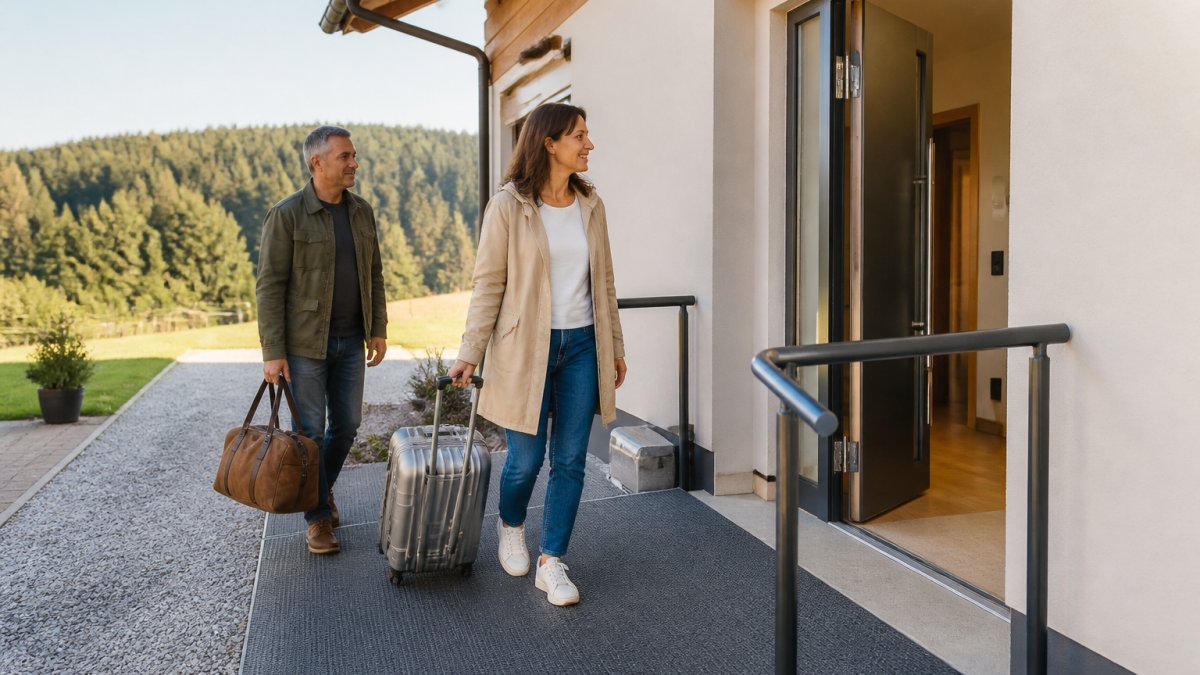
Access to an accessible vacation rental often determines the first impression. A step-free entrance area with a maximum slope of 6 % is standard. The entrance door should be at least 90 cm wide (preferably 100 cm) so that you can comfortably roll through it in a wheelchair. A door opener or a large door handle makes entering much easier.
Also pay attention to the flooring in front of the door. A level, non-slip surface is essential—especially important in the Waldviertel, where wet conditions and fallen leaves are common. Ask if the entrance area is covered. This will protect you from the rain and make access to the accessible vacation rental much more pleasant.
Doors, Hallways, and Freedom of Movement
All interior doors should be at least 85 cm wide—preferably 90 cm. That may not sound like much of a difference, but 5 cm can make the difference between comfort and frustration. Automatic door openers are a big plus, but manual doors with large, easy-to-reach handles work well, too.
Hallways in an accessible vacation rental in the Waldviertel should be at least 150 cm wide so that you can turn around in a wheelchair. In some older homes, this isn’t possible—which is a deal-breaker. Ask for the exact dimensions before you book.
Thresholds are the enemy of a truly accessible vacation rental. Even thresholds as low as 2 cm can be problematic. Wherever rooms adjoin, there should be a level transition—or at least a very gentle ramp (max. 6 % slope).
Bedroom and Living Area
The bedroom in an accessible vacation rental in the Waldviertel must be at least 300 cm × 400 cm so that you can roll your wheelchair next to the bed and transfer to it. The bed should be 50–55 cm high—that’s the standard wheelchair height. Ask the host for the exact bed height.
The living area should have enough space to move around. That means at least 150 cm of clear space between pieces of furniture. An accessible vacation rental in the Waldviertel shouldn’t be cluttered—you need space to live, not just to walk through.
| Area | Minimum size | Ideal | Why It's Important |
|---|---|---|---|
| Front door | 90 cm | 100 cm | Convenient Wheelchair Access |
| Interior Doors | 85 cm | 90 cm | Easy maneuverability |
| Hallway width | 150 cm | 180 cm | Wheelchair users can turn around here |
| Bed height | 45–55 cm | 50–55 cm | Transferring from a Wheelchair |
| Bedroom Floor Space | 300×400 cm | 350 × 450 cm | Freedom of Movement |
| Flooring | Exactly, slip-resistant | Non-slip surface | Safety and Control |
Wheelchair-Accessible Bathroom in a Vacation Rental: What You Should Check
The bathroom is often the bottleneck of an accessible vacation rental in the Waldviertel region. A poorly planned bathroom can ruin an entire vacation. Here are the key points to consider.
Shower and Bathtub
A wheelchair-accessible shower must be at ground level—no steps, no thresholds. The shower area should be at least 150 cm × 150 cm so that you can roll your wheelchair right in.
Grab bars are essential. At least two sturdy grab bars (Ø 3–4 cm) should be installed on the sides of the shower.
A removable showerhead with a long hose is a big plus. This allows you to adjust the shower to suit your needs. The temperature control should be simple and reliable—no one wants to be caught off guard by water that’s too hot or too cold while on vacation.
Toilet and sink
The toilet should be 45–50 cm high (standard height with a raised seat). You’ll need at least 70 cm of free space next to the toilet to transfer from a wheelchair. This is non-negotiable—without this space, the toilet is practically unusable.
Grab bars next to the toilet are important. They should be sturdy and mounted at a height of about 75 cm. Many inexpensive grab bars aren't sturdy enough—ask about the quality and how they're mounted.
The sink should be wheelchair-accessible, with at least 67 cm of knee clearance underneath. The faucet should be operable with one hand or the elbow (single-handle faucets are ideal). A mirror cabinet at a reachable height (max. 100–110 cm) is practical but not required.
Although many vacation rentals have wheelchair-accessible bathrooms, the grab bars are often mounted too high or aren't sturdy enough. This is dangerous. Always ask where the grab bars are and whether a previous guest in a wheelchair she tested them.
Accessible Travel and Mobility on Site
One Barrier-free vacation apartment It's not much use if you can't get there or aren't able to get around once you're there. The trip there is often underestimated, but it's essential for a relaxing vacation. Here is some specific information and questions you should clarify before booking.
Traveling by Car
Parking at the lodging: That's the most important thing. For some people, a parking spot 50 meters away is out of the question. Ask for a reserved spot right next to the lodging. The ideal options are:
- Level Surface: Asphalt or concrete, not gravel or grass.
- Width: At least 3.5 meters, preferably 4 meters. That will give you enough space to open the door and unload the wheelchair.
- Canopy: In the Waldviertel, the weather can quickly become a problem. A roof will keep you dry in rain and snow.
- Near the front door: A maximum of 10–15 meters. Every additional meter is exhausting.
Ask, „Is there a reserved parking space right next to the lodging? Is it at ground level and covered?“ If the answer is no, ask about alternatives.
Access Road: The path from the parking lot to the lodging should be level. Ask about any slopes or uneven surfaces. A slope steeper than 6 % is problematic.
Traveling by Public Transportation
Train Station: The nearest train station is often the starting point. Ask your host, „Which train station is the closest?”
Important Questions About the Train Station:
- Is there an elevator to the platform?
- Are the entrances at ground level, or are there ramps?
- How long does it take to walk from the platform to the station exit?
ÖBB (Austrian Federal Railways) offers a mobility service. You can request assistance with boarding and exiting the train free of charge. Please book this service at least 24 hours in advance by calling 051 717 (ÖBB Mobility Service) (Mobility Service).
Bus stop: Many bus stops in the Waldviertel are not accessible. The path to the stop may be unpaved, and getting off the bus can be difficult. Ask your host: „Is there a bus stop nearby?”
Taxi or car rental service: This is often the best option. An accessible taxi can take you directly from the train station to your accommodations. Ask your host about local taxi services that accommodate wheelchair users.
Ask: „Is there an accessible taxi service nearby? How long does it take to get from the train station to my lodging?“
Local Mobility
Sidewalks and Paths: The Waldviertel is a rural area. Wide sidewalks and ramps aren't available everywhere. Ask your host:
- „What shops, restaurants, or attractions are within walking distance?“
- „What are the trails like—asphalt, gravel, or forest trails?“
- „Are there any inclines or bumps?“
- „How long does the trip take in a wheelchair?“
A host who can answer these questions has really taken the time to get to know the region.
Estimate distances realistically: A 500-meter trip in a wheelchair takes 10–15 minutes, depending on your strength and the condition of the route. Be sure to allow plenty of time.
Accessible Restrooms on the Go: This is often a problem. Ask your host, „Where are the accessible restrooms nearby? Are they open to the public, or are they only in restaurants?“ Restrooms in restaurants are often available only to diners.
Rental Car with a Wheelchair Ramp: If you want to get around, a rental car with a ramp or lift is an option. It's expensive, but it gives you freedom. Ask your host if they know of a local rental service.
Checklist: Questions to Ask Before Booking
Print out these questions and write them to your host—it’s better to do so in writing than over the phone.
Getting There:
- Which train station is the closest? How far is it from there to the lodging?
- Is there a reserved parking space right next to the accommodation? Is it at ground level and covered?
- What is the path like from the parking lot to the front door?
- Do you know of an accessible taxi service?
On site:
- What shops, restaurants, or attractions are within walking distance?
- What are the trails like—asphalt, gravel, or forest trails?
- Are there any hills? If so, how steep are they?
- Where are the nearest accessible restrooms?
- Which flat paths nearby are accessible by wheelchair?
Many hosts underestimate how important getting there and getting around once you’re there are. They think that accessible accommodations are enough. That’s not true. A vacation is only relaxing if you can get around easily once you’re there.
Ask the Right Questions Before Booking
Here are the questions you should ask the host—before you book. It’s better to ask in writing than over the phone, so you can refer back to the answers later.
Start with a direct question: „Is the accommodation accessible?“ Pay attention to the answer. A “yes” without any details is suspicious.
Ask for measurements: door widths, hallway widths, bed height, and shower area. A reputable host should be able to give you these figures off the top of their head or look them up quickly.
Ask about their experience: „Have you ever hosted guests in wheelchairs?“ If so, ask how it went.
Ask about certification: Has the accessible vacation rental in the Waldviertel region been officially inspected and certified? In Austria, there are standards such as ÖNORM B 1600.
Ask about emergencies: What happens if something breaks? How easy is it to reach the host?
The best accessible vacation rental in the Waldviertel is one where the host or a family member has limited mobility. This ensures that not only are the dimensions right, but also the details that matter in everyday life.
Accessible Tourist Attractions in the Waldviertel Region
A vacation is more than just the accommodations. The Waldviertel offers many options for people who use wheelchairs—but only if you know in advance which paths and places are truly accessible. Many travel guides list attractions without mentioning that access requires navigating stairs or unpaved paths. Here is specific information about popular destinations.
Lake Edlesberg
The lake is a classic destination in the Waldviertel region. Access to the shore is partially accessible, but not throughout the entire area. The parking lot by the lake is level and sufficiently large. The path from the parking lot to the shore is about 200 meters long and mostly at ground level, with a fine gravel surface—accessible to wheelchairs with good suspension, but slippery after rain.
Accessible restrooms are located at the parking lot. Ask the host about the exact hours of operation and whether the restrooms are available in the winter. The path along the shore is not wheelchair-accessible throughout—after about 300 meters, the path becomes narrower and more uneven. Plan for a visit of 1–2 hours, no more.
Ottenstein Castle and Reservoir
The castle is one of the region’s major attractions. The parking lot is wheelchair-accessible and located about 150 meters from the castle. The path is level and paved. The castle itself is partially accessible: the inner courtyard is wheelchair-accessible, and some rooms on the ground floor are accessible. The stairs leading to the upper floors are not wheelchair-accessible.
The reservoir promenade next to the castle is a popular walking route. The path is about 2 kilometers long, mostly flat, and paved. There are several rest areas with benches. Accessible restrooms are located at the castle. The path is easily navigable for wheelchair users, but the surface can become slippery in strong winds or rain.
Museums and Cultural Sites in the Waldviertel
Many smaller museums in the region are housed in older buildings and are not wheelchair-accessible. The Waldviertel Local History Museum, which has locations in several towns, often has stairs or narrow doorways. Please call ahead to check whether access is possible.
Larger cultural venues, such as Greillenstein Castle, have higher standards. The parking lot is accessible, and access to the castle is partially at ground level. Some rooms are wheelchair-accessible, while others are not. Call ahead and ask specific questions: „Can I take my wheelchair into the courtyard?“ and „Which rooms can I visit?“
Restaurants and Cafés
The Waldviertel has many charming restaurants, but not all of them are wheelchair-accessible. Level access is the minimum requirement. Also keep in mind:
- Door width: At least 85 cm, preferably 90 cm. Many older inns have narrower doors.
- Space between tables: At least 120 cm, so you can wheel your wheelchair through. Many restaurants have tight layouts.
- Restrooms: Ask if the restroom is accessible at ground level and if there is a grab bar. Many inns have restrooms in the basement or upstairs.
- Personnel: Friendly staff who are willing to help are invaluable. When making your reservation, ask if the staff has experience with guests who use wheelchairs.
Some restaurants in larger towns, such as Waidhofen an der Thaya, have higher standards. Ask your host for recommendations—he knows the region and can honestly tell you which restaurants are truly accessible.
Forest and farm roads
Hiking is possible everywhere in the Waldviertel. However, many marked hiking trails are not wheelchair-accessible—they have stairs, narrow passages, or steep sections. Forest and field paths are often better: they are wider, flatter, and less steep.
Ask your host about flat paths nearby. A good host knows local forest or field paths that are wheelchair-accessible. The condition of the path is important: A paved path (asphalt or gravel) is better than an unpaved forest path. After rain, unpaved paths can become slippery or muddy.
Plan for realistic distances. A 2-kilometer round trip takes half a day for many wheelchair users. Take your stamina and the need for breaks into account.
Ask the host: „Which nearby paths are wheelchair-accessible?“ and „What is the surface like—asphalt, gravel, or a forest trail?“ A host who can answer these questions has really taken the time to get to know the region.
Differences Between Certified Accessibility and Self-Declaration
Not all accessible vacation rentals are the same. There is a big difference between certified accessibility and a self-declaration by the host.
Verified Accessibility: An independent agency visited the accommodation, took measurements, and issued a certificate. In Austria, there are standards such as ÖNORM B 1600. Certification under this standard sends a strong message.
Self-reporting: The host fills out a form or describes the accommodation as accessible on their own. This can be honest and accurate, but it can also be vague or optimistic. A host who says „the accommodation is accessible“ without providing any details has likely not given the matter much thought.
Ask to see certificates or inspection reports. A good host will be happy to provide them. We understand that trust is important—we’re transparent about the exact amenities in our accessible vacation rentals in the Waldviertel.
Book Directly Instead of Through Platforms: Benefits for Wheelchair Users
Many people book accessible vacation rentals through major online platforms. That's convenient, but it's not always the best solution for specific needs.
When you book directly, you can speak with the host. You can ask questions that aren't answered in a standardized description.
Platforms often have rating systems, but reviews from people who use wheelchairs aren't always available. An accessible vacation rental in the Waldviertel region could have a five-star rating without a single person who uses a wheelchair having tested it.
Booking directly with a reliable host also offers more flexibility. If something goes wrong, you can communicate with them directly. On large platforms, you're often just a ticket number.
At Ferienwohnungen Gutenbrunn, you’ll enjoy personalized service from Anna & Herbert. We know our accessible vacation rentals in the Waldviertel region inside and out and can honestly tell you whether they’re a good fit for your needs.
Common Misconceptions About Accessible Vacation Rentals
Many people have misconceptions about what accessible vacation rentals are. Here are the biggest misconceptions.
Misconception 1: Accessible = simple and spartan. That's not true. An accessible vacation rental in the Waldviertel can be just as comfortable and beautiful as any other.
Misconception 2: One ramp is enough. No. An accessible vacation rental requires a whole system: step-free entrances, wide doors, a functional bathroom, and plenty of space.
Misconception 3: The host knows what "accessible" means. Often not. Many hosts have no experience with wheelchair users. They mean well, but their understanding of accessibility is vague.
Misconception 4: Certification guarantees suitability. Certification under ÖNORM B 1600 is valuable, but it does not take your individual needs into account.
Misconception 5: Accessible vacation rentals are more expensive. That's not always true. Some are more expensive because they come with high-quality features. But accessibility isn't automatically a luxury feature.
People who use wheelchairs and are looking for an independent vacation without compromises, and families who need accommodations where everyone can live comfortably.
Conclusion: Independent, barrier-free vacations
An accessible vacation rental in the Waldviertel region can change your life. Not in a dramatic way—but in a tangible one. A vacation where you don’t have to constantly ask for help, where you can do the things you want to do, and where you don’t feel restricted—that’s priceless.
The checklist in this guide will help you ask the right questions. The specific measurements will give you peace of mind. And the booking tips will help you avoid disappointment.
The Waldviertel is a wonderful region for a vacation. It’s peaceful, close to nature, and full of possibilities. With the right accessible vacation rental in the Waldviertel, you can make the most of it.
Frequently Asked Questions
How can I tell if a vacation rental is truly wheelchair-accessible?
A truly accessible vacation rental has doors at least 1.50 meters wide, threshold-free entrances, an elevator or ramp, wheelchair-accessible bedrooms with enough space to turn around, and an accessible bathroom with a floor-level shower and grab bars. Don’t rely on photos alone: Ask for specific measurements and have details about ramps, door widths, and bathroom amenities confirmed in writing before you book.
What measurements should I ask for when planning a wheelchair-accessible bathroom?
The bathroom should be at least 2.25 meters × 2.25 meters so that you can maneuver your wheelchair in front of the toilet, sink, and shower. The shower must be at floor level, at least 1.50 meters wide, and equipped with grab bars at a height of 85 centimeters. The toilet and sink should be wheelchair-accessible. Ask about the exact layout and whether grab bars are available.
How can I reliably verify the accessibility of an accessible vacation rental before booking?
Request a detailed list of amenities in writing that includes door widths, ramp length and slope, elevator dimensions, and bathroom size. Ask for guest reviews from other wheelchair users. Book directly with the hosts instead of through platforms—that way, you can ask specific questions and get personalized answers from someone who knows the accommodation.
What information should I provide to the accommodation before I arrive?
Please let us know whether you use a manual or motorized wheelchair, how wide it is, whether you need assistance with transfers, and whether you’ll be bringing any special equipment. Please also let us know your arrival time so that your hosts can assist you. The more details you provide, the better your hosts can prepare and ensure your arrival goes smoothly.
Are there accessible tourist attractions for wheelchair users in the Waldviertel region?
Yes, the Waldviertel offers several accessible destinations, such as Lake Edlesberg, which has wheelchair-accessible entry and level paths, as well as various hiking trails with flat sections. Ask your hosts for local tips—they know the region well and can recommend routes suitable for wheelchair users, as well as provide information on the accessibility of parking lots and rest areas.
What is the difference between certified accessibility and a self-declaration?
"Verified accessibility" means that an independent auditor has evaluated and certified the accommodation. "Self-reported information" is based on the hosts' own statements. Certified listings offer greater assurance, but reputable hosts who provide self-reported information can also offer reliable details—especially if they’re easy to reach and answer your questions in detail.
Why is booking directly with accessible vacation rentals better than using booking platforms?
When you book directly, you speak with the hosts themselves, who are familiar with the accommodation and can answer specific questions about accessibility. You’ll receive personalized assistance before, during, and after your arrival. Platforms often have limited information, and your inquiries end up at a call center instead of with someone who can truly help you.
At Ferienwohnungen Gutenbrunn, we have four lovingly furnished, barrier-free vacation apartments that are specially designed for people who use wheelchairs. Our apartments feature step-free access, wheelchair-accessible bathrooms with grab bars, ample space to move around in every room, and personalized assistance from Anna & Herbert. Book directly with us and enjoy a vacation on your own terms in the natural beauty of the Waldviertel—without compromise.
Comments are closed, but trackbacks and pingbacks are open.