


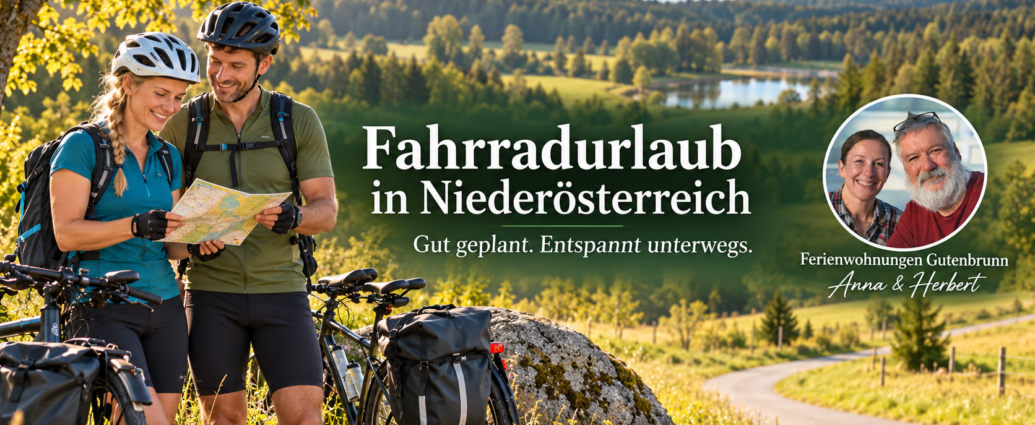
Step 1: Choose the right region and time of year for your cycling vacation in Lower Austria
Anyone planning a cycling vacation in Lower Austria Anyone planning a cycling trip makes the first and most important decision long before setting out: the region and the time of year. Both factors determine how crowded the bike paths will be, how much shade the route offers, and whether the place to stop for a break after a stage will still be open. The Waldviertel lies on a granite plateau, which means: rolling highlands instead of Alpine passes, cool mornings even in midsummer, and plenty of quiet side roads.
The best time of year for leisurely bike rides is between May and September (Cycling in Austria: Inspiration, Routes, and Tips). July and August bring the warmest days, but also the most visitors to the Danube. If you want to avoid the crowds, go in June or early fall. In the Waldviertel region itself, the trails are significantly less crowded year-round than along the major river bike paths.
Waldviertel, the Danube, or the Ybbstal: Which region suits your driving style?
The Waldviertel is the perfect choice for anyone seeking peace and quiet, granite cliffs, ponds, and narrow roads. The Danube offers classic river cycling combined with cultural experiences and a well-developed infrastructure. The Ybbstal Valley combines both: a gentle ride along the river, with views of the foothills of the Alps, and fewer people than along the Danube.
For families with children and cyclists looking for a peaceful base for day trips, the Waldviertel is the more relaxing option. The signage is good, the routes are rarely steep, and you’ll find places to stop for a bite to eat in villages rather than at popular restaurants with long lines.
Step 2: Choose bike trails and routes for your cycling vacation in Lower Austria
It’s best to choose bike routes based on difficulty and stage length, not just on the number of kilometers. A 40-kilometer riverside bike route feels different from a 40-kilometer ride across a plateau with a headwind. So plan each stage based on elevation gain, not just distance.
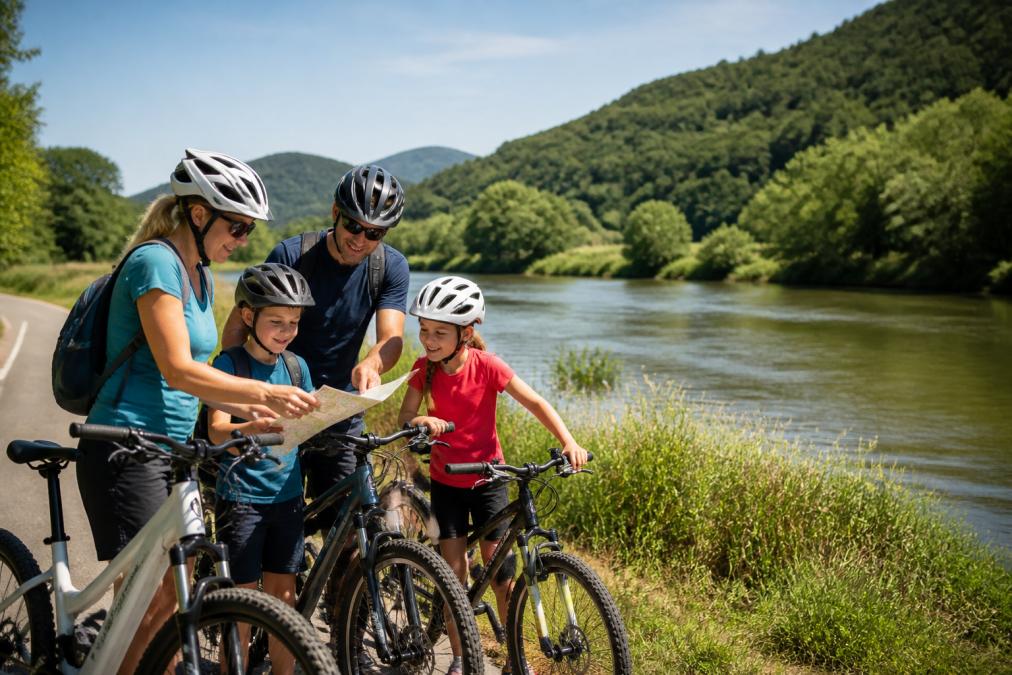
For multi-day trips, there's a simple rule of thumb: 50 to 70 kilometers per day at a leisurely pace, 30 to 45 kilometers when traveling with children (Brochure Details). If you're going on a multi-day tour for the first time, you should make a point of keeping the first stage short.
River bike paths such as the Danube, Kamp, and Ybbs for leisurely rides
River bike paths are the most reliable choice for leisurely cycling. They are mostly flat or gently sloping, follow the water, and thus involve very little elevation gain. The Danube Cycle Path is the best known; the Kamprad Cycle Path winds through forests and wine-growing regions; and the Ybbstal Cycle Path combines gentle climbs with peaceful stretches.
The advantage: You can take a shortcut at any time, because train stations and buses are located along the rivers. The disadvantage: It gets very busy along the Danube during peak season. If you want to combine the river bike paths with the Waldviertel region, use them as a feeder route and then switch to the quieter side roads.
Always plan river bike routes to go downstream. That may sound obvious, but depending on the route, it can save you a noticeable amount of energy, because even a minimal downward slope adds up over hours.
Step 3: Testing E-Bike Rentals in the Waldviertel for Day Trips
A E-Bike Rental A test of day trips in the Waldviertel region shows one thing above all: The quality of the bikes matters more than the price. If you rent a bike locally, you should pay attention to battery capacity, frame height, and whether a second battery or a charger is included for use on the go.
It’s convenient to have a rental location near your lodging. That way, your tour starts right at your doorstep, and returning the equipment doesn’t require an additional transfer. There are several rental locations in the region that offer one-day and multi-day rentals; availability is limited during peak season, so it’s worth making a reservation in advance.
- Check the battery range: 60 to 100 kilometers is typical for day trips
- Please specify the frame height in advance to ensure the bike fits
- A helmet and a lock are part of the basic equipment
- For multi-day trips, ask about charging options at your lodging
The most common mistake when renting e-bikes is waiting until the day of arrival to make a reservation. During peak season, the right frame sizes are often sold out by then, and the group ends up setting off on bikes that don't fit properly.
Step 4: Find the right lodging for your cycling vacation
Your accommodations determine the nature of your entire cycling vacation. A central location shortens the distance to the trails; a lockable room for your bikes takes away your biggest worry at night; and a reliable charging station for e-bike batteries is what makes multi-day tours truly relaxing.
What Cyclists Should Look for When Choosing a Place to Stay
Being bike-friendly means more than just a parking spot. Keep these points in mind before you book:
- Lockable, covered space for all bikes
- Outlet for charging e-bike batteries
- A way to dry wet cycling clothes
- Tool kit or pump for minor repairs
- Location near a bike path or a feeder route
- Breakfast or a kitchen, so you're not dependent on a restaurant to start your day
For vacation rentals Gutenbrunn The four apartments feature a kitchen-dining area and bedrooms, are wheelchair-accessible, and wheelchair accessible Easily accessible and situated in a quiet location in the Waldviertel region. For families, cyclists with a dog ...and for guests with limited mobility, this makes all the difference between a complicated and a relaxed start to the day of cycling.
Step 5: Create a packing list for your cycling vacation
Your packing list for a cycling vacation should be based on the weather, the length of the route, and your accommodations—not on a generic list found online. If you’re traveling in the Waldviertel, you’ll need rain gear and a warm layer, even in the summer.
Basic bike equipment:
- Bicycle helmet and cycling gloves
- Rain jacket and rain pants, breathable
- Two water bottles or a hydration system
- Repair kit, spare inner tube, multi-tool, pump
- Power bank and charger for e-bike batteries and smartphones
- First-aid kit and personal medications
- Sunscreen and Lip Balm
For multi-day tours, additionally:
- Cycling jerseys and cycling shorts to change into
- Casual evening attire for a stop for refreshments
- Detergent for hand washing
- A pannier or saddle bags instead of a backpack
Never pack more than 10 kilograms of luggage for a multi-day trip. You'll notice every extra kilo by the third day, especially on undulating plateaus.
Step 6: Plan logistics for multi-day trips
When it comes to multi-day tours, logistics determine whether the trip remains relaxing or turns into a logistical nightmare. If you sort out your travel arrangements, the order of the stages, luggage transport, and the return trip in advance, all you’ll have to do each day is ride your bike. Most competitors list routes but say nothing about how to put them together into a well-organized week—and that’s precisely the key planning step.
Planning Your Stages: From the Route to the Daily Stage
Don't start with the most scenic route; start with your daily routine. Realistic stage planning involves four steps:
- Set Total Distance, at a leisurely pace, 50 to 70 kilometers per day; with children, 30 to 45 kilometers.
- Check the elevation gain per stage, in the Waldviertel region, undulating plateaus with daily elevation gains of 300 to 600 meters are realistic, while along the Danube, they are often less than 100.
- Mark stage locations with rail access, as an emergency exit in case of a change in weather or a malfunction.
- Shorten the first and last stages, Traveling to and from a destination takes energy that is then lacking in daily planning.
A tried-and-true approach: set the first leg to 60 percent of the planned average distance, ride the middle legs in full, and shorten the last leg back to 70 percent. This leaves a buffer for breakdowns, weather, and a longer stop for refreshments.
Traveling by Train with a Bicycle
Traveling by train is often the easiest option for cycling vacationers because you can get off right at the start of your route and remain flexible about your return trip. It’s important to check in advance whether you can bring your bike: On regional trains, this is usually possible, but on long-distance trains, reservations are typically required and space is limited. Before booking, check whether your chosen connection has bike spaces, and plan to take a train earlier than necessary—missing connections with a bike is much more inconvenient than without one.
If you’re traveling by car, it’s best to park it at your lodging and plan your stops as a loop route. Alternatively, you can take the train or bus for the return trip and leave the car at your destination. For the latter option, it’s a good idea to choose lodging with parking at the starting point and a second lodging with train access at the destination.
Luggage Transport: A Comparison of Three Methods
There are three ways to handle luggage transport, each with its own trade-offs:
- Luggage Transfer Service, your luggage is transported from one accommodation to the next. It's convenient, but you're tied to fixed pickup times and pay per leg of the trip.
- A Solid Foundation with Day Trips, you stay in the same place several times and go on day trips from there. It’s much more affordable and more convenient for families, since no one has to pack every day. Downside: less variety in the routes.
- Carry It Yourself with Saddle Bags, maximum flexibility, but every kilo counts. For multi-day tours across undulating plateaus, this is the most strenuous option.
For most cycling vacationers, a fixed base is the best compromise: two to three nights at each accommodation, day trips in different directions, and no need to worry about daily transfers. This makes planning more flexible because, if the weather is bad, you can simply change direction instead of postponing the stage.
Return Trip and Buffer Time
Don’t plan your return trip for the last day of cycling. Leaving half a day as a buffer between the last leg of the trip and your journey home prevents a mechanical issue, a sudden change in weather, or a missed train from throwing your entire plan off track. If you’re traveling back by train, it’s best to reserve bike spaces at the same time you book your outbound trip; during peak season, they’re often fully booked if reserved later.
Print or save the stage locations, including train stations, and the addresses of your accommodations for offline use. In the Waldviertel, there are areas with poor cell service, and having an offline list of stages is the easiest way to be prepared.
Travel, Luggage Transport, and Public Transportation
Before booking, check whether your chosen lodging is suitable as a fixed base for several day trips. This saves on transportation costs and makes tour planning more flexible. Once you’ve planned out the stages—including elevation gain, train stations, and buffer days—you’ll spend every day just riding your bike, and that’s exactly what sets an organized cycling week apart from a grueling one.
Step 7: Plan a Realistic Budget for Your Bicycle Vacation
The budget for a cycling vacation consists of several items that are easy to underestimate. In addition to lodging and meals, there are e-bike rentals, admission fees, train tickets, and the occasional visit to a bike shop. Instead of fixed prices—which vary depending on the season and provider—it helps to have a budget structure with rough estimates and flexibility.
The Four Budget Categories
Break down the costs into four categories, each with its own adjustment factor:
| Block | Typical order of magnitude | Adjusting screw |
|---|---|---|
| Accommodations | Largest single item, per night and per person | Season, Room Category, Direct Booking |
| Meals | per person per day, depending largely on breakfast | Kitchen-diner, regional shopping, a stop for refreshments |
| Bike and Equipment | per day or multi-day package | Bringing Your Own Bike vs. Renting, Multi-Day Discount |
| Getting There and Activities | per person, one-time fee | Book Train Tickets Early, Combo Tickets |
Accommodations are almost always the biggest expense. Saving money here is where you’ll save the most, but not at any cost: Accommodations without a lockable bike storage area or charging facilities will end up costing you more in stress than in money.
Catering: The Underestimated Item
Food and beverages is the expense category that fluctuates the most. There are three common patterns:
- Breakfast included; lunch and dinner available, convenient, but the most expensive option.
- Kitchen-living room with self-catering facilities, which is significantly cheaper—especially for families—but takes up time in the evening.
- Mix: Breakfast included, packed lunch, dinner at a local restaurant, the usual compromise for cyclists on vacation.
If you're planning a kitchen-diner, you should plan to do your grocery shopping locally the day before. In the Waldviertel, towns are more spread out than along the Danube, and it's not always possible to find a supermarket open in the afternoon.
Bike Rental: Daily Rate or Multi-Day Package
When renting a bike, the multi-day package is almost always worth it. Individual daily rentals add up quickly, while multi-day rates are significantly cheaper per day. If you bring your own bike, you’ll save the entire rental cost, but you’ll have to cover travel and maintenance expenses. For e-bikes, it’s important to clarify battery capacity and the availability of a spare battery before booking; otherwise, the planned distance could become a problem.
Reserve and Unforeseen Costs
Set aside about 10 percent of your total budget as a reserve. Typical unforeseen expenses include repairs, an additional train ticket if you have to cut a stage short, an unplanned overnight stay, or a visit to a repair shop. This reserve isn’t a luxury—it’s a safety net that keeps your trip stress-free even if something breaks down.
When Booking Directly Helps
When it comes to accommodations, it’s worth making a direct inquiry because direct bookings are often more flexible than those made through platforms, and you can clarify special requests—such as a crib, accessible entry, or a charging station for e-bike batteries—right away. This isn’t just about price—it’s what turns a booking into the perfect foundation for your cycling week.
Plan your budget in four categories, set aside a 10 percent reserve, and clarify bike storage, charging options, and meal arrangements before booking. If you take care of these three points in advance, you’ll know your cost structure and won’t have to do the math while you’re on the road.
Step 8: Safety and Emergency Tips for Your Bike Ride
Safety on a bike ride starts with visibility and ends with the emergency number. If you ride during the day, wear bright clothing, and know your route, you’ve already significantly reduced the biggest risk.
- Ride on side streets and bike paths, not on busy state roads
- Wear a helmet, even on short rides
- Before setting out, check your brakes, tire pressure, and battery level
- Be sure to have the emergency number 144 and the address of your lodging with you
- Let someone know which stage you're riding and when you'll be back
- During a thunderstorm: Seek shelter; do not continue driving on open, elevated ground.
In the Waldviertel region, the trails are well-marked, but towns and villages are fewer and farther apart than along the Danube. If you're cycling with children, you should therefore plan for longer stretches without stops and be sure to include breaks for drinking. The European Commission provides additional tips on safe cycling in its Campaign for Sustainable Mobility.
Avoiding Common Mistakes When Planning a Biking Vacation
The most common mistake is overestimating the daily distance. Many people plan the first leg to be as long as the last, even though the journey there already takes a toll on their energy. The second most common cause of stress is staying at a place without proper cycling infrastructure: no lockable room, no charging facilities, and no access to a bike path.
Other common mistakes:
- Booking too late, especially during peak season
- Skip the weather gear because the forecast looks good
- Do not check the e-bike battery for the planned distance
- Do not set aside a reserve for repairs
- Do not coordinate the return trip with the bike transport service
If you take care of these five points in advance, you'll have a much more relaxing time on the tour. The difference between an enjoyable and a grueling week of cycling rarely comes down to the scenery, but rather to how well you prepare.
Planning a Bicycle Vacation in Lower Austria It all comes down to the choice of accommodations. If you’re looking for a quiet place to relax after a strenuous day of hiking, Ferienwohnungen Gutenbrunn offers barrier-free and wheelchair-accessible apartments with personalized service from Anna and Herbert, Vacation with Your Dog and a location that’s just as ideal as a starting point for bike tours in the Waldviertel as it is for rainy days. Book directly with the hosts and start your next bike tour from a place to stay that suits your pace.
Frequently Asked Questions
Which bike trails in the Waldviertel are the most beautiful for a cycling vacation?
In the Waldviertel region, the Kamp-Thaya-March Bike Trail and the Ybbstal Bike Trail are particularly popular. The Kamp-Thaya-March Bike Trail winds through rolling hills and idyllic river valleys, while the Ybbstal Bike Trail stands out for its Alpine foothills and cultural attractions. Both are ideal for multi-day e-bike tours and offer good infrastructure with places to stop for refreshments along the route.
How do I find the right lodging for a cycling vacation in Lower Austria?
Look for bike-friendly accommodations that offer secure parking, tools, and drying facilities. In the Waldviertel region, vacation rentals are ideal because they give you flexibility and allow you to set your own pace. Before booking, check whether the accommodation is close to bike paths and whether luggage transport or e-bike rentals are available nearby. Booking directly with the hosts often ensures the best availability.
Are the bike paths in Lower Austria suitable for e-bikes?
Yes, most bike paths in Lower Austria are perfectly suited for e-bikes. River bike paths like the Danube Bike Path or the Ybbstal Bike Path are flat to slightly hilly, making them ideal for e-bike tours. The Waldviertel region also has well-developed routes with charging stations in many towns. When planning your trip, keep the battery range in mind and plan longer stages with inclines accordingly.
When is the best time to go on a cycling vacation in Lower Austria?
The best time to go on a cycling vacation in Lower Austria is from May through September. During these months, temperatures are mild, the bike paths are in good condition, and the rest stops are open. Early summer offers blooming landscapes, while fall features forests ablaze with color. In the height of summer, you should take advantage of the early morning hours for longer stages to avoid the heat.
Comments are closed, but trackbacks and pingbacks are open.