


Last updated: November 4, 2026
Quick Overview
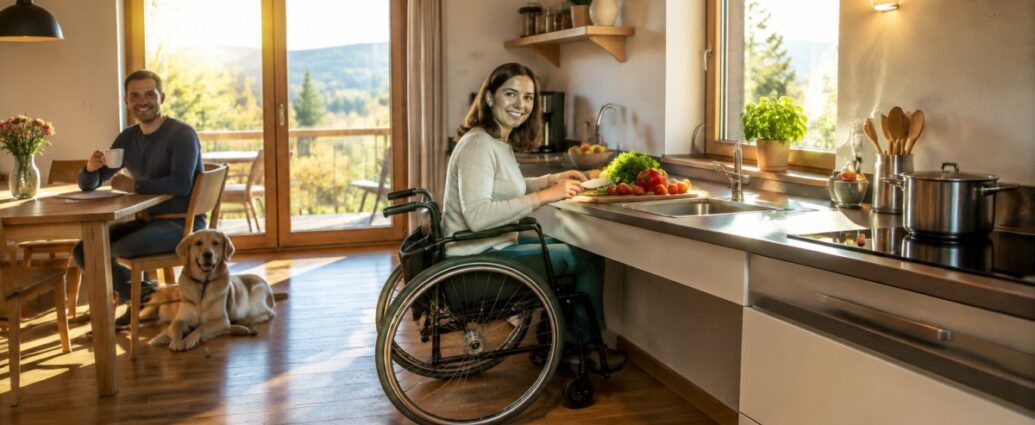
Accessible kitchens in vacation rentals require wheelchair-accessible countertops, height-adjustable units, and sufficient space to move around so that guests with limited mobility can cook without assistance. According to the BORA guide, the recommended countertop height is 85 to 90 centimeters; for seated use, it is approximately 75 to 80 centimeters. Height-adjustable countertops and lift systems will be considered standard features by 2026.
- ÖNORM B 1600 is the mandatory standard, while DIN 18040-2 serves as a planning reference.
- The adjustment range of lift systems should cover at least 65 to 95 centimeters.
- Wheelchair-accessible areas must have a clear width of at least 80 centimeters and a knee depth of at least 30 centimeters.
- At least 150 by 150 centimeters of clear space must be provided in front of the main work area.
- An induction cooktop is the safer choice in a rental property because the surface doesn't get hot.
Table of Contents
- What Really Makes a Kitchen in Vacation Rentals Accessible
- ÖNORM B 1600 Accessible Construction: The Normative Framework for Landlords
- Height-adjustable countertops and lift systems as standard features
- Clearance under the sink, stove, and countertop
- Ergonomics of Sitting: Work Height, Reach, and Control Height
- Mobility spaces for wheelchair users in the vacation kitchen
- Wheelchair-Accessible Kitchen Design Checklist for Vacation Rentals
- Accessible Appliances for Vacation Rentals: Usability and Safety
- Safety and Accident Prevention in an Accessible Rental Kitchen
- Digital Assistance Systems and Smart Tools for Greater Inclusion
- Cost-Benefit Analysis for Landlords: Why Accessible Kitchens Pay Off
- Maintenance and Repair of Accessible Kitchen Equipment
- Experience accessible kitchen amenities at the Gutenbrunn vacation rental
- Frequently Asked Questions
What Really Makes a Kitchen in Vacation Rentals Accessible
An accessible kitchen in a vacation rental is one that people with mobility impairments can use without assistance: it features work surfaces that are wheelchair-accessible, height-adjustable units, controls within easy reach, and sufficient space to move around. A general overview of what constitutes a Barrier-free vacation apartment ...helps to place the kitchen equipment in its overall context. The difference from a private, accessible kitchen lies in the fact that it is a rental business: The equipment must work for a variety of guests and be easily adaptable to different needs.
An accessible kitchen is the room that determines whether a guest can take care of themselves or needs help with every task. That’s exactly where it becomes clear whether a lodging facility truly lives up to its promise of being „accessible.“.
The most common source of disappointment for guests isn’t major renovations, but rather the small details: a countertop that’s 10 centimeters too high, a refrigerator whose compartments can only be reached from above, or a stove whose control knobs are hidden behind a hot burner. Such issues compromise independence, and they can be avoided with a manageable amount of effort.
According to [source], the recommended work height for accessible kitchens in 2026 is BORA Guide to Planning Accessible Kitchens between 85 and 90 centimeters. This measurement is a starting point, not a one-size-fits-all solution. Anyone who rents out a vacation rental needs additional flexibility because guests come in all sizes.
ÖNORM B 1600 Accessible Construction: The Normative Framework for Landlords
In Austria, accessible construction is guided by ÖNORM B 1600, supplemented by DIN 18040-2 as the planning basis for accessible housing. Both sets of standards are important for vacation rental owners: They specify dimensions and clearances that hold up in court and when dealing with guests.
The DIN 18040-2 as a Key Guide for Accessible Housing Among other things, it describes reach zones, movement areas, and permissible heights for control elements. Adhering to these values does not automatically guarantee good design, but it does provide a reliable minimum standard. We have summarized the details regarding the legal requirements for accessible vacation rentals in a separate article: Legal Standards for Accessible Vacation Rentals.
A Comparison of DIN 18040-2 and ÖNORM B 1600: Which Standard Applies in Austria?
DIN 18040-2 is a German standard that is frequently used as a planning reference in Austria. ÖNORM B 1600 is the binding standard for Austrian construction projects; it is enforced through building codes and funding guidelines, which vary by federal state and building category. In practice, the dimensions largely overlap, but differ in certain details regarding movement areas and reach spaces.
For landlords, this means: ÖNORM B 1600 is the standard against which the amenities must be measured. DIN 18040-2 serves as a second opinion and as a point of reference when dealing with planners who are familiar with German standards. Anyone who tries to pit the two standards against each other is wasting time. Those who adopt the stricter requirement are rarely wrong.
Height-adjustable countertops and lift systems as standard features
In 2026, height-adjustable countertops and lift systems will be considered standard features in accessible kitchens, rather than special solutions. According to Ropox for Height Adjustment in Accessible Kitchens Electrically adjustable countertops and upper cabinets are becoming increasingly popular because they make a kitchen suitable for multiple user groups at the same time.
For a vacation rental, this is the key factor. A fixed countertop at 85 centimeters may suit one guest but not another. A lift system solves this problem with the push of a button and without the need for modifications between bookings.
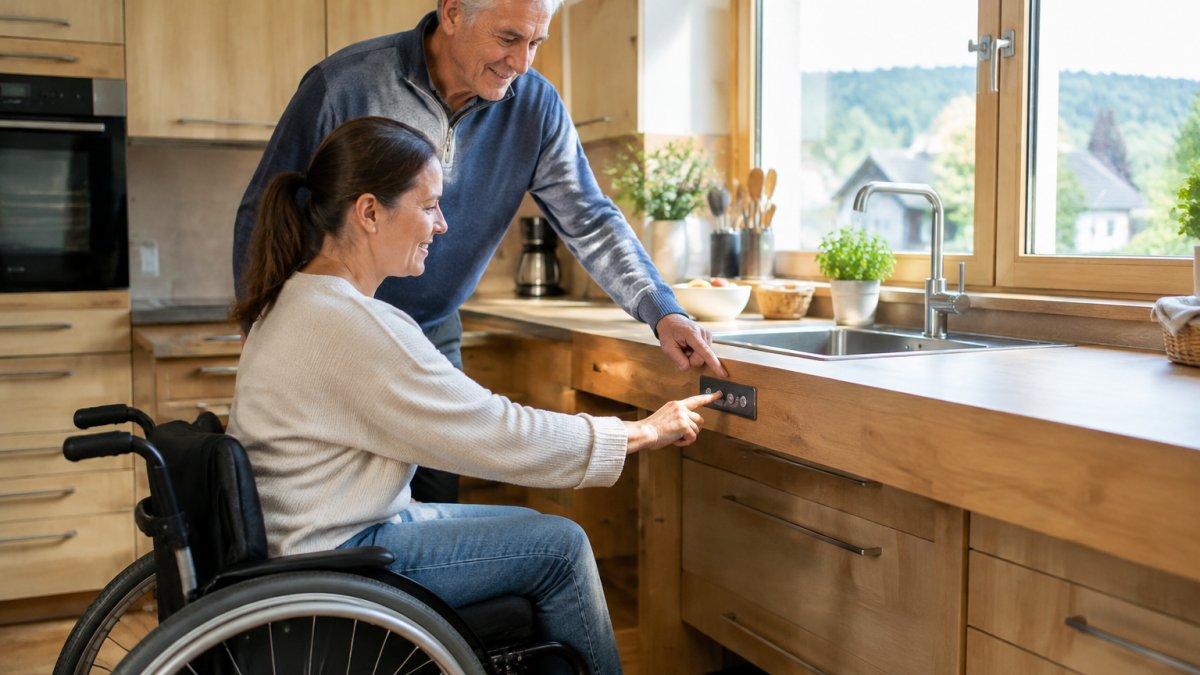
What we look for when selecting a table: The height adjustment range should cover at least 65 to 95 centimeters so that both seated and standing guests can work. The controls should be located on the front edge, not under the tabletop. And the mechanism must be designed for rental use—that is, for multiple adjustments per week over the course of several years.
Clearance under the sink, stove, and countertop
"Under-seat clearance" means that a seated person can slide their knees under the countertop, sink, or cooktop. Without this clearance, even the most adjustable countertop is useless because the guest sits to the side of it instead of in front of it.
The Planning Tips from Nullbarriere for an Accessible Kitchen A key requirement is providing wheelchair-accessible space, combined with full-extension drawers. In practice, this means: at least 80 centimeters of clear width under the countertop, no base trim in the way, and no pipes in the knee space. The sink is installed flush with the countertop and with the drain on the side so that the basin does not protrude into the knee space.
We show how a kitchen-dining area and a bedroom can complement each other effectively in an accessible vacation rental in Accessible Accommodations: Kitchen-Diner & Bedroom.
Note: The most common mistake is installing a slab that allows space underneath, only to find that the sink’s drain pipe runs beneath it. The guest approaches in a wheelchair and cannot get closer than 30 centimeters. Check the knee clearance with a tape measure after installation—do not rely on the blueprint.
Ergonomics of Sitting: Work Height, Reach, and Control Height
Ergonomics when sitting requires three factors that work together: a work surface height of about 75 to 80 centimeters for seated use, a reach range of 40 to 120 centimeters above the floor, and controls at a height that can be reached without standing up.
The ones from Pressalit on Flexibility in Accessible Kitchens Adaptability is no luxury here. A guest who is 1.55 meters tall and one who is 1.90 meters tall need different counter heights. In a rental apartment, both will encounter the same kitchen—perhaps even during the same season.
Specifically, this means the following in terms of equipment:
- The countertop and upper cabinets are height-adjustable—not just the main work surface
- Oven at eye level or with a swing-out door, never under the countertop
- Dishwasher installed at a higher level so you don't have to crouch down to load and unload it
- Full-extension drawers instead of cabinets with shelves, so that the back area remains accessible
The last line is where many plans fall apart. A cabinet with shelves is cheaper and looks the same on the floor plan. To a seated guest, it’s just a closed box.
Mobility spaces for wheelchair users in the vacation kitchen
Maneuvering areas are the open spaces in front of cabinets, appliances, and countertops where a wheelchair can turn and maneuver. DIN 18040-2 and ÖNORM B 1600 specify guidelines that are often not met in vacation homes because the kitchen is treated as a secondary room.
The following guidelines apply: at least 150 by 150 centimeters of clear space in front of the main work area so that a wheelchair can turn around, and at least 90 centimeters of clearance between two pieces of furniture. With a kitchen unit on both sides, space becomes tight, and that is precisely where the complaints arise that landlords later receive.
Here's a simple test: Place a chair with casters in the kitchen and try to turn it around in front of the sink without moving anything. If you can't do that, the space to move around is too small, regardless of what the property listing says.
Wheelchair-Accessible Kitchen Design Checklist for Vacation Rentals
This checklist summarizes the planning process in the order in which it is carried out in practice. It is not a substitute for technical planning, but it covers the points that are regularly overlooked during acceptance inspections.
| Checkpoint | Target value | Common Mistake |
|---|---|---|
| Working Height | 75–80 cm when seated, 85–90 cm when standing, adjustable | Rigid panel at standard height |
| Clearance | At least 80 cm clear width, 30 cm knee depth | Drain pipe in the knee area |
| Activity Area | 150 x 150 cm in front of the main zone | The Kitchen as a Walk-Through Room |
| Passage width | At least 90 cm between cabinet fronts | Two lines are too close together |
| Reach | 40–120 cm above the ground | Upper cabinets are too high |
| Operating Height of Equipment | 40–120 cm, front side | Stove knob behind the cooktop |
| Drawers | Full-extension, one-handed operation | Shelves in base cabinets |
| Sink | Flat, side drain | Deep basin, center hole |
You can find practical accessibility criteria for vacation rentals—which you can use during the planning phase and for annual inspections—in Ensuring Accessibility in Vacation Rentals.
Accessible Appliances for Vacation Rentals: Usability and Safety
Accessible electrical appliances for vacation rentals are characterized by tactile controls on the front panel, one-handed operation, and protection against accidental operation. The appliances must also be intuitive for different users without the need for instruction, which is a stricter requirement in rental settings than in private households.
Induction cooktop, oven with swing-out door and one-handed operation
An induction cooktop is the safer choice in a rental setting because the surface itself does not get hot, and a zone that has been turned off does not retain residual heat. For guests with reduced sensitivity in their hands, this is a significant difference. The controls should be located on the front, with clearly tactile buttons and no touch-sensitive surfaces that respond to damp fingers.
The oven should be installed at a height between 40 and 120 centimeters, with a door that swings open to the side rather than downward. A door that opens downward forces seated guests to lean back and reach over the hot door. The swing-out door solves this problem with a single motion.
The following applies to all appliances: One-handed operation is the key factor, not the number of functions. A stove with twelve programs that can only be accessed through a menu is useless to a guest who cannot use one hand.
Safety and Accident Prevention in an Accessible Rental Kitchen
Safety in an accessible rental kitchen depends on three measures: non-slip floors, rounded edges, and a countertop next to each appliance where hot pots can be temporarily set aside. The last point is almost always overlooked, yet it is the one that prevents burns.
Other factors that matter in the rental business:
- Stove with child safety lock and automatic shut-off, because guests with children and guests with dementia use the same kitchen
- No open shelves above the cooktop
- Lighting under the wall cabinets so that countertops aren't cast in their own shadows
- A way to call for help or a contact person who can be reached, since a fall in the kitchen often goes unnoticed
The Tips from EnableMe on Customizing Accessible Kitchens make it clear that rigid standards do not cover every need. Safety is therefore not a matter of standards, but a question of specific use.
Digital Assistance Systems and Smart Tools for Greater Inclusion
Smart assistive devices complement the building's design features where structural modifications reach their limits. Talking kitchen scales and measuring cups assist guests with visual impairments, such as EnableMe: Smart Kitchen Aids describes. Such devices are attractive to landlords because they can be retrofitted without any construction work.
Useful additions for a vacation rental:
- Talking Scale and Measuring Cup with Voice Output
- Stove with an audible indicator when a cooking zone is on
- Motion Detectors for Workplace Lighting
- Digital guest folder with user manuals in large print
The benefits aren't limited to guests. A guest who can use the kitchen independently asks fewer questions and is more likely to book again. To learn how to make amenities available to guests that aren't part of the standard equipment, read Assistive Device Rental for Your Vacation in a Vacation Rental.
Cost-Benefit Analysis for Landlords: Why Accessible Kitchens Pay Off
An accessible kitchen pays off for landlords in four ways: a larger target audience, longer stays, fewer damages caused by misuse, and access to subsidies tied to accessible amenities. The investment is spread out over several years, while the benefits accrue with every booking.
The costs are primarily associated with the initial setup. If a kitchen renovation is already planned, often only a portion of the additional costs applies. Specific prices depend on the scope and features. Those who are renovating their kitchen anyway will pay the difference. If you’re only retrofitting individual elements, you should start with the countertop, because it offers the greatest return on investment.
On the benefits side are points that are difficult to convey in a table but become apparent during operation:
- Accessible features can expand the target audience and reduce damage caused by user error.
Subsidies and Tax Treatment in Austria
For landlords, the most important factor is not the room rate, but how the investment is treated. Subsidies for accessibility improvements in Austria are typically awarded at the state level. The requirements vary depending on the state and the type of building. The specific requirements differ depending on the state, the type of building, and whether the apartment is owner-occupied or rented out.
A common pattern: Grants for accessible renovations require a minimum scope of work and must be certified by a qualified professional. Those who simply replace a countertop often fall through the cracks. Those who bundle multiple measures as part of a renovation that was already planned are more likely to qualify. Before hiring a contractor, check whether the state’s funding agency recognizes the project, and obtain written confirmation of this recognition before paying the invoice.
Tax-related questions regarding the depreciation of accessible equipment should be discussed with a tax advisor.
Increase in the Property's Value
Regardless of subsidies and depreciation, an accessible kitchen affects the resale value. A vacation rental that can be used by guests in wheelchairs, with walkers, or with small children without the need for renovations appeals to a wider pool of buyers. It is not possible to quantify this effect across the board, as it depends on the location, occupancy rate, and condition of the rest of the apartment.
A payback analysis depends on occupancy rates, the season, and room rates. It would be unreliable to provide general figures here. You can find pricing information on our website or upon request.
Please note: The most common mistake is to apply for the grant only after receiving the invoice. Make sure you understand the order of the grant application and the contract before hiring a contractor.
Maintenance and Repair of Accessible Kitchen Equipment
Maintenance determines whether an accessible kitchen will still be accessible after three years. Motorized height adjustment, swing doors, and pull-out systems are mechanical components, and these wear out faster in rental properties than in private homes. The difference lies not in the number of movements, but in the nature of those movements: guests operate the appliances without instruction, often using more force than necessary, and they change every week. A motor that lasts ten years in a private home can become sluggish after just three years in a rental setting.
A maintenance schedule that has proven effective for vacation rentals:
- After each booking: Visual inspection of the countertop for levelness and noise; cleaning the full-extension drawer slides; checking that the control knobs are securely fastened
- Monthly: Check that the adjustment motors are synchronized, adjust the hinges on the swing door, and inspect the seals on the undermount sink
- Quarterly: Re-measure traffic areas if furniture has been moved; check the lighting under the upper cabinets for any sagging
- Annually: Have a qualified technician check the electric controls and test the safety features of the stove and oven
The part that breaks down most often is the adjustment mechanism. A motor that becomes stiff often goes unnoticed until a guest can no longer operate it. If you include the inspection in the handover checklist between two bookings, it won’t be forgotten. Here’s a simple test: Move the plate to the lowest setting once and to the highest setting once, and check for jerking or uneven movement.
Durability in Rental Properties with High Tenant Turnover
For vacation rentals, it’s not just whether a system works, but whether it works without instruction. That changes the choice of equipment. A lift system with a touchscreen and menu navigation is convenient in a private home, but poses a risk in a rental property because guests may not know how to operate it. Systems with a single, clearly tactile switch per direction and clear labeling in large print have proven to be effective.
The choice of materials also affects maintenance costs. Countertops with a matte finish show fingerprints and cleaning marks more quickly than textured surfaces. In rental properties that are cleaned frequently, a surface that can be cleaned with standard household cleaners and without special care is a good investment. When it comes to drawer systems, it’s worth opting for a higher load-bearing class, since guests often overload drawers and slam them shut.
Documentation for the Transition Between Entries
Maintenance rarely fails due to a lack of willingness, but rather because of the handoff process. There is little time between two bookings, and anything not on the schedule isn’t checked. A handoff log that explicitly lists the accessibility features solves the problem. It should include three items: the function last checked, the name of the person who performed the check, and the date. If a defect is found, it should be noted in the same report so that the repair does not get lost between two areas of responsibility.
For the annual inspection by a qualified professional, it is advisable to schedule a fixed date outside the peak season. During the peak season, the kitchen is in operation every day, and any malfunction in the adjustment system would immediately affect a reservation. If you schedule the inspection for the spring, you’ll have peace of mind before the peak season begins.
Note: A common mistake is to base maintenance solely on visible damage. The adjustment mechanism often fails gradually, and the guest doesn't notice until they can no longer adjust the tabletop to their height. Inspecting the tabletop after each reservation helps identify malfunctions before the next guest arrives.
Experience accessible kitchen amenities at the Gutenbrunn vacation rental
You can put this theory to the test by spending a night in an accessible vacation rental and making coffee in the morning. That’s exactly what our four apartments are designed for: guests in wheelchairs, families with children, and dog owners will find an accessible kitchen-dining area and a bedroom here.
Anna and Herbert manage the apartments themselves. If you book directly with us, you’ll save on platform fees. The peaceful location in the Waldviertel region offers the perfect opportunity to unwind, with hiking trails and Lake Edlesberg nearby.
Take a moment to measure your kitchen with a tape measure instead of relying on the property description: counter height, knee clearance, and space to move around. If you find any gaps, that’s no cause for concern—it’s the start of a planning process that will pay off for years to come. At Ferienwohnungen Gutenbrunn, you’ll find accommodations with personalized service, a kitchen-dining area designed to accommodate a variety of guests, and a location in the Waldviertel that combines tranquility with opportunities for excursions during your stay. Book directly with Anna and Herbert and take a look at the apartment before you arrive.
Frequently Asked Questions
What dimensions must an accessible kitchen meet according to ÖNORM B 1600?
The ÖNORM B 1600 standard specifies movement areas of at least 150 x 150 centimeters in front of central kitchen units and wheelchair-accessible areas around the sink and stove. For the work surface height, expert sources recommend 85 to 90 centimeters when using the kitchen while standing. However, individual adaptation is crucial: Rigid standard specifications do not cover every need, so the design should always be tailored to the specific person.
How high should the countertop be in a wheelchair-accessible kitchen?
For accessible kitchens, work surface heights of 85 to 90 centimeters are recommended; when used while seated, the bottom edge of the countertop should ideally be around 70 centimeters so that a wheelchair can roll underneath. A height-adjustable countertop is the most flexible solution because it can be adapted to different users. This ensures that the kitchen remains equally accessible to both wheelchair users and guests who stand.
What amenities are required by law for an accessible vacation rental?
In Austria, the ÖNORM B 1600 standard provides the primary guidelines for accessible construction, supplemented by DIN 18040-2 as a reference. Binding requirements are set forth in the respective building codes of each federal state, particularly for new construction or major renovations. For landlords, it is recommended to use a checklist that includes wheelchair-accessible areas, height-adjustable countertops, full-extension drawers, and sufficient space for movement.
How can a kitchen be retrofitted cost-effectively for wheelchair users?
The most cost-effective measures are, first and foremost, replacing individual elements: a wheelchair-accessible sink cabinet, an induction cooktop with one-handed controls, and full-extension drawers. Height-adjustable countertops and lift systems cost more but pay off thanks to their flexible use for all guests. A cost-benefit analysis for landlords should take into account the higher occupancy rates resulting from inclusive target groups. Specific prices depend on the scope and amenities.
What should landlords keep in mind when planning accessible kitchens?
Landlords should adapt the kitchen to guests’ actual needs rather than simply meeting standards. Key features include wheelchair-accessible areas, maneuvering space for wheelchair users, easily reachable storage areas, and durable, easy-to-clean materials. Digital assistive technologies, such as voice-activated kitchen scales, enhance accessibility. A wheelchair-accessible kitchen design checklist helps ensure that no detail is overlooked, and maintenance and upkeep should be firmly factored into the plan.



Comments are closed, but trackbacks and pingbacks are open.