


Table of Contents
- Wheelchair-Accessible Family Vacations: The Most Important Things at a Glance
- Step 1: Select vacation destinations and regions
- Step 2: Find and check wheelchair-accessible accommodations
- Step 3: Organize Your Travel and Local Transportation
- Step 4: Discover accessible tourist attractions in the region
- Step 5: Planning a Vacation with a Wheelchair—Daily Routine and Breaks
- Common Challenges and How to Overcome Them
- Conclusion: A barrier-free family vacation is possible
- Frequently Asked Questions
Last updated: October 12, 2026
Wheelchair-Accessible Family Vacations: The Most Important Things at a Glance
A family vacation with a wheelchair user requires careful planning, but it’s entirely possible. Proper preparation makes all the difference between a stressful trip and a truly relaxing one. Here at Ferienwohnungen Gutenbrunn, we know from our own experience that families with wheelchair users deserve the same quality and relaxation as everyone else.
The good news: More and more regions are offering accessible accommodations and activities. The problem is often not the availability of options, but finding them. Much of the information about accessibility is inaccurate or even incorrect. A hotel may claim to be wheelchair-accessible, only for it to turn out upon arrival that the doors are too narrow or there are hidden steps.
This guide shows you how to plan a family vacation with a wheelchair, step by step. You'll learn how to Truly accessible accommodations find, organize the trip, and discover places to visit that are accessible to everyone.
Step 1: Select vacation destinations and regions
The region is your starting point. Not all areas are equally accessible for wheelchair users. Some places have hilly terrain, while others are flat. Some have good public transportation, while others do not.
Lower Austria has a lot to offer. The Waldviertel, for example is mostly flat and offers peaceful natural surroundings. The area around Lake Edlesberg has flat trails and good infrastructure. The Danube Valley features spectacular scenery, but also has steeper sections—here, you’ll need to choose your route more carefully.
Think about what your family needs:
- Flat terrain or mountainous?
- Close to lakes, rivers, or forests?
- How important are cultural offerings (museums, events)?
- Do you need good public transportation, or are you traveling by car?
- Would you prefer quiet places or places with more activity?
A good rule of thumb: Choose a region that you personally find interesting. A place you like will also be more enjoyable for your family, regardless of how accessible it is.
Step 2: Find and check wheelchair-accessible accommodations
This is the most critical step. Bad accommodations can ruin your entire vacation. Good ones make everything easy.
What to Look for When Searching for Accommodations
Start by doing some targeted research. Not every accommodation labeled „accessible“ actually is. Look for vacation rentals or hotels that are specifically designed for wheelchair users.
Pay attention to these details:
- Entrances and Doors: Are there steps in front of the lodging? Are the doorways at least 90 cm wide? That is the standard for wheelchair accessibility.
- Bathroom: Is the restroom wheelchair-accessible? Are there grab bars? Can you get into the shower or bathtub in a wheelchair?
- Bedroom: Can I reach the bed from my wheelchair? Is there enough room to maneuver?
- Kitchen and living area: Are the cabinets and countertops at an appropriate height?
- Parking: Is there a parking space for people with disabilities right next to the lodging?
Many websites feature photos. That's a good start, but it's not enough. Photos can be misleading. A photo doesn't show whether a door is actually 90 cm wide or just appears to be that wide.
Why „accessible“ alone is not a reliable indicator
In practice, „accessible“ means something different depending on the provider. For a wheelchair user with a wide active wheelchair, an 80-centimeter-wide door is unusable, whereas for a person with a walker, it’s often sufficient. That’s why the label alone isn’t enough—you need measurements and a description of the actual usability.
The criteria for accessible construction commonly used in Austria—such as those described in the ÖNORM guidelines and in the funding criteria of the State of Lower Austria for accessible lodging facilities—provide a good framework (ÖNORM B 1603:2013 10 01). These criteria aren't a seal of approval, but they give you a framework for asking hosts specific questions.
Checklist for Verifying Actual Accessibility
Before you book, contact the accommodation directly. Ask specific questions—not just, „Is the accommodation accessible?“
Use this checklist:
- Are the exact door widths known? (At least 90 cm for wheelchairs)
- How many steps are there in front of the entrance? (Ideally, none—or is there a ramp?)
- How wide is the bathroom door, and what is the layout of the bathroom?
- Are there grab bars in the bathroom and toilet?
- Is it possible to use the shower or bathtub with a wheelchair?
- What is the bedroom layout like? (Bed size, distance from the bed, space to move around)
- Is there a parking space for people with disabilities right next to the lodging?
- Are the paths between the parking lot and the entrance level and easy to walk on?
- What are the kitchen features like? (Counter height, space to move around)
- Is there an elevator, or are there only stairs between floors?
Specific measurements you should ask for before booking
The following figures are based on practical experience and cover the most common pitfalls. They are not a substitute for individual advice, but they do help to debunk vague claims:
- Door width: At least 90 cm clear width; 100 cm is better if a wide active wheelchair is used.
- Space for movement in the bathroom: At least 150 cm x 150 cm in front of the toilet and shower to allow for maneuvering.
- Shower area: Flooded shower with no threshold, featuring a folding shower seat and grab bars.
- Restroom: Raised toilet with a side grab bar; sufficient side clearance for a transfer.
- Bed: At least 90 cm of clear space on one long side for transferring from a wheelchair.
- Thresholds: A maximum height of 2 cm; anything higher requires a ramp.
- Flooring: non-slip, without high-pile carpets that increase rolling resistance.
If a host can't provide these measurements, it's not a deal-breaker, but it's a sign that you should ask for more details or request photos with a measuring tape.
Where to Look in Lower Austria
In addition to general booking sites, it’s worth checking out regional resources. The Lower Austria Tourism Board lists accessible travel options on its website and provides links to businesses that have undergone an accessibility audit. The regional associations in the Waldviertel and Mostviertel also list accessible accommodations and places to visit. These lists are not exhaustive, but they’re a good starting point because they bring together businesses that have focused on this topic.
The best strategy is still to call the accommodation and speak with the hosts. Many are happy to provide detailed information. Gutenbrunn Vacation Rentals, for example, is happy to answer such questions because the hosts, Anna and Herbert, know the property personally and are on site.
Ask about guests with similar needs. If the accommodation has already hosted wheelchair users, the hosts can share their experiences—not just theoretical information. Also, ask for a short video showing the route from the parking lot to the bathroom; that reveals more than any description ever could.
Step 3: Organize Your Travel and Local Transportation
The trip there is often underestimated. Many families take care of their accommodations but forget to plan how they’ll get there. This is exactly where it’s decided whether the vacation will start off on a relaxed note or end in frustration right at the train station.
Traveling by Car
If you’re traveling by car, it’s usually easier. You’re in control of your own mobility. Look for accessible parking spaces at rest stops and your destinations. In Austria, accessible parking spaces are regulated by the traffic code and marked with the international symbol; to use them, you’ll need a valid permit that’s also recognized abroad.
Practical tips for the trip:
- Plan for longer breaks so that everyone can move around.
- If possible, reserve a accessible parking space right at your lodging; not all establishments have one.
- Check in advance to see if the path from the parking lot to the entrance is paved and level. Gravel or grass pavers can be difficult to navigate in a wheelchair.
Travel by Train and Bus
If you use public transportation, it gets a little more complicated, but it’s still doable. ÖBB offers a special service for travelers with limited mobility: You can request assistance with boarding, transferring, and exiting, ideally a few days before your trip (Mobility Service). When making your reservation, it's best to specify whether you use a wheelchair, its dimensions, and whether you need a ramp or a lift.
Important points to keep in mind when traveling by train:
- Please let us know in advance if you need assistance; we cannot guarantee that support will be available on short notice.
- Check whether the selected train station is accessible without steps. Not every train station in Lower Austria is barrier-free.
- Ask about the car class with a wheelchair-accessible compartment and the location of the accessible restrooms on the train.
The following applies to regional buses: Not every bus can accommodate wheelchairs. The Verkehrsverbund Ost-Region (VOR) operates local public transportation in Lower Austria and Vienna; on its website, you’ll find information about accessible routes and wheelchair transportation. Check in advance whether the specific route uses low-floor buses and whether a ramp is available.
Local Mobility
You'll need to get around once you're there. Questions you should consider:
- How do you get to tourist attractions from your lodging?
- Is there accessible paths or streets?
- Is it possible to park the car and continue on from there in a wheelchair?
- Are there any taxi services that can transport wheelchairs?
Not every taxi company in Lower Austria has wheelchair-accessible vehicles. Ask the local municipality or your lodging provider about local service providers. In larger towns, there is often at least one vehicle equipped with a ramp or lift.
Regional Characteristics
A flat region with good roads is a major advantage. The Waldviertel offers ideal conditions here because the terrain is mostly flat and many of the roads are paved. In the Mostviertel and along the Danube, on the other hand, there are steeper sections that you’ll need to choose carefully.
If you're traveling by train, plan the final leg of your journey from the station to your lodging carefully. A quick call to your lodging will often clarify whether a pickup service is available or if a local taxi company has a wheelchair-accessible vehicle.
Getting there isn't just a side issue—it's part of accessibility. If you plan your train and bus trips—and the final leg of your journey—in advance, you'll avoid stress on the day of your arrival and have more energy for your actual vacation.
Step 4: Discover accessible tourist attractions in the region
Places to visit make a vacation interesting. Without them, it quickly gets boring.
Hiking Trails and Nature Experiences Accessible to Everyone
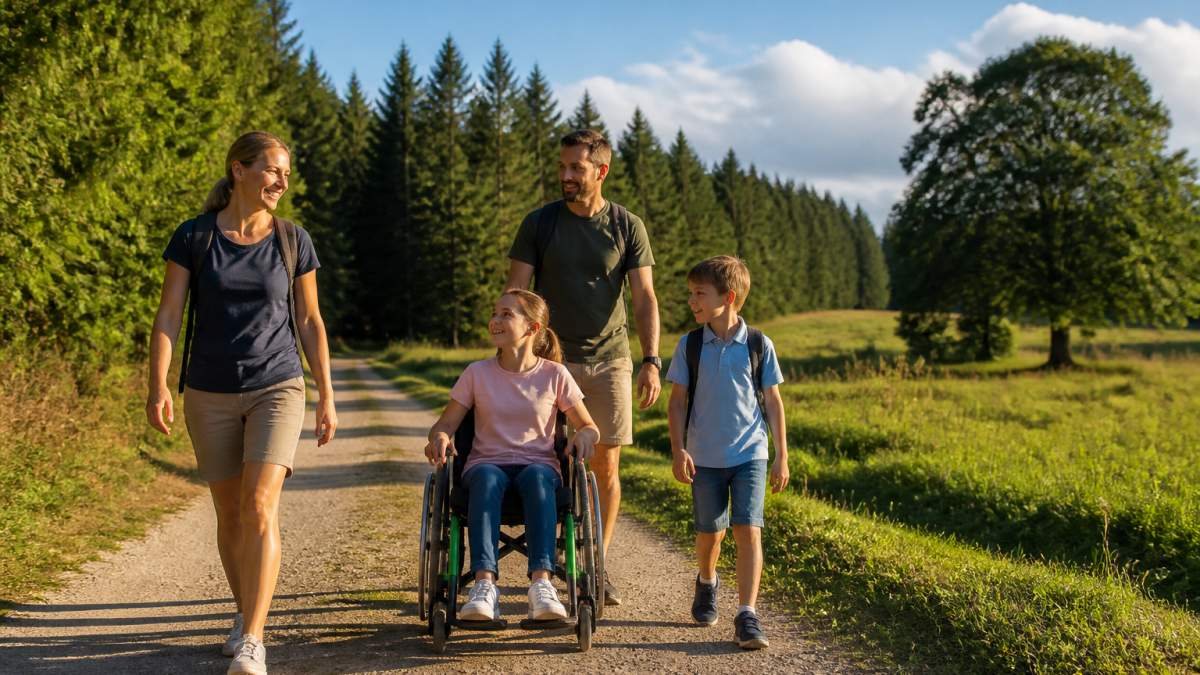
Not all hiking trails are wheelchair-accessible. Many are too steep, too narrow, or unpaved. But there are exceptions.
The goal is to find flat, wide paths—ideally paved or with a solid surface. Paths in the Waldviertel region are often well-maintained. Lake Edlesberg has a flat loop trail that is wheelchair-accessible.
Key points:
- Is the path flat or only slightly uphill?
- Is the surface hard (asphalt, concrete slabs) or soft (gravel, crushed stone)?
- How wide is the path? (At least 1.5 m so that wheelchairs and strollers can pass side by side)
- Are there any benches where I can rest?
- Are there restrooms nearby?
- How long is the route?
Many trails aren't fully accessible. A trail might be flat for 2 km and then suddenly have a bridge with steps. Ask for more information or check out reviews.
Restaurants and Recreational Facilities with Accessibility Features
Eating out is part of a vacation. A restaurant must not only serve good food, but also be accessible.
Check:
- Can I get to the door in a wheelchair? (No steps, wide doorway)
- How do I get to the table? (Is it wide enough for wheelchairs?)
- Where are the restrooms? (Are they accessible and wheelchair-accessible?)
- Can you roll a wheelchair under the table? (Not all tables are high enough.)
Recreational facilities such as museums or event venues should be assessed in a similar manner. Many museums have elevators and accessible parking spaces, but not all of them do.
The best strategy is to call the business directly or send an email in advance. Ask specifically: „Can we get inside with a wheelchair and move around freely?“ Most businesses will give you honest answers.
Step 5: Planning a Vacation with a Wheelchair—Daily Routine and Breaks
A good daily routine is important. Too many activities lead to stress and exhaustion. Too few get boring.
Plan realistically. One day in a wheelchair is more tiring than without one. Longer rides, bumpy paths, constant maneuvering—all of that takes energy.
A good structure:
- A light activity in the morning (a walk, breakfast at a café)
- A break at the lodging at noon (lunch, rest period)
- Another activity in the afternoon
- Relaxing in the evening or light activity
Breaks are important. Everyone needs time to catch their breath. Children need time to play. Wheelchair users need physical rest.
Don't overdo it. It's better to do three good activities a day than five hectic ones. Your vacation should be relaxing, not stressful.
Common Challenges and How to Overcome Them
Some problems come up time and time again. Here are some solutions:
Problem: Stairs and steps everywhere
Solution: Do your research beforehand. Ask your lodging and the places you plan to visit about ramps or elevators. Some have hidden entrances without steps.
Problem: Incorrect accessibility information
Solution: Don't just rely on descriptions. Call and ask specific questions. Ask about other guests' experiences.
Problem: Not enough space in the bathroom
Solution: Look closely at the photos. Ask for exact measurements. Sometimes there are alternative bathrooms or shower options.
Problem: Poor Accessibility of Activities
Solution: Plan shorter trips. Focus on destinations near your accommodations. Use public transportation if it's easily accessible.
Problem: Lack of Restrooms Along the Way
Solution: Plan routes that take you past restaurants or public restrooms. Find out where the restrooms are located beforehand.
A common mistake: planning too much. Families try to see everything in two weeks. This leads to stress and takes away from the relaxing nature of the trip. Less is more.
Conclusion: A barrier-free family vacation is possible
A family vacation with a wheelchair isn't just a dream—it's a realistic possibility. With good planning, specific questions, and realistic expectations, it can work.
The steps are simple: Choose a region, check out accommodations, figure out how to get there, research activities, and plan your daily schedule.
The most important thing is not to hesitate. Many families put off their vacation because they think it's too complicated. It's not. It just takes a little more preparation than a normal vacation.
Gutenbrunn Vacation Rentals understands these needs. The accessible vacation rentals are specially designed for wheelchair users and families with limited mobility. Anna and Herbert, the hosts, are on-site and happy to help with any questions. The location in the Waldviertel region offers flat terrain, peaceful natural surroundings, and great opportunities for day trips. When you book directly, you get clarity and personal contact—not just a hotline.
Frequently Asked Questions
How can I check if a place to stay is truly wheelchair-accessible?
Be sure to ask specifically about clearance widths (at least 90 cm for wheelchairs), the height of beds and closets, step-free access to the shower, and grab bars in the bathroom. Request photos or videos of key areas. Many accommodations describe themselves as accessible but have hidden obstacles such as door thresholds or hallways that are too narrow. Contact the hosts directly—personal responses are more reliable than standard descriptions.
What questions should I ask about accessibility before booking?
Ask: Are there steps at the entrance or in the hallway? Are the doors wide enough (at least 80 cm)? What amenities does the bathroom have (walk-in shower, grab bars, toilet height)? Can the kitchen be accessed from a wheelchair? Is there an elevator if the accommodation has multiple floors? How do the hosts respond to questions—are they helpful and easy to reach? A good accommodation provider provides detailed answers and offers solutions.
How do I plan trips with a wheelchair when different family members have different needs?
Choose destinations that offer a variety of activities: a flat hiking trail for wheelchair users, a slightly more challenging trail for more active family members, and play areas for children. Plan for longer breaks—people in wheelchairs get tired more quickly. Use restaurants and cafés as meeting spots. Find out in advance about parking spots near accessible entrances. Be flexible: If an outing becomes too tiring, have a Plan B for more relaxed activities nearby.
What unexpected challenges should I expect when traveling on vacation in a wheelchair?
Be prepared for: cobblestone streets in town centers, a lack of ramps at restaurants, restrooms that aren’t wheelchair-accessible even though the lodging claims they are, parking spaces that aren’t available, and paths that seem accessible in descriptions but have uneven surfaces. Pack tools and spare parts. Write down the phone numbers of repair services. Choose accommodations with hosts who are easy to reach and can provide assistance on short notice.
Start your next family vacation with a wheelchair by choosing accommodations that are truly accessible. Ferienwohnungen Gutenbrunn offers accessible rooms, personalized on-site assistance, and a central location for exploring the region. Book directly and enjoy a vacation without barriers.


Comments are closed, but trackbacks and pingbacks are open.