


Castle, church, spring, and Trucker House Discover – on a walking tour of the town Gutenbrunn.
Gutenbrunn is a small town whose history can be traced within a surprisingly compact area. Around the church square, the castle, the spring, and the Truckerhaus, pilgrimage traditions, forestry, glassmaking, the Habsburg era, and the everyday life of past generations all come together. Those who want to do more than just walk through the village—but take a closer look—can discover these traces on a short historical walking tour of the village.
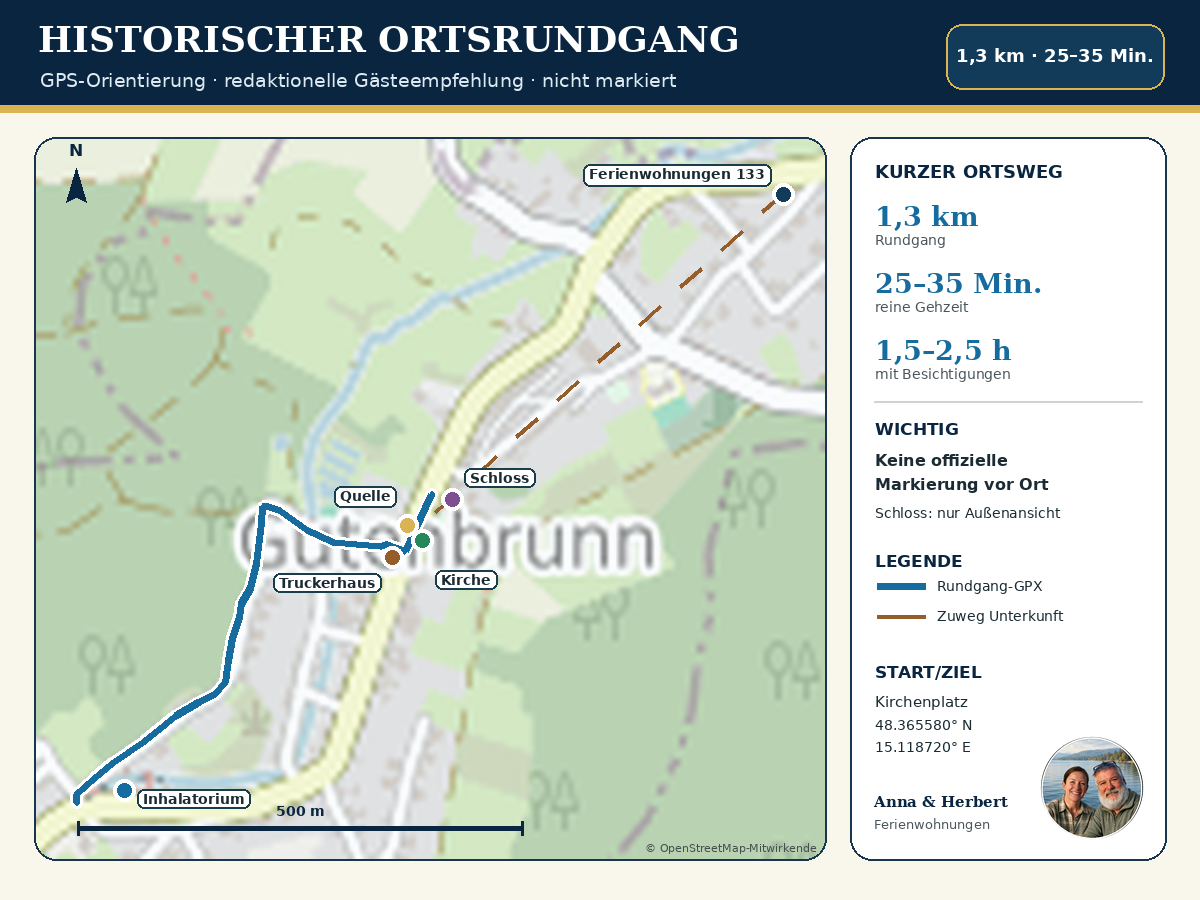
Our loop is about 1.3 kilometers long. The walking time alone is approximately 25 to 35 minutes. However, we recommend allowing 1.5 to 2.5 hours for sightseeing, taking photos, and short breaks. The trail is therefore well-suited for a quiet morning, a relaxing afternoon, or as a bad-weather alternative to a longer hike.
Important: This walking tour is a guest recommendation compiled by the editorial team at Ferienwohnungen Gutenbrunn. It is not an officially marked themed route. The provided GPS file is for orientation purposes. The historical sites themselves are real and are located close to one another; the castle is privately owned and can only be viewed from the outside.
The Town Walking Tour at a Glance
- Length: about 1.3 kilometers
- Walking time only: about 25 to 35 minutes
- Recommended duration, including sightseeing: about 1.5 to 2.5 hours
- Difficulty: easy
- Character: a short local route along roads, sidewalks, and local walking paths
- Start and finish: Gutenbrunn Church Square
- Stops: Parish and Pilgrimage Church, Guter Brunnen, Gutenbrunn Castle, Museum in the Truckerhaus and Inhalation Room
- Trail Markings: No specific markings for this loop trail
- GPX file: available at the end of the post
- Suitable for: guests interested in culture, foodies, families with older children, and seniors who can walk steadily
- Special Notes: The castle can only be viewed from the outside; please note the museum's hours and the seasonal opening schedule for the Inhalatorium
A short path leads from the Gutenbrunn vacation rentals to the town center. This path is shown as a dashed line on the orientation map; it is not part of the 1.3-kilometer circular GPX route indicated.
Why Gutenbrunn Is Called That
As part of the Gutenbrunn walking tour, the town’s name leads directly to one of the tour’s most important stops: the „Guten Brunnen.“ According to the official local history, the first documented mention of Gutenbrunn, dating from 1556, refers to a spring. Over the centuries, religious traditions, hopes for healing, and ultimately Gutenbrunn’s reputation as a health spa developed around this spring.
The municipality historically describes the water as iron-rich. This explains why the spring was regarded as something special in the past and attracted visitors. However, this should not be taken to imply any medicinal benefits or drinking water quality today. We recommend drinking the water only if it is expressly designated as drinking water on site.
The very name of the town makes it clear: Gutenbrunn did not come to be here by chance. The spring served as a landmark, a source of stories, and a part of the local identity. That is why our historical walk does not begin with a long list of dates, but with a place that remains visible and photogenic to this day.
Station 1: Parish and Pilgrimage Church of the Visitation of Mary
The Parish and Pilgrimage Church of the Visitation of Mary stands on Kirchenplatz. Together with the spring and the nearby castle, it forms the historic heart of Gutenbrunn. The current church building dates back to around 1800. Emperor Franz I, who had acquired the Gutenbrunn estate in 1795, had the church rebuilt or, more accurately, extensively renovated.
Inside is a miraculous image of the Virgin Mary nursing her child. Several religious stories are associated with the church and the spring. One tradition tells of the Holy Family’s flight from Bohemia to Mariazell and a rest stop at the Gutenbrunner Spring. Another legend tells of a shepherd boy whose cow kept returning to the spring; at the bottom of it, an image of the Virgin Mary appeared.
Stories like these are part of the local tradition of faith and pilgrimage. They are not historically verifiable facts. That is precisely why they should be read as what they have been for many generations: symbols of trust, hope, and the special significance of this place.
It’s worth setting aside a few minutes to visit. Please be considerate of church services, devotions, and moments of personal quiet. Even if the church is closed, you can still easily see its location within the complex, which includes the spring and the castle, from the outside.
Our tip for this stop
Don’t start taking pictures right away. Stand for a moment at the edge of the church square and take in the distances between the church, the spring, the truckers’ lodge, and the castle. In just a few steps, you’ll see how closely religious, aristocratic, and everyday life were intertwined in Gutenbrunn.
Station 2: The Good Well – The Origin of the Town’s Name
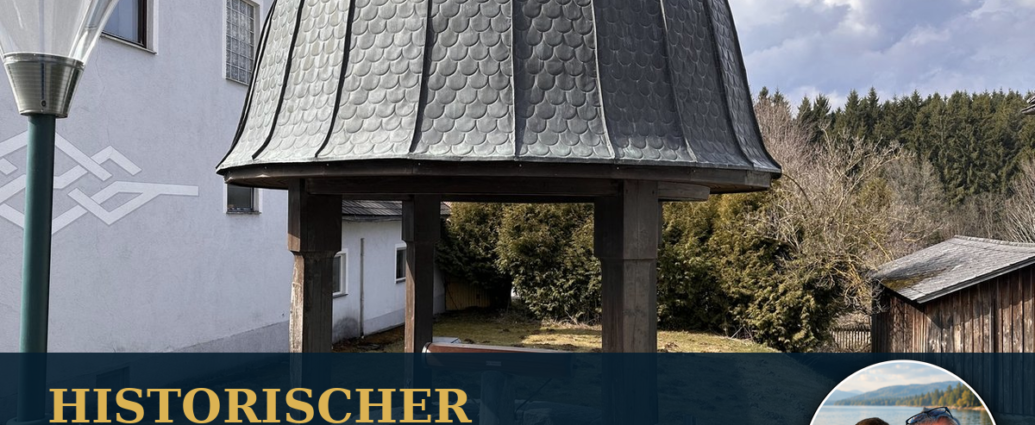
Just a few steps away from the church stands the Gutenbrunner Fountain. The featured image for this article shows the actual fountain: a round, brick structure with wooden supports and a distinctive, curved shingle roof. It is not a symbolic or fictional motif.
The fountain is the most vivid starting point for discussing the early history of Gutenbrunn. The spring is mentioned as early as the first documented reference to the town in 1556. About two centuries later, a chapel was built at the spring based on a tradition of Marian apparitions. The combination of water, pilgrimage, and the later health spa gave rise to a reputation that extended far beyond the small town.
In the late 18th century, the future Emperor Franz I also visited Gutenbrunn. The municipality states that he acquired the estate in 1795. As a result, the town became part of a broader process of aristocratic and economic development.
Today, the fountain is above all a quiet place of remembrance. There’s no need for elaborate staging here. The shape of the roof, the wooden structure, the brick edging, and its location next to the historic buildings speak for themselves.
Please note
No current medical recommendations can be derived from the historical use of the spring water or from traditional accounts about it. Whether the water is safe to drink depends solely on clear labeling and the most recent information provided by local authorities.
Stop 3: Gutenbrunn Castle – From Entrepreneur to Emperor
It’s just a short walk from the fountain to Gutenbrunn Castle. Josef Edler von Fürnberg had the Neoclassical building constructed between 1771 and 1785. Fürnberg left his mark on Gutenbrunn during a period of economic growth. He expanded the log flume and promoted glass production—two industries that were of great importance to the Weinsbergerwald.
In 1795, Emperor Franz I acquired the estate. With this, Gutenbrunn came under imperial ownership. This era is an important part of the town’s history, but it should not be told solely as a story of famous names. The castle, the log flume, and the local businesses were all connected to the people who worked in the forest, transported timber, produced glass, sold goods, or lived in the surrounding settlements.
The castle complex is now a protected and restored site. It is privately owned. Only parts of the grounds are open to the public. For our tour, this means that we will view the building exclusively from areas open to the public, respect any barriers, and not enter any private areas.
An Eye for Detail
Take note of the understated proportions of this Neoclassical structure. The castle does not come across as a monumental residence, but rather as a stately home closely tied to a Waldviertel village with a strong agricultural character. It is precisely this scale that gives it its charm.
Gutenbrunn and Glass Art
The town’s development is closely linked to glassmaking. One particularly significant figure is Johann Joseph Mildner, who lived from 1765 to 1808. He became known for his double-walled glasses featuring inlaid medallions. Today, these so-called Mildner glasses are considered remarkable examples of Gutenbrunn’s glassmaking tradition from an art-historical perspective.
Nuremberg’s promotion of glass production and the abundant timber resources in the surrounding area went hand in hand: The forests provided fuel and raw materials, while entrepreneurs, artisans, and workers drove economic development. Anyone taking the walking tour from the castle to the Truckerhaus is therefore not only moving between buildings, but also through different aspects of the town’s history—rule, production, trade, and everyday life.
Stop 4: Museum in the Truckerhaus
The Truckerhaus was once a general store. Today, it houses a museum and serves as a venue for the Weinsbergerwald Cultural Initiative. This is where the town tour takes a more in-depth turn: The exhibition covers a wide range of topics, from medieval settlement through industrialization and the Habsburg era to economic crises and resettlements.
According to the municipality, the museum is open daily year-round from 8 a.m. to 6 p.m. for self-guided tours. Since opening hours are subject to change, we recommend checking them on the municipality’s official website before your visit.
The Gutenbrunn „Trail“ also begins at the Truckerhaus. It takes you to 54 marked locations and sites throughout the town. Our 1.3-kilometer loop is not the same as this more extensive “Spurensuche” tour. However, if you still have time and are curious after the short walk, the Truckerhaus is the perfect starting point for further exploration.
How much time should I set aside?
About 20 to 30 minutes is enough for a quick overview. Those who read the texts carefully and delve deeper into the context can stay much longer. The museum is therefore well-suited as a flexible stop: a quick visit during a walk, or a more in-depth visit on a rainy day.
From Abundant Forests to Industrialization
For centuries, the forests around Gutenbrunn served as both a living environment and an economic hub. Timber was harvested, transported, and processed. In the early 20th century, the Körnerwerke sawmill employed several hundred people. A road approximately 20 kilometers long Forest Railway linked jobs with timber harvesting.
This industrial scale surprises many visitors, because Gutenbrunn today seems quiet and close to nature. But the town was not always just a place of retreat. It was a workplace, a production site, and the hub of a vast network of forestry, transportation, and processing.
The historical walking tour of the town helps to bring these contrasts together. Along this short route, we encounter the spring as a historic landmark, the church as a place of pilgrimage, the castle as the seat of economic and political decision-making, and the Truckerhaus as a place of commerce and remembrance.
Station 5: The Inhalatorium—A Peaceful Conclusion
A local walking path leads from the town center to the Inhalatorium. This path makes up the longer part of our short loop. The Inhalatorium is a peaceful facility that, according to the municipality, is open daily around the clock from May through October. Admission is by voluntary donation.
We deliberately do not present this place as a medical remedy. It is primarily intended as a place to take a break: sit down, breathe calmly, and take in the sound of the water and your surroundings. Of course, if you have health concerns or symptoms, a visit here is no substitute for medical advice or treatment.
After the break, take the same route back to the town center. This makes it easy to find your way around. If you only want to visit the main historic sites, you can skip the Inhalatorium and shorten the tour accordingly.
Step-by-Step Directions
1. Start at Kirchenplatz
Start at the Parish and Pilgrimage Church of the Visitation of Mary. The main sites are located around the square, just a few minutes' walk apart.
2. To the Spring and the Castle
First, go to the Guten Brunnen, and then to the castle. While at the castle, stay on public grounds and respect private property.
3. Back to the Trucker House
Head back toward Kirchenplatz and visit the museum in the Truckerhaus. If you’d like to learn more about the 54 stops on the local historical trail, you can find information there.
4. Continue to the inhalation room
Follow the local footpath marked in the GPX file toward the Inhalatorium. The section is short, but may be slippery or uneven depending on the weather.
5. Back the same way
After your break at the Inhalatorium, walk back to the church square along the same path. This concludes the approximately 1.3-kilometer loop.
Who is this tour suitable for?
The tour is short and not very physically demanding. It’s especially well-suited for guests who prefer to experience history on foot rather than during a long museum visit. It’s also easy to fit into your schedule after arriving, before dinner, or on a day with changeable weather.
Families can turn the walk into a little scavenger hunt: Where does Gutenbrunn get its name? What connects the forest to glassmaking? Why are the spring, the church, and the castle so close together? You can learn more about the answers at the Truckerhaus.
The short distance is pleasant for seniors. Nevertheless, it’s a good idea to wear sturdy shoes. Some sections, transitions, and entry points may have uneven surfaces or slight inclines.
Accessibility and Strollers
The town center is easy to navigate thanks to its short streets and sidewalks. However, we cannot guarantee full compliance with accessibility standards along the entire route. Historic entrances, thresholds, slopes, weather conditions, and the path to the inhalatorium may make it difficult to navigate the route with a wheelchair, walker, or stroller.
Anyone who requires barrier-free access should check in advance with the local municipality or the operators to confirm the desired stops. The orientation map does not guarantee accessibility.
Best time for the walking tour of the town
The central area, featuring the church, fountain, castle, and Truckerhaus, is worth visiting year-round. In spring and summer, the gardens and green spaces are especially inviting. Fall, with its muted colors, perfectly complements the area’s forest and industrial history. In winter, a quiet atmosphere often settles around the church and castle; however, snow and ice can make the paths difficult to navigate.
If you’d like to visit the inhalatorium, it’s best to plan your visit between May and October. According to the latest information from the municipality, the museum is open daily from 8 a.m. to 6 p.m. Please double-check both details before you arrive.
Practical Tips
- Wear comfortable shoes with non-slip soles.
- Before you start, download the GPX file to your smartphone or GPS device.
- Expect slippery spots in wet conditions and during the winter.
- Please respect private property and barriers at the castle.
- Please be considerate of worship services and personal prayer in and around the church.
- Check the opening hours in advance on the official websites.
- When visiting the spring, do not rely on historical accounts of its healing properties; pay attention only to current signage.
- Dogs should be kept on a leash at all times within the town limits and when encountering others.
Why This Short Tour Is Worth It
You don’t have to go far to journey through several centuries in Gutenbrunn. The spring traces back to the town’s earliest history. The church tells of pilgrimages and the imperial era. The castle evokes memories of Fürnberg, a period of economic prosperity, and Emperor Franz I’s acquisition of the estate. The Truckerhaus adds the perspective of the people, trade, and industrialization. Finally, the Inhalatorium serves as a peaceful bridge to the present.
Precisely because the tour is short, there’s time to take it all in. Gutenbrunn doesn’t showcase its history through a single major attraction, but rather through a dense collection of small, authentic places.
Staying at the Gutenbrunn Vacation Rentals
From our vacation apartments, you can reach the historic town center on foot via a short path. This walk is the perfect way to start your day with a leisurely breakfast, a stop for refreshments, or another excursion into the Weinsbergerwald.
You can check availability and book your stay directly here:

Comments are closed, but trackbacks and pingbacks are open.