


Table of Contents
- Why Travel to the Waldviertel by Train in a Sustainable Way
- Traveling to Gutenbrunn by Public Transportation: Finding the Right Route
- Plan the last leg of the journey from the train station to your lodging
- Exploring the Waldviertel Without a Car: Sustainable Outing Options
- Day Trips in the Waldviertel Without a Car: Practical Route Planning
- CO₂ Savings: Take the Train Instead of the Car to the Waldviertel
- Accessible Travel and Mobility on Site
- Checklist: What to Do Before Your Train Trip
- Frequently Asked Questions
Last updated: October 17, 2026
Why Travel to the Waldviertel by Train in a Sustainable Way
Traveling sustainably by train to the Waldviertel means consciously choosing a mode of transportation that makes your trip comfortable while also protecting the environment. The narrow-gauge railway and regional train connections offer an experience that goes far beyond mere transportation.
At Ferienwohnungen Gutenbrunn, we regularly see that guests arrive more relaxed when they take the train. Instead of spending hours in the car, you can enjoy the scenery, read, or get in the mood for your vacation.
The advantages are obvious:
- No need to look for a parking spot on site
- Less Stress from Driving
- Direct access to nature experiences right from the bus stop
- The feeling of doing something good for the environment
Many visitors say that the train ride itself becomes part of their vacation—not just a necessary means of getting there.
Traveling to Gutenbrunn by Public Transportation: Finding the Right Route
Getting to Gutenbrunn by public transportation is easier than many people think, provided you plan your route not just based on the destination train station, but on the actual stop near your lodging. The region is accessible via the Austrian rail network, but the final leg of the journey almost always involves a regional train or a shared taxi. If you plan this in advance, you’ll avoid the common disappointment of finding that while the train you booked is on time, your connection to the Waldviertel isn’t.
Timetable Lookup and Ticket Purchase
Don't start your search with your destination station; start with the address of your lodging. The Austrian Federal Railways (ÖBB) schedule information and the Scotty app from the East Region Transport Association (VOR) both show you the complete route to the nearest stop, including walking distance and transfer times. To do this, enter your starting location and the specific stop—not just „Gutenbrunn.“.
When purchasing tickets, you have several options:
- Single-ride tickets for the exact route (for routes within a transit network, these are often available as a through ticket via the VOR)
- Multi-day discount passes from the public transportation authority
- ÖBB Discount Cards for Regular Travel
- Book directly through the ÖBB app, at the ticket counter, or at a ticket machine
Buy your ticket at least one day before your trip and check whether the route you've chosen requires a reservation; for popular weekend routes during the vacation season, this can be a real bottleneck.
Transit connections from major cities
The specific route depends on where you start. Here are three realistic examples:
- From the East (Vienna, St. Pölten): To get there, take the Franz-Josefs-Bahn toward Krems or the train line toward Zwettl. In Zwettl or Krems, transfer to the regional train to the Waldviertel. Expect at least one, and often two, transfers.
- From the south (Linz, St. Pölten): The route runs via the Westbahn to St. Pölten and from there on toward Zwettl; it involves one transfer, but the total travel time is longer than that of the direct connection from Vienna.
- From the west (Linz, Freistadt): Take the Summerauer Bahn toward Freistadt and continue on to the Waldviertel by regional bus or train. Here, the bus connection is often the critical point.
When making connections, it’s important to allow for realistic transfer times. You should allow at least 10 to 15 minutes between two trains, especially if you’re traveling with luggage. For connections to regional buses in the Waldviertel, 20 minutes is a more realistic estimate, since these buses often run only once an hour or less frequently.
Before booking, check whether your connection has a shared taxi (AST) service at the destination station. Many municipalities in the Waldviertel region operate these shared taxis, which run only by advance booking; without a reservation made the day before, you’ll be left standing on the platform.
What the schedule information doesn't reveal
Three things you should clarify as well, because they aren't listed in any online information:
- Seasonal schedule changes: Regional train service in the Waldviertel often operates differently in the summer than in the winter. Be sure to check the schedule for your specific travel date, not for „just any“ day.
- Rail Replacement Service: During construction work on branch lines, buses will replace trains, with different travel times and, in some cases, different stops.
- Last connection of the day: If you're arriving in the late afternoon, you should know the last available return trip in case your arrival is delayed.
The best way to plan your trip is to start with the stop closest to your lodging, not the train station in the next town. If you figure out your connections, shared taxis, and the seasonal schedule in advance, you’ll arrive feeling relaxed and avoid the most common source of stress on the day of your trip.
Plan the last leg of the journey from the train station to your lodging
Once you arrive by train, the so-called “last mile” begins—the journey from the train station to your accommodations. There are several sustainable options here that complement your train trip perfectly.
On foot, by bike, or by shuttle
From the stops in the Waldviertel, you can reach many accommodations on foot. The routes are often scenic, and you’ll get to know the region as you walk.
If the distance is greater, you can bring a bike or rent one on site. Many train stations offer bike rentals, and the Waldviertel routes are ideal for cyclists.
The last mile shouldn't be stressful:
- On foot: 30–45 minutes, depending on the distance
- By bike: 15–30 minutes
- By shuttle: 10–20 minutes
- By taxi: fast, but less sustainable
Exploring the Waldviertel Without a Car: Sustainable Outing Options
The Waldviertel Without a Car Exploring the area is definitely possible and even recommended. The region has far more to offer than many visitors realize, and the narrow-gauge railroad is just the beginning.
Narrow-Gauge Railroad and Themed Rides
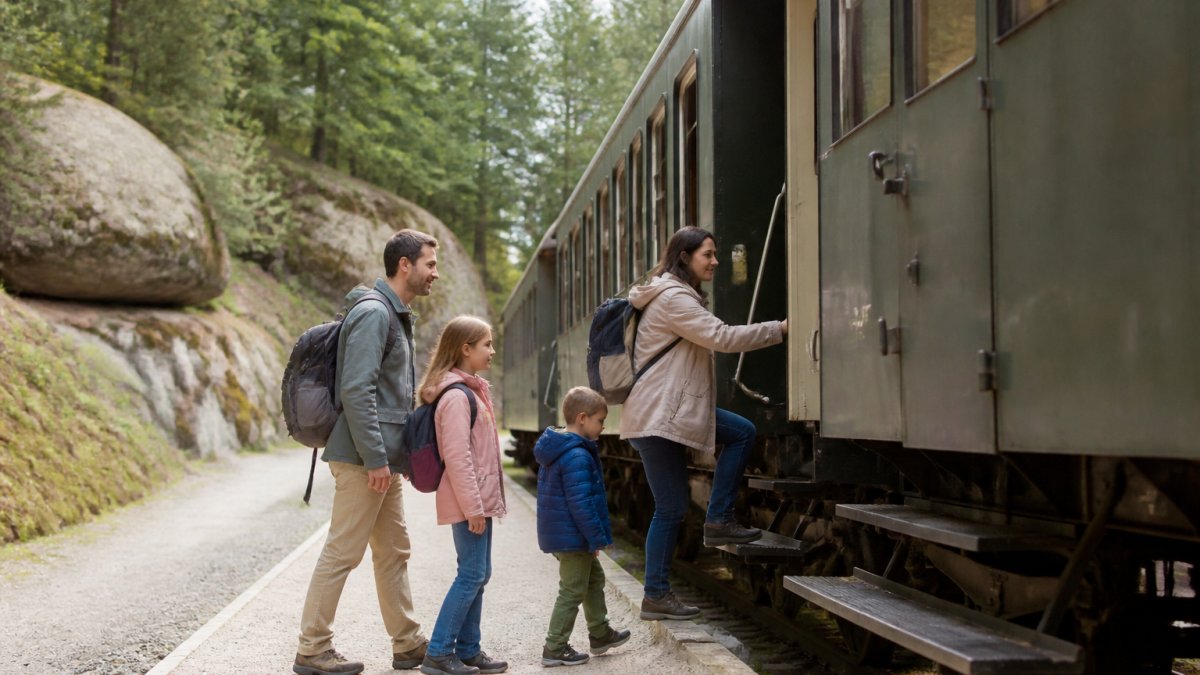
The Waldviertelbahn is a narrow-gauge railway that has been transporting visitors through the region for decades. It is not just a means of transportation, but an experience in itself.
Themed trips are held regularly—such as vintage and steam train rides, culinary tours, or special family trips. These trips combine the experience of nature with entertainment and often include regional specialties.
The travel times are manageable, usually between 1 and 2 hours. This makes these trips perfect for a half-day and a great fit for your vacation plans.
Hiking and biking trails starting from bus stops
Hiking trails begin at many of the Waldviertelbahn’s stops. The routes lead through forests, past ponds, and across granite landscapes—typical Waldviertel scenery.
Popular hiking destinations from train stations:
- Ednesberg Lake (short hike, family-friendly)
- Pond Landscapes Near Raabs (moderate difficulty, 2–3 hours)
- Granite boulders near Waldenstein (easy, magnificent views)
- Cultural Trails Through Historic Villages (varying difficulty)
Cyclists will find an extensive network of bike paths. Many routes connect several train stations, allowing you to plan your trip flexibly: take the train there and bike back—or vice versa.
The best combination is often this: take the train to the first stop, then hike or bike to the next stop, and then take the train back. This way, you can experience the region to the fullest without missing your car.
Day Trips in the Waldviertel Without a Car: Practical Route Planning
Planning trips in the Waldviertel without a car requires a little advance planning, but it rewards you with authentic experiences and less stress.
Natural and Cultural Attractions by Train and on Foot
The region offers a mix of natural attractions and cultural highlights. Many of them are easily accessible by train.
Cultural Goals:
- Historic village centers with museums
- Artisan Shops and Art Galleries
- Regional Inns Serving Waldviertel Cuisine
- Churches and Chapels with Local History
Nature Destinations:
- Forest landscapes with marked hiking trails
- Pond Landscapes (ideal for birdwatching)
- Granite landscapes with impressive rock formations
- Stream courses and small nature reserves
Plan your route so that you have no more than 2–3 transfers. That way, the trip itself will be relaxing rather than stressful.
Day Trips with Family and Children
Day Trips with Kids are especially beautiful in the Waldviertel because the distances are manageable and there's plenty of variety.
A sample daily schedule:
- Take the train to the first stop in the morning
- Short hike to a nature destination (1–1.5 hours)
- Lunch break at an inn serving regional dishes
- A light bike ride or a second short hike in the afternoon
- Return trip by train in the late afternoon
Children benefit from this combination: physical activity, nature, new experiences, and the excitement of the train ride time and time again.
Families with children ages 5 and up who enjoy nature, being active, and train rides—and parents who want to stay relaxed.
CO₂ Savings: Take the Train Instead of the Car to the Waldviertel
For many visitors, the environmental aspect is an important reason to travel sustainably by train to the Waldviertel and explore the region that way. The benefit is real, but it can only be properly assessed if you understand the underlying assumptions. Rather than making a blanket statement, it’s worth taking a closer look at the three factors that actually make the difference.
The Three Key Factors in the Emissions Balance
The carbon footprint of a trip to the Waldviertel depends not only on the mode of transportation, but on three factors:
- Vehicle Capacity: A fully occupied regional train spreads its emissions across many people. A car with just one person bears the entire burden of emissions alone. So the advantage of taking the train increases with the train’s occupancy rate and decreases if you’re driving alone in a fuel-efficient compact car.
- Distance and detour factor: Trains rarely travel in a straight line. People traveling from Vienna often cover more kilometers by rail than by road. This puts the advantage per kilometer into perspective, but not the overall advantage, because rail is significantly more efficient per passenger-kilometer.
- Drive Type and Energy Mix: Electric rail lines in Austria benefit from the high proportion of renewable energy in the traction power supply. An internal combustion engine cannot match this advantage, regardless of driving style.
What this means for your specific trip
The CO₂ calculator feature in the ÖBB schedule information service provides a reliable figure for your route: It displays the estimated emissions per person for a specific connection and compares them to the emissions from a car. Use this feature for your actual route instead of relying on average values—the difference between a short regional trip and a long journey from the west is significant.
Three rules of thumb that have proven effective in practice:
- The longer the distance, the more obvious the rail advantage. Over short distances, the lead shrinks because fixed costs (access to the station, waiting time) carry more weight.
- The more people in the car, the smaller the difference. A family of four traveling by car divides emissions by four; the train usually comes out ahead, but the gap is narrowing.
- The last mile counts, too. A shuttle or shared taxi from the train station to your lodging also produces emissions. If you walk or bike, you’ll keep your carbon footprint to zero.
Beyond CO₂: Local Effects
The environmental benefit is only part of the picture. There are also effects that cannot be expressed in kilograms but are noticeable on the ground:
- Fewer Air Pollutants in town centers, because no additional cars are driving through the narrow streets of the Waldviertel region.
- Less Noise on the side roads, which are often narrow and winding anyway.
- Less land use parking spaces—a real consideration in villages with limited space.
- Strengthening Regional Transportation: Every ticket is also a vote to keep the route you use running.
Do not compare flat-rate figures from different sources. A CO₂ comparison is only meaningful if the route, vehicle type, and occupancy rate are assumed to be the same for both modes of transportation. The ÖBB schedule information provides this basis for comparison for your specific route.
Traveling by train to the Waldviertel is generally the lower-emission option, but the advantage isn’t always consistent. By considering the route, train occupancy, and the last mile, you can accurately assess the benefit for your own trip rather than simply making a blanket claim.
Accessible Travel and Mobility on Site
Accessible travel is an important issue that is often overlooked. However, the Waldviertel region and its rail connections are becoming increasingly accessible.
Many train stations have elevators and level access. Wheelchair users and people with limited mobility should coordinate their trip with the railway company in advance—ÖBB offers special assistance.
On location in the Waldviertel:
- Many hiking trails are partially accessible
- Bus stops are becoming increasingly accessible
- Inns and museums are improving their accessibility
- Apartments Gutenbrunn offers fully accessible accommodations
Plan your route with the local operators—that way, you’ll avoid any surprises and enjoy a relaxing vacation.
Checklist: What to Do Before Your Train Trip
Good preparation makes your trip more enjoyable. This checklist will help you make sure you don't forget anything:
- Check the schedule and buy tickets (at least 1 day in advance)
- Check that your luggage is the right size for train travel (stairs, narrow aisles)
- Plan and book your return trip now
- Confirm whether a shuttle is available or how to get from the train station to the lodging
- At Apartments Gutenbrunn Please provide your arrival time
- Arrange for a bicycle or rental bike on site (if desired)
- Confirm accessibility (if applicable)
- Check the weather forecast and pack appropriate clothing
- Check Your Travel Insurance
- Save the contact information for the lodging and the rail carrier
A sustainable train trip to the Waldviertel is the ideal start to a relaxing vacation. You’ll arrive feeling relaxed, avoid the hassle of finding parking, and support a sustainable transportation system at the same time. At Ferienwohnungen Gutenbrunn, you’ll find warm hospitality, accessible accommodations, and the perfect base for hikes, bike rides, and nature adventures. Book directly with us and enjoy a break free from time pressures in one of the most beautiful natural landscapes.
Frequently Asked Questions
How can you travel sustainably by train to the Waldviertel?
Book your train trip through ÖBB or with combined tickets. Plan your route on fahrplan.oepnv.at or other transportation platforms. Take direct trains or connecting trains from major cities. The narrow-gauge railway offers additional scenic rides. Plan the last leg of your journey from the train station to your lodging by bike, on foot, or via shuttle. This way, you’ll reduce your CO₂ emissions compared to driving.
How do you get to Gutenbrunn by public transportation?
Check your travel options from your hometown at fahrplan.oepnv.at. Typical transfers are made at stops such as Horn or Gmünd. When booking your accommodations, ask about shuttle options or bike transport. The schedule information shows you current connections and travel times.
What should I take care of before my train trip to the Waldviertel?
Book your tickets early through ÖBB or Verbundtickets. Check the options for bringing your bike. Let your lodging know your arrival time. Confirm accessible entry options, if necessary. Download timetables or save them digitally. Plan your excursions based on train stops. Pack weather-appropriate clothing and hiking boots—the Waldviertel offers many trails for walking and biking.
What kinds of excursions in the Waldviertel can you do without a car?
From train stations, you can access hiking trails that wind through forests, past ponds, and across granite landscapes. The Waldviertelbahn itself is an experience—themed and nostalgic train rides depart regularly. Bicycle tours connect stations with natural destinations such as Lake Edlesberg. Cultural sites such as museums and regional attractions are often within walking distance or accessible by bike. Combine train travel, biking, and hiking for a varied itinerary.


Comments are closed, but trackbacks and pingbacks are open.